
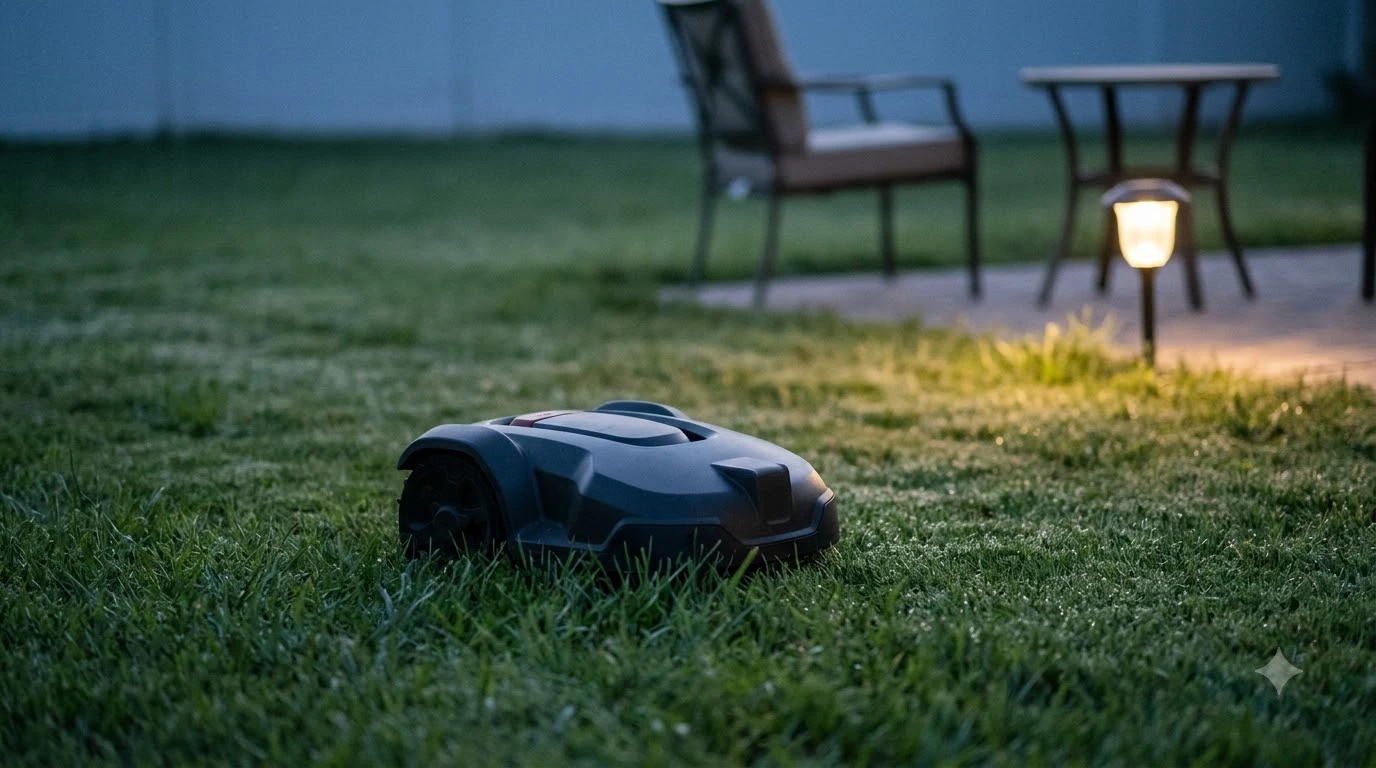

Can a robot mower handle a lawn with moss? It can cut the grass, but mowing does not remove the moss or fix why it grows. Moss shows up where the turf is already weak, usually from shade, compacted or poorly drained soil, low fertility, or acidic soil. Mowing height and frequency still matter for the grass around the moss, but the underlying conditions decide whether the moss goes away. A robot mower handles a lawn with moss best when the shade and drainage are dealt with too. This guide covers what the university and manufacturer sources say, as of November 2026.
The short answer
- Mowing alone: a robot mower trims the grass, but the sources do not say mowing removes moss.
- Main causes: excess shade, compaction, poor drainage, low fertility, and acidic soil.
- Mowing setting: Robomow cites a practical cutting length of 30 to 40 mm, and blades set too high or cut too rarely leave more room for moss.
- Treatment: iron sulfate turns moss black within a few days, but it is a short-term fix applied from fall through spring.
- Deep shade: if grass cannot grow there, the sources suggest converting the spot rather than fighting moss every year.
What moss tells you about your lawn
Moss grows where grass is already struggling, and excess shade is the most common cause the sources name. Moss has no roots. It takes in water through its surface and moves into thin turf rather than attacking healthy grass. HortGuide, an arborist guide, puts it this way: moss is the scoreboard, not the opponent. Illinois Extension lists the same main causes and adds poor air circulation and high or low soil pH to the list. So the answer to “can a robot mower handle a lawn with moss” depends mostly on those conditions, not on the mower.
| Condition | What it does to the turf | Fix the sources name |
|---|---|---|
| Excess shade | Grass thins, and HortGuide calls shade the most common cause in its region | Prune trees and shrubs for more light and airflow (Illinois Extension); deep shade usually cannot be changed |
| Compaction | Roots and water struggle to move through the soil | Core aerate (Illinois Extension); HortGuide advises pulling cores in fall while grass is growing |
| Poor drainage | Standing water after rain holds moisture that favors moss | Check low corners, slope bottoms, and spots where downspouts drain across the lawn (HortGuide) |
| Low fertility | Thin turf gives moss room to spread | Feed at a rate suited to the light: 1 to 2 lb of actual nitrogen per 1,000 sq ft per season in shade, 2 to 4 lb in full sun (Illinois Extension) |
| Acidic soil | Grass grows poorly in acid soil, while moss tolerates it | Lime only if a soil test shows pH below about 5.5 (HortGuide and Illinois Extension) |
A quick compaction check is to push a screwdriver into the turf. If it stops after the first couple of inches, compaction is a likely factor, according to HortGuide. Work through the table before buying any moss product, because a moss treatment on its own usually returns when the cause stays the same.
Timing matters too. HortGuide estimates from six years of daily weather at one station that about 132 days a year favored moss over grass. From November through March, 60 to 75 percent of days fell in that window, while from June through September almost none did. The author notes the count probably undercounts the window, since humid, rain-free days also help moss. Cool-season grasses such as perennial ryegrass and fine fescues barely grow when soil stays in the forties, so the lawn is most exposed during the cold, damp months.
Can a robot mower handle a lawn with moss in practice?
A robot mower can run over and cut the grass on a mossy lawn, and regular mowing is part of the fix. In short, can a robot mower handle a lawn with moss? Yes, as long as you manage the cause. The sources do not say that mowing removes moss, so treat the mower as a way to keep turf dense, not as a moss control tool.
Robomow says the practical cutting length for a robot is 30 to 40 mm, and no robot mows shorter than 15 mm. It also warns that blades set too high and cut infrequently leave more room for weeds and moss, which spread quickly. Illinois Extension gives a general range of 3 to 4 inches for most lawn grasses, which is not robot-mower guidance, so do not swap one number for the other (see also mowing height for shade grass). Its one-third rule still applies: avoid removing more than a third of the blade in one mowing.
Heads up
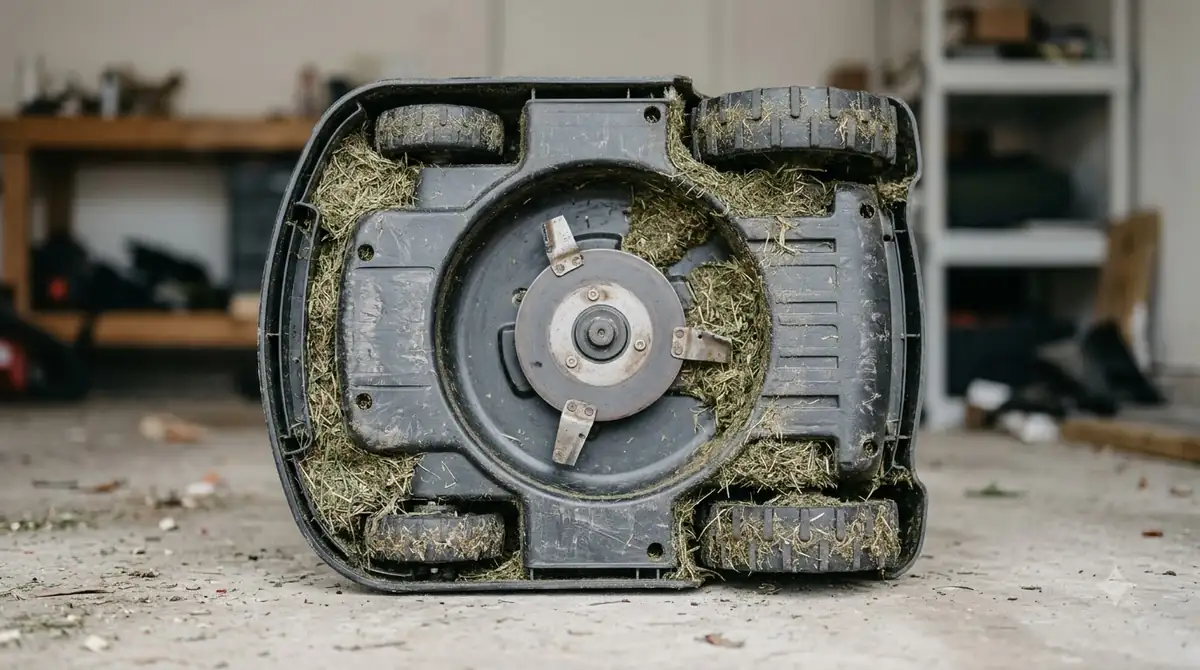
Set the cutting height and schedule from the robot manual first, then adjust for the grass. Cutting the lawn shorter to starve moss can stress the turf and leave bare soil where moss spreads faster.
How to treat moss before the next mow
Iron sulfate turns moss black within a few days and deepens grass color, but it does not grow grass. HortGuide describes it as a desiccant and colorant, not a cure, and Illinois Extension says iron products control moss only to some extent and that the moss tends to return. Use it as one step in a longer plan, not as the whole answer, and fit it into a robot mower lawn care calendar.
- Find the cause first. Run the screwdriver test, check how many hours of direct sun the spot gets, and note any low spots where water sits.
- Fix conditions in fall. Core aerate for compaction, prune overhanging branches for light, and feed at a rate suited to the shade. HortGuide says heavier fall fertilizing does more for turf density than spring feeding.
- Treat active moss from fall through spring. HortGuide says never apply iron sulfate in summer. It also permanently stains concrete, pavers and painted surfaces, so keep it off hard surfaces.
- Clear dead moss and overseed. Rake out the killed moss, then overseed with a shade-tolerant fine fescue, as HortGuide recommends; see can you overseed with a robot mower for timing around the mower.
Wet ground and boundary wire
Soft, mossy or compact ground is where Husqvarna says to push boundary wire stakes down with care. The same wet spots that favor moss are often the places where the wire needs extra attention. HortGuide lists standing surface water after rain, low corners and slope bottoms as the spots that hold moisture for moss, so walk those areas before you lay the wire. Our guide to robot mower wet grass explains when to hold off on mowing. When people ask can a robot mower handle a lawn with moss in these wetter zones, the wire layout is the first thing to check.
Husqvarna advises burying the wire 1 to 20 cm into the ground, and suggests burying it when the lawn is uneven. Its support page also says to remove rocks and sharp objects that could break the wire over time. That matters in any yard where stones show on the surface.
When deep shade means moss is the answer
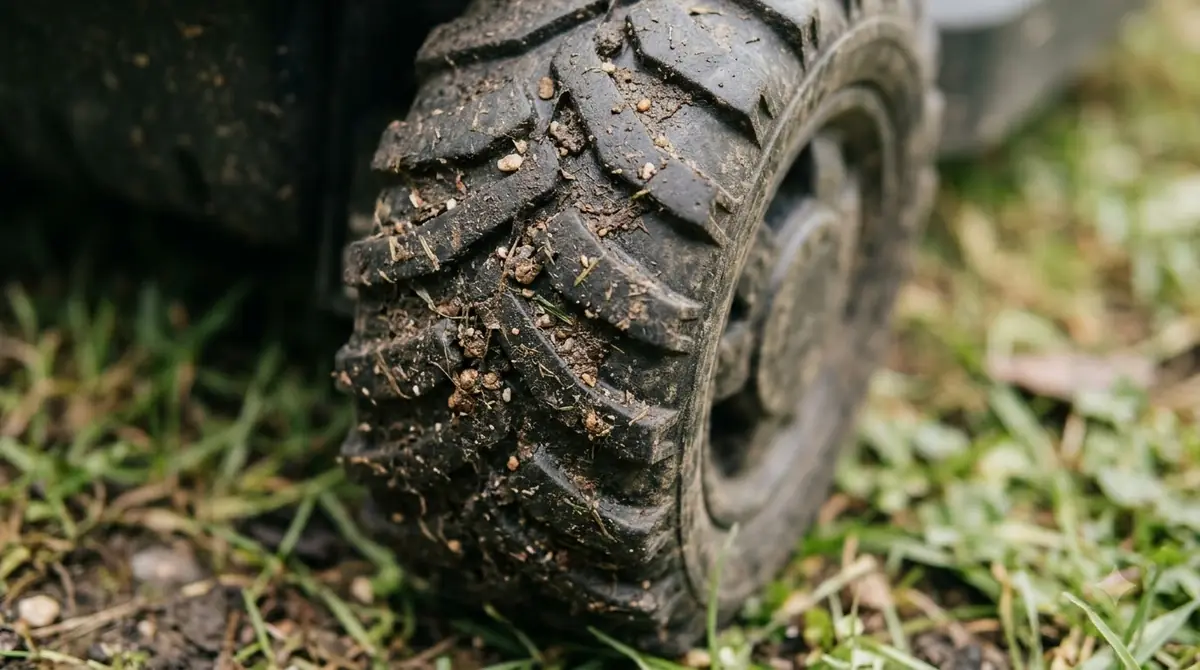
Grass will not hold deep shade, and neither fertilizer nor lime changes that, according to HortGuide. The sources give two options: remove the shade, or convert the area to moss or a shade-tolerant groundcover. Removing a tree or large shrub is a major decision, so most owners will choose the conversion.
Our reading is that a converted patch should be fenced off with the boundary wire, so the robot mower does not keep running over bare moss and the wire stays clear of the bed. The best robot mower for a shaded lawn guide covers the shade side of that choice. Set that boundary before the first mow of the season. For can a robot mower handle a lawn with moss over the long term, that one boundary keeps it out of the converted area.
Frequently asked questions
Does a robot mower kill moss?
Can a robot mower handle a lawn with moss? Yes for the cutting, but no source reviewed says mowing kills or removes moss. Illinois Extension lists mowing as a lawn-care practice, while moss control relies on iron-based products or raking followed by reseeding.
What mowing height should a mossy lawn get?
Robomow cites a practical cutting length of 30 to 40 mm for robot mowers and says no robot mows shorter than 15 mm. Blades set too high and cut infrequently leave more room for moss, so keep the setting and schedule steady.
How fast does iron sulfate work on moss?
Iron sulfate turns moss black within a few days. It works as a desiccant, not a cure, and the moss tends to return, so fix shade, drainage or compaction at the same time.
Does lime fix moss?
Only if a soil test shows the pH is below about 5.5, according to HortGuide. Illinois Extension says limestone is not suggested unless a soil test shows the pH needs raising.
Sources
- Managing Moss in Lawns (University of Illinois Extension): used for the causes, shade pruning, aeration, nitrogen rates, mowing one-third rule and iron product notes.
- Moss in Lawns: Why It’s There and Whether to Fight It (HortGuide, by an ISA certified arborist): used for moss biology, drainage checks, the screwdriver test, the weather-window figures, the pH threshold, iron sulfate timing and deep shade.
- Tips to prevent wire break in an Automower installation (Husqvarna US support): used for stake placement in soft or mossy ground and wire depth.
- What is the ideal cutting height for a robotic lawnmower? (Robomow blog): used for the 30 to 40 mm practical length, the 15 mm minimum and the note on moss spread.
 Up next9 min readBy YardChoosing and Using a Robot Mower for a Lawn With Thick Thatch and Moss PatchesUpdated Nov 19, 2026
 6 min readBy YardHow Does a Robot Mower Handle a Wheelbarrow Left on the Lawn?Updated Nov 12, 2026
 8 min readBy YardHow Does a Robot Mower Handle a Patio? Wire and Edge RulesUpdated Nov 12, 2026
 7 min readBy YardHow Does a Robot Mower Handle a Boulder in the Lawn?Updated Nov 12, 2026
 9 min readBy YardHow Does a Robot Mower Handle Tree Stumps in the Lawn?Updated Nov 12, 2026
 7 min readBy YardCan a Robot Mower Handle a Yard With Ground Squirrel Holes?Updated Nov 12, 2026