
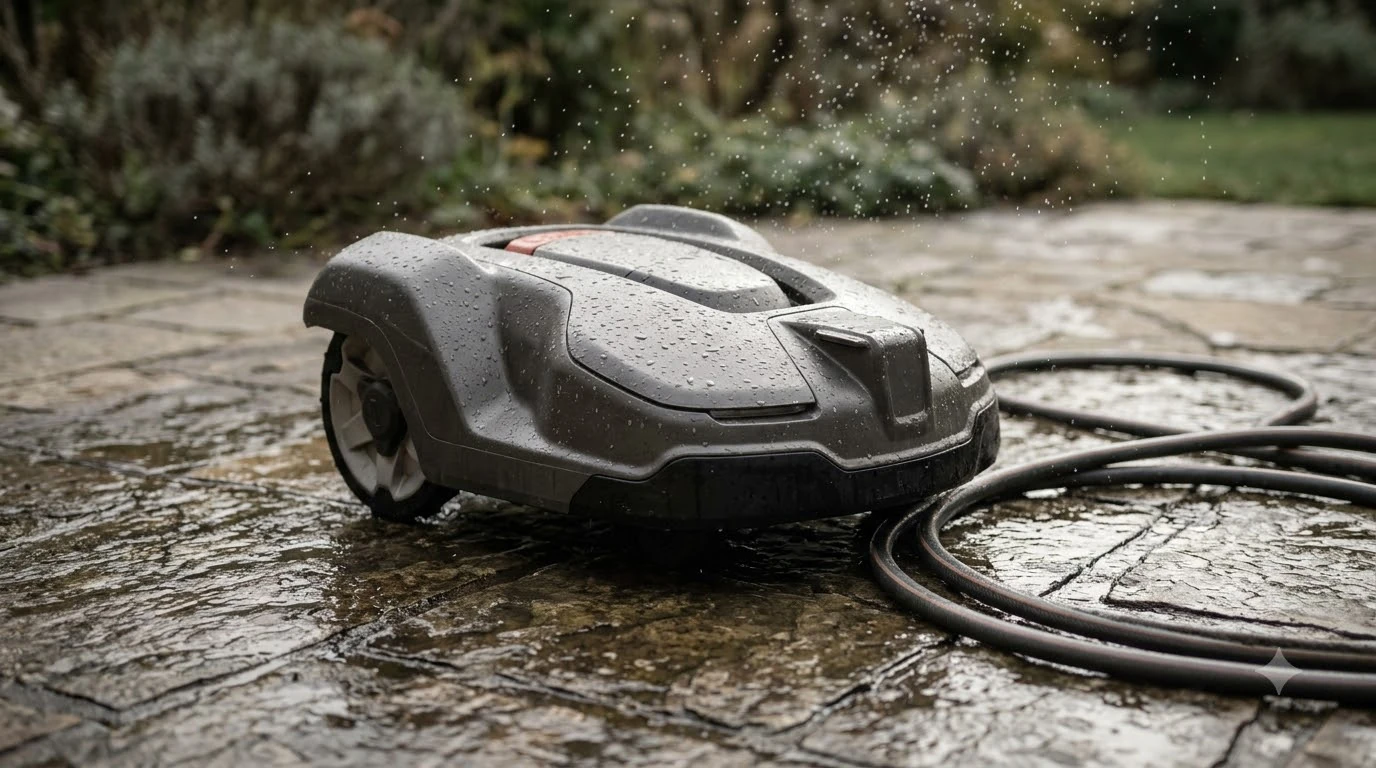

Asking how does a robot mower handle a patio usually comes down to one measurement: whether the paving sits level with the lawn. A flush patio can often be crossed, while a patio or wall that rises above the grass needs the boundary wire kept back so the mower stays off it.
The short answer
- Level patio: the wire can usually sit 10 to 15 cm from the edge, and the wheels can cross a flush edge.
- Raised patio, wall or steps: keep the wire about 30 to 35 cm back from solid edges.
- Wire under pavers: 4 to 5 cm is the optimal laying depth in one manufacturer’s guidance.
- Drop-offs: our reading is to fence them with wire or a no-mow zone, because the sources we read do not confirm that a step down is detected.
- Before you buy: check the model manual for lift, tilt and drop behavior.
How a robot mower handles a level patio
In short, how does a robot mower handle a patio that is flush with the grass? A patio that sits level with the lawn is usually safe for the wheels to cross, so the boundary wire can run about 10 to 15 cm from its edge. Anker’s perimeter wire guide says that where a path or patio is level with the lawn, the wire can usually sit 10 to 15 cm away, and that the mower’s wheels can safely travel over that edge. This reduces the strip of uncut grass that would otherwise be left along the paving. Robomow’s installation guide gives a similar figure of approximately 10 cm for slabs and paths at or below lawn level.
Anker’s separate guide on crossing paths describes flat paving, concrete and asphalt as usually the most straightforward surfaces. It says a grass-to-hard transition should let the mower roll onto and off the hard surface. These are general statements, not a guarantee for every model. Our reading is that a flush patio is the easy case, and that a supervised pass in both directions is the practical way to confirm it on your own lawn before you rely on it.
How does a robot mower handle a patio that sits above the lawn?
A patio or wall that rises above the grass needs the wire kept further back, with Robomow giving about 35 cm for walls and tall stones and Anker giving 30 to 35 cm for solid obstacles. The distance is a planning figure. It sets how close the working area comes to the raised edge.
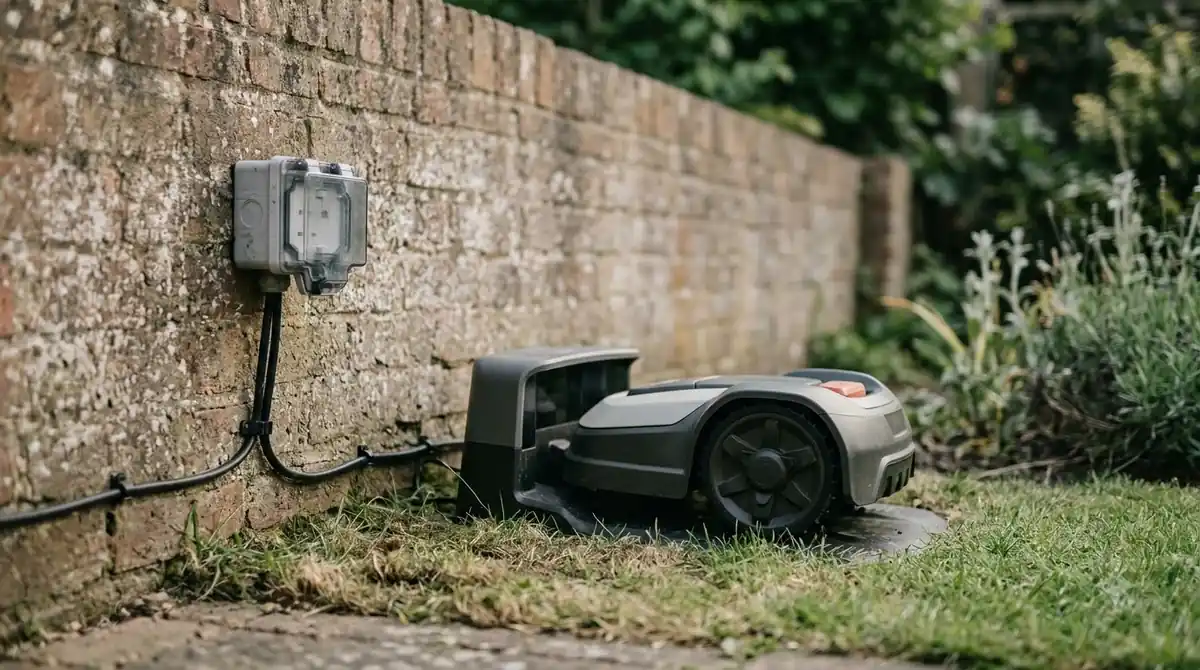
Robomow’s wire layout guide lists about 10 cm for beds or hedges, about 35 cm for walls and tall stones, and about 35 cm for a pond, with additional obstacles to keep the mower from falling in. The same guide says flower beds with borders several centimeters high need no additional perimeter wire. The table below puts the figures side by side.
| Edge type | Wire distance | Source |
|---|---|---|
| Slabs and paths at or below lawn level | Approx. 10 cm | Robomow |
| Level path or patio | 10 to 15 cm | Anker |
| Solid obstacles (walls, fences, raised beds) | 30 to 35 cm | Anker |
| Walls and tall stones | Approx. 35 cm | Robomow |
| Pond | Approx. 35 cm, plus extra barriers | Robomow |
For a raised patio, how a robot mower handles it depends on the buffer you set. Our reading is that a raised patio should get the largest buffer in the table, because the sources give these distances as planning figures for the wire, not as a sensor limit. If the patio has a low border of a few centimeters, the lighter figure may be enough. If it has a wall or a step, use the 35 cm figure and check the result on the lawn. For walls specifically, see robot mower for a yard with retaining walls.
Heads up
These distances come from the installer guides named in the sources. Your model’s manual sets the real numbers, so use those if they differ.
Drop-offs and steps down from a patio
The sources we read do not confirm that a mower detects a step down from a patio, so the safe planning assumption is a no-mow zone rather than a sensor catch. Most install guides say little about drop-offs. Sunseeker’s blog says slopes often feature natural obstacles such as exposed tree roots, rocks and sudden drop-offs, and says its app lets you designate no-mow areas such as steep embankments or garden beds.
How does a robot mower handle a patio edge it cannot see? Sensor type matters here. PCWorld describes bump sensors as the simplest obstacle detection, which react after contact, while ultrasonic and infrared sensors detect before contact. Lift sensors signal that the mower has been caught on something, and tilt sensors detect unsafe angles. None of these is described as a step-down detector in the sources we read. Husqvarna’s sensor page describes a lift sensor that turns the blades off when the mower is lifted, and collision sensors that stop forward movement.
Burying boundary wire under pavers
Robomow’s guidance is to lay the wire 4 to 5 cm deep, with the mower still receiving the signal at depths up to 7 cm, so wire can run under stones or slabs. Robomow says the wire can be buried under stones or patio slabs, and can also mark passages under paths. Anker’s perimeter guide gives a typical depth of 3 to 5 cm and says some systems allow roughly 7 to 10 cm. The two sources differ at the top end, so take the depth from your model’s manual.
Anker also advises testing with the wire laid on the surface before burying it, which makes a layout mistake cheap to fix. Our guide on whether to bury or peg robot mower boundary wire compares the two methods.

Passages between the patio and the lawn
A passage the mower must cross should be wider than 70 cm in Robomow’s layout, and Anker suggests starting near 80 to 100 cm, subject to the manufacturer’s minimum. Robomow gives the 70 cm figure for narrow passages to separate mowing zones, so that the signal from neighboring wires does not interfere. Anker’s crossing guide calls 80 to 100 cm a useful starting point and says your model may require more or less.
If the mower must cross a path, This Old House’s install guide says a double wire lets the mower cross, because the two wires cancel the signal over that stretch. For a loose path, Anker’s guide suggests two flush rows of solid pavers or a narrow bonded-gravel strip for the wheels (see also gravel path crossings). Our reading is that a route across a patio should be planned on purpose, not left as a gap by chance.
Frequently asked questions
Can a robot mower drive onto a patio?
How does a robot mower handle a patio it can reach? A patio that sits level with the lawn is usually the easy case, because the sources we read say the wheels can travel over a flush edge. A patio that rises above the lawn should be fenced off with boundary wire, since the planning figures treat a raised edge as an obstacle. Check the model’s manual for its rules on hard surfaces, and run a supervised pass in both directions before you rely on it.
How far should the boundary wire sit from a patio?
For a patio level with the lawn, Anker gives 10 to 15 cm from the edge. For solid obstacles such as walls and raised beds, Anker gives 30 to 35 cm, and Robomow gives about 35 cm for walls and tall stones. Use the figure that matches your edge, then confirm it against your model’s installation manual.
Can boundary wire run under patio pavers?
Yes, according to Robomow, which says wire can be buried under stones or patio slabs. Its optimal laying depth is 4 to 5 cm, and the mower can receive the signal at up to 7 cm. Anker reports a typical depth of 3 to 5 cm, with some systems up to 7 to 10 cm, so the model’s manual should set the final depth.
Will the mower stop if it is lifted off a patio?
Models with lift and tilt sensors are designed to stop the blades when they are picked up or tilted. Husqvarna’s sensor page describes a lift sensor that turns the blades off when the mower is lifted. Not every model lists these sensors, so confirm the sensor list on the product specification sheet before you buy.
Sources
- Laying the lawn boundary wire (Robomow, manufacturer): distances to beds, slabs, walls and ponds; burial depth; passages wider than 70 cm.
- Robot lawn mower perimeter wire guide (Anker, brand blog): 10 to 15 cm from level edges; 30 to 35 cm from solid obstacles; 3 to 5 cm burial.
- Robot lawn mower cross path guide (Anker, brand blog): flat paving and grass-to-hard transitions; 80 to 100 cm starting width.
- How to install a robotic lawnmower (This Old House): double wire for crossing pathways; wire secured every 3 feet.
- How Husqvarna Automower sensors work (Husqvarna, manufacturer): lift and collision sensor behavior.
- How robot lawn mowers cut grass without whacking off your toes (PCWorld, Ed Oswald, June 26, 2024): bump, ultrasonic, infrared, lift and tilt sensor types.
- Can robotic lawn mowers handle slopes (Sunseeker, brand blog): drop-offs listed as natural obstacles; no-mow areas in the app.
 Up next6 min readBy YardRobot Mower Concrete Basketball Pad Edge: Set the Wire RightUpdated Nov 14, 2026
 6 min readBy YardHow Does a Robot Mower Handle a Wheelbarrow Left on the Lawn?Updated Nov 12, 2026
 7 min readBy YardHow Does a Robot Mower Handle a Boulder in the Lawn?Updated Nov 12, 2026
 9 min readBy YardHow Does a Robot Mower Handle Tree Stumps in the Lawn?Updated Nov 12, 2026
 8 min readBy YardHow Does a Robot Mower Handle a Lawn with Lamp Posts?Updated Nov 12, 2026
 9 min readBy YardHow Does a Robot Mower Handle a Well Cap or Utility Pedestal in the Lawn?Updated Nov 12, 2026