
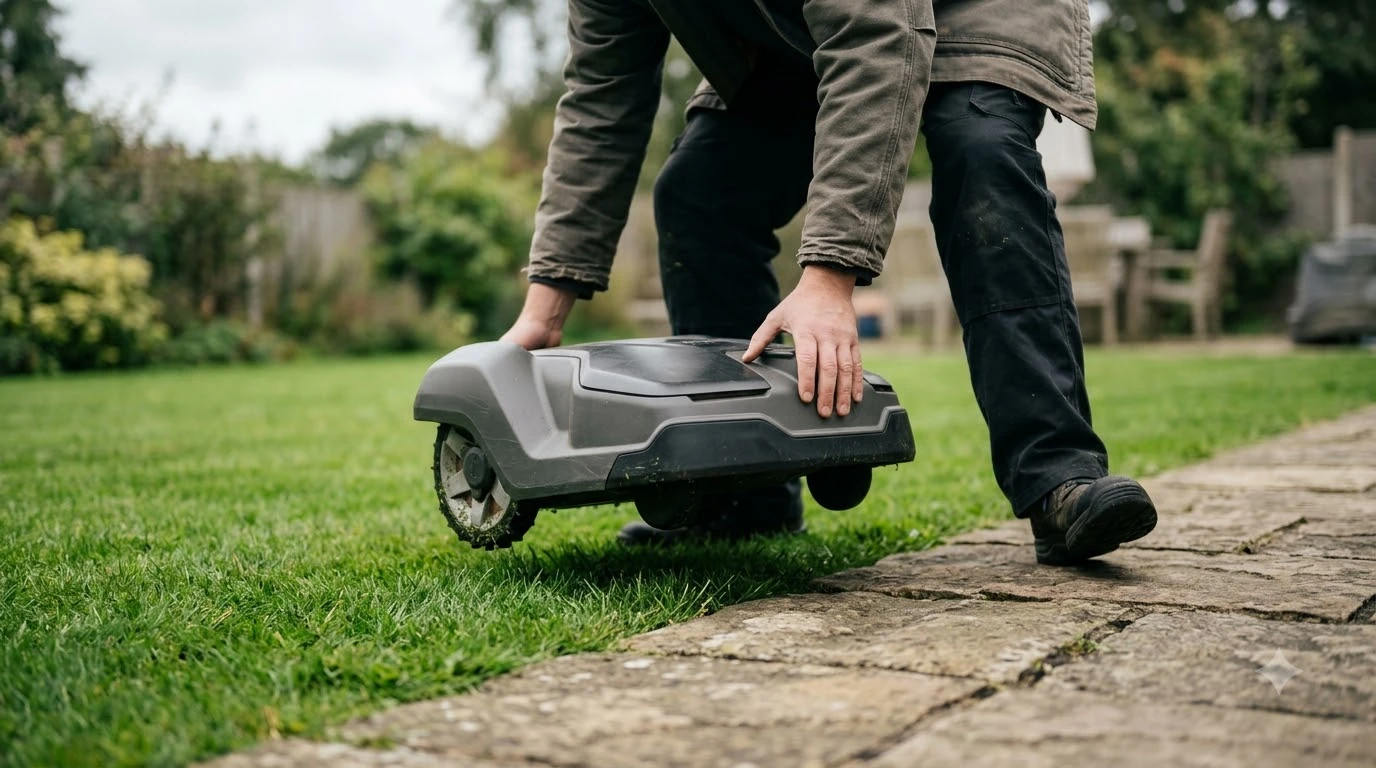

Is my yard suitable for a robot mower? It is when the lawn fits the model’s rated area, its slopes stay inside the stated incline limit, and the grass is cut to a workable height first. Four checks cover most yards: lawn size, slope, ground and grass condition, and obstacles with boundary wire clearance. Limits differ by model, so the spec sheet of the exact mower decides the final answer.
The short answer
- Size: the measured lawn should sit inside the mower’s rated coverage, with some margin for beds and paths.
- Slope: every sloped area should stay inside the incline limit for that model, which Husqvarna lists as up to 35 degrees for one model.
- Ground and grass: fill dips and holes, and cut tall grass to your target height before the first run.
- Obstacles: keep boundary wire 30 to 35 cm from walls and fences, and 10 to 15 cm from beds and hedges.
Is my yard suitable for a robot mower? Start with lawn size
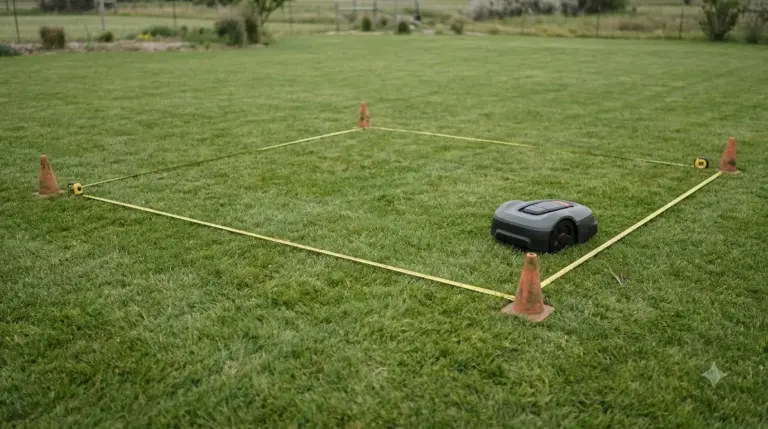
Measure your lawn first, then compare the total with the rated coverage of the model you want. Husqvarna says select Automower models cut lawns up to 5000 square meters, with the 450X rated at about 5000 square meters (plus or minus 20 percent) and the 315X at about 1600 square meters (plus or minus 20 percent). The Husqvarna lawn suitability guide suggests building a site plan in Google Earth Pro to measure your perimeter and area.
Our reading is that a lawn close to the rated limit leaves little room for the mower to work around beds, trees and paths. Choose a model rated comfortably above your measured area, so the mower does not spend its battery on the edges of the job. The guide to choosing a robot mower by lawn size walks through the same comparison.
Heads up
Rated areas come from the manufacturer and apply to a specific model. Compare your figure with the spec sheet of the exact mower, not with a figure from a brand headline.
Look at slopes and inclines
Is my yard suitable for a robot mower if it has slopes? Yes, when every sloped area sits inside the model’s stated incline limit. Husqvarna lists up to 35 degrees for its 435X AWD, and that figure does not carry over to other models.
Incline limits are model specific. The Husqvarna guide gives the 35-degree figure for one all-wheel-drive model and does not give a slope figure for its other models, so check each model’s rating before you assume a hill is fine.
Our reading is that a slope close to the stated limit leaves little room for error. Treat the figure as a ceiling, not a target. If you are unsure of your own slope, start with measuring your yard slope in degrees. If a steep bank runs along one side of the yard, it is often simpler to plan the boundary wire around it than to rely on the mower to handle it, and the manual for your model explains the setup options.
Plan for uneven ground and low spots
Is my yard suitable for a robot mower if the ground is bumpy? Often, because Husqvarna says its large driving wheels handle uneven ground and help prevent scalping. The same guide recommends back-filling dips, grooves and holes for a smoother finish.
Our reading is that a bumpy lawn is usually a repair job rather than a deal-breaker. A lawn with deep ruts or large bare patches needs fixing before the mower goes out, or the wheels will keep finding the same gaps. See what works and what fails on an uneven lawn for more detail.
Clear obstacles and set the boundary wire
A yard suits a robot mower when its obstacles can be detected and avoided, and the boundary wire keeps a safe distance from them. Husqvarna says the mower’s sensors detect furniture, pets and large objects, then stop, reverse and carry on. The explainer on how robot mowers avoid obstacles covers the sensing side in more detail.
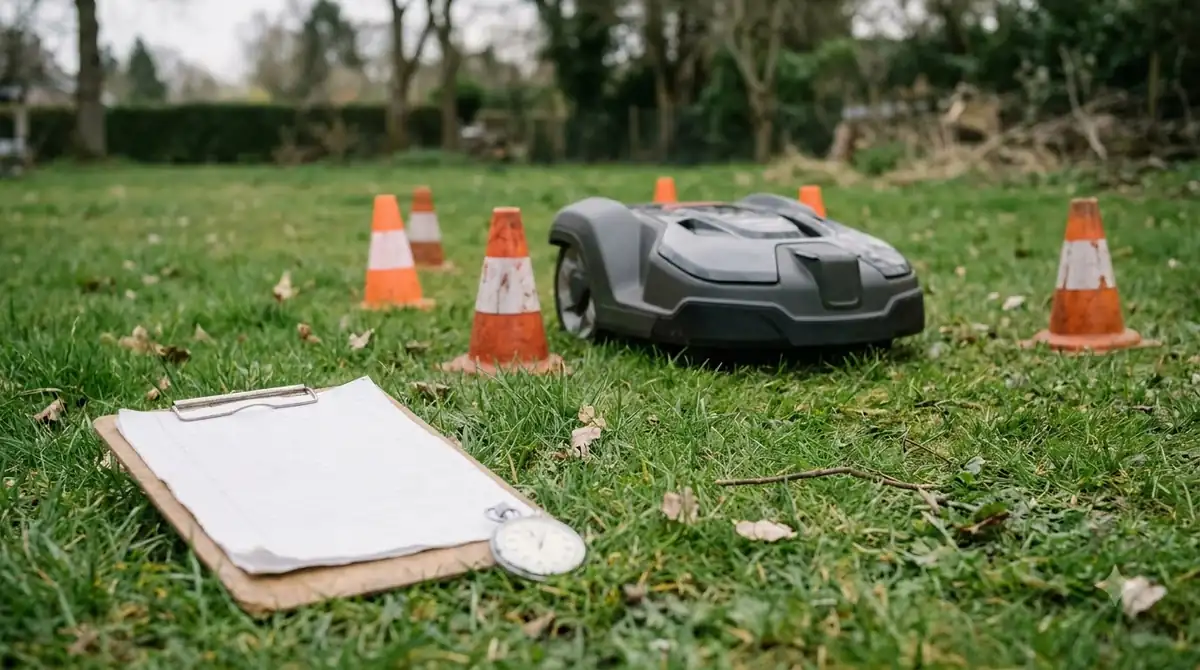
Small items such as pine cones, pebbles and twigs are mulched or discharged. Small toys are not told apart from organic debris, so the guide advises removing them before each mow. Separate lawn areas can be linked by a passageway across paths or driveways.
Wire placement is a separate question from sensing. The Anker robot mower boundary wire guide gives these distances:
| Obstacle | Wire distance (Anker guide) |
|---|---|
| Solid obstacles such as walls, fences and raised beds | 30 to 35 cm |
| Flower beds, hedges and level paths | 10 to 15 cm |
| Ponds | 35 cm, ideally with a physical barrier |
The same guide says a wire extension must match the original wire’s thickness, material and electrical resistance, and the total length must stay within the manufacturer’s maximum, which is listed in the manual. So, is my yard suitable for a robot mower if it has many beds, trees and narrow paths? It can be, but it needs more planning than an open lawn, since each obstacle adds wire and navigation work.
Heads up
These distances come from one vendor guide. The manual for your model sets the final numbers, and some brands list their own offsets.
Cut the grass to a workable height first
Cut the grass to your target height before the first run, because Husqvarna recommends setting the height first and dense or tall patches trigger a spiral cutting mode until they match the rest of the lawn. The cutting height is set on the mower or in the app.
The Anker guide advises cutting the grass below 6 cm before the wire goes in, and trimming edges carefully so the wire can sit close to the soil. Our reading is that an overgrown yard is best cut once by hand or with a conventional mower, then handed over to the robot.
Husqvarna’s New Zealand version of the same guide lists couch, kikuyu and buffalo grass, or a mix of them, as the grasses its Automower works with. Check your own grass type against the manual of the model you plan to buy.
Shade, the charging base and edges
The guides read for this article do not give limits for shade, tree cover or charging station placement, so the model manual is the place to check those points. None of the three pages mentions shade, and the Husqvarna page gives no guidance on where to put the charging station.
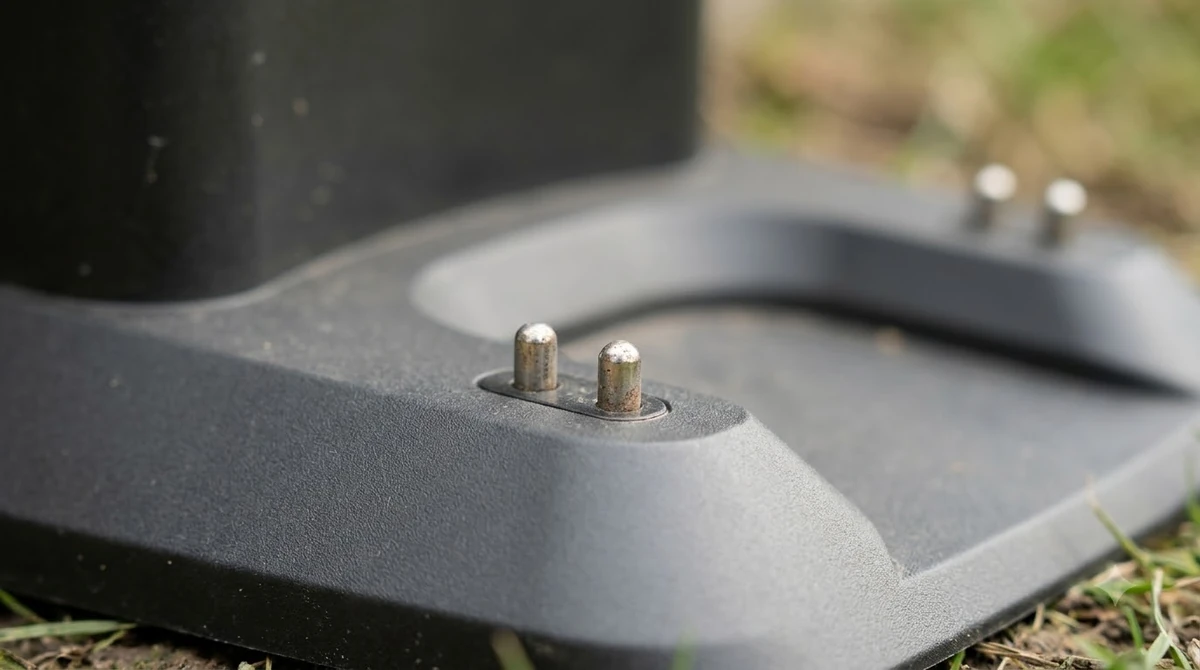
Our reading is that a yard under dense tree cover, or one without a dry and accessible spot for the charging station, deserves a closer look before you buy. Measure the route from the planned dock position to the lawn before you choose a model, and read the charging station placement rules for the dock itself.
None of the pages read for this guide describes edge trimming, so plan to trim borders by hand or with a trimmer. Our reading is that this step applies to nearly every yard, whatever mower you choose.
What to check before you buy
Is my yard suitable for a robot mower? Confirm each of the checks below against the spec sheet and manual of the exact model, since every figure in this guide varies by model.
- Size: the measured lawn sits inside the rated coverage, with margin for beds and paths.
- Slope: each sloped area is inside the incline limit listed for that model.
- Ground: dips, grooves and holes are filled, and the wheels suit the lawn.
- Grass: the lawn is cut to a workable height before the first run, and the grass type is covered by the manual.
- Obstacles: beds, trees, ponds and paths are mapped, with wire distances and extension limits taken from the manual.
- Base: the charging station has a dry, accessible spot with a clear route to the lawn.
Our reading is that if two or three of these checks sit close to the limit, a model with more margin in that area is the safer choice. Compare models by their spec sheets rather than by headline claims.
Frequently asked questions
Can a robot mower cut a yard with trees?
The guides read for this article do not give tree-canopy limits, so check the model manual for navigation details. Our reading is that a yard with heavy tree cover and many obstacles needs more planning than an open lawn before you choose a model.
Do I need to remove toys before mowing?
Yes. Husqvarna advises removing small toys, because the mower does not tell them apart from organic debris.
What grass types suit a robot mower?
Husqvarna’s New Zealand guide lists couch, kikuyu and buffalo grass, or a mix of them, as the grasses its Automower works with. Check your own grass type against the manual of the model you plan to buy.
How do I measure my yard for a robot mower?
Husqvarna suggests building a site plan in Google Earth Pro to measure the perimeter and area. Compare that total with the rated coverage of the model, and leave some margin for beds, trees and paths.
Sources
- Husqvarna Automower, lawn suitability guide (Australia) (manufacturer): rated lawn sizes, the 35-degree incline figure, uneven ground, obstacles, grass height and the Google Earth Pro measuring method.
- Husqvarna Automower, lawn suitability guide (New Zealand) (manufacturer): grass types, obstacle handling and charging notes.
- Anker, robot lawn mower boundary wire guide (UK) (vendor): wire distances from obstacles, grass height before installation and wire extension rules.
 Up next9 min readBy YardHow Do I Know If a Robot Mower Will Work in My Yard?Updated Nov 11, 2026
 7 min readBy YardCan a Robot Mower Work in a Long Narrow Yard?Updated Nov 11, 2026
 7 min readBy YardWill a Robot Mower Get Stuck on a Rocky Yard?Updated Nov 11, 2026
 8 min readBy YardRobot Mower for Narrow Side Yard Passages: What Widths Work?Updated Nov 11, 2026
 9 min readBy YardCan a Robot Mower Work in an L-Shaped Yard?Updated Nov 11, 2026
 8 min readBy YardWhat Yards Are Not Good for Robot Mowers?Updated Nov 11, 2026