
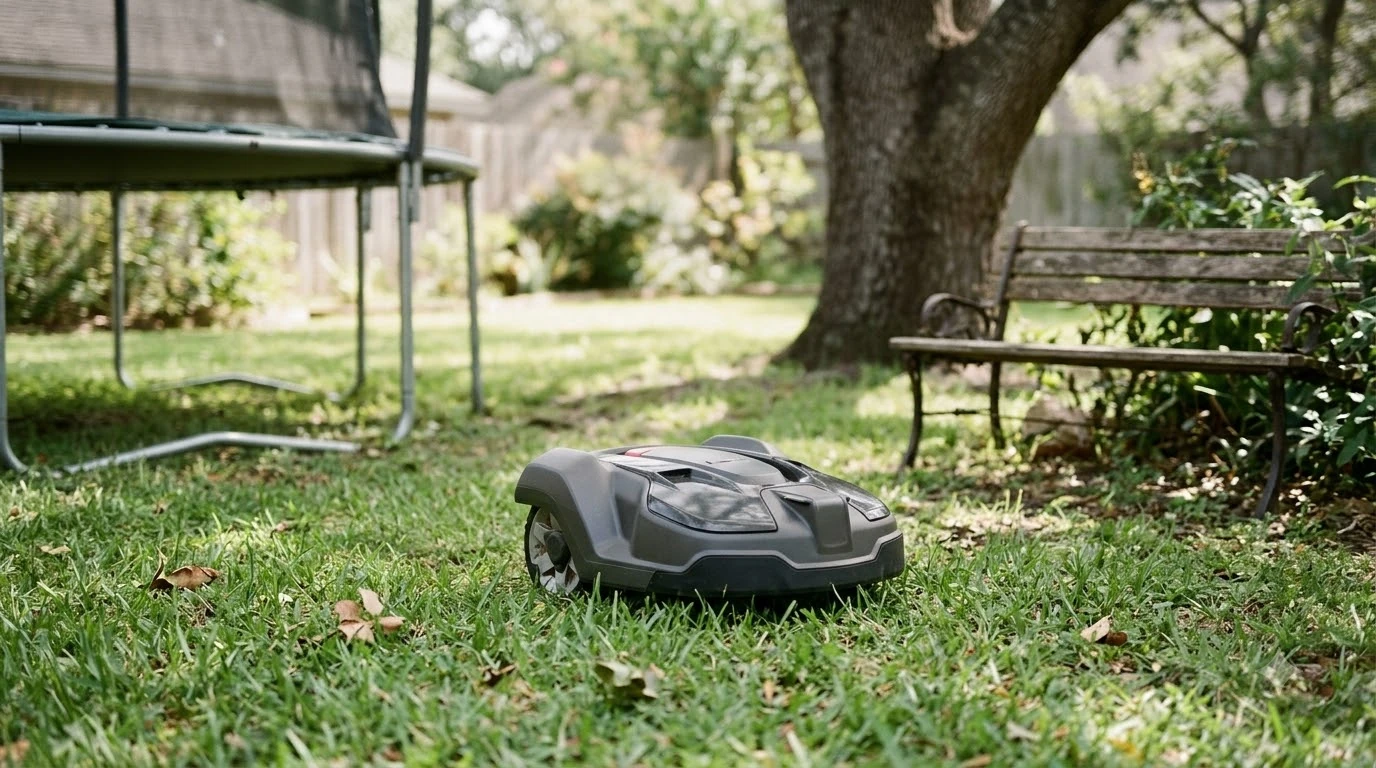

A robot mower that works under trees without RTK navigates with LiDAR, cameras or a boundary wire, since none of these depend on satellite position alone. Vendors say RTK loses accuracy under dense canopy, but none of the pages we read give an independent figure for how far any method holds up in a shaded yard. The points below come from manufacturer pages and one university extension guide, as of 2026-11-10.
The short answer
- Satellite-free options: LiDAR, camera-based vision and boundary wire do not need a satellite fix to know where the mower is.
- Vendor limits: LiDAR is weakened by fog and heavy rain, and vision can struggle with small branches, according to the vendors.
- Hybrid models: many RTK mowers add LiDAR or vision as a fallback, so they still carry an RTK receiver.
- Check before you buy: ask how long the mower runs without a satellite fix, and watch the shadiest zone over several runs.
Why RTK struggles under trees
RTK loses accuracy under trees because its correction signal depends on clear sky at both ends of the link. Sunseeker Elite, which sells both RTK and LiDAR mowers, says RTK performance “may be affected in areas with heavy tree cover, tall buildings, or narrow passages.” Its FAQ adds that performance “may decline under dense tree cover due to weaker satellite signals.” Both lines are marketing copy, so read them as the seller’s view of its own weak spot.
The base station is the other weak point. Ecovacs’s LiDAR and RTK comparison says an RTK base station must be set up “in an open, unobstructed area,” and that obstructions “can risk interfering with satellite connectivity.” Our reading is that a dock or base placed under a branch line is the setup most likely to show weak signal, because the base and the mower both lose sky at the same time.
Lymow, which sells an RTK model, puts it more bluntly: performance “may degrade under extremely dense tree canopy.” None of these pages gives a numeric accuracy figure for a treed yard, so you cannot size the loss from vendor copy alone. If you are new to the technology, read how RTK navigation works on a robot mower first.
What makes a robot mower that works under trees without RTK
Three methods keep position without relying on satellites alone: LiDAR, vision and boundary wire. Each is a different route to a robot mower that works under trees without RTK. Each one carries a different limit, and the vendor pages name them.
| Method | What vendors say about trees | Limit the vendors name |
|---|---|---|
| LiDAR | Ecovacs lists it as “Unaffected by shade or structures”; Sunseeker says it is “not affected by tree cover or nearby buildings” | Weakened by fog and heavy rain; higher price than RTK, per Ecovacs |
| Vision (VSLAM) | Lymow says it takes over for up to 10 minutes when GPS weakens under dense cover | Smaller branches may not always trigger obstacle avoidance |
| Boundary wire | Keeps a fixed edge that does not depend on satellite position | Breaks from equipment, burrowing animals and frost heave; 4 to 8 hours to install |
Many robot mowers combine these methods. Ecovacs says its GOAT O1000 RTK adds a solid-state LiDAR and a fish-eye camera “to reduce disturbance from shade or roofs.” A mower like that still has an RTK receiver, so it is not RTK-free. It simply leans less on the satellite when the sky is blocked. The table is vendor-sourced, and no row is backed by an independent test. For a broader side-by-side, see RTK, LiDAR and vision navigation compared.
How LiDAR and vision keep the mower on course
LiDAR and vision systems keep detecting objects around the mower when the satellite fix drops, and Lymow gives the most specific fallback window in the pages we read. Lymow’s RTK and wire guide says that under dense tree cover the GPS weakens and its VSLAM system takes over “for up to 10 minutes.” That is one vendor’s figure for one product, so treat it as a claim to check, not a general rule.
Vision has its own gaps. The same Lymow page says the obstacle system “uses visual semantics to detect trees and larger objects,” but that “smaller branches may not always trigger avoidance.” Lymow lists 2.8 in of obstacle clearance for its One Plus model. For a yard with low limbs or thin shrubs, that detail matters more than a headline feature list.
LiDAR has a different profile. Ecovacs states that LiDAR “detects objects in real time” and needs no specific base station placement. The same comparison says fog and heavy rain weaken LiDAR, because they can scatter and absorb the laser beams. Ecovacs also says LiDAR costs more because its sensors and software add to the upfront price. A separate explainer covers how LiDAR navigation works on a robot mower in more detail.
When a boundary wire is the satellite-free choice
A boundary wire gives the mower a fixed edge, so it is the third kind of robot mower that works under trees without RTK, but installation is the main cost. Lymow estimates wired installation at “4-8 hours (digging trenches, laying wire)” in its comparison table.
Lymow also lists wire problems that show up over time, including breaks from landscaping equipment, burrowing animals and frost heave. It calls wire installation “impractical” on steep terrain. Its price ranges are vendor figures as of 2026-11-10: wired models at $800 to $2,000 and wireless models at $2,000 to $5,000. A wire is the option that depends least on sky view, but changing the layout later means moving the wire. The guide on laying boundary wire around trees and obstacles shows how to route it.
Shade and tree roots still affect the grass
Mississippi State University Extension says turf under shade “may require additional water due to tree root competition.” A mower can work well and the grass can still thin, so the satellite question is only part of the picture. The extension guide, Selecting and Managing Turfgrass for Shade, also warns that “foot traffic, whether from pets or people, can cause excessive stress for shaded turf.”
The same guide says that under many shade trees, the wheels of riding lawn mowers are a main cause of turf decline. It covers riding mowers, not robots. Our reading is that a robot makes many light passes over the same ground, so a tight loop under one tree adds repeated traffic to thin turf. Widening the mowing boundary around the tree can spread that traffic out.
What to check before you buy and set up
Check the fallback behavior, the dock position and the shaded zone before you rely on a satellite-free mower under trees. Most vendor pages do not publish a fallback duration, so ask for it in writing. A robot mower that works under trees without RTK still needs this check, because the vendor claims describe the design, not your lawn. If you are comparing models, start with the best robot mower for a lawn with trees.
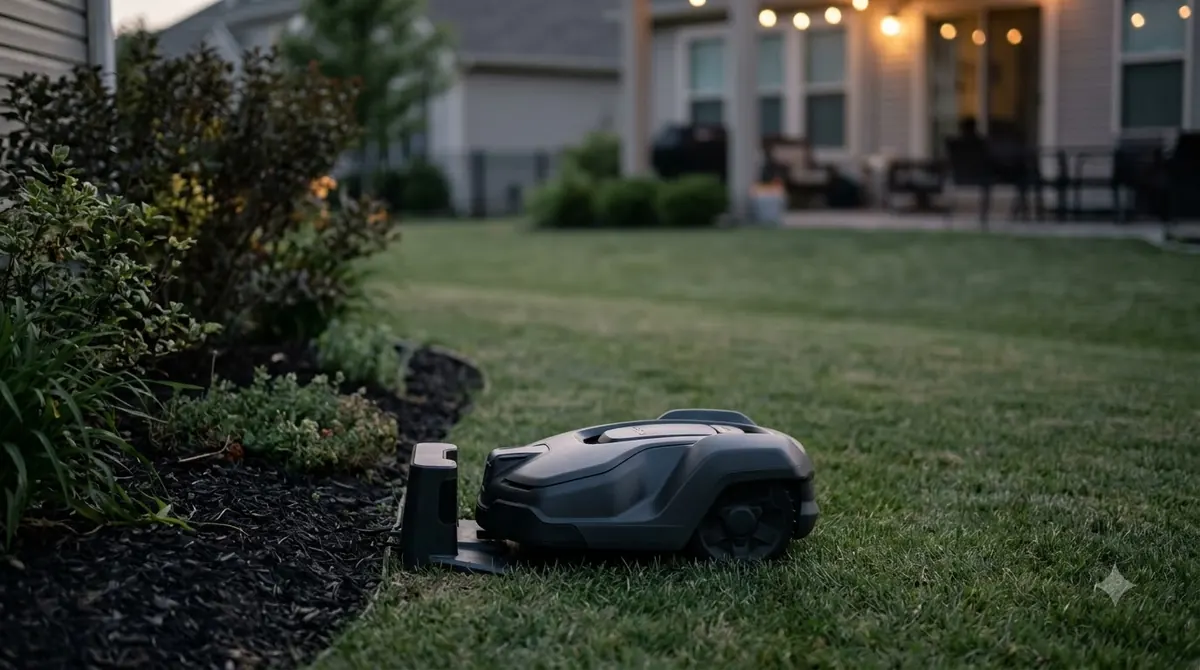
- Put the dock in the most open spot. RTK base stations need an open, unobstructed area, while LiDAR models have no specific placement rules, according to Ecovacs.
- Ask how long the mower runs without a fix. Lymow’s 10-minute VSLAM figure is one example. Compare the answer across makers.
- Watch the shadiest zone for several runs. Note pauses, slow stretches, route corrections or docking trouble under the canopy.
- Plan a wire for the dense zone if the runs show trouble. A wire adds installation hours, so limit it to the area that needs it.
Frequently asked questions
Can a robot mower work under trees without RTK?
Yes, in principle. LiDAR, camera-based and boundary wire designs do not rely on satellite position alone. Vendors say they hold up better under canopy, but the pages we read give no independent figures, so check the shadiest part of your yard before you commit.
Does LiDAR work in the shade?
Vendors say so. Ecovacs lists LiDAR as “Unaffected by shade or structures,” and Sunseeker says it is not affected by tree cover. Both claims come without test data. Ecovacs also says fog and heavy rain can weaken LiDAR.
How long can vision navigation hold position when GPS fails?
Lymow says its VSLAM system takes over for up to 10 minutes when GPS weakens under dense cover. That is one vendor’s figure for one product. Ask other makers for their own number before comparing models.
Does a boundary wire avoid the tree problem?
A wire does not need satellites, so tree cover does not weaken its edge. Lymow says installation takes 4 to 8 hours, and wire can break from equipment, burrowing animals and frost heave. It suits a fixed tree zone better than a yard that changes often.
Sources
- RTK vs LiDAR Robot Lawn Mowers (Sunseeker Elite, vendor): RTK and LiDAR behavior under tree cover, FAQ on canopy.
- RTK vs LiDAR Robot Lawn Mowers: Which One You Should Choose? (Ecovacs, vendor): base station placement, LiDAR shade and fog limits, cost.
- RTK vs Wire: Which Robot Mower Setup is Easier? (Lymow, vendor): VSLAM fallback window, obstacle detection, wire installation and wire failures.
- Selecting and Managing Turfgrass for Shade (Mississippi State University Extension, P2892): tree root competition, foot traffic and mower wheel effects under shade trees.
 Up next8 min readBy YardRobot Mower Under Trees: What Changes and What to DoUpdated Nov 11, 2026
 8 min readBy YardWhere to Place RTK Antenna in a Yard With TreesUpdated Nov 11, 2026
 8 min readBy YardRTK Robot Mower Near Tall Buildings: What Affects AccuracyUpdated Nov 11, 2026
 8 min readBy YardWill a Robot Mower Get Stuck on a Clay Soil Lawn That Stays Wet?Updated Nov 11, 2026
 8 min readBy YardRobot Mower for Tall Fescue Lawns: Height Limits That MatterUpdated Nov 11, 2026
 8 min readBy YardHow Does a Robot Mower Handle Trees?Updated Nov 11, 2026