


Does a robot mower reduce ticks in the yard? Not on its own. The best study we found on mowing and blacklegged ticks showed no detectable effect from mowing frequency. Robot mowers keep grass short, but tick control depends more on the edges, leaf litter and the wood line around the lawn, which a robot mower usually does not reach.
The short answer
- Mowing alone is not a tick control. A 2019 study of 16 Massachusetts yards collected no ticks at all, so mowing frequency made no detectable difference.
- Frequent mowing is still advised. CDC says to “mow the lawn frequently,” but it does not give a grass height.
- Edges and leaf litter matter more. Maine Extension and CDC both point to leaf litter, tall brush and a 3-ft barrier between the lawn and wooded areas.
- A robot mower usually cannot reach those areas. This is our reading of how boundary-wire mowers work.
Does a robot mower reduce ticks in the yard? What the 2019 study found
Mowing frequency is the question most owners ask first, and the study that tested it most directly is small. Lerman and D’Amico (2019, PLoS One) mowed 16 lawn-dominated yards in Springfield, Massachusetts, weekly, every two weeks or every three weeks from May to September in 2013 and 2014. The team dragged cloth across the lawns 144 times to count ticks. They collected no ticks of any species, so mowing frequency showed no detectable effect on tick presence. The study did not test the ticks for Borrelia, the bacteria behind Lyme disease.
The study also found that taller grass did not mean more ticks. The authors wrote that taller grasses “did not result in more ticks but did support higher abundances and diversity of native bees,” which is a trade-off to weigh when you set a robot mower schedule. The authors also say the data offer little basis for comparing mowing treatments, because no ticks were found in any group. Treat this as a null result, not proof that mowing never matters. You can read the full paper in PLoS One via PubMed Central.
Why a robot mower does not fully solve it
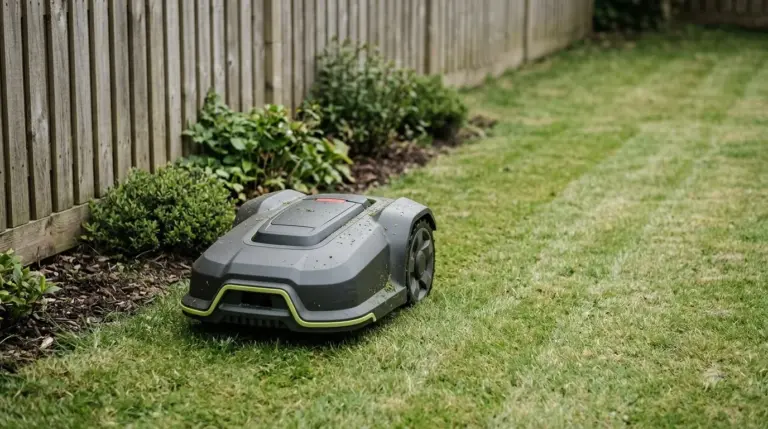
So does a robot mower reduce ticks in the yard? Only in the part of the yard it cuts. A robot mower keeps the cut area short on a timer, but ticks need humidity and cover, and those often sit outside the cut area. Maine Extension advises that owners “regularly mow lawns and keep leaves raked to reduce humidity at ground level.” A mower can handle the first half of that advice, but it does not rake leaves, and leaves tend to pile at the fence line, under trees and against the wood line. A leaf blower for robot mower lawn cleanup is the usual tool for that job.

Our reading is that most boundary-wire robot mowers cut only inside the wire. The strip along the fence, the woodpile and the wooded edge therefore usually stay uncut and need hand work, which is why it helps to know whether robot mowers trim edges on your model, and to keep a cordless string trimmer for robot mower edges ready. Those are the same areas that extension guidance targets, so the mower covers the lawn while the edges need a separate plan.
Heads up
After heavy leaf fall, check the zones next to the wood line by hand. A robot mower may chop a light layer of leaves, but a thick pile can clog the deck or leave the edge untouched.
What helps more than mowing
Edge work, leaf removal and a barrier matter more than cut height. CDC advises removing leaf litter, clearing tall grass and brush around homes and at lawn edges, and placing “a 3-ft wide barrier of wood chips or gravel between lawns and wooded areas.” Maine Extension gives the same 3-ft barrier and also allows mulch. It adds that compost bins for leaves should sit away from the house, or that leaves can be mowed in place into small fragments.

| Action | What the sources say | Robot mower role |
|---|---|---|
| Remove or move leaf litter | CDC: remove leaf litter. Maine: compost leaves away from the house, or mow them in place into small fragments. | Cannot rake. Do this by hand or with a blower; light leaves may be chopped. |
| Clear tall grass and brush at edges | CDC and Maine both advise clearing tall grass and brush around homes and lawn edges. | Usually stops at the wire, so trim these strips by hand. |
| 3-ft barrier between lawn and woods | CDC: wood chips or gravel. Maine: wood chips, mulch or gravel. | Keep the mower off this strip, and check the boundary setting. |
| Firewood and debris | CDC: stack firewood neatly in a dry area; remove old furniture or trash where ticks can hide. | Not a mower task. |
| Play areas and patios | Maine: place playground equipment, decks and patios in sunny spots away from yard edges when possible. | Layout choice made when the yard is planned. |
Pets and wildlife bring ticks in
Ticks can arrive on pets and wildlife, so a mower does not control this route. Mississippi State Extension, in a 2005 newsletter, advises keeping pets out of wooded areas, because they can pick up ticks and carry them back into the lawn. It also recommends collars, repellents or insecticides for pets, and limiting wildlife access with fencing, lights or similar measures. CDC lists fences to keep out deer, raccoons and stray dogs.
The same Mississippi State article advises keeping vegetation cut low to discourage deer and other animals from entering the lawn. On that point, a robot mower that cuts often can help, though it does not replace fencing or treating pets. Our note on robot mowers and wildlife at night covers the animal side of the yard.
How to set up a tick-aware yard with a robot mower
Use the mower for the lawn and handle the edges on a separate schedule. This plan follows the sources above, with our reading where noted.
- Keep the mower on a frequent schedule. CDC advises mowing the lawn frequently, so keep the timer running through the growing season.
- Check the boundary setting. Our reading: confirm the wire or zone keeps the mower clear of the wood line, so the edge is handled by hand.
- Rake or move leaves in autumn. Move them away from the house and the lawn edge, as Maine Extension suggests.
- Lay a 3-ft barrier between lawn and woods. Use wood chips, mulch or gravel, following CDC and Maine.
- Keep pets out of wooded areas. Mississippi State Extension advises collars, repellents or insecticides for pets that roam.
Does a robot mower reduce ticks in the yard where you live? That depends on local conditions. Tick risk varies by region and tick species, and the sources above come from Massachusetts, Maine, Mississippi and CDC national guidance. The 2019 study covered only one city over two seasons. Before you change a yard plan, check your state or county extension service for local tick guidance, since advice for one area may not fit another.
Frequently asked questions
Do robot mowers kill ticks?
Does a robot mower reduce ticks in the yard on its own? Not as a control method. The 2019 study did not show that mowing frequency reduces ticks, so a robot mower should not be the main plan.
Should I mow more often to reduce ticks?
CDC advises mowing the lawn frequently, but the research did not show a drop in ticks from frequent mowing. Keep to a schedule that suits your lawn, and focus on edges and leaf litter.
Where do ticks usually sit in a yard?
Maine Extension and Mississippi State Extension point to leaf litter, tall weedy vegetation, brush and the edge between lawns and wooded areas.
Does cutting grass low help with deer?
Mississippi State Extension advises keeping vegetation cut low to discourage deer from entering the lawn, so regular mowing can help with that. CDC and Maine also advise fencing to keep deer out.
Sources
- Lawn mowing frequency in suburban areas has no detectable effect on Borrelia spp. vector Ixodes scapularis (Lerman and D’Amico, PLoS One, 2019): mowing frequency study design and results.
- Landscape Management (University of Maine Cooperative Extension Tick Lab): mowing, leaf raking, the 3-ft barrier and edge clearing.
- Preventing Tick Bites (CDC): tick-safe zone advice, leaf litter, edges, 3-ft barrier and fencing.
- Limiting the potential for ticks in your lawn (Mississippi State University Extension, 2005): vegetation height, pets and wildlife.
 Up next6 min readLearnHow Long Does It Take a Robot Mower to Map a Yard?Updated Nov 14, 2026
 7 min readLearnDoes a Robot Mower Work With a Dog in the Yard?Updated Nov 11, 2026
 8 min readLearnHow to Reduce Static Electricity Buildup on a Robot MowerUpdated Nov 19, 2026
 7 min readLearnHow to Reduce Robot Mower NoiseUpdated Nov 11, 2026
 10 min readLearnCan Kids Play in the Yard While a Robot Mower Runs?Updated Nov 11, 2026
 8 min readLearnAre Robot Mowers Worth It for Large Yards?Updated Nov 11, 2026