

Are robot mowers worth it for large yards? Yes, when the area they actually cut sits well below the rated lawn size and the lawn is open enough to mow reliably. A robot can cut a big lawn on its own, but rated size, slope and obstacles decide whether it finishes the job. Lot size alone does not settle the question.
The short answer
- Measure the mowable area. Subtract beds, patios and the driveway from the lot before you compare any number with a rating.
- Leave headroom. Most of Husqvarna’s US Automower models list rated lawn sizes from 0.5 to 2 acres, with a plus-or-minus 20 percent tolerance on each rating.
- Check slope and pattern. Slope limits vary by model, and a random mowing pattern can look less uniform than striping.
- Compare the total cost. Whether robot mowers are worth it for large yards depends on upfront price, service fees and the time you save.
Are robot mowers worth it for large yards? Measure the area first
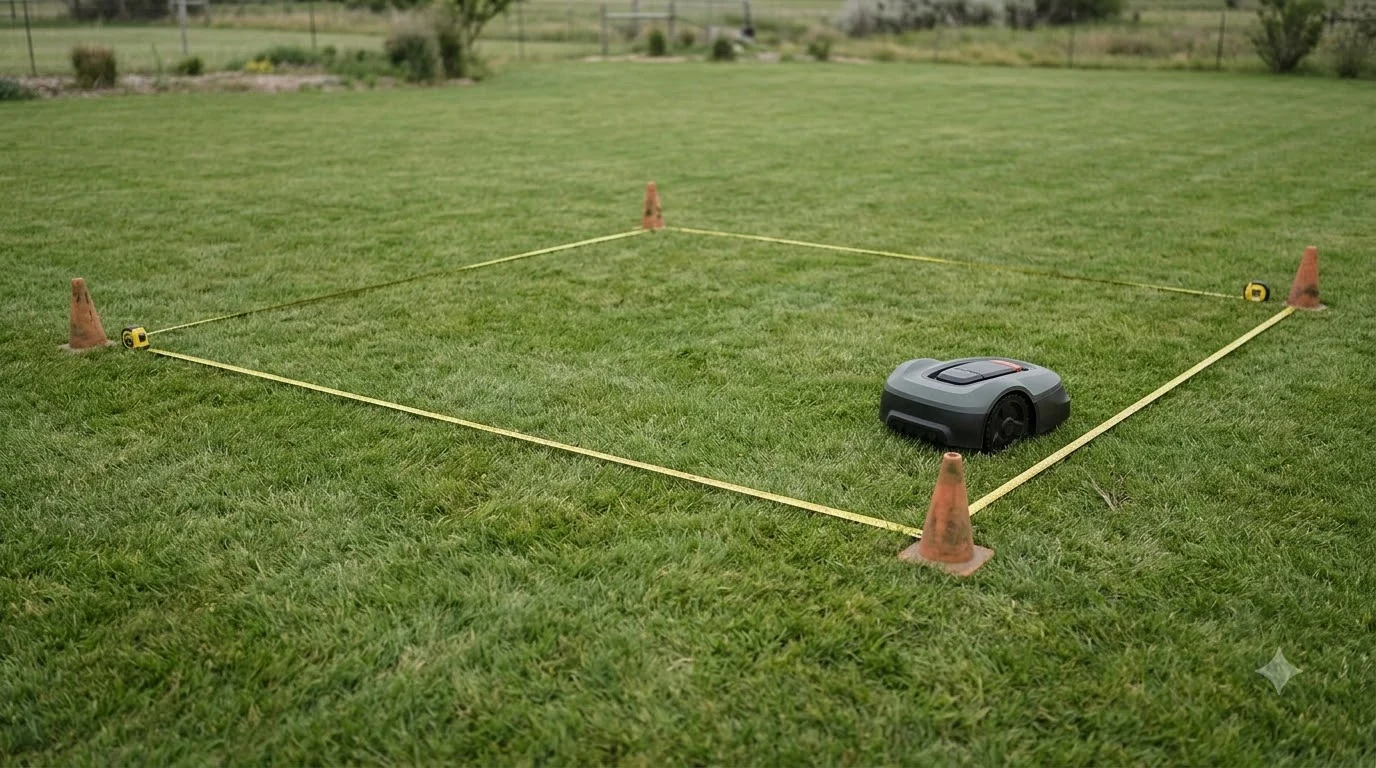
Measure the area the mower will actually cut, not the total lot. Clemson HGIC says measuring the lawn is one of the most crucial steps in managing it, and it recommends the offset method for most irregular lawns. In that method you draw a line along the longest span, mark offset lines at right angles, and measure each line from edge to edge. The closer the offsets, the more accurate the total, according to the Clemson HGIC factsheet on measuring a home lawn.
The arithmetic is simple. A rectangle 50 feet by 25 feet covers 1,250 square feet. One acre is 43,560 square feet, so that lawn is about 0.03 acres. The Clemson example of irregular offset lines comes to 1,536 square feet, which is still well under one acre.
Our reading: once you have the number, subtract the beds and hardscape. The page does not give a per-acre figure or a deduction rule, so those steps are our own practice rather than a published method. For the measuring steps themselves, see this guide to measuring yard square footage.
How much lawn do the large robot mowers cover?
Husqvarna’s US robotic mower page labels each model with a lawn size, marked plus or minus 20 percent. The table below lists the models we read there, along with the wire type each one uses.
| Model | Lawn size (plus or minus 20%) | Wire type |
|---|---|---|
| Automower 410 iQ | 0.5 acre, “small to medium yards” | Physical and virtual |
| Automower 435X AWD | 0.9 acre | Physical |
| Automower 420 iQ | 1 acre, “medium to large yards” | Physical and virtual |
| Automower 535 AWD EPOS | 1 acre | Physical and virtual |
| Automower 435 iQ AWD | 1.3 acres | Virtual and physical |
| Automower 560 EPOS | 1.5 acres | Virtual |
| Automower 440 iQ and 580 EPOS | 2 acres | Virtual and physical (440 iQ); virtual (580 EPOS) |
The top of this table is 2 acres. The same page also lists a separate CEORA model at 6 acres with virtual wire, but it sits outside the residential Automower lineup shown above. A rating near the top of a model’s range only works if most of that space is open, flat and free of obstacles. Our reading: a lawn near 1.5 acres with many beds and trees may use up most of a 2-acre model’s rating. If you want models at this size, see the best robot lawn mower for a large yard.
Does the mowing pattern matter on a large lawn?
Yes, because the pattern affects both coverage and the look of the lawn. Mammotion describes a common random pattern in which the mower runs straight until it meets a boundary wire, an obstacle or a sensor alert, then turns. Its guide also says owners can choose zigzag (parallel) and chessboard (cross-cut) patterns in the app, and that alternating the direction each week helps.
A parallel pattern has a known weak spot. Husqvarna’s support page notes that a parallel pattern can leave edges uncut, because the mower runs in one direction. It recommends alternating the cutting direction for edge coverage, and says checkerboard or triangle patterns cover the edges from several angles. On a big open lawn, that edge gap matters more than the striping does.
Striping is a separate question. eufy advises changing the striping pattern every few mowings so the grass does not lean one way, which is a habit a robot can handle with the app settings.
Is a robot mower cheaper than a riding mower?
A robot mower’s upfront price in one manufacturer’s guide runs from about $700 to $5,000 as of November 2026, with bands at $700 to $1,500, $1,500 to $2,500 and $2,500 and up. That is a vendor price guide, and it is one of the fastest-changing facts in this category, so check current listings before you decide. The same page’s table starts at $900 rather than $700, so even the lower bound varies within one source.

The same guide describes the running costs. It says robot mowers are relatively low-maintenance, need no fuel or oil changes, and typically need blade replacements a couple of times a year. It adds that a battery may need replacing after three to five years, which belongs in any long-term estimate. It describes ride-on mowers as cheaper at the start, averaging about $2,500, but more expensive over time because of fuel, oil and servicing.
So, are robot mowers worth it for large yards on cost alone? The fair comparison is over several years. Add the purchase price, blade and battery replacements, electricity for charging, and any installation or boundary-wire work, then set that against a riding mower’s price and fuel costs. No source we read gives a single cost comparison for a large yard, so we leave the final number to your own figures. Our reading: a robot is most likely to justify its cost where you would otherwise pay a service or spend many hours on a riding mower. For that side of the sum, see robot mower vs lawn service cost.
How do slopes and terrain change the answer?
Slope is often the limit that matters most on a large property, so check it first. Are robot mowers worth it for large yards with long grades? Only if the model’s stated limit covers your steepest section, and robot mower slope ratings explained helps you read that limit. Husqvarna’s Automower 435 iQ AWD is described as navigating slopes up to 70 percent. The same US page includes a slope filter that ranges from 45 to 68 percent, but it does not assign a slope figure to each model, so you should check the spec sheet for the exact model you plan to buy.
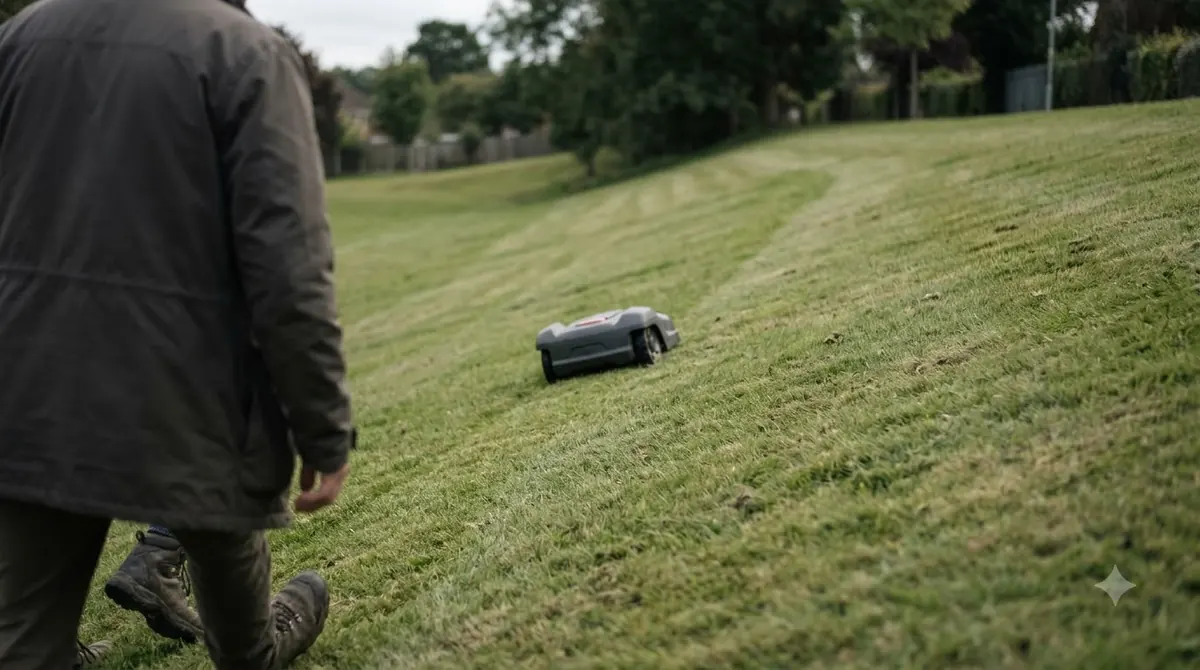
Our reading: steep sections may call for a model built for slopes, such as one with all-wheel drive, and bumpy lawns can leave low spots that are harder to cut evenly. A large yard with long slopes deserves a model rated for that grade, not one that only meets the lot size.
Are robot mowers worth it for large yards? Five checks before you buy
Are robot mowers worth it for large yards like yours? Run these five checks to find out.
- Measure the mowable area. Use the offset method and subtract beds, paths and hardscape.
- Pick a rating with headroom. Keep the mowable area below the rated size, allowing for the plus-or-minus 20 percent tolerance.
- Check the slope rating. Compare the steepest section of your lawn with the model’s stated limit.
- Decide on the wire type. Physical wire needs a perimeter installed before the first cut (see how much boundary wire you need), while virtual or RTK setups need a different installation.
- Plan the pattern and edges. Choose a pattern that covers edges, and expect a random pattern to look less uniform.
Frequently asked questions
How big a yard can a robot mower handle?
Most of the Husqvarna Automower models we read are rated from 0.5 to 2 acres, with a plus-or-minus 20 percent tolerance, and one separate model is rated at 6 acres. The mowable area should sit comfortably below the rating, not at it.
Do robot mowers work on hills?
Some do. Husqvarna describes the 435 iQ AWD as navigating slopes up to 70 percent. Check the stated limit for your exact model, because slope figures vary between models.
Are robot mowers worth it for large yards compared with a service?
It depends on the upfront price, the service fees you would otherwise pay and the maintenance you will do yourself. We did not find a source that compares these costs for a large yard, so run the numbers with your own quotes.
Do robot mowers leave stripes?
A random pattern does not stripe the lawn. Zigzag and chessboard patterns can be set in some apps, and changing the pattern every few mowings helps the grass stand more evenly.
Sources
- Husqvarna robotic lawn mowers (manufacturer): lawn size ratings, wire types, and the 70 percent slope figure for the 435 iQ AWD.
- Clemson HGIC, measuring the area of a home lawn (university extension): offset method and worked area examples.
- Mammotion, lawn mowing patterns for robotic lawn mowers (manufacturer): random pattern and app pattern settings.
- Husqvarna support, what is systematic mowing (manufacturer): parallel pattern and edge coverage.
- Mammotion, robot lawn mower vs ride-on mower (manufacturer): upfront price bands, as of November 2026.
 Up next10 min readLearnAre Robot Mowers Worth It for Seniors? 5 Simple ChecksUpdated Nov 11, 2026
 7 min readLearnDoes a Robot Mower Work With a Dog in the Yard?Updated Nov 11, 2026
 9 min readLearnAre Robot Mowers Tax Deductible for Rental Property?Updated Nov 11, 2026
 8 min readLearnAre Robot Mowers Expensive to Repair? What to ExpectUpdated Nov 11, 2026
 7 min readLearnAre Robot Mowers Safe at Night for Wildlife?Updated Nov 11, 2026
 9 min readLearnAre Robot Mowers Dangerous?Updated Nov 11, 2026