


Are robot mowers worth it for seniors? Often yes, when the yard fits the mower’s rated size and slope, the setup is manageable, and the weight and app suit the owner. No public source ranks robot mowers by age, so the answer depends on checks you can make: lawn size, slope, weight, boundary setup, phone app, and safety features. This guide covers each one with the sources behind it.
The short answer
- Effort: a robot mower removes walking and pushing, which is the main physical load of a push mower.
- Size and slope: match the mower’s rated area and slope limit to your yard, with a margin.
- Weight: check the weight before buying, since lifting and cleaning are the tasks most likely to need strength.
- Setup: wire-free models skip the boundary-wire install, but need a clear view of the sky at the base station.
Why a robot mower can suit an older owner
Are robot mowers worth it for seniors? That often comes down to effort. A robot mower takes over the job that causes the most strain with a push mower. Penn State Extension advises setting a push mower’s handle at mid-waist height and pushing rather than pulling. That advice is for a walk-behind machine. A robot mower changes the job: the owner sets the schedule and the mower follows its boundary without anyone steering it.
Family Handyman makes the same point from the accessibility side. It describes robot mowers as “a great way for a disabled DIYer to still have a hand in lawn care” and notes that app control suits people who may not always be able to physically push or ride a mower.
On turf quality, Iowa State University’s STORIES article reports research by Thoms and Messer finding no significant difference between robotic and traditional mowers, with efficiency gains in time and cost in many cases. For most older owners the real question is the physical work and the setup, not the grass.
Our reading: robot mowers are worth it for seniors who want a lawn kept short without regular physical effort, as long as the yard passes the size, slope and setup checks below.
Weight and lifting
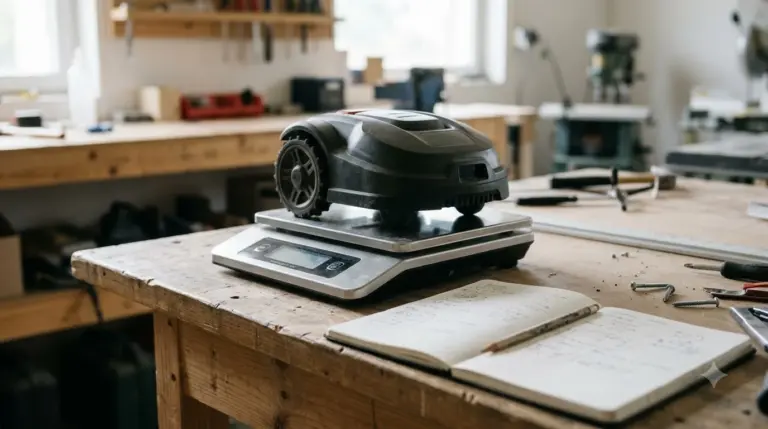
Are robot mowers worth it for seniors who cannot lift much? Weight matters most at the moments you lift the mower: during setup, cleaning, and repair. Husqvarna’s product page for the Automower 435 iQ AWD lists its weight at 39.9 lb. Family Handyman’s list of accessible mowers gives the WORX WR165 robot mower at 21 lb, and notes that wide-based mowers are heavy, which makes them harder to lift and to clean out grass clippings. Clipping cleanup is the task most likely to need lifting, so check the weight before you buy. For more on this, see how much a robot mower weighs.
Penn State Extension’s lifting advice applies to any heavy load: hinge at the hips and keep the lower back straight. The same page warns that lifting a 10-pound load incorrectly can put about 100 pounds of pressure on the lower back. Our reading: for anything you cannot lift comfortably, plan on a helper.
Lift and tilt sensors matter too. Husqvarna lists both as “Yes” for the 435 iQ AWD and says its anti-theft alarm sounds if the mower is picked up. The same page does not say what the blades do when the mower is lifted, so do not assume the blades stop. Check the manual for each model you consider.
Wired or wire-free setup
Wire-free models skip the boundary-wire installation, which is often the hardest part of setup for a non-technical owner. Our comparison of wire-free vs boundary wire robot mowers covers the trade-offs. lawnmowers.com says burying the wire takes an afternoon with an edger or a wire-laying machine, at a depth of 2 to 5 cm, with stakes every 50 to 80 cm. Its guide adds that grass can grow over the wire within 3 to 4 weeks. Our reading: that can make later repairs harder.

Mammotion, a vendor that favors wire-free designs, calls wired installation “labor-intensive” and rates wire-free setup as “Low to Moderate.” Read that with its bias in mind. Its hybrid option uses short wire sections for flower beds, ponds, and steep slopes. If the owner wants to do the work alone, see installing a robot mower yourself.
The trade-off is cost and sky view. lawnmowers.com says premium wire-free models cost 30 to 50 percent more than wired ones, and that wire-free models need a clear sky over the base station and struggle under heavy tree cover.
Heads up
Price figures in these sources are not dated for current US retail. Check today’s prices before you compare models.
Using the app and controls
Phone control can let an owner start, stop, and adjust settings without walking to the mower. For the 435 iQ AWD, Husqvarna says the cutting height can be changed from a smartphone through the Automower Connect app. Its FAQ gives a range of 1.2 to 2.9 inches, while the spec sheet lists a maximum of 2.8 inches, so confirm the figure for the model you buy. The same page says blades can be changed in minutes.
Husqvarna’s US robotic mowers page says the Automower Connect app connects the mower to a smartphone, but does not say whether the app is required for daily use. Ask the seller before buying if you plan to run the mower without a phone.
Our reading: if the owner will use the app, read its setup steps in the manual before buying, and make sure a family member can help with the first connection.
Lawn size and slope
Check rated area and slope limits against your yard before comparing anything else. Husqvarna’s US page lists the 410 iQ at about 0.5 acre, the 420 iQ at about 1 acre, the 435 iQ AWD at about 1.3 acre, and the 440 iQ at 2 acres, each with a plus or minus 20 percent tolerance. The 435 iQ AWD’s spec sheet gives 0.9 acre for an irregular lawn and 1.3 acre for a systematic one, so the shape of the yard changes the number.
Husqvarna’s UK support page says standard models handle slopes of 25 to 50 percent, AWD models up to 70 percent, and that a 50 to 70 percent zone should be kept free of obstacles. It also advises keeping 1.5 m between the bottom of a slope and the boundary wire. Eufy’s retailer blog adds that the maximum slope is an absolute limit, not a daily target, and that wet grass reduces tire grip.
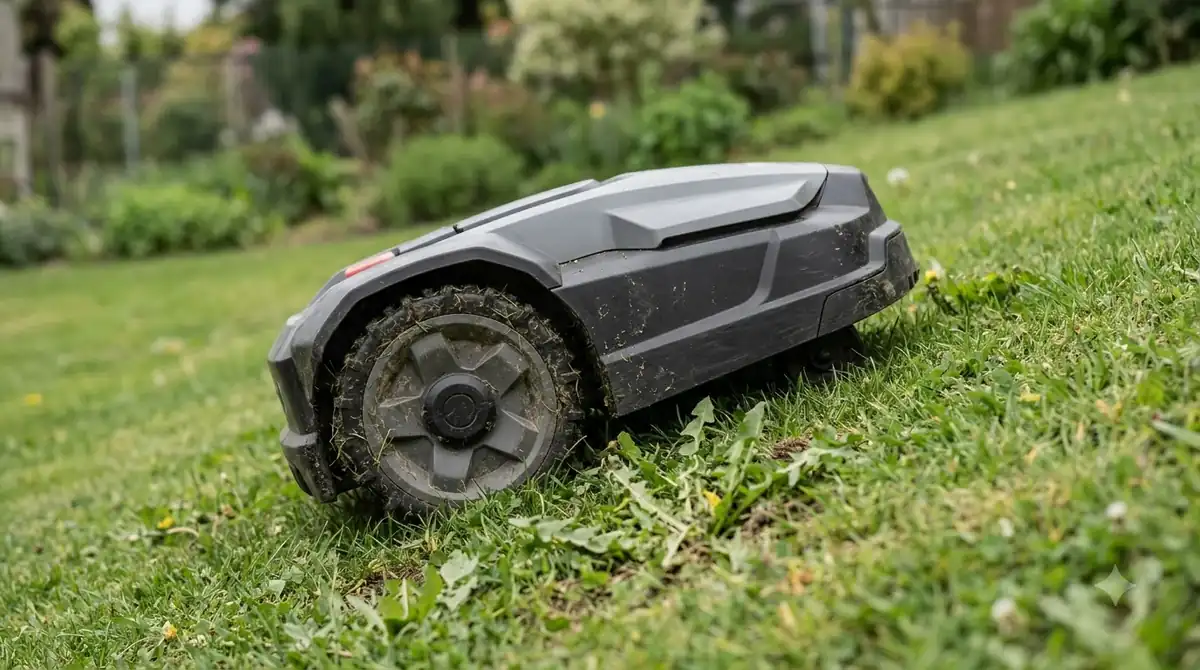
Our reading: a steep bank or a wet hollow adds risk to the mower and to any retrieval or repair. Pick a model with a margin above the steepest section of your lawn, not one that sits right at its limit. Robot mower slope ratings explained covers how to read the figures.
Safety around the mower
Robot mowers have spinning blades and need the same respect as any mower, and whether robot mowers are dangerous is a fair question to ask. Husqvarna’s Ireland safety Q&A says all its robotic mowers have pivoting blades, and that the blades do not start at the charging station. The same page does not say what happens when the mower is lifted or tipped, does not mention a PIN or child lock, and does not describe person detection.
Anker/eufy, a vendor, says many of its models stop the blades when lifted or tipped, but not all of them. Check each model’s manual for lift and tilt behavior. If children or visitors use the yard, ask whether a PIN lock is available.
Our reading: keep the charging station and garage area clear, and keep hands and feet away from a running mower, as with any mower.
When a riding or self-propelled mower may fit better
A riding mower removes the walking, and some riders suit people with mobility limits better than a robot does. Family Handyman quotes a lawn-care expert saying riding mowers “make it way easier for someone with mobility issues because no walking or pushing is involved.” It also notes that a zero-turn mower with joystick controls “requires just one hand.”
A rider has its own demands: getting on and off the seat, storage space, and slope limits that differ from a robot’s. If the owner cannot safely mount a seat, or the yard is too steep for the rider, a robot may still be the better fit. Our reading: compare the two options against the owner’s real mobility and the yard, not against a general rule.
Are robot mowers worth it for seniors? Five checks first
Are robot mowers worth it for seniors in your yard? Five checks settle most decisions about whether a robot mower fits an older owner.
- Lawn size. Measure the lawn and compare it with the rated area, using the irregular figure if the yard has beds, corners, or narrow passages.
- Slope. Match the rated slope to the steepest section, with a margin.
- Weight. Confirm the weight, and whether the owner or a helper can lift it safely for cleaning and repair.
- Setup. Choose between wired and wire-free, and check that the base station has a clear view of the sky.
- App and safety. Confirm whether the app is needed for daily use, whether the blades stop when the mower is lifted, and whether a PIN lock is available.
Frequently asked questions
Are robot mowers easier than a push mower for seniors?
They remove the walking and pushing, which is the main physical load of a push mower. Penn State Extension’s advice on manual mowing, with the handle at mid-waist height and pushing rather than pulling, shows how demanding push mowing can be on the back and arms. A robot changes the job to setup, cleaning, and occasional lifting.
Can an older owner install a robot mower alone?
The sources read do not address this directly. lawnmowers.com describes wired installation as an afternoon of digging and laying wire, which may be easier with a helper. A wire-free model removes most of that work, but the base station still needs a clear sky view.
Are robot mowers worth it for seniors on a budget?
It depends on the yard and on the owner’s ability to do the work. lawnmowers.com says premium wire-free models cost 30 to 50 percent more than wired ones, and prices change, so compare current figures. Iowa State research found no significant difference in turf quality, so the case rests on time and effort rather than better grass.
What if the yard has steep slopes?
Husqvarna’s UK support page says standard models handle 25 to 50 percent slope and AWD models up to 70 percent. Choose a model with a margin above your steepest section, and keep the boundary wire 1.5 m away from the bottom of a slope, as Husqvarna advises.
Sources
- Husqvarna Automower 435 iQ AWD (manufacturer): weight, lift and tilt sensors, app, cutting height, capacity and slope specs.
- Husqvarna US robotic mowers (manufacturer): rated capacity by model.
- Husqvarna support on steep slopes (manufacturer): slope ranges and boundary distance.
- Husqvarna safety Q&A (manufacturer): blade behavior and charging station.
- Penn State Extension, healthy tips to garden with fewer aches and pains (university): handle height, pushing, lifting technique.
- Family Handyman, best accessible lawn mowers (publication): weight, app control, riding mower comments.
- lawnmowers.com, robotic mower boundary wire guide (publication): installation effort, wire depth, cost and sky view.
- Mammotion, do robot lawn mowers need a boundary wire (manufacturer, bias noted): installation effort comparison.
- Iowa State University STORIES, future lawn care (university): turfgrass quality research.
- Eufy, robot lawn mower slope limits (retailer): slope limit and wet grass grip.
 Up next8 min readLearnAre Robot Mowers Worth It for Large Yards?Updated Nov 11, 2026
 9 min readLearnRobot Mower Buying Guide 2026: What to Check Before You BuyUpdated Nov 11, 2026
 8 min readLearnHow to Update Robot Mower Firmware: 5 Safe StepsUpdated Nov 11, 2026
 9 min readLearnAre Robot Mowers Tax Deductible for Rental Property?Updated Nov 11, 2026
 8 min readLearnAre Robot Mowers Expensive to Repair? What to ExpectUpdated Nov 11, 2026
 7 min readLearnAre Robot Mowers Safe at Night for Wildlife?Updated Nov 11, 2026