


This robot mower buying guide 2026 covers the four specs that decide whether a model fits your yard: lawn size, slope, navigation and battery. As of Nov 2026, the sources below agree on what to check, even where their exact figures differ.
The short answer
- Lawn size: in this robot mower buying guide 2026, match the rated area to your grass, not the whole lot.
- Slope: treat the percentage as a maximum limit, not a daily target.
- Navigation: boundary wire, RTK and vision each suit a different kind of yard.
- Battery: plan for replacement around 2 to 5 years, and confirm it can be swapped locally.
- Weather and safety: check the IP rating, rain sensor, PIN lock and blade-stop behavior.
How much lawn does a robot mower need to cover?
Manufacturers rate coverage in acres. Husqvarna’s US line runs from 0.5 to 6 acres across 10 models, and each rating carries a plus or minus 20 percent tolerance. Consumer NZ, an independent consumer group, ran its robot mower tests on lawns of up to 2,000 square meters, which is about half an acre.
Our reading is to measure only the grass. Beds, patios, decks and the driveway do not need mowing, so they should not count toward the total. Then choose a model rated above that figure, because a rating close to your exact area leaves little room for narrow passages or odd corners. For more on this, see choosing a robot mower by lawn size.
How steep a slope can a robot mower climb?
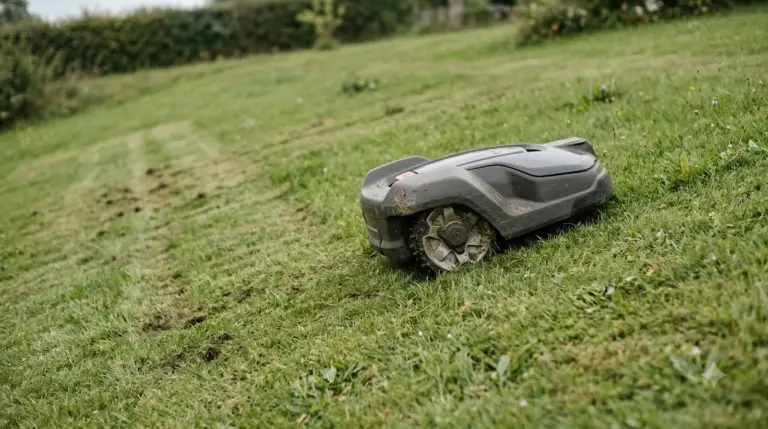
In any robot mower buying guide 2026, slope is given as a percentage, and it is a ceiling rather than a target. Consumer NZ tested its robot mowers on a slope of 19 degrees (35 percent). Some models claim up to 39 degrees (80 percent), but certain manuals say steep slopes should only be used for short spells.
Husqvarna’s Automower 440 iQ is rated at 45 percent (about 24 degrees) inside its installation area, and only 15 percent at the boundary, so the edges can be less capable than the middle of the lawn. The 435 iQ AWD is listed at up to 70 percent on Husqvarna’s US page, and its support page says standard models span 25 to 50 percent depending on the model, with AWD models up to 70 percent.
Eufy describes its slope figure as an absolute limit, and says running at the top of the range strains the motor and drains the battery. Our reading: choose a model whose rating sits well above your steepest section. Robot mower slope ratings explained covers how to read the figures.
Boundary wire, RTK or vision: which navigation fits your yard?
Navigation decides how much work the installation takes and where the mower tends to struggle. Husqvarna’s US lineup lists physical wire or virtual wire boundaries. Its 435X AWD is listed as physical wire only, while the 560 EPOS, 580 EPOS and CEORA are virtual only. The table below summarizes the trade-offs as Eufy describes them, with Mammotion’s vendor view added where noted.
| Method | Strength | Limit |
|---|---|---|
| Boundary wire | Once installed, the mower follows the signal and stays inside the wired area | Takes time to install around driveways, beds, paths and trees; if the wire breaks, the mower may stop working |
| RTK satellite | Can work well on open lawns with a good sky view, with no buried wire | Trees, buildings, sheds, fences and narrow side yards can affect reception; some systems need a reference station |
| AI vision | Can reduce reliance on buried wire or an RTK station; recognizes grass, paving, toys and low obstacles | Lighting, shadows, very overgrown grass and unclear lawn edges can still affect performance |
| LiDAR | Can be less dependent on satellite signals; useful where walls, fences, trees or beds give reference points | Open, featureless areas may give the sensor fewer reference points |
Mammotion, which sells wire-free models, says its RTK base needs an open area without major obstructions. That is a vendor view, so weigh it against the independent notes above. Our reading: a wire-based model still makes sense for a simple yard with clear edges. A yard with trees, narrow side passages or many changing features is where you should check the sky view and the layout before you choose satellite or vision navigation. Our comparison of RTK vs LiDAR vs vision robot mowers goes further.
What will batteries and replacement parts cost over time?
Lithium-ion batteries lose capacity with use. Mammotion’s US buyer guide says they usually last 2 to 5 years. Which?, a UK consumer magazine, reports that a replacement battery can sometimes cost more than GBP 100, and that if the battery cannot be replaced, the whole mower may need replacing. That makes the battery one of the first items to check, and robot mower battery life covers it in more detail.
Consumer NZ advises checking three things: whether the battery is user-replaceable, whether replacements are sold locally, and what they cost. Blades are the other recurring cost, so budget for them alongside the battery.

Does weather protection matter, and is a rain sensor worth it?
A rain sensor is useful, but you should not assume it is standard. Consumer NZ found that fewer than half of its tested models have one. Robomow, a robot mower brand, describes the feature as a sensor that interrupts mowing, with the mower waiting at its station until the rain subsides.
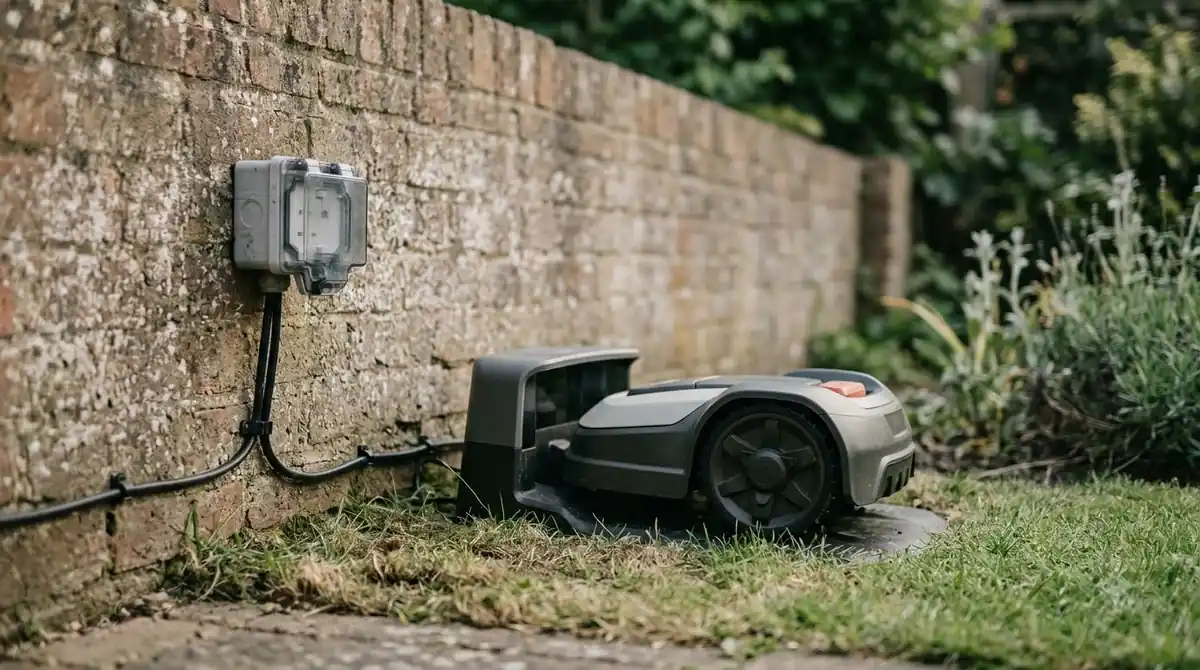
IP ratings describe water resistance, and Consumer NZ notes that IPX6 is better than IPX5. Our reading: a higher rating matters most if the mower stays outside in wet weather or the charging base sits in a damp spot. The charging base also needs mains power within cable reach of a socket, as Which? points out, so plan the outlet before delivery. For outdoor power, the US Consumer Product Safety Commission recommends a portable GFCI when operating garden equipment, so use a GFCI-protected outlet for the charger.
What safety and anti-theft features should you check?
A robot mower buying guide 2026 should cover a PIN lock, a lift alert and clear blade-stop behavior. Consumer NZ lists PIN locks, alarms, lift alerts, geofence alerts and GPS tracking among the features it checked. Which? notes that PIN codes are on almost all models, and some raise an alarm when the mower leaves the wire area.
- Blade start: Husqvarna says its blades do not start at the charging station, and the mower drives away for 5 seconds before the blades start.
- Wildlife setting: Husqvarna’s Wildlife Consideration stops movement from dusk to dawn.
- Animal risk: a Swiss animal protection study tested 18 robot mowers and rated 11 as high risk for hedgehogs. The study recommends running mowers in daytime and supervising them.
Our reading: check the wildlife and blade settings before you buy, because the spec sheet alone does not show how a mower behaves around animals. For a wider view, see whether robot mowers are dangerous.
Robot mower buying guide 2026: seven checks before you buy
Use these seven checks to compare models on the same spec sheet, and rule out any model that fails the first two.
- Lawn area. Compare the rated acreage with your grass area and leave a margin.
- Slope. Use the percentage limit and confirm it applies to the installation area.
- Navigation. Match wire, RTK or vision to your sky view and obstacles.
- Battery. Confirm it is user-replaceable and check the local replacement cost.
- Weather. Check the IP rating and whether a rain sensor is included.
- Safety. Look for a PIN lock, lift alert, blade-stop and wildlife settings.
- Running cost. Add batteries, blades and any installation kit to the price.
| Criterion | What the sources show | Source |
|---|---|---|
| Cutting height | Most cut as low as 20 mm, some only to 30 mm; the best tested offer a 40 to 45 mm range with 9 or more heights | Consumer NZ |
| Slope | Tested at 35 percent; standard Husqvarna models 25 to 50 percent | Consumer NZ; Husqvarna |
| Battery life | Usually 2 to 5 years | Mammotion |
| Water resistance | IPX6 is better than IPX5 | Consumer NZ |
This guide works best when you start with lawn area and navigation, because those two decide whether a model can work in your yard at all. Then compare battery replacement and running costs. A model that fits your grass but has a battery you cannot replace locally is a costly mismatch, in our reading.
Frequently asked questions
Do I need a boundary wire to use a robot mower?
No. Wire-free models use RTK or vision navigation instead. Each method has limits: RTK needs a clear sky view, and vision needs visible features to navigate. Check your yard before you choose a model.
How steep a slope can a robot mower handle?
Check the percentage on the spec sheet and treat it as a maximum. Husqvarna’s support page lists its standard models at 25 to 50 percent and its AWD models at up to 70 percent, so the range is wide.
How long does a robot mower battery last?
Mammotion’s US buyer guide says lithium-ion batteries usually last 2 to 5 years. Before you buy, confirm the battery can be replaced and check what a replacement costs locally.
Does a robot mower need a garage?
Not always. It depends on the model’s water-resistance rating and where the charging base sits, so check the IP rating and the space you have before you decide on shelter.
Sources
- Robot lawn mowers buying guide (Consumer NZ, updated March 2026): slope test, lawn area, cutting heights, rain sensors, IP ratings.
- Robotic lawn mowers (Husqvarna US): lawn size ratings and boundary types by model.
- Automower 440 iQ (Husqvarna US): slope rating inside the installation area and at the boundary.
- Robot lawn mower navigation types (eufy, brand blog): trade-offs of boundary wire, RTK, vision and LiDAR.
- Automatic lawn mower guide (Mammotion, brand blog): battery life of 2 to 5 years.
- Five questions to ask before buying a robot lawn mower (Which?): battery replacement cost, charging socket, anti-theft alarms.
- Robotic mower safety questions and answers (Husqvarna): blade start behavior, drive-away delay, wildlife setting.
- US Consumer Product Safety Commission guidance on portable GFCI (CPSC): GFCI protection for garden equipment.
 Up next9 min readLearnWhat to Know Before Buying a Robot MowerUpdated Nov 11, 2026
 9 min readLearnRobot Mower Pros and Cons: What Owners Should Weigh Before BuyingUpdated Nov 11, 2026
 10 min readLearnAre Robot Mowers Worth It for Seniors? 5 Simple ChecksUpdated Nov 11, 2026
 8 min readLearnWho Should Not Buy a Robot Mower?Updated Nov 11, 2026
 9 min readLearnShould I Buy a Robot Lawn Mower? Who It Suits and Who Should Skip ItUpdated Nov 11, 2026
 8 min readLearnHusqvarna Automower No Loop Signal: Causes and FixesUpdated Nov 11, 2026