
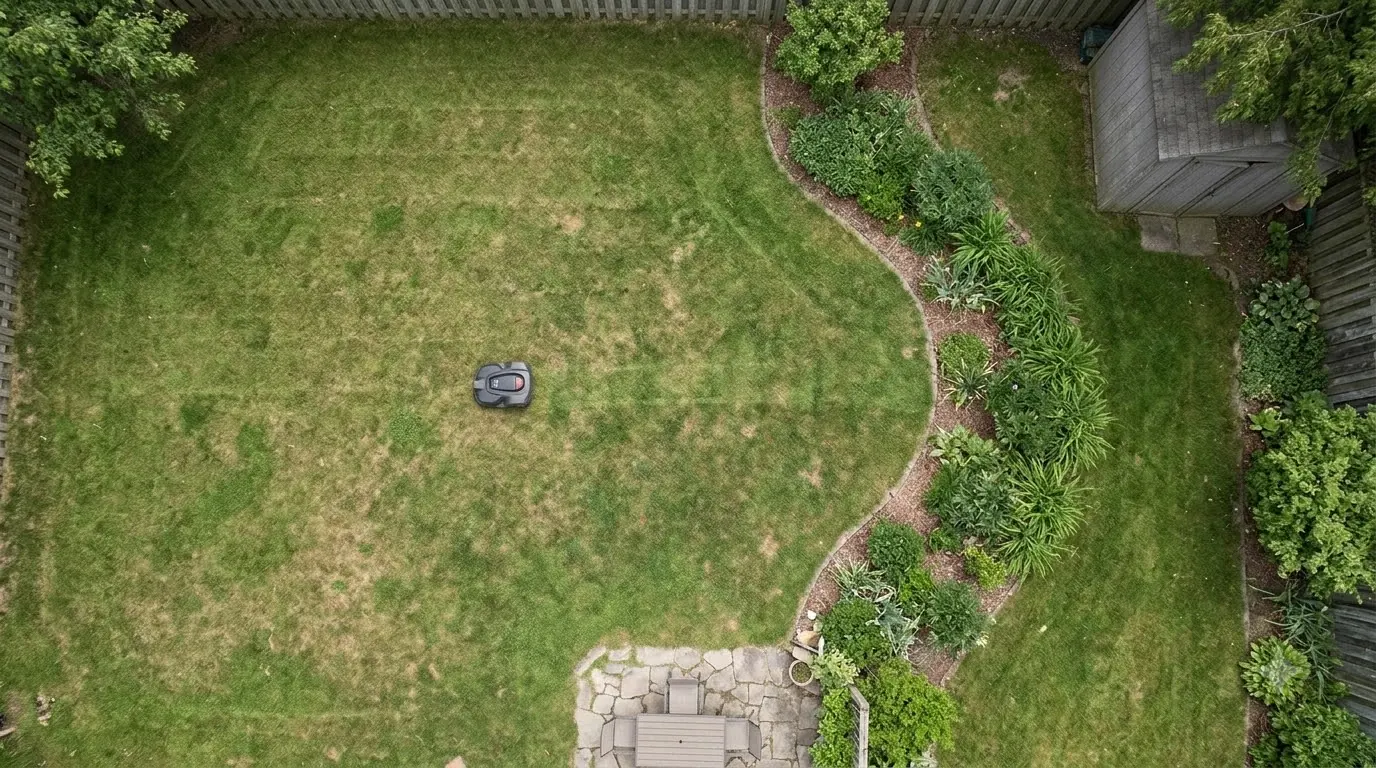

What to know before buying a robot mower comes down to four checks: rated area against your lawn size, slope, how the mower finds its boundary, and how much installation work the yard needs. Robot mowers cut on a schedule without a person pushing them, so the yard matters more than the brand name.
The short answer
- Size: choose a rated area at least 20 to 30 percent above your measured lawn.
- Slope: read the maximum incline on the spec sheet and measure your steepest section.
- Boundary: a perimeter wire works regardless of weather or satellite signal, while wire-free models rely on GPS, cameras or LiDAR.
- Setup: Husqvarna estimates 2 to 5 hours of installation, depending on lawn size and complexity.
Match the rated area to your real lawn size
Choose a model rated for at least 20 to 30 percent more area than your measured lawn, so obstacles and battery limits do not leave grass uncut. Sunseeker gives this buffer in its buying guide and recommends measuring from satellite mapping, then subtracting the house, driveway, patios and large beds that the mower will not cut. A separate guide shows how to measure yard square footage.
Clemson Extension calls measuring lawn area “one of the most crucial steps” in managing a lawn, and its examples show the arithmetic. A rectangle 50 feet by 25 feet covers 1,250 square feet. Curved edges can be measured with the offset method, where the closer the offset lines sit to one another, the more accurate the estimate. Clemson’s lawn measuring guide covers the full method.
Husqvarna rates its Automower line for lawns up to 5,000 square meters, plus or minus 20 percent depending on the model and garden complexity. That is about 1.2 acres by our conversion. For larger lawns, Husqvarna suggests installing two or more machines side by side. Our reading is that a rating like this describes a simple lawn, so a complex yard with beds and narrow passages should sit closer to the lower end of the range.
Check the slope before you check the price
Slope limits differ by model, so the number to compare is the maximum incline on the spec sheet, set against the steepest section of your lawn rather than the average. Sunseeker suggests measuring with a smartphone level app or a digital inclinometer.
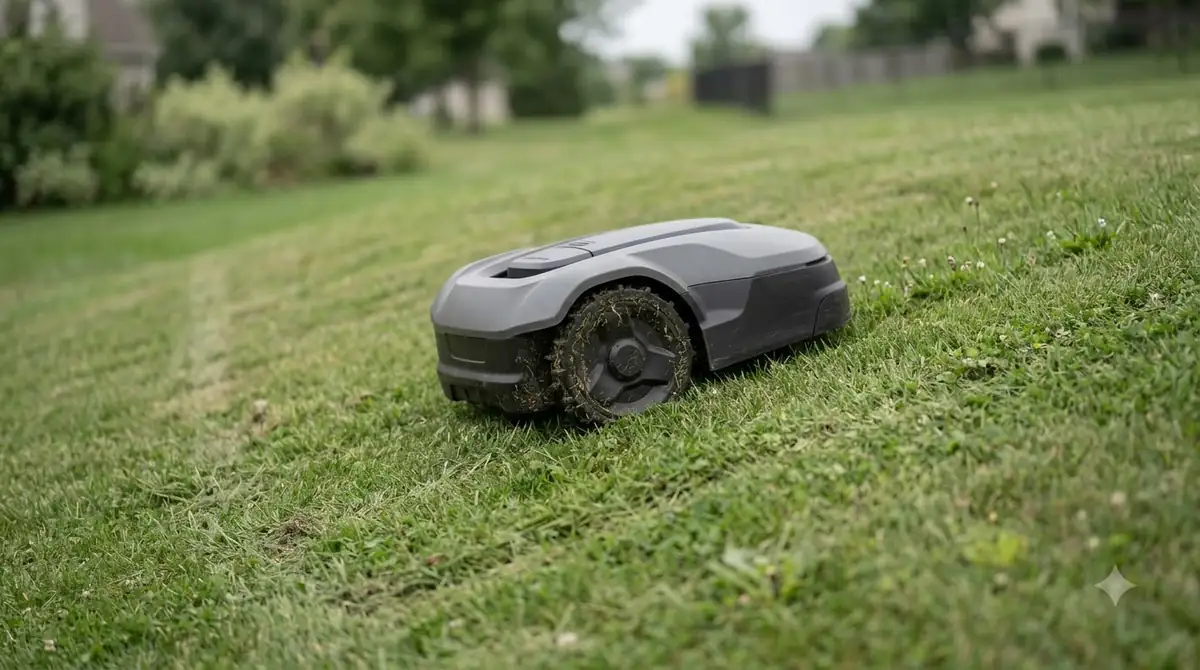
Husqvarna states that its standard Automower handles up to 50 percent slope depending on model, and its all-wheel drive model up to 70 percent, or 35 degrees. On steeper ground, Husqvarna advises running the guide wire diagonally up and down the slope and clearing trees and stones from the path. Our reading is that a steep lawn is the case where all-wheel drive and a careful spec check matter most. See robot mower slope ratings explained for how the figures are given.
Choose between a boundary wire and wire-free navigation
A perimeter wire is the most predictable option. Sunseeker describes it as reliable and working regardless of weather or satellite signal, though it takes installation effort and is less flexible if you later redesign the landscape. Husqvarna says the wire can be laid on the ground with the supplied staples, or buried to a suggested depth of 3 to 10 cm. It becomes overgrown after some weeks.
Wire-free models use GPS, vision cameras or LiDAR, and each has a condition to check. Sunseeker notes that GPS needs clear skies, cameras need good lighting, and LiDAR works best in an uncluttered yard. If your yard has heavy tree cover, open sky, or many fixed obstacles, those conditions should decide the navigation type. The trade-offs are set out in wire-free vs boundary wire robot mowers.
Plan the installation and setup time
What to know before buying a robot mower includes the installation work. Husqvarna estimates that installing its mower takes approximately 2 to 5 hours, depending on the size and complexity of the lawn. The same source notes that installation by the seller or a service point is not included in the recommended retail price, so ask whether the boundary kit and any setup service are part of the quoted price before you buy. For a closer look at that line item, see robot mower installation cost.
Plan a spot for the charging station with access to power, and check that the boundary route can run around beds, trees and the edge of the lawn without long gaps. Our reading is that a complex yard will need more of the 2 to 5 hour window, while a simple rectangle is likely to sit near the lower end.
Look at noise, rain and battery runtime
Husqvarna puts the sound level of its Automower at around 60 dB. It contrasts this with petrol and ride-on mowers, which it says generate between 95 and 100 dB(A). These are manufacturer figures, so compare them with independent data if noise matters for early morning or evening mowing.
On weather, the two sources take different approaches. Husqvarna says its mower mows in rain or shine. Sunseeker describes automatic rain sensors that send the mower back to its charging station in wet weather. Our reading is that you should check whether a model has a rain sensor and whether you want it running on wet grass at all.
For battery life, Sunseeker recommends comparing capacity in ampere-hours (Ah) with the mowing-to-recharge ratio. Its example sets a model that mows for 70 minutes and recharges in 50 against one that mows for 90 minutes but needs 120 minutes to recharge. The ratio shows how long the yard is actually being cut, so it matters as much as the headline runtime. Sunseeker also says lithium-ion batteries are preferred. More detail is in robot mower battery life.
Budget for blades, cleaning and winter storage
Husqvarna says blades typically last 1 to 2 months on 1,000 square meters, and that replacing a blade takes about five minutes. Our reading: that makes blades a small but regular cost to plan for, and a good reason to ask what a spare set costs before you buy.
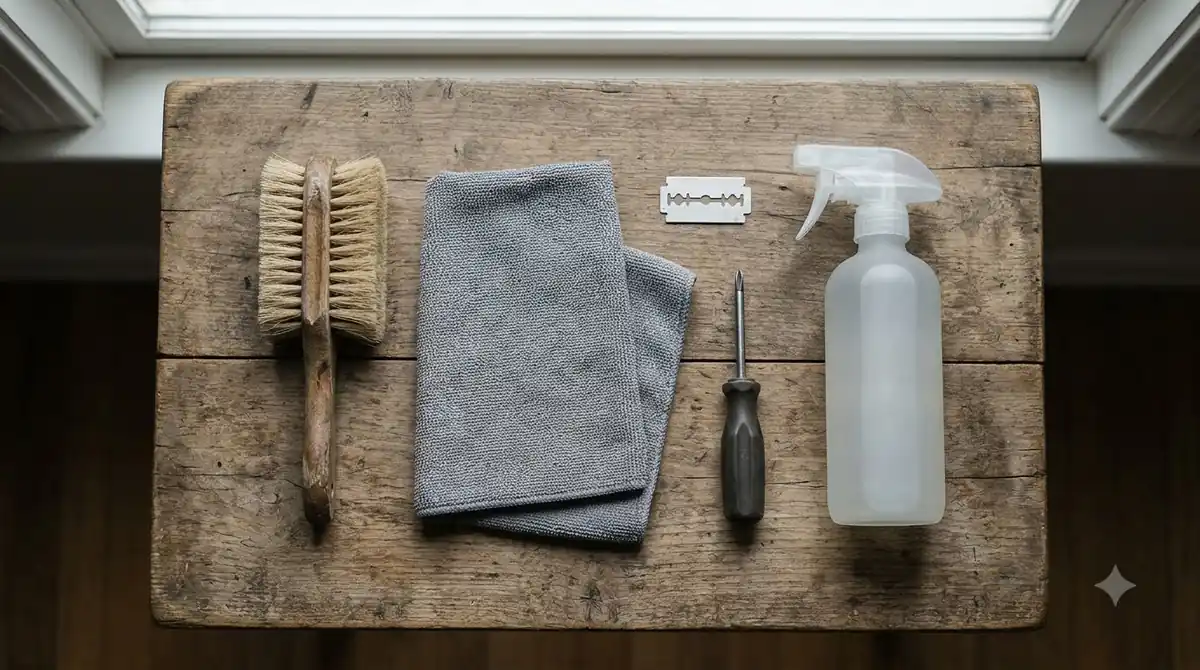
Sunseeker advises comparing the total cost over five to seven years, not just the purchase price, because running costs include a battery replacement after several years. For winter, Husqvarna recommends storing the mower indoors if you will not mow, charging it fully, cleaning and drying it, and keeping it in a dry, frost-free place. The loop wire can stay in the lawn. Our reading is that these recurring costs belong in the budget from the start.
Read the warranty and support terms
What to know before buying a robot mower also covers support. Warranty length varies by brand, and the Sunseeker guide does not state a figure. It advises looking for comprehensive coverage on both the mower and its battery, along with good support and spare parts availability.
Before you buy, ask the seller what the warranty covers, how long it runs, and where spare blades and parts are supplied. Our reading is that a short warranty on the battery is a bigger risk than a short warranty on the body, since the battery is the part that wears out over several years.
What to know before buying a robot mower: a final checklist
Work through these checks in order, starting with the measured lawn area and ending with the warranty.
- Measure the lawn. Subtract the house, driveway, patios and large beds, then add a 20 to 30 percent buffer to the rated area.
- Find the steepest section. Compare its incline with the model’s maximum slope.
- Pick the navigation type. Decide between a perimeter wire and wire-free models based on tree cover, signal and light.
- Confirm the setup. Check whether the boundary kit is included and how long installation is expected to take.
- Check noise and rain behavior. Look at the manufacturer’s sound figure and whether the model has a rain sensor.
- Compare battery ratio. Check the mowing-to-recharge ratio, not just the runtime.
- Read the warranty. Confirm coverage for the mower and its battery.
These checks are what to know before buying a robot mower, and each one can rule a model in or out before you compare features. Our reading is that a model that fits your measured area, slope and boundary method is a better purchase than one with more features that your yard cannot use.
Frequently asked questions
Do I need to measure my lawn before buying a robot mower?
Yes, and what to know before buying a robot mower starts with that measurement. Sunseeker advises choosing a model rated for at least 20 to 30 percent more than your measured lawn, after you subtract the house, driveway, patios and large beds. A measured number makes it easier to compare rated areas across models.
Can a robot mower handle a steep hill?
It depends on the model. Husqvarna states up to 50 percent slope for its standard Automower and up to 70 percent, or 35 degrees, for its all-wheel drive model. Check the maximum incline on the spec sheet for the exact model you are considering.
Is a boundary wire always needed?
Not always. Wire-free models use GPS, vision cameras or LiDAR. Sunseeker notes that a perimeter wire works regardless of weather or satellite signal, so it can suit yards where those sensors struggle.
How long does installation take?
Husqvarna estimates approximately 2 to 5 hours, depending on the size and complexity of the lawn. Its installation service is not included in the recommended retail price, so confirm what the quoted price covers.
Sources
- Robotic lawn mower FAQ (Husqvarna, manufacturer): capacity, slope limits, boundary wire, installation time, noise, blade life and winter storage.
- What to consider when buying a robot mower (Sunseeker, manufacturer): rated area buffer, measuring method, slope checks, wire vs wire-free, rain sensors, battery ratio and running costs.
- Measuring the area of a home lawn (Clemson Extension, Home and Garden Information Center): measuring method and sample area calculations.
 Up next9 min readLearnRobot Mower Buying Guide 2026: What to Check Before You BuyUpdated Nov 11, 2026
 9 min readLearnRobot Mower Pros and Cons: What Owners Should Weigh Before BuyingUpdated Nov 11, 2026
 9 min readLearnDo Robot Mowers Need a Flat Lawn?Updated Nov 11, 2026
 8 min readLearnMammotion Luba Stuck at Charging Station: Causes and FixesUpdated Nov 11, 2026
 10 min readLearnAre Robot Mowers Worth It for Seniors? 5 Simple ChecksUpdated Nov 11, 2026
 8 min readLearnDo Robot Lawn Mowers Get Stolen? What the Evidence ShowsUpdated Nov 11, 2026