
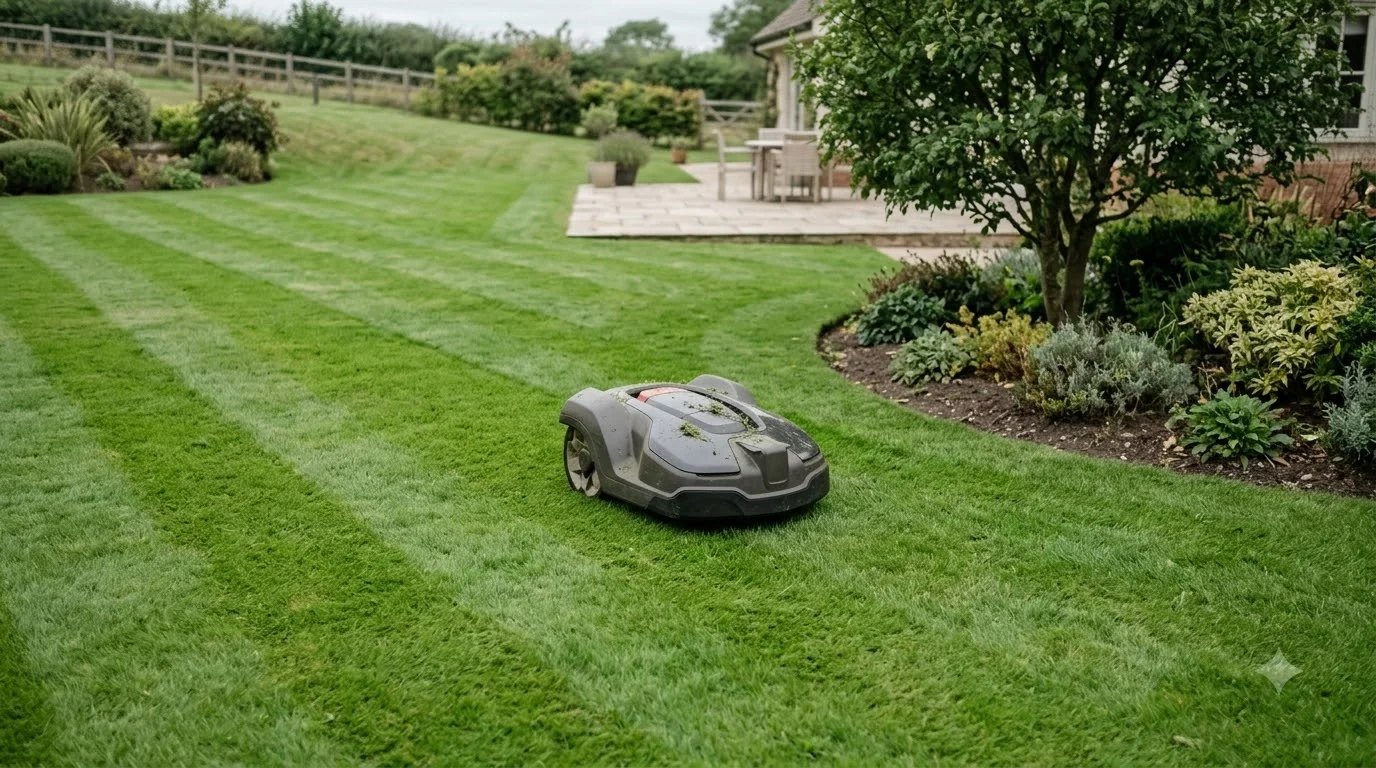

Usually no. Do robot mowers need a flat lawn? Not perfectly flat, but they do need the ground free of deep holes, ruts and abrupt steps. Eufy’s setup checklist focuses on removing sudden changes in the surface rather than leveling the whole yard. The ground under the charging dock should also be firm and reasonably level, since the mower has to find it reliably.
The short answer
- Perfect flatness is not required. Small bumps and shallow dips are usually fine.
- Deep holes and ruts are the real problem. They can make the mower tilt, lose grip or get stuck.
- Eufy advises about 3 cm of surface variation as a practical limit, not a formal standard.
- Slope rating decides hills. Check the rated maximum before you buy, because it is an absolute limit.
Do robot mowers need a flat lawn, or just a smooth one?
A robot mower handles a bumpy lawn far better than a push mower, but it still needs a surface it can roll across without losing contact with the ground. Anker’s UK guide describes small bumps as usually fine, and says deeper holes and ruts can cause the mower to tilt, lose grip or get stuck. Robomow puts the ideal case plainly: a robot works best on a simple, open area with no obstacles, a condition it says is usually found, at best, on sports fields. That makes flat ground the best case, not a hard requirement.
Eufy’s slope guide advises keeping surface variation under approximately 3 cm by filling holes and low spots with topsoil. That figure is vendor best practice rather than a measured spec, so treat it as a rule of thumb. Our reading is that a lawn with many high and low spots will cut less evenly even when the mower keeps moving.
| Lawn problem | Why it matters for the mower | Common fix |
|---|---|---|
| Small bumps and shallow dips | Usually fine; wheels roll over them | Usually none needed |
| Surface variation above about 3 cm | Eufy advises keeping variation under about 3 cm | Fill holes and low spots with topsoil |
| Deep holes and ruts | Can cause tilt, lost grip or getting stuck | Fill with topsoil before the first mow |
| Sudden drop-offs | Can cause tilt or lost grip at the edge (our reading) | Fill or fence off with a boundary |
How steep a slope can a robot mower handle?
Slope ratings are where the flat-lawn question becomes practical. Eufy lists basic models at roughly 10 to 25 percent, mid-range models at about 35 percent, advanced models at about 40 percent and all-wheel-drive models at about 70 percent, though its page gives slightly different figures in different sections, so treat them as approximate. Husqvarna lists its standard models at 25 to 50 percent and its 435X AWD at up to 70 percent. Robomow says smaller robots often manage 20 to 25 percent slopes and larger ones 45 percent or more.
Percent is not the same as degrees, which can cause confusion. Our calculation is that 25 percent is about 14 degrees, 40 percent is about 21.8 degrees and 70 percent is about 35 degrees. Eufy also notes that a rated maximum is an absolute limit, not a target for everyday mowing. It says running at the top of the range continuously strains the motor, drains the battery faster and increases tire slip. If you are unsure of your own slope, how to measure your yard slope shows the method, and robot mower slope ratings explained covers what the numbers mean.
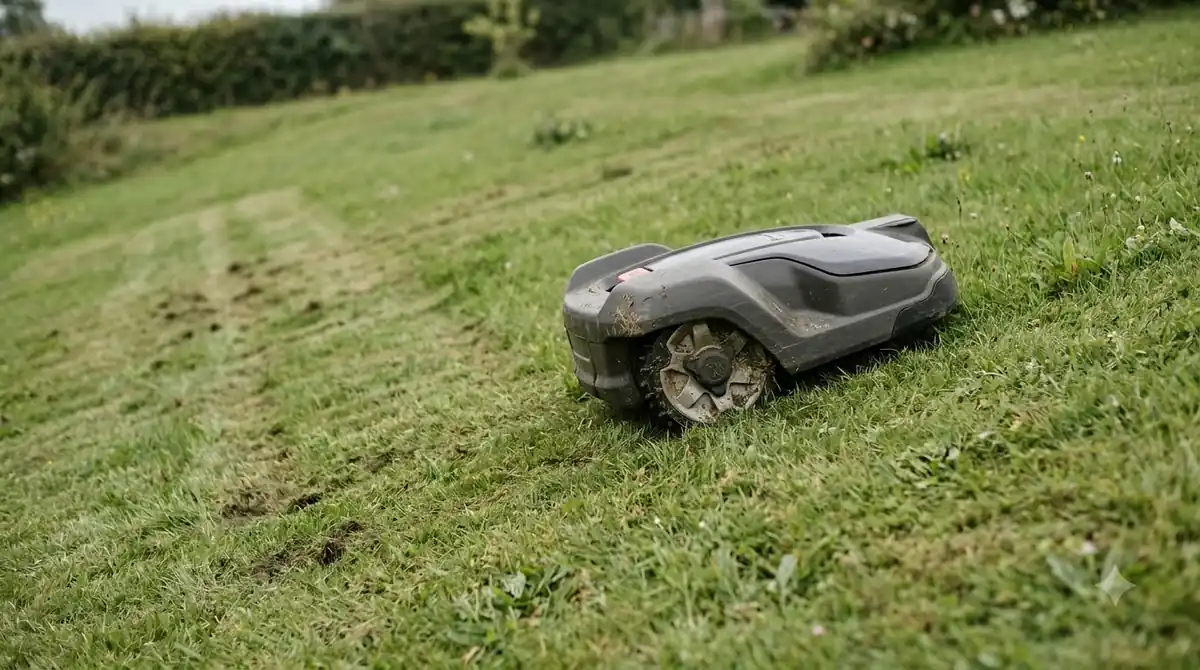
Wet conditions reduce the margin. Eufy notes that wet grass lowers tire grip even within the rated limit, so a mower can slide on damp turf that it climbs easily when dry. Husqvarna warns that obstacles on steep slopes raise the slipping risk, especially when the grass is wet. Honda says broad-tread rear wheels help shed mud and keep grip, and that losing wheel contact is what leads to missed areas and stalling. Coarse treads or spikes help on damp slopes, according to Robomow. For choosing a model by hill, see how to choose a robot mower for slopes.
What to fix before you set up the mower
For most yards, the honest answer to “do robot mowers need a flat lawn” is that prep means filling holes and removing abrupt edges, not leveling the whole lawn. The Eufy setup checklist says you do not need to make the lawn perfectly flat. It recommends filling obvious holes caused by pets or heavy foot traffic, firming loose soil around repaired irrigation points, and checking exposed roots that create sudden steps in the mowing surface. For filling holes and dips, a robot mower on a lawn with holes and dips looks at what can go wrong.
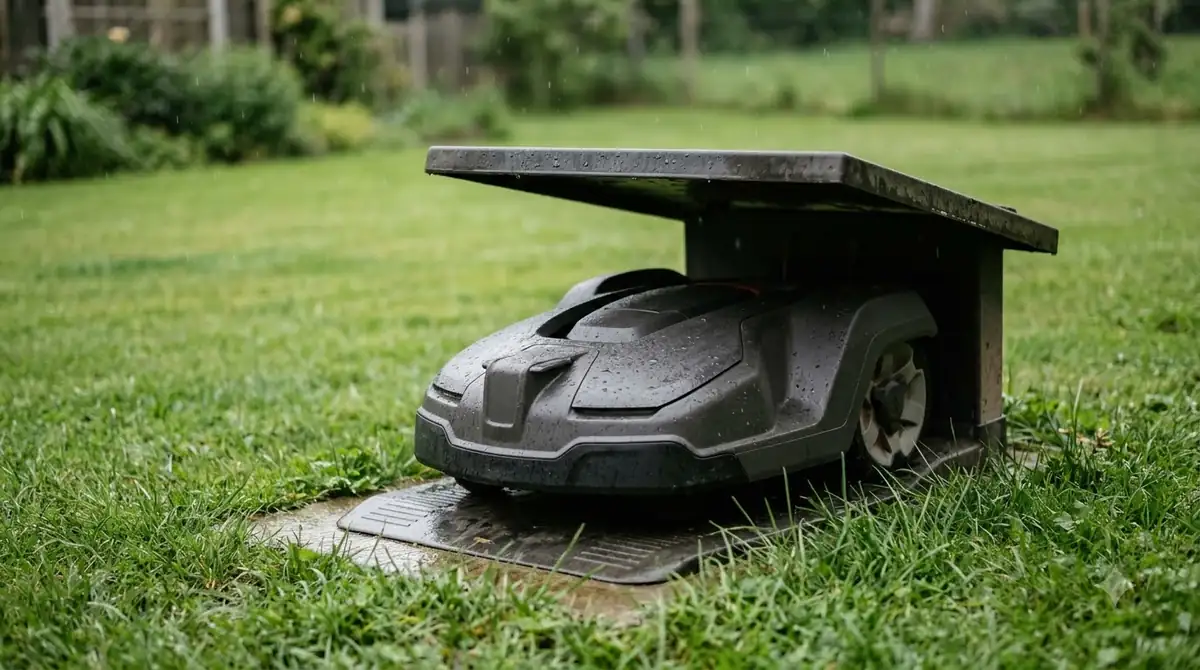
- Fill deep holes and ruts. Anker advises filling deep potholes, sudden drop-offs and severe ruts with topsoil before the first mow.
- Thin-layer low spots. Ask Extension (Q&A 881570) describes adding thin layers of soil over a low area every week or two, using soil similar to the soil underneath. Completely covering the grass crowns will smother them.
- Match the soil. Extension (Q&A 877901) says sand should be used only when the soil underneath is sandy, and that mostly clay soil should be leveled with similar soil. Completely filling low areas means reseeding them. A product guide such as lawn leveling sand for a robot mower can help you choose material.
- Mow overgrown grass first. Eufy’s checklist lists grass below 9 cm as an operating condition for its E15 and advises cutting an overgrown lawn down to the starting height for your model, without cutting too short.
- Level the dock area. Eufy advises firm, reasonably level ground for the charging station but gives no numeric tolerance, so a visibly tilted base is the signal to fix it.
Timing matters for topdressing. The Ask Extension answer says that by late September you may want to stop topdressing and core aerate, then continue leveling the following spring.
When leveling is not worth the effort
For a permanent dip or a steep patch, you may be better off routing the mower around it. Husqvarna describes using boundary wire islands or AIM stay-out zones, if your model supports them, to keep the mower away from slopes beyond its limit. Honda notes that narrow passages below about 60 to 75 cm can limit some models, so a tight gap may matter more than a bumpy patch.
So, do robot mowers need a flat lawn everywhere to work well? No, a route that avoids the worst areas is usually enough. Our reading is that a small, isolated dip is rarely worth weeks of topdressing if you can fence it off. A large, low area that covers much of the mowing zone is the case where fixing the surface pays off.
What to check before you buy
Asking “do robot mowers need a flat lawn” for your own yard really means asking where the problem sits. A flat front lawn with one deep rut is a different job from a back yard whose steepest section runs along the boundary. Our reading is that the decision rests on the worst patch, not the average slope, so judge each problem area separately.
Before you decide how much leveling your lawn needs, or whether a robot mower will manage as it is, check three things: the slope rating, the worst spot in the lawn, and the dock location. The slope rating should cover your steepest area with room to spare, not just the average slope.
- Slope rating: compare the rated maximum in percent and degrees with your steepest section.
- Worst spot: walk the lawn and mark deep holes, ruts and sudden drop-offs.
- Dock location: choose firm ground with a clear approach and a reasonably level pad.
- Wet days: Husqvarna recommends waiting at least 24 hours after rain, longer after heavy rain, before mowing.
Frequently asked questions
Can a robot mower climb a 40 percent slope?
Only if the model is rated for it. For hills, the rated slope matters more than how flat the lawn is, so check the model first. Eufy lists advanced models at about 40 percent, and all-wheel-drive models at about 70 percent. Basic models are rated much lower, so check the specific model.
Do I need to fill every dip in my lawn?
No. Small bumps and shallow dips are usually fine, so a robot mower does not need a flat lawn in every corner. Focus on deep holes, ruts and sudden drop-offs, which can cause tilt, lost grip or getting stuck.
Should I level the lawn before the first mow?
Usually not. Eufy’s setup checklist says you do not need to make the lawn perfectly flat. Mow overgrown grass first, fill deep holes with topsoil, and make sure the dock sits on firm ground. Full leveling is not required by the vendor guidance we reviewed.
Can a robot mower work on a wet slope?
Wet grass reduces grip, even within the rated limit. Husqvarna recommends waiting at least 24 hours after rain, and longer after heavy rain. Treads and spikes help on damp slopes.
Sources
- Do robot mowers work on uneven lawns (Anker, Eufy brand): small bumps usually fine, deep holes and ruts cause tilt, topsoil fill advice.
- Can a robotic lawnmower mow well on uneven, difficult surfaces? (Robomow): flat area as best case, slope ranges, tread and spikes.
- Robot lawn mower slope limits (Eufy): rated slopes by class, rated maximum as absolute limit, wet grass grip.
- Robot lawn mower setup checklist (Eufy): remove abrupt changes, fill holes, firm dock ground, overgrown grass.
- How to optimise an Automower installation for steep slopes (Husqvarna): slope ranges by model, wet slipping risk, wheel cleaning, stay-out zones.
- Can you mow wet grass? (Husqvarna): wait at least 24 hours after rain.
- Can robotic lawn mowers handle slopes and uneven gardens? (Honda): broad-tread wheels, passage width near 60 to 75 cm, loss of wheel contact.
- Ask Extension Q&A 881570 (university extension): thin-layer topdressing and never covering crowns.
- Ask Extension Q&A 877901 (university extension): sand only for sandy soil, reseeding for full fill.
 Up next8 min readLearnHow Big of a Robot Mower Do I Need?Updated Nov 11, 2026
 8 min readLearnHow Often Does a Robot Mower Need to Charge?Updated Nov 11, 2026
 10 min readLearnAre Robot Mowers Worth It for Seniors? 5 Simple ChecksUpdated Nov 11, 2026
 9 min readLearnWhat to Know Before Buying a Robot MowerUpdated Nov 11, 2026
 8 min readLearnDo Robot Lawn Mowers Get Stolen? What the Evidence ShowsUpdated Nov 11, 2026
 8 min readLearnMammotion Luba Stuck at Charging Station: Causes and FixesUpdated Nov 11, 2026