
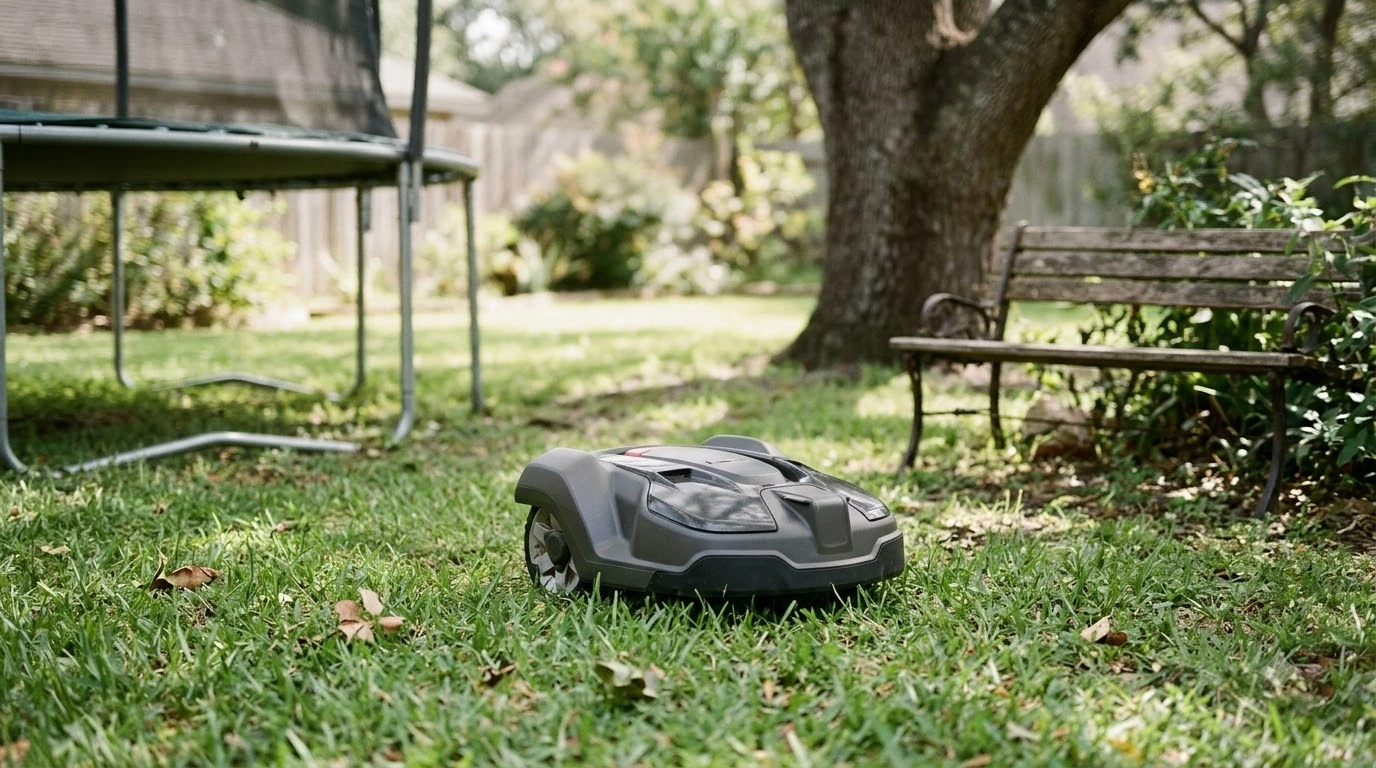

A robot mower for yard with heavy tree canopy can still cut well, but only if its navigation does not rely on satellite signals alone. Dense canopy can block, weaken and reflect the satellite signals that RTK systems use, and heavy shade also thins the turf underneath. This guide explains what changes, which navigation types cope better, and what to check before you buy.
The short answer
- Satellite risk: canopy can block, weaken and reflect the signals that RTK-only mowers need.
- Wire option: a boundary-wire system does not depend on satellites, according to a vendor guide.
- Sensor claims: vendors say sensor-assisted mowers keep working under dense canopy, but independent tests are scarce.
- Lawn health: UF/IFAS Extension says heavily shaded turf is generally not recommended.
Robot mower for yard with heavy tree canopy: why satellite navigation struggles
Tree canopy can block, weaken and reflect satellite signals, so a mower that depends on them can lose accuracy under heavy cover.
RTK navigation relies on satellite data plus a correction from a reference station. Mammotion’s installation notes say that if the reference station is obstructed, satellite signals may degrade and lead to positioning drift. Mammotion’s boundary wire comparison makes this point in its installation section.
The problem is most serious near the charging dock and along the property edges, where the mower needs a clean fix to start and finish each run. Our reading is that the sky view above the dock matters more than the shade in the middle of the lawn. That is the first thing to check for any robot mower for yard with heavy tree canopy. Tall buildings can cause a similar signal problem, covered in RTK robot mowers near tall buildings.
Which navigation types cope with tree cover
Boundary wire is the option least tied to satellite visibility, while RTK-only mowers are the most exposed to canopy, based on the vendor and forum sources we read.
Wire systems use a perimeter cable laid around the lawn, so their position does not depend on satellites. Mammotion describes wired mowers as operating independently of satellite signals and as stable in heavily shaded environments. Wire-free models use satellite navigation with other sensors, and Mammotion says multi-sensor fusion keeps them working under dense tree canopies. That is a vendor claim, and we could not check it against independent tests. A separate guide covers the best robot mower without a boundary wire.
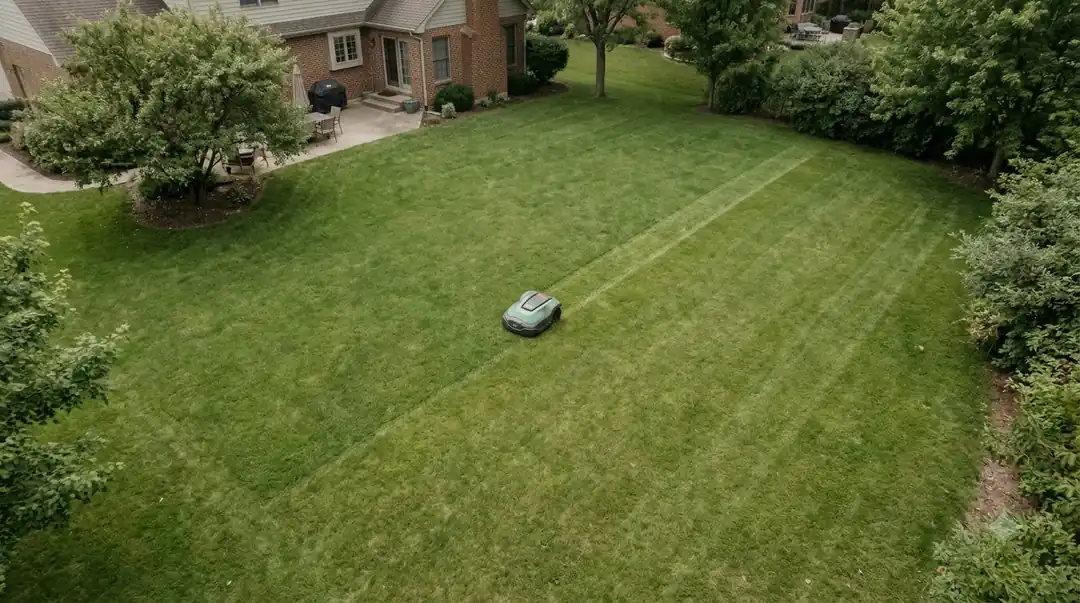
| Navigation type | Under dense canopy, per the sources | Evidence level |
|---|---|---|
| Boundary wire | Works independently of satellite signals, and is described as stable in heavy shade | Vendor claim (Mammotion) |
| RTK only | Depends on a clear satellite fix, and an obstructed reference station can cause drift | Vendor installation note (Mammotion) |
| RTK with vision or sensor fusion | Vendor says it keeps navigating where GPS weakens under dense canopy | Vendor claim, not independently tested in the pages we read |
Wire is a trade-off rather than a free upgrade. The cable has to be laid around the lawn at setup, and it needs work again if you later change the boundary. Our reading is that a yard where most of the lawn sits under cover deserves a serious look at wire before you pay for a satellite-based model. The comparison of boundary wire versus RTK installation time shows what that setup involves.
If you are comparing options for a robot mower for yard with heavy tree canopy, ask each seller for the manual’s canopy statement in writing, and ask which sensor takes over when satellite data drops out. A vague answer is a reason to look at another model.
How much to trust forum test data on tree cover
One open forum test reported 88.5% fixed under trees in one record group, but its author says the data cannot separate tree effects from other changes.
The post logs a single GNSS unit on a 16.4 km baseline under trees in rain, and on a 1.99 km baseline with network RTK. Three of the four record groups held 100% fixed for the whole long-baseline session. The fourth dropped to 83.3% in half sky and 88.5% under trees, so the higher figure under trees is not a clean finding. The author says canopy, baseline, correction source and weather changed at once, that there was one unit per position, and that there was no ground truth.
The author also warns that a fixed flag does not prove the position was right. That matters for a robot mower, because the mower needs an accurate position, not just a status light. The Open Robotics forum thread covers outdoor robots in general and does not discuss lawn mowers.
Heads up
Mammotion’s page is a vendor blog with a reason to favor its own products. The forum thread is a single-unit user test. Neither is an independent lab result.
Shade also thins the lawn under the trees
UF/IFAS Extension advises against growing turfgrass in heavily shaded areas, because shaded grass depletes its energy reserves and thins out over time.
Grass in shade stretches its blades and stems as it reaches for light. That growth uses up the plant’s carbohydrate reserves, which can reduce vigor and coverage and leave bare spots that invite weeds. Shade also shifts as trees mature and seasons change, so a lawn that is fine today can thin later.
If you keep a mower on a partly shaded lawn, UF/IFAS lists these practices for turf in shade:
- Mow at the highest recommended height for the species, since more leaf area absorbs more light.
- Use less fertilizer, and choose a slow-release nitrogen source.
- Water shaded grass less than grass in full sun, because a full-sun schedule can raise disease risk.
- Avoid heavy foot traffic, which injures shaded grass and can damage tree roots.
Species matter too. UF/IFAS says bahiagrass, bermudagrass and seashore paspalum are not recommended for shady landscapes, zoysia is a good option for moderate shade, and centipedegrass has fair shade tolerance. Among St. Augustinegrass cultivars, Floratam is significantly less shade tolerant than CitraBlue, Classic and several others. Our reading is that the grass species should be checked before you expect a full lawn under the trees.
What to check before you buy
Use this list before you buy a robot mower for yard with heavy tree canopy. Check the sky view at the dock, the shade pattern across the lawn, the navigation type, the grass species and the manufacturer’s stated limits before you commit.
- Sky view at the dock. An obstructed reference station can degrade satellite signals, so look at the sky over the charging station and any base station location first.
- Shade pattern. Note which parts of the lawn are shaded and for how long, since shade changes as trees mature.
- Navigation type. Compare wire, RTK-only and sensor-assisted models using the table above, and ask the seller how each one behaves under cover.
- Grass species. Confirm the species and its shade tolerance against the UF/IFAS guidance before you expect a full lawn under the trees.
- Manufacturer limits. Read the manual for stated canopy and sky-view limits. None of the sources we read gives a universal canopy threshold, so the manual is the only place to check a specific model.
For a robot mower for yard with heavy tree canopy, the decision comes down to satellite dependence and grass health, not just the brand. Our reading is that wire or sensor-assisted designs deserve a close look where the lawn is mostly shaded, while RTK-only models make more sense where the sky over the dock is clear. To build a shortlist, see which robot mower has the best navigation.
Frequently asked questions
Will a robot mower work under heavy tree canopy?
It can, but reliability depends on the navigation type. A vendor describes boundary-wire mowers as operating independently of satellite signals, while RTK-only mowers depend on a clear satellite fix. Check the manufacturer’s stated canopy limits before you buy.
Does shade kill lawn grass?
UF/IFAS Extension says heavily shaded areas are generally not recommended for turfgrass, because shaded grass stretches and depletes its energy reserves. Over time that can thin the lawn and leave bare spots that invite weeds. Ground covers, shade-tolerant plants or mulch are the suggested alternatives.
Should I raise the cutting height for shaded grass?
Yes, according to UF/IFAS advice. Mow shaded grass at the highest recommended height for the species and cultivar, because more leaf area absorbs more light and higher mowing promotes deeper rooting. Set the height on your mower where the model allows it.
Is RTK useless under trees?
Not useless, but its accuracy under canopy is uncertain. A vendor installation note says an obstructed reference station can degrade satellite signals and cause drift. A single-unit forum test found high fixed rates under trees, but its author says a fixed flag does not prove the position was correct.
Sources
- Growing Turfgrass in the Shade (UF/IFAS Extension, EDIS EP072): shade effects on turf, mowing height, fertilizer, water, traffic and species tolerance.
- Boundary wires vs no-wire robot mowers (Mammotion EU blog, a vendor, dated 14 Aug 2026): wire and RTK navigation claims and the reference station obstruction note.
- How much RTK fix do your outdoor robots keep under tree canopy? (Open Robotics forum, single-unit user test): fix-rate figures and the author’s caveats.
 Up next8 min readBy YardWhere to Place RTK Antenna in a Yard With TreesUpdated Nov 11, 2026
 9 min readBy YardRobot Mower for Terraced Yard: What to Check FirstUpdated Nov 11, 2026
 8 min readBy YardRobot Mower for Yard With Retaining Walls: What to CheckUpdated Nov 11, 2026
 8 min readBy YardBest Robot Mower for a Duplex Yard: What to Check Before You BuyUpdated Nov 11, 2026
 8 min readBy YardBest Robot Mower for a Coastal Yard With Salty Air: What to CheckUpdated Nov 11, 2026
 8 min readBy YardRobot Mower That Works Under Trees Without RTK: What to Look ForUpdated Nov 11, 2026