
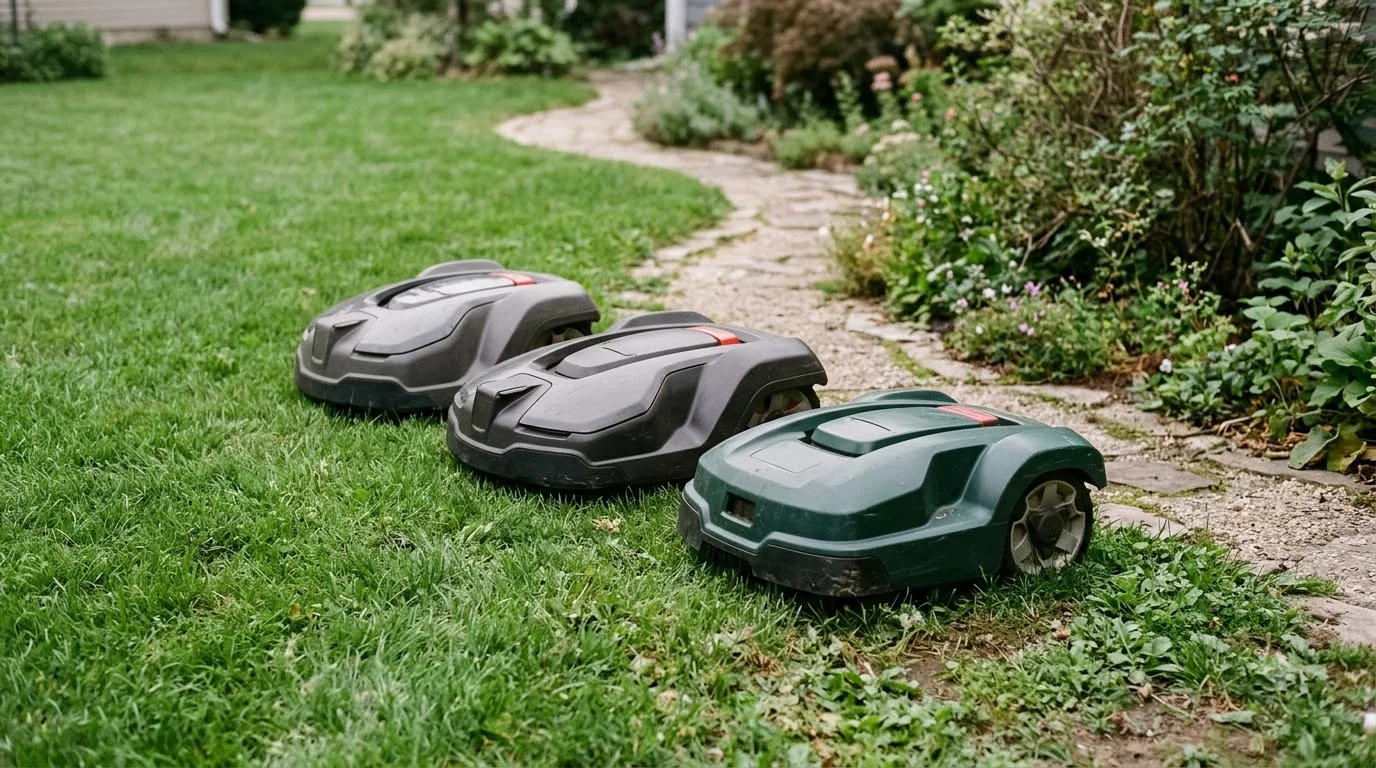

This ECOVACS GOAT A2000 LiDAR PRO review covers a wire-free robot mower with a 30 to 90 mm cutting height and an integrated edge trimmer. The manufacturer lists dual-LiDAR navigation, IPX6 water resistance and 50% (27°) slope climbing. Two independent hands-on reviews (not tests by us) praised the mowing but reported clear limits on slopes, tall grass and edge trimming, so this review sticks to the published specs and what those reviewers observed.
The short answer
- Navigation: no boundary wire, beacons or RTK antenna; Ecovacs describes a 360° dual-LiDAR system with 2 cm precision.
- Cutting: 30 to 90 mm height range, adjustable in 1 cm steps in the app, with a 13-inch (33 cm) cutting width listed by a comparison site.
- Edge trimming: the TruEdge trimmer cleans up clear edges but misses square corners, according to one reviewer.
- Known limits: one reviewer got stuck repeatedly on a sloped edge, and autonomous mode struggled with tall, dense grass.
- Who it fits (our reading): a mostly flat lawn that is kept up regularly, where wire-free setup and a trimmer matter more than GPS tracking.
ECOVACS GOAT A2000 LiDAR PRO review: key specs
The official ECOVACS product page is the most direct source for the mower’s core specifications. It lists a cutting height range of 30 to 90 mm, adjustable through the app, and a slope climbing rating of 50% (27°). It gives a mowing rate of 400 m² per hour, but it does not publish a maximum lawn area, so any “up to a given acre” claim from a seller should be checked against the manufacturer’s own material.
| Spec | What the sources say | Source |
|---|---|---|
| Cutting height | 30 to 90 mm, adjustable in 1 cm steps in the app | ECOVACS product page |
| Coverage rate | 400 m² per hour; no maximum lawn area listed | ECOVACS product page |
| Slope climbing | 50% (27°) | ECOVACS product page |
| Battery and charging | 3.0 Ah battery; 113.4 W fast charging, about 50 minutes; runtime not listed on the official page | ECOVACS product page |
| Cutting width | 13 in (33 cm) | smarthomecompared |
| Water resistance | IPX6 | ECOVACS product page |
| Noise level | Not listed on the official page or in the reviews we read | Gap in sources |
| Warranty | Not listed on the official page; check the seller’s terms | Gap in sources |
The official page also describes a 32V platform with dual blade discs spinning at 3,000 rpm, which it says is 33% faster than the G1’s 2,250 rpm. The app supports remote and automatic mapping, a map editor that lets you add, merge, split and delete areas, and per-area mowing schedules.

How the navigation works without a boundary wire
The A2000 does not need a buried or surface boundary wire, and it does not rely on RTK or GPS positioning according to the product page. Instead, it uses what Ecovacs calls a HoloScope 360 dual-LiDAR system (our guide to how LiDAR robot mowers navigate explains the general idea), which combines a rotating 360° LiDAR with a 3D time-of-flight LiDAR, and states a precision of 2 cm.
In practice, the first job is mapping. The reviewer at EFTM set the mower up by powering it on, pairing it over Wi-Fi and Bluetooth, and driving it around the lawn edge with the phone as the controller. Forward movement was quick, but turning was slow, and the app then produced a 3D map that could be edited. For a reader used to wire-based systems, that is the main change: setup is a walk-around, not a buried cable.
Cutting performance and the integrated edge trimmer
Our ECOVACS GOAT A2000 LiDAR PRO review relies on the two reviewers here, because the manufacturer page publishes no edge-quality results.
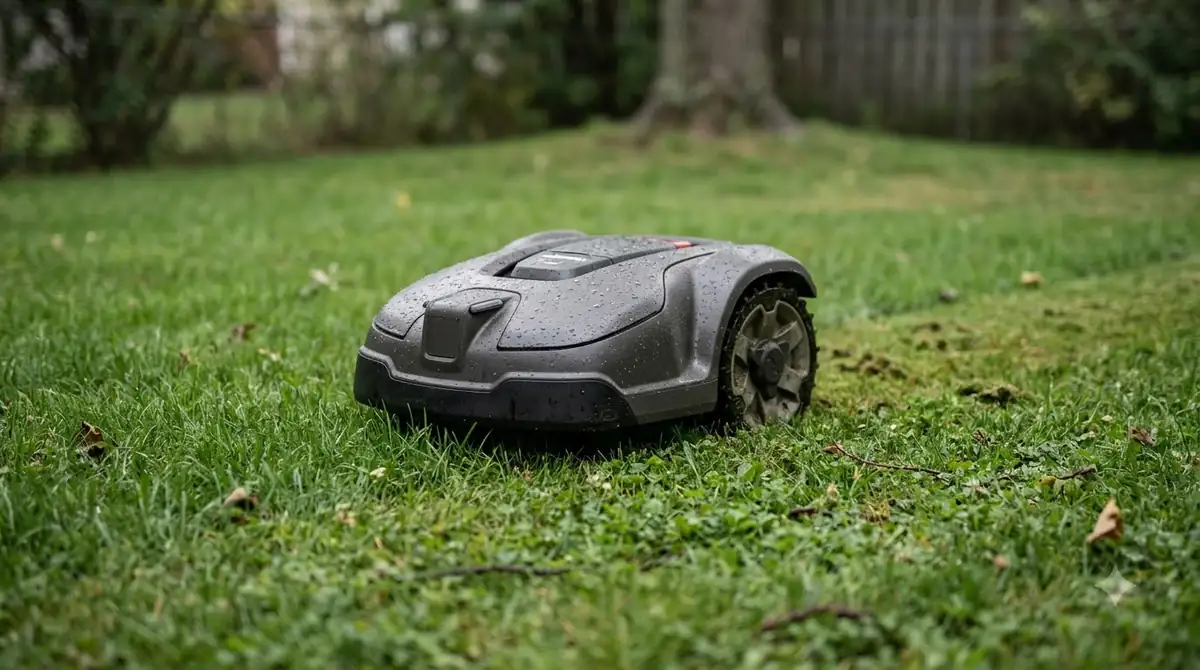
The mower is built around a dual-disc cutting system at 3,000 rpm, and it handles a 30 to 90 mm height range. EFTM gave mowing performance 86% and value for money 87% in its scoring, and the reviewer described the mower as keeping the lawn trimmed, sending it out “every couple of days” during the test. The reviewer also noted that the cutting looked more like a trim across the top of the grass than a traditional blade cut.
The integrated TruEdge trimmer is the feature that most sets this model apart from simpler mowers. Digital Reviews reports that it spins up to 8,500 rpm and cuts a path about 180 mm wide. EFTM found it worked well along clearly defined edges, but it did not reach into square corners when the mower turned, and the reviewer said it was “not quite a full replacement for the whipper snipper just yet.” Neither review quantified edge quality, so treat the trimmer as a useful helper for clean, distinct borders rather than a full substitute for hand trimming. For the wider picture, see do robot mowers trim edges.
What independent reviewers observed
Two hands-on reviews are the most useful independent evidence available for this model. They ran the mower in different conditions, so their results should be read side by side.
- EFTM (July 2026, winter test): the reviewer scored the mower 90% overall, with design at 93%, usability at 94%, performance at 86% and value at 87%. The review says the mower is expensive and only saves money if you would otherwise pay someone to mow.
- Digital Reviews (Australian lawn): the front and back lawns measured 81 m² and 101 m² according to the app’s mapping. The back lawn, unmowed for six to eight weeks, took 36 minutes in a remote run. The reviewer estimated that cutting the same areas by hand would take about 90 minutes.
- Noise: neither review gives a decibel figure. Digital Reviews says the mower was quieter than the reviewer’s battery mower in cutting mode, while its line trimmer was louder but ran only intermittently.
The two reviews agree that mowing quality is the strong point. They also show that the mower is not fully hands-off: EFTM still saw missed corners, and Digital Reviews switched to manual mapping on the overgrown yard. No independent long-term durability test appeared in the sources we read.
Limits reviewers reported: slopes, tall grass and safety stops
The most repeated limits were getting stuck on a sloped edge, struggling with overgrown grass in autonomous mode, and a safety behaviour that can leave gaps in the trim. Each one is a real constraint for some lawns, even though the official slope rating is 50%. Our slope rating explainer shows why a listed percentage does not guarantee grip on every surface, and a guide to robot mowers that handle tall grass covers the overgrown-lawn side.
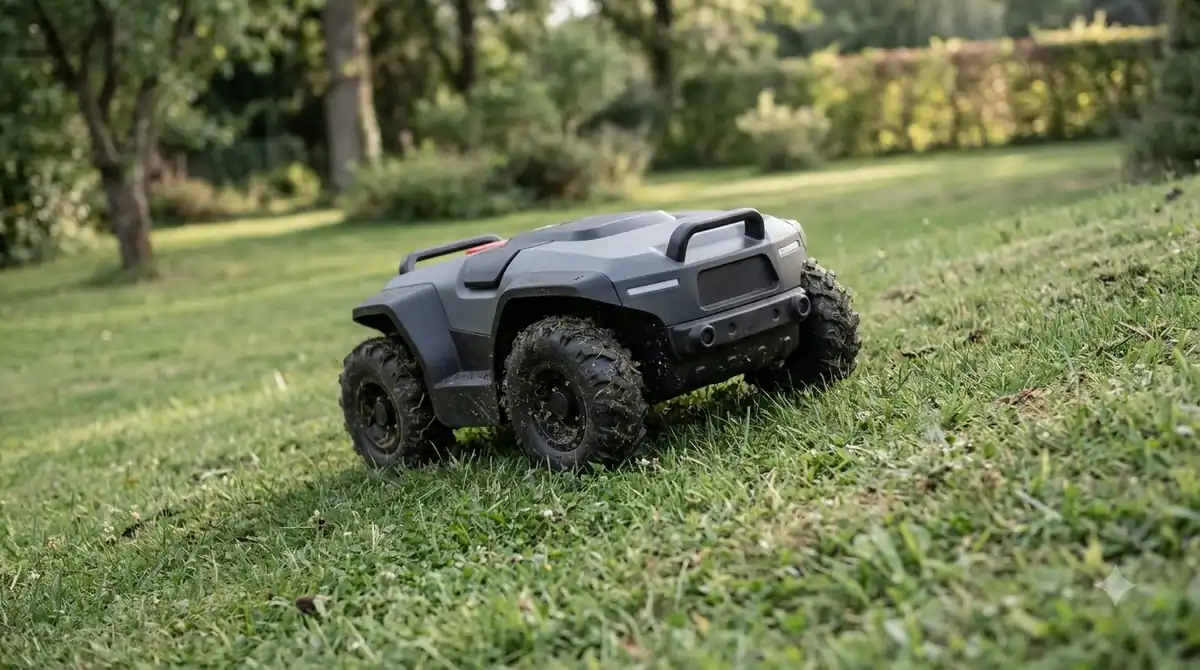
On a sloped edge above a rock wall, the EFTM reviewer said the mower repeatedly got stuck and had to be recovered. Digital Reviews found that autonomous mode struggled with tall, dense grass on the overgrown backyard and barely made a start there, so the reviewer mapped the boundaries by driving the mower manually. Some long strands of Kikuyu grass were also tricky for the wheels to get through without becoming entangled.
The safety behaviour is worth noting. According to EFTM, when a person comes within 1.5 metres, the edge trimmer switches off, but the mower keeps driving. That means the trimmer is not active when someone is close, and the reviewer said the mower “misses a spot” as a result.
Heads up
Digital Reviews said the Home Assistant integration did not yet support the Australian version of the A2000 LiDAR Pro at the time of testing. If smart-home control matters to you, check current integration support for your region before you buy.
How it compares with the Mammotion YUKA 2000
The YUKA 2000 is the most common comparison for this model. A comparison site shows the two mowers with similar battery runtime of about 150 minutes, but the navigation, warranty and connectivity differ. Anyone weighing the two models should treat this ECOVACS GOAT A2000 LiDAR PRO review as a spec summary, since the figures come from one comparison site.
| Feature | ECOVACS GOAT A2000 LiDAR PRO | Mammotion YUKA 2000 |
|---|---|---|
| Navigation | LiDAR, no perimeter wire | RTK positioning, no perimeter wire |
| Cutting width | 13 in (33 cm) | 12.6 in (32 cm) |
| Cutting height | 30 to 90 mm | 3 to 10.2 cm |
| Warranty | Not listed on the official page | 3 years |
| GPS tracking | No | Yes |
| Cellular connectivity | Not listed | 4G cellular |
| Battery runtime | About 150 minutes | About 150 minutes |
These are listed figures from one comparison site, not a head-to-head test. Our reading is that the YUKA 2000’s longer warranty, GPS tracking and cellular connectivity matter most to buyers who want theft tracking or remote access, while the A2000 matters more to buyers who want an integrated edge trimmer.
Who each option suits (our reading)
Based on the published specs and the two reviews, this ECOVACS GOAT A2000 LiDAR PRO review finds the A2000 best suited to a mostly flat, cleared lawn that is mowed regularly, where a buyer wants wire-free mapping and an integrated edge trimmer. Owners of steep or uneven lawns, very tall or overgrown grass, or yards that need GPS tracking should look more closely at the limits above and at alternatives.
Before you buy, check the current price and seller, since prices in the sources we read varied by seller and date. Also confirm the warranty terms in your country (the robot mower warranty guide lists what to look for), check whether your region supports the app and smart-home integrations you need, and compare the slope and grass-height conditions in your own yard against the limits reviewers reported.
Frequently asked questions
Does the Ecovacs GOAT A2000 LiDAR PRO need a boundary wire?
No. Ecovacs lists LiDAR navigation with no perimeter wire. The EFTM reviewer set up the boundary by driving the mower around the lawn edge with the phone app.
What cutting height does the A2000 offer?
The official page lists 30 to 90 mm, adjustable in 1 cm steps through the app. The page does not give a separate figure for each grass type.
Can the A2000 handle slopes?
Ecovacs rates it for 50% (27°) slope climbing. One reviewer still got stuck repeatedly on a sloped edge above a rock wall, so a steep or uneven yard needs a test run before you rely on it.
Does the edge trimmer replace a hand trimmer?
Not yet, according to the EFTM reviewer. The trimmer cleans up clear edges well, but it does not reach square corners, and the reviewer called it “not quite a full replacement” for a hand trimmer.
Sources
- ECOVACS GOAT A2000 LiDAR PRO product page (manufacturer): cutting height, slope rating, coverage rate, battery and charging, IPX6, navigation, obstacle avoidance, trimmer and app features.
- EFTM review of the GOAT A2000 LiDAR PRO (independent review): setup, mowing and edge trimming observations, slope and safety behaviour, and scores.
- Digital Reviews, ECOVACS GOAT A2000 LiDAR PRO review (independent review): overgrown-yard test, lawn areas and mowing times, mapping limits, trimmer speed and path width, and noise comparison.
- smarthomecompared, GOAT A2000 LiDAR PRO vs Mammotion YUKA 2000 (comparison site): cutting width, battery runtime, navigation, warranty and GPS tracking for both models.
 Up next8 min readReviews & CompareECOVACS GOAT A3000 LiDAR PRO Review: Specs, Limits and What to CheckUpdated Nov 16, 2026
 8 min readReviews & CompareEcovacs GOAT O1000 LiDAR PRO Review: LiDAR + Edge TrimmerUpdated Nov 16, 2026
 8 min readReviews & CompareEcovacs GOAT A2000 vs Mammotion LUBA 3 AWD 1500H: Specs ComparedUpdated Nov 12, 2026
 11 min readReviews & CompareEcovacs GOAT O1000 LiDAR PRO vs Navimow i110N: Specs ComparedUpdated Nov 16, 2026
 7 min readReviews & CompareMOVA LiDAX Ultra 1000 vs ECOVACS GOAT O1000 LiDAR PRO: Which Fits Your Lawn?Updated Nov 16, 2026
 12 min readReviews & CompareIs the Ecovacs GOAT A1600 RTK Worth It? Specs, Limits and Trade-offsUpdated Nov 11, 2026