
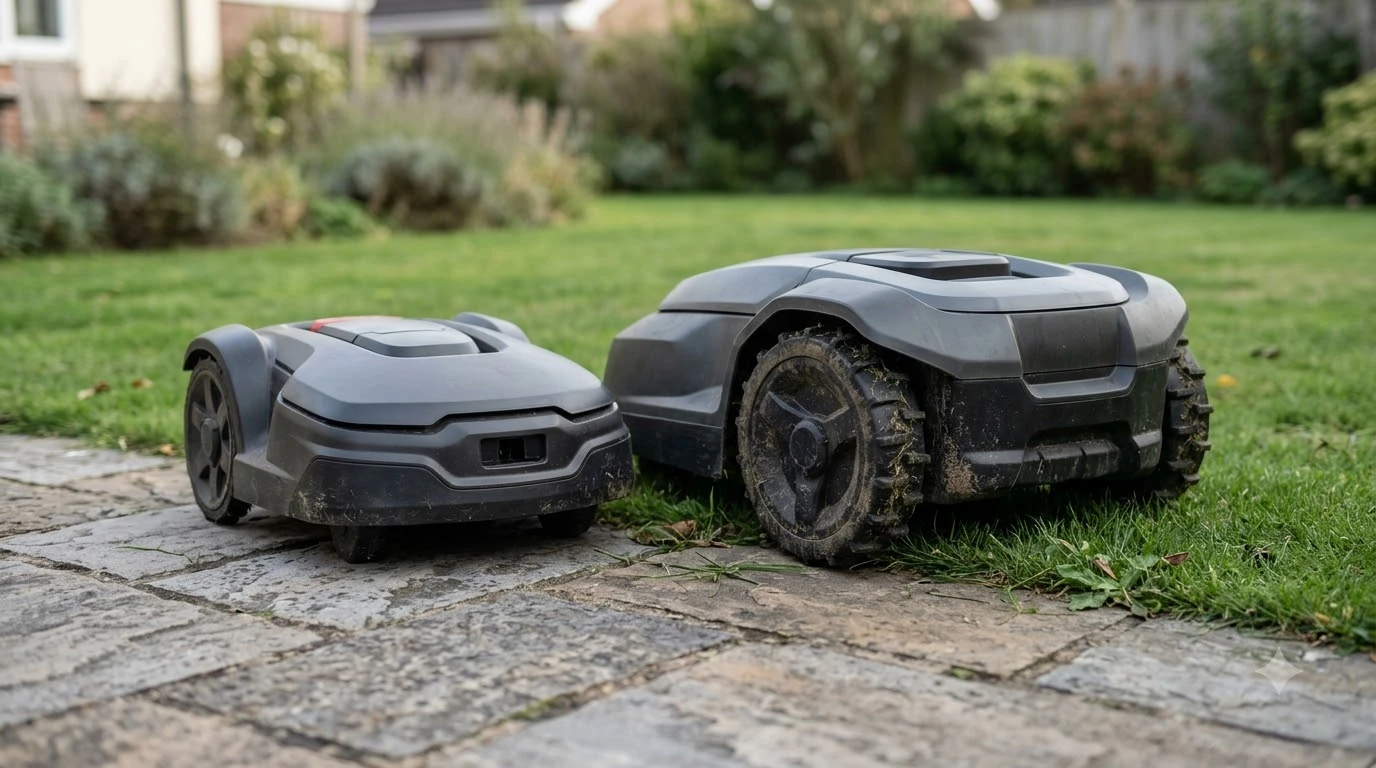

The Ecovacs GOAT O1000 LiDAR PRO is a wire-free robot lawn mower that uses multiline LiDAR for navigation, and its US spec page rates the work area at a 45% slope (24 degrees) with a 90-minute runtime per charge. This Ecovacs GOAT O1000 LiDAR PRO review uses the manufacturer’s published numbers as of November 2026. We have not tested this mower, so this review only summarizes what the page says and where the page is unclear.
The short answer
- Navigation: multiline LiDAR with 3D ToF and an AI camera. The page says no physical boundary wire is needed.
- Slope: 45% (24 degrees) in the work area. The virtual boundary is listed at 17%.
- Deck: 8.66 inches for the mower and 7.09 inches for the trimmer.
- Coverage rate: about 120 m² per hour in delicate mode and 180 m² per hour in efficient mode. The page gives no acreage limit.
- Noise: 61 dBA for the body and 81 dBA for the trimmer.
- Battery: 18 V, 5200 mAh, with 90 minutes of mowing and a 70-minute charge. The warranty length is not stated on the page.
Ecovacs GOAT O1000 LiDAR PRO review: the spec page figures
The GOAT O1000 is sold in two versions with different navigation and specifications, so this review covers only the LiDAR PRO and names the variant behind every figure. The Ecovacs US LiDAR PRO page names the navigation system HoloScope 360. The page describes it as a 360-degree rotating LiDAR paired with a 3D ToF LiDAR, and it lists obstacle avoidance as 3D ToF plus an AI camera plus multiline LiDAR.
Anyone comparing spec sheets should know that the page does not agree with itself on cutting height. The spec table gives a range of 1.18 to 3.15 inches with a 0.43-inch step, the body text gives 1.2 to 3.1 inches in 0.20-inch steps, and the feature list gives 3 to 8 centimeters.
Heads up
The three cutting-height figures on the page do not match. Check the height range and step in the owner’s manual before you rely on any single value.
Cutting width and height
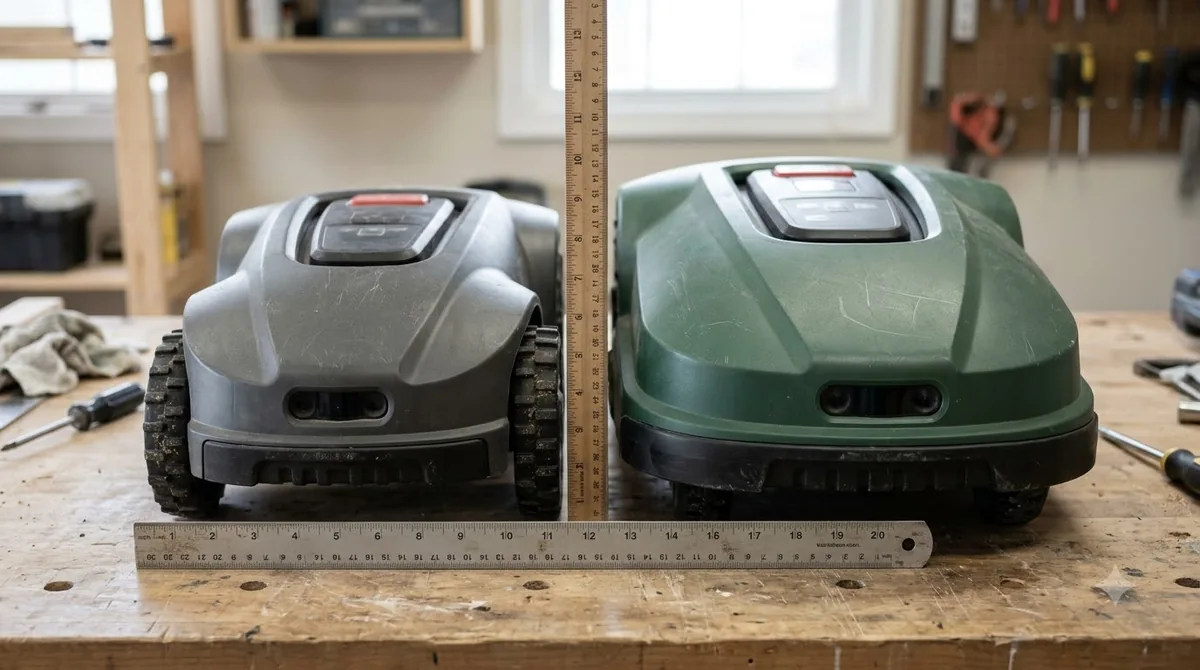
The mower deck is listed at 8.66 inches wide, and the trimmer head at 7.09 inches. Deck width sets how many passes a lawn needs, so the 8.66-inch figure is the number buyers usually compare first across robot mowers.
The trimmer is a separate, narrower head. Its 7.09-inch width is the figure that matters near bed edges and tight corners. Our reading is that a narrower trimmer is a practical advantage only where the edge clearance is tight, and the page does not show how the trimmer is mounted or how close it can get to a border.
Slope rating: 45% and the 17% boundary
The page rates the work area at 45%, which it lists as 24 degrees. Slope is often quoted in percent or in degrees, and any Ecovacs GOAT O1000 LiDAR PRO review has to keep the two scales apart because they are not the same. A 45% slope is a rise of 45 units for every 100 units of horizontal distance, which is about 24 degrees.
The virtual boundary is rated at 17% on the same page, but the page gives no degree value for that figure, and it does not say how the 17% limit affects the mower. We do not describe it further. Our reading is that buyers should compare slope ratings in the same unit, and should not read the 17% boundary figure as the steepest ground the mower will work.
Mowing rate and what it means for one acre
The page lists about 120 m² per hour in delicate mode and about 180 m² per hour in efficient mode. It does not give an area limit in acres or square feet. Converted, the rates are roughly 1,290 ft² per hour and 1,940 ft² per hour. These conversions are our own arithmetic.
One acre is about 4,047 m². At the published rates, mowing one full acre once would take about 34 hours in delicate mode and about 22 hours in efficient mode, before charging and overlap. These are theoretical figures we calculated from the page’s rates, not measured results. Our reading is that the charge time, not the rate, will often decide how many days a full acre takes.

Navigation without a boundary wire
The page says the mower “can detect and remember all types of boundaries without users needing to put up physical wires.” It lists the navigation as multiline LiDAR, with a 3D ToF sensor and an AI camera for obstacle avoidance. For readers deciding between wire-based and wire-free setups, the wire-free vs boundary wire guide explains the trade-off, and how LiDAR robot mowers navigate covers the sensor side.

The page does not say whether the LiDAR PRO version uses RTK satellite correction. The RTK fields in its spec table are blank, and the page ties RTK to a separate GOAT O1000 RTK Care Kit. Do not assume that RTK is part of this variant until the seller or manual confirms it.
Noise, runtime and charging
dBA is a weighted decibel scale, so noise figures are only comparable when both come from the same scale. The noise section of this Ecovacs GOAT O1000 LiDAR PRO review can only repeat what the page lists. The page lists 61 dBA for the main body and 81 dBA for the trimmer. On the page’s own numbers, the trimmer is 20 decibels louder than the body, so the trimmer figure is the one to weigh if neighbors are close to the yard.
The battery is 18 V with 5,200 mAh. The page gives 90 minutes of mowing per charge and 70 minutes to recharge. Our reading is that a 70-minute charge is short enough to run more than one cycle a day on a small lawn, but on a large lawn the recharge pauses will add to the total mowing time.
LiDAR PRO vs the RTK version
The two variants share the same 8.66-inch deck and 45% slope rating on their pages. They differ in navigation, battery, noise and runtime. Our Ecovacs GOAT O1000 RTK review covers the other version in full, and the RTK vs LiDAR guide explains the navigation difference. The Ecovacs US RTK page gives the comparison figures in the table below.
| Spec | GOAT O1000 LiDAR PRO | GOAT O1000 RTK |
|---|---|---|
| Navigation | Multiline LiDAR, 3D ToF, AI camera | RTK, camera, 3D ToF |
| Slope (work area) | 45% (24 degrees) | 45% (24 degrees) |
| Cutting width | 8.66 in (trimmer 7.09 in) | 8.66 in |
| Coverage rate | About 120 m² per hour delicate, 180 m² per hour efficient | About 1,507 ft² per hour delicate, 1,938 ft² per hour efficient |
| Noise | 61 dBA body, 81 dBA trimmer | 57 dBA |
| Battery | 18 V, 5,200 mAh | 18 V, 4,000 mAh |
| Mowing per charge | 90 minutes | About 65 minutes |
| Charge time | 70 minutes | About 100 minutes |
The coverage rates use different units on the two pages. Converted to metric, the RTK figures are about 140 m² per hour in delicate mode and about 180 m² per hour in efficient mode. That is our conversion. Our reading is that the efficient-mode rates are the same, while the LiDAR PRO’s delicate mode is slower on the page’s own numbers.
What to check before you buy
The page answers most questions about specifications but leaves three open. The steps below cover those gaps, and they are the points this Ecovacs GOAT O1000 LiDAR PRO review cannot settle from the page alone. If you are still choosing between GOAT models, the Ecovacs GOAT model guide lays out how the line is organized.
- Cutting height. Confirm the height range and step in the manual, because the page lists three different sets of figures.
- Warranty. The page does not state a length. It links to a Returns and Warranties policy, so read that policy before you buy.
- RTK. The page leaves the RTK fields blank for this variant. Ask the seller whether the LiDAR PRO uses RTK, since that determines which positioning system the unit relies on.
- Lawn area. Convert your lawn to square meters and divide by the rated rate to get a rough mowing time. Add the charge time for each cycle.
The page gives no fixed price for this variant, and this review does not quote one.
Frequently asked questions
Does the Ecovacs GOAT O1000 LiDAR PRO need a boundary wire?
The Ecovacs US page says the mower can detect and remember boundaries without physical wires. It does not describe any setup that uses a wire.
How steep a slope can the GOAT O1000 LiDAR PRO handle?
The page rates the work area at 45%, which it lists as 24 degrees. It gives a separate 17% figure for the virtual boundary, with no degree value.
How long does one charge last?
The page lists 90 minutes of mowing per charge and 70 minutes to recharge. Real runtime depends on lawn conditions, which the page does not address.
Is the GOAT O1000 LiDAR PRO the same as the RTK version?
No. The comparison table in this ecovacs goat o1000 lidar pro review sets the two side by side. The two share the 8.66-inch deck and 45% slope rating on their pages, but they differ in navigation, battery capacity, noise, and runtime.
Sources
- Ecovacs US, GOAT O1000 LiDAR PRO product page (manufacturer): cutting height, width, slope, coverage rate, navigation, boundary, noise, battery, runtime.
- Ecovacs US, GOAT O1000 RTK product page (manufacturer): comparison figures for the RTK version.
 Up next7 min readReviews & CompareMOVA LiDAX Ultra 1000 vs ECOVACS GOAT O1000 LiDAR PRO: Which Fits Your Lawn?Updated Nov 16, 2026
 11 min readReviews & CompareEcovacs GOAT O1000 LiDAR PRO vs Navimow i110N: Specs ComparedUpdated Nov 16, 2026
 8 min readReviews & CompareECOVACS GOAT A3000 LiDAR PRO Review: Specs, Limits and What to CheckUpdated Nov 16, 2026
 9 min readReviews & CompareEcovacs GOAT A2000 LiDAR PRO Review: Specs, Mapping and LimitsUpdated Nov 16, 2026
 9 min readReviews & CompareEcovacs GOAT O1000 RTK Review: What the Published Specs SayUpdated Nov 11, 2026
 8 min readReviews & CompareEcovacs GOAT O1000 RTK vs Ecovacs GOAT A1600 RTK: What the Specs ShowUpdated Nov 11, 2026