
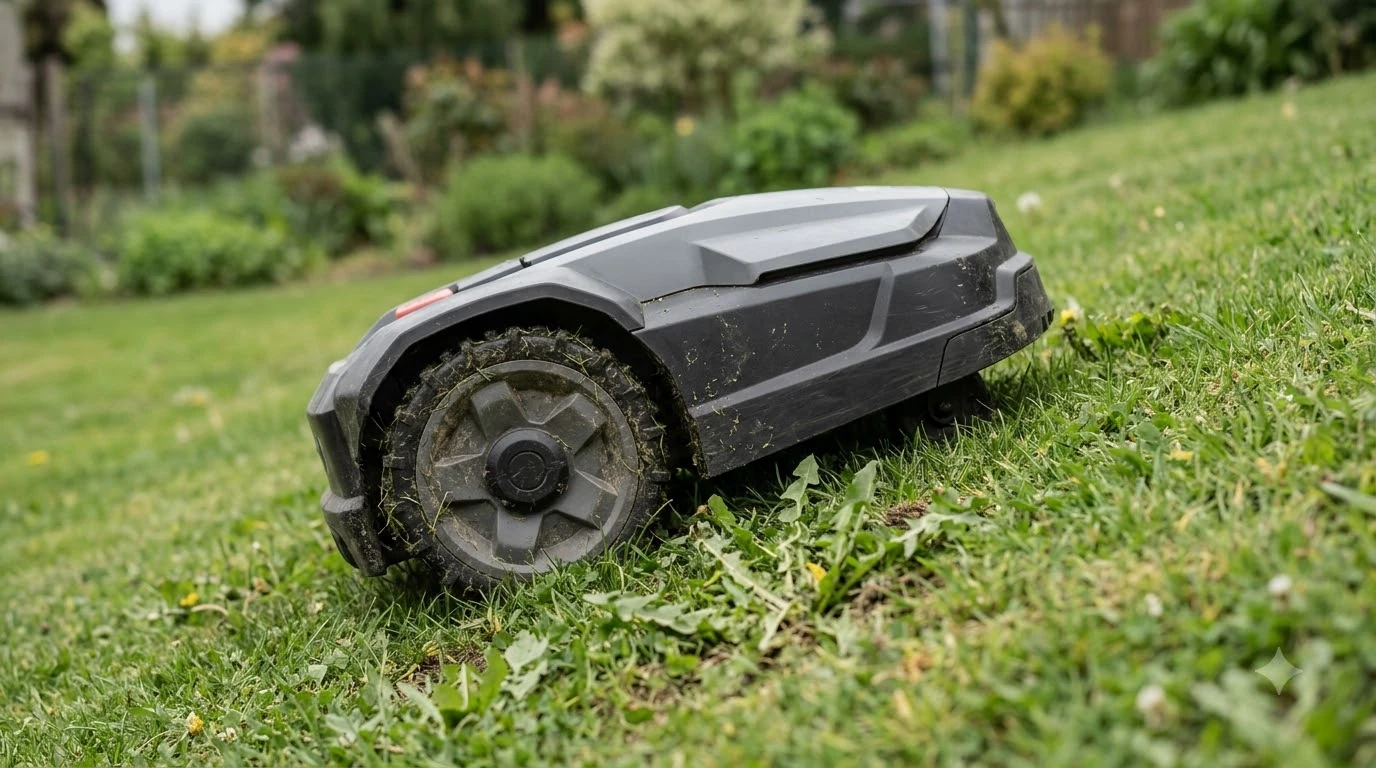

Robot mower traction spikes for slopes are an optional accessory, not a standard fit. Some suppliers offer spikes or traction wheels, and manufacturer guides say drive type, wheel size, tread and wet ground usually matter more than any add-on. We found no independent test that measures how much spikes help on a real slope.
The short answer
- Optional, not standard: spikes or special tires are often sold as accessories, so check whether your mower includes them.
- Drive type first: Mammotion says front-wheel drive suits only gentle slopes, while all-wheel drive keeps the remaining wheels moving if one lifts.
- Check the rating: published slope limits differ by model, from 18 degrees to about 25 degrees in the examples below.
- Wet grass is the main limit: moisture makes wheels spin, and spikes do not remove that risk.
- Follow the manual: confirm which accessories your model approves before you fit anything.
Are robot mower traction spikes for slopes worth it?
Traction spikes are an optional accessory that some suppliers offer to improve grip, and Robomow says the tread on these traction wheels can give optimal grip even on wet grass. The same guide notes that if spikes or special tires are not in the box, they are often available as optional accessories. That wording shows spikes are an add-on, not a feature every robot mower has. In practice, robot mower traction spikes for slopes are worth asking about only after you have checked the rating and drive type.
What the sources do not show is how much spikes add. We found no independent testing that compares a mower with and without spikes on the same slope. Treat any claim about extra climbing angle as the vendor’s claim until you see a test from a neutral source.
What slope can a robot mower handle?
Slope ratings are set by each manufacturer, which is why a robot lawnmower rated for one hill may not suit another. The same number can mean different things across brands. The table below lists the figures that the manufacturer pages we read give for specific models or typical ranges.
| Model or range | Stated maximum slope | Source type |
|---|---|---|
| Honda HRM 1000, 1500, 2500 and 4000 | Up to 47% (about 25 degrees) | Manufacturer |
| Honda Miimo 40 and 70 | Up to 27% | Manufacturer |
| Eufy E18 | Up to 18 degrees | Manufacturer |
| Robomow robotic mowers for slopes (typical) | About 35 to 45 degrees | Manufacturer, typical figure |
For a fuller explanation of the numbers, see what manufacturers mean by a slope rating. The percent and degree figures do not convert cleanly into each other, so compare like with like. Robomow’s own conversion table lists 35 percent as 19.3 degrees and 45 percent as 24.2 degrees. Our reading is that each rating is the steepest gradient the model is designed for, so a robot mower slope rating is a ceiling to stay under, not a target.
Heads up
Robomow says many robot mowers need a run-out zone with a maximum slope of 15 percent in order to turn without difficulty. A mower rated for a steep hill can still struggle at the edges if the area around the turn is too steep.
Does drive type matter more than spikes?
Drive layout decides how much weight the driven wheels carry on a climb, so it usually matters more than any add-on. Mammotion’s comparison describes three common layouts.
- Front-wheel drive (FWD): Mammotion says these suit only gentle slopes, because weight shifts toward the rear on a climb and can cause slip on steeper gradients.
- Rear-wheel drive (RWD): weight moves to the rear drive wheels on a climb, which gives better grip and stability on moderate slopes.
- All-wheel drive (AWD): if one wheel lifts in a rut or dip, the remaining wheels keep the mower moving. Mammotion also notes that two-wheel-drive models can spin in place on slick inclines and leave wheel-burn marks.
If you are weighing layouts for a hilly lawn, our all-wheel versus two-wheel drive comparison covers the trade-offs. Our reading is that a spike kit does not change the drive layout. If a model is front-wheel drive and your lawn has a steep section, a better fit is usually a different mower, not a set of spikes on the old one.
How do wheel size and tread help grip?
Wheel size and tread work together to keep the mower on the ground. Robomow says the size of the wheels helps determine tilt resistance, and that drive wheels are usually larger to transmit power and improve grip. Some designs add a fourth wheel for extra traction, though Robomow describes three wheels as the usual layout for slope models.
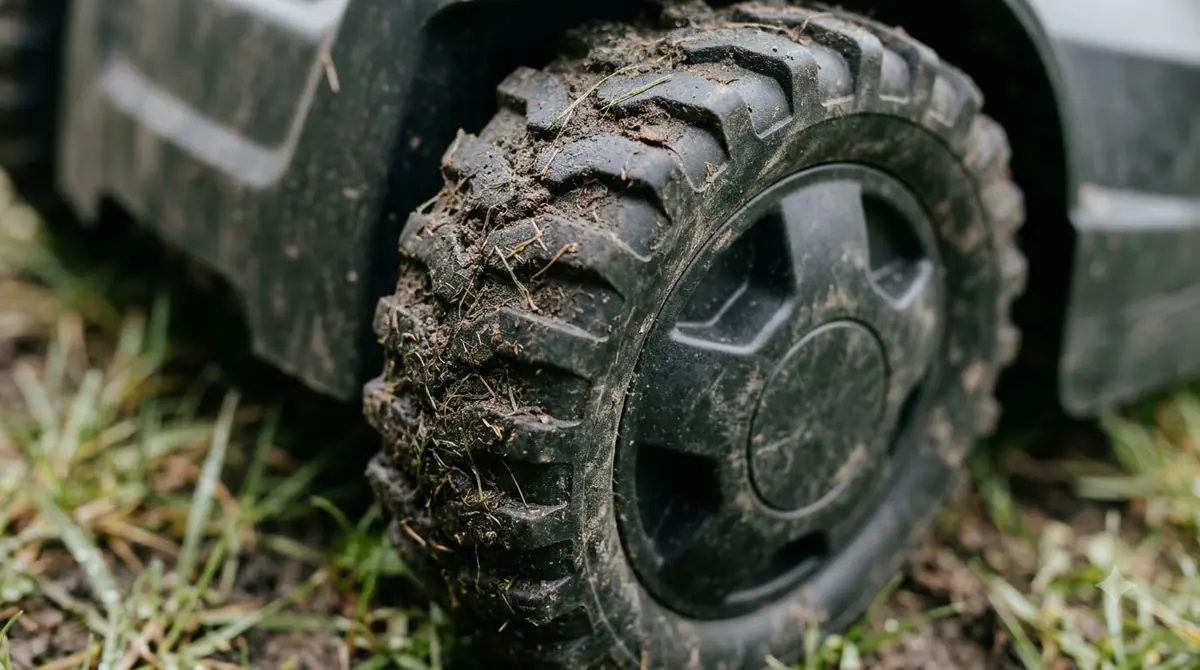
- Broad tread: Honda says its HRM range uses broad-tread rear wheels designed to shed mud and keep grip in wet conditions.
- Deep tread: Eufy says deep tread patterns and heavy-duty rear wheels provide grip, and advises buyers to look for deeply grooved tyres designed for slopes.
- Traction wheels: where a supplier offers traction wheels for a robot mower, Robomow says the tread can give optimal grip, even on wet grass.
Honda also calls wheel tread one of the most important traction factors, and says deeper, wider tread helps a mower grip wet or soft grass instead of sliding. Check the tread on the wheels your mower ships with before you buy an accessory set, and read about when a worn wheel needs replacing, because worn tread will cost you more grip than any add-on can return.
Why wet grass and leaves limit slope performance
Our guide to running a robot mower on wet grass covers the schedule side of this. Wet grass reduces tyre grip for any mower, even when the slope is inside the rated limit. Eufy states this directly, and Robomow says moisture often makes wheels spin more easily or lets the mower slip.
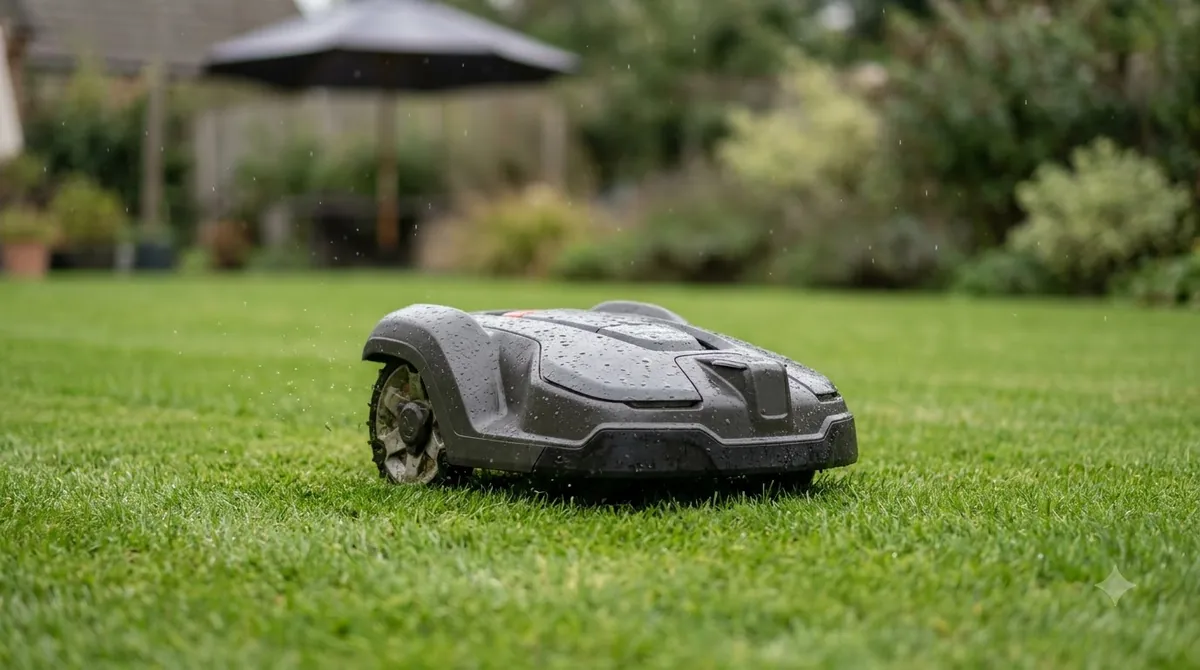
Honda advises avoiding scheduling mowing sessions in wet conditions where possible, especially early in the morning. That is the main caution for a robot mower on a wet slope. Robomow also says the steeper the slope, the more important it is to choose suitable weather. Robomow also says leaves can reduce grip, so clearing them from the mowing area on a slope is a practical step.
Turns, run-out zones and wheel contact
Climbing straight up is only part of the test. Honda says turning across a slope, mowing near edges and moving on wet grass are more demanding than a straight climb. If a wheel loses contact with the ground, the mower can miss patches, stall or stop, so the lawn layout matters as much as the rating.
Robomow’s 15 percent run-out figure is the practical check here, and it applies whether or not you add robot mower traction spikes for slopes. First measure the slope of your yard. Then walk the slope and the area beside it before you commit to a mower, and look for any sharp dip or hump where a wheel could lift. Honda says suspension-style wheels and lift sensors help keep the mower in contact with the ground.
For a steep yard, the decision on robot mower traction spikes for slopes usually starts with drive type, rated slope and tread, with accessories added only where the manual allows them.
Frequently asked questions
Do robot mowers come with traction spikes?
Not always. Robomow says spikes or special tires are often available as optional accessories when they are not included in the delivery. Check the box contents and the manual for your specific model before assuming they are fitted.
What slope can a robot mower handle?
It depends on the model. Honda’s HRM range is rated up to 47 percent, about 25 degrees, and Eufy’s E18 up to 18 degrees. Robomow gives typical slope figures of 35 to 45 degrees. Use the rating for the exact model you are buying.
Is an all-wheel-drive robot mower needed on a slope?
Not always. Mammotion says front-wheel drive suits only gentle slopes, while all-wheel drive keeps the remaining wheels moving if one lifts. For a steep or uneven yard, drive layout is usually the first thing to check.
Do robot mower traction spikes for slopes help on wet grass?
Robomow says some traction wheels or spikes can give good grip on wet grass. We found no independent test that measures how much they help, so treat the benefit as unconfirmed and keep to the rated slope in wet weather.
Sources
- Can robotic lawn mowers handle slopes and uneven gardens? (Honda): slope ratings for HRM and Miimo models, broad-tread wheels, wet-grass and turning cautions.
- FWD vs RWD vs AWD robot lawn mowers (Mammotion): how each drive layout behaves on climbs and when wheels lose grip.
- Robotic mowers for slopes: buying tips (Robomow): optional spikes and traction wheels, wheel size, typical slope figures, 15 percent run-out zone.
- Robot lawn mower slope limits (Eufy): E18 rating of 18 degrees, deep tread advice, wet grass and rated limit as an absolute maximum.
 Up next9 min readGearBest Anti-Theft Lock for Robot Mower: What Actually Protects ItUpdated Nov 11, 2026
 8 min readGearBest Soil Moisture Sensor to Pair With Robot Mower: What Actually Controls MowingUpdated Nov 11, 2026
 8 min readGearHow to Clean a Robot Mower Safely, Step by StepUpdated Nov 11, 2026
 9 min readGearHow to Find a Break in Robot Mower WireUpdated Nov 11, 2026
 9 min readGearRobot Mower Charging Station Power Requirements ExplainedUpdated Nov 11, 2026
 8 min readGearWhere to Mount an RTK Base Station for a Robot MowerUpdated Nov 11, 2026