

The best robot mower for a yard with maple trees is one that keeps its position under the canopy. Satellite navigation (RTK) can lose signal under dense trees, while lidar systems are described by vendors as less affected by shade. Maples add a second issue in autumn, because leaf drop can cover the lawn and the boundary. This guide covers what to check before you buy and how to plan around both problems.
The short answer
- Navigation under canopy: RTK signal can be weakened or blocked by trees, so check the positioning method before anything else.
- Lidar or vision: vendors say lidar is less affected by shade, but ask for the model’s own test conditions.
- Fall leaves: plan on removing leaves regularly, because a leaf-covered lawn can hide the boundary and clog the deck.
- Base station: an RTK base needs an open spot with a clear sky view, so place it away from the maple canopy.
Why trees affect robot mower navigation
Trees affect satellite signals in two ways. The canopy can block the sky, and leaves and branches can reflect signals so that they arrive at the receiver along several paths. Mowrator’s explanation of RTK signal loss under trees describes this multipath effect, and says a lost fix can lead the mower to pause, slow down, or correct its route. That explanation is qualitative and vendor-written, so it does not give a measured loss rate. Leaves can weaken satellite signals, as poor GPS under leafy canopy explains.
Ecovacs says RTK struggles under dense trees and buildings, because obstructions interfere with the satellite connection. Its guidance also says the RTK base station needs an open, unobstructed area. For a maple-shaded yard, that means the base station should sit where the sky is clear, which may not be in the middle of the lawn.
Best robot mower for a yard with maple trees: lidar and vision
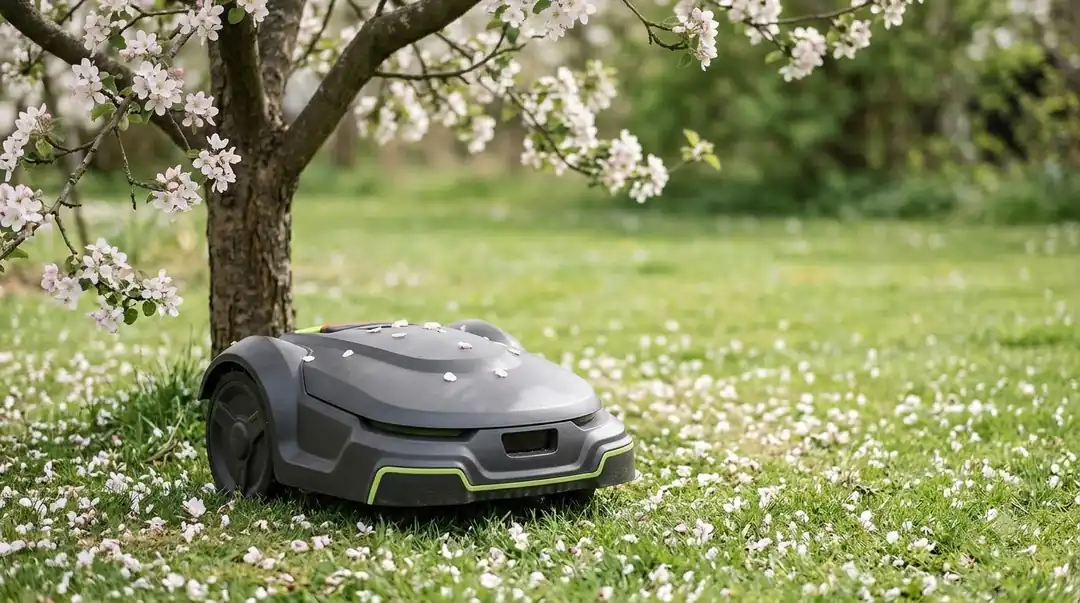
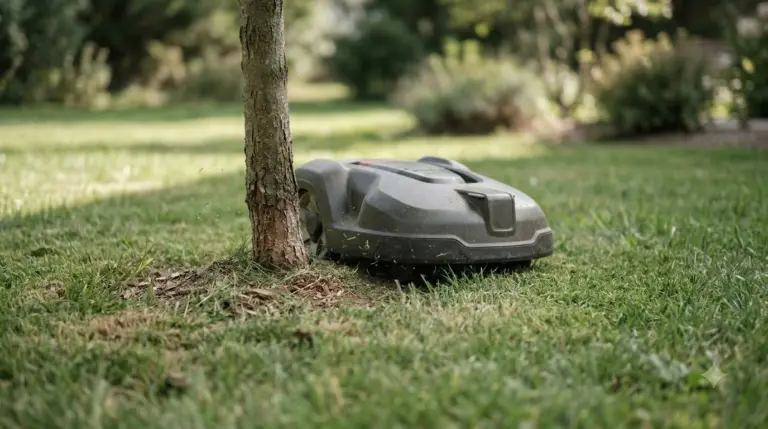
Lidar works differently. A lidar mower sends out laser pulses, measures the time each pulse takes to return, and builds a 3D map that updates as it moves. Anker’s description of lidar mowers says the system is unaffected by shade or structures. That is a vendor claim, and it is not a measured result for any particular yard, so treat it as a reason to test rather than a guarantee. Trunks are detected by the mower’s sensors and bumpers, as trunks and sensor avoidance explains for mature maples.
Our reading is that lidar and vision systems are a better starting point for a dense maple canopy than RTK alone. They still need a clear boundary, such as a wire or a well-mapped edge, and they still need a check after a storm drops branches on the lawn.
| Setup | What the vendor sources say | What to test in your yard |
|---|---|---|
| RTK | Trees block and reflect satellite signals; base needs an open area | Look at the mower’s signal status under the thickest part of the canopy |
| Lidar | Described as unaffected by shade or structures | Confirm the boundary and check after the first full week |
| Wire boundary | No satellite dependence for the perimeter | Check the wire path for roots and fallen branches |
Heads up
Maples can drop branches and seed pods. Check the lawn after storms, because a fallen branch can stop the mower or push it off its path.
Leaves, shade, and the mower schedule
Autumn leaf drop is the most visible maple problem. A thick layer of leaves can hide the boundary wire, cover the charging dock path, and clog the deck. Our reading is that you should plan a weekly leaf check during fall, even if the mower runs daily. A mower cannot cut a leaf layer evenly, and leaves that stay on the grass can smother the turf underneath. Grass beneath maples is shaded for much of the day, and shade-friendly picks compare mowers that suit low light.
Shade also changes how the grass grows. Our reading is that a lawn under dense maples may do better with a slightly higher cut and fewer runs in the darkest areas, so the grass is not stressed. Test that against your own lawn, because shade effects vary with the canopy.
What to check before you buy
- Positioning method. Ask whether the model uses RTK, lidar, vision, or a wire, and whether the manufacturer names tree cover as a supported condition.
- Base station placement. If the model uses RTK, check that you have a clear sky spot for the base before you buy.
- Boundary plan. A wire can be the most predictable choice when the trees hide much of the sky, since it does not depend on satellite signal for the perimeter.
- Leaf handling. Look at the deck and cutting height options, and plan a clean schedule for removing leaves and seed pods.
If the seller offers a trial period or a demo, use it during a week of leaf drop, because that is when the canopy and the leaf cover are both at their worst. Model specifications are the manufacturer’s claims. Use them as a checklist, and ask the seller or support team how the mower behaves in a yard with the same tree density as yours. A dense canopy changes the whole setup plan, as heavy canopy yards explains for properties with many trees.
Related reads: Maple roots often sit at the surface, and the surface tree roots check explains the risk. Many front yards have trees and no fence, so see robot mowers in unfenced front yards for how the boundary is handled.
Frequently asked questions
Can a robot mower work in a yard with maple trees?
Often, yes, but the positioning method matters. RTK can lose signal under dense canopy, while lidar and wire systems depend less on satellite signal. Test the model in your yard before relying on it.
Do fallen maple leaves stop a robot mower?
Thick leaf cover can hide the boundary and clog the deck, which can stop the mower or make it cut unevenly. Clear leaves regularly during autumn.
Where should an RTK base station go under maples?
Ecovacs says the base station needs an open, unobstructed area. Pick a spot with a clear view of the sky, away from the canopy.
Is lidar better than RTK under trees?
Vendors describe lidar as less affected by shade, but this is a manufacturer claim. Our reading is that lidar is a reasonable first choice for a dense canopy, provided you verify it in your yard.
Sources
- Mowrator, RTK robot mower signal loss under trees (vendor): trees block and reflect satellite signals; a lost fix can cause pausing or route correction.
- Anker, lidar robot lawn mower explained (vendor): lidar sends laser pulses and builds a 3D map; described as unaffected by shade or structures.
- Ecovacs, lidar vs RTK robot lawn mowers (vendor): RTK struggles under dense trees; base station needs an open area.
 Up next8 min readBy YardBest Robot Mower for a Yard With Tree Roots: What to CheckUpdated Nov 13, 2026
 8 min readBy YardRobot Mower for Yard With Heavy Tree Canopy: What to CheckUpdated Nov 11, 2026
 7 min readBy YardBest Robot Mower for a Yard with Lots of TreesUpdated Nov 18, 2026
 8 min readBy YardWhere to Place RTK Antenna in a Yard With TreesUpdated Nov 11, 2026
 11 min readBy YardBest Robot Mower for Complex Yards: 6 Checks to MakeUpdated Nov 16, 2026
 10 min readBy YardBest Robot Mower for a Yard with Lawn Ornaments: What to CheckUpdated Nov 12, 2026