
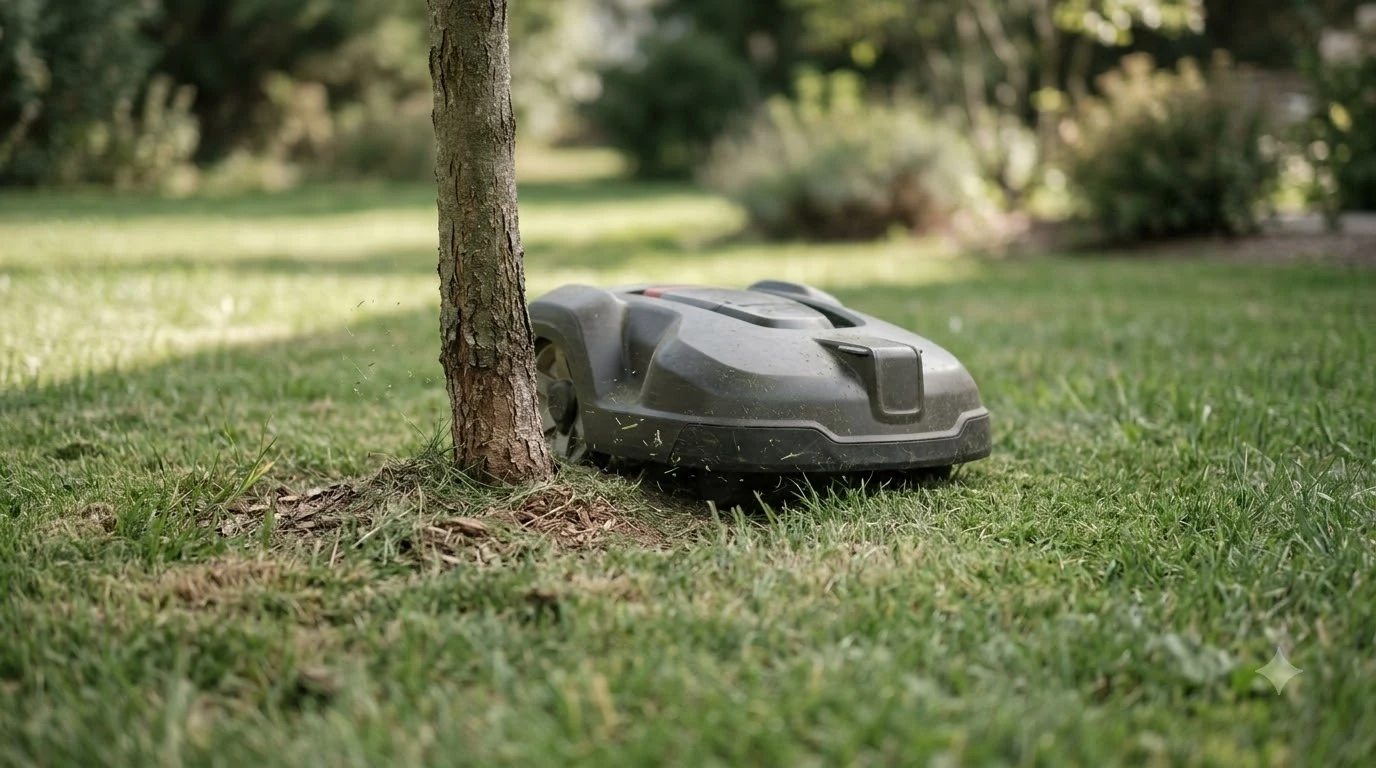

There is no single best robot mower for a yard with lawn ornaments, but the right choice depends on how the model detects objects before contact and how well you can fence off the pieces you want left alone. As of November 2026, the manufacturer pages we read describe the sensor types and no-go zone tools that matter most, and few of them name garden decorations directly.
Ornaments are harder than they look. A tall, rigid statue is usually easier to see than a small, flat or legged piece, and tall grass can hide both. The best robot mower for a yard with lawn ornaments is therefore less a product name than a set of features you can check against your own layout.
The short answer
- Sensor timing: vision and ultrasonic sensors can react before contact on selected models, while a bump sensor reacts only after contact.
- Night use: some Husqvarna models use infrared at night, while Aspire models run without vision support in the dark.
- No-go zones: app-drawn virtual zones or physical stay-out zones keep the mower away from fixed ornaments.
- Wire islands: an island in the boundary wire is the usual fix for a fixed object that cannot take a bump.
- Before each run: move small or fragile pieces, because no sensor set is a guarantee.
Why ornaments are harder than they look
Ornaments are missed for predictable reasons: low height, flat shape, legs and grass cover. Husqvarna’s AI vision documentation sorts objects into risk groups. Low-risk items such as toys, garden furniture and flowerpots are approached more closely before the mower changes direction, while humans, animals and water hoses get a larger safety distance. The page does not name decorative garden ornaments, so a statue or figure is not clearly placed in either group. Our reading is that most ornaments fall into the lower-risk or unlisted category, which means the mower may get close before it turns.
Two more points from Husqvarna’s documentation shape the decision. The company says objects lying flat or very close to the ground may not be detected, and it describes its radar and ultrasonic guidance as “not a safety feature,” with “no guarantee that objects will not be run over.” Those statements cover the whole system, not only ornaments, so treat detection as a help rather than a fence.
What sensors do most of the work
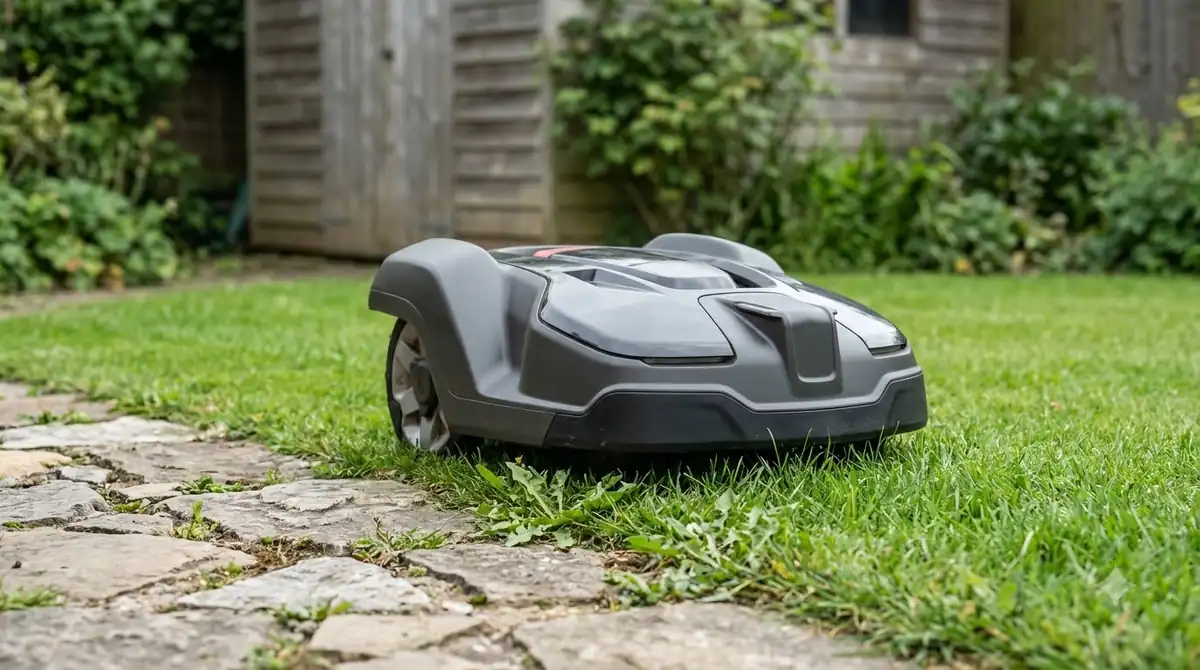
Sensors differ in timing, and timing is the first thing to compare. A bump sensor records a collision after it happens, so it works as a backup layer rather than a way to keep clear of an ornament. Ultrasonic and camera systems can react before contact, but only on selected models, so check the specification for the model you are considering rather than assuming every mower has them. Our list of the best robot mower with obstacle avoidance compares the sensor types.
Lymow’s page for its One Plus model describes a different combination: binocular AI vision cameras, five ultrasonic sensors for measuring distance, and two Hall sensors in the front bumper that stop the blades and movement on impact. Those are the vendor’s own specifications, and we have not tested them. The same page says the model can detect bed edges through 3D spatial awareness, even without physical borders, which is a useful capability to ask about for any ornament-heavy yard.
Which ornaments a mower is most likely to miss
The table below groups common yard items by the detection problem each one creates. The main variables are height, rigidity, whether the piece is flat, and whether it has legs or a raised part.
| Ornament type | Why it is a problem | What the sources say |
|---|---|---|
| Tall, rigid statues | Usually easier for sensors to see (our reading) | Lymow lists garden statues among the object types its model recognizes |
| Small figures, gnomes and blocks | Low profile, easy to miss in grass | MyRobotMower says plastic figures and building blocks are likely to be run over |
| Legged or raised pieces (bird baths, benches) | Hard to judge, and the mower may try to pass under them | Husqvarna says raised objects with legs “may be difficult” to assess and recommends a stay-out zone |
| Flat or ground-level pieces (stepping stones, solar lights) | Can be missed when flat or very close to the ground | Husqvarna says flat or very close-to-ground objects may not be detected |
| Movable items (toys, hoses, garden tools) | The mower may cut around them if they are left in place | Lymow says it returns to cut an area once movable items are cleared; Husqvarna treats hoses as high risk |
Legged and raised pieces deserve the most attention. The risk is concrete: the mower may try to pass under them, and a bird bath on a narrow pedestal or a bench with exposed legs gives a shape that sensors do not read well. For these items, a stay-out zone or a wire island is a safer plan than hoping the sensors catch them.
Night and low-light operation
Night performance varies by model: some Husqvarna NERA models use infrared sensors, while Aspire models operate without vision support in the dark.
Night operation is a separate check from daytime detection. Husqvarna’s documentation says the NERA models (405VE, 410VE, 430V and 450V) use infrared sensors and can detect and avoid objects at night. The Aspire R6V, 308V and 312V models operate without vision support at night and may collide with objects they would normally avoid in daylight. If the mower runs in the evening, or your ornaments sit in shaded areas, that difference matters more than most headline features.
For a best robot mower for a yard with lawn ornaments, night behavior is worth checking first when ornaments sit in shaded corners. Our reading is that a mower that runs only in daylight faces fewer of these limits, but the schedule still matters. Set the mowing window so the mower works when it can see its surroundings best, and confirm the night behavior in the manual for the exact model.
Virtual no-go zones and physical stay-out zones
A no-go zone keeps the mower out of a marked area, and our explainer on what a no-go zone on a robot mower is covers the basics. Virtual zones are drawn in an app, while physical stay-out zones use a marker the mower will not cross.
Lymow’s page says that for beds level with the lawn, you can draw virtual no-go zones in the app. The company says its app supports up to 80 zones, lets you set cutting heights per zone, and allows edits to one area without remapping the whole yard. Those are vendor specifications.
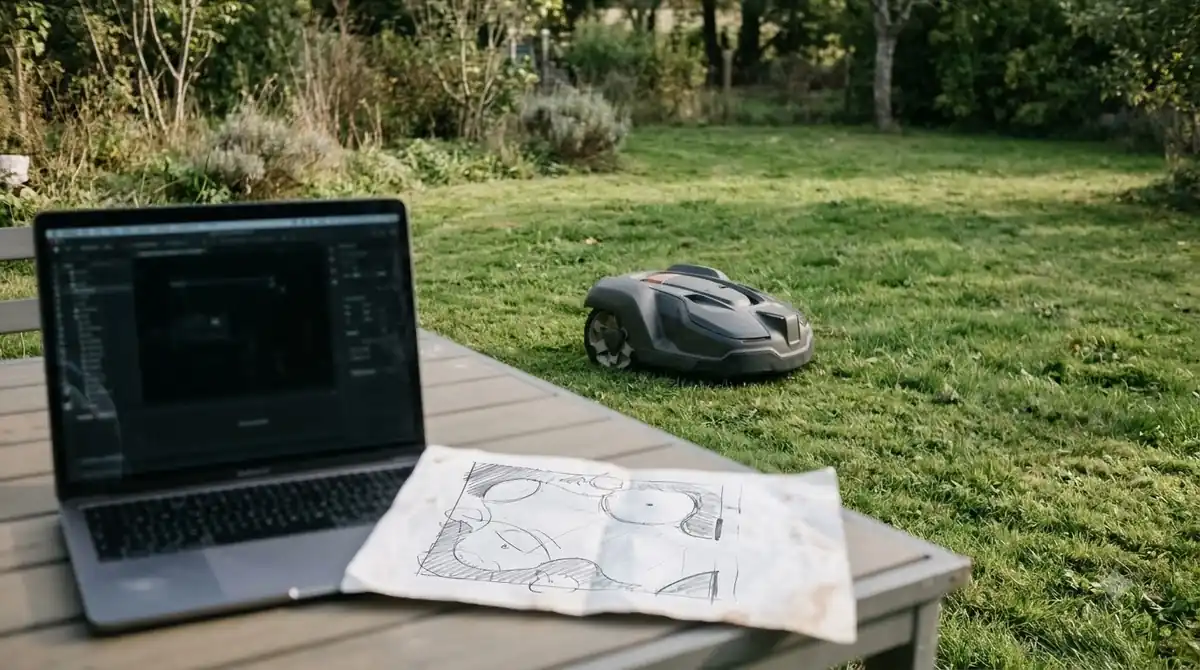
Husqvarna’s EPOS stay-out zones have a minimum size of 30 x 30 cm, and the company’s documentation recommends them around trees, roots and stones. Its AI vision page advises stay-out zones for permanent objects and for items hidden in high grass. For an ornament you never want touched, a zone is more dependable than sensor detection alone, and a zone plan is the most useful feature to compare when you shop for the best robot mower for a yard with lawn ornaments.
When you set up zones, mark every fixed ornament, such as a statue, a bench or a bird bath, and leave a clear path so the mower can still reach the areas you want cut. Our steps to set up no-go zones on a robot mower walk through the app side, and a separate guide covers a robot mower working around a bird bath.
Boundary wire islands for beds and fixed items
An island is a loop of boundary wire around an obstacle, so the mower cuts around it without touching it. Husqvarna’s installation guidance recommends islands for obstacles that cannot take a bump, such as flower beds and rockeries.
Worx’s wiki for its Landroid Classic gives a clearance figure of 26 cm for its island wire setup. Clearance figures belong to specific models, so read the installation manual for your mower before cutting wire. An island suits a statue or bench base that will never move, and our guide to laying boundary wire around trees and obstacles shows the loop. Island support is one more check when you compare the best robot mower for a yard with lawn ornaments. For a figure you shift around the yard, a virtual zone is easier to change.
Tall grass and small items
Tall grass can hide low or small ornaments, so trim edges and move loose pieces before each run.
Husqvarna’s object avoidance guidance says golf balls in tall grass may be missed, and that tall grass and flowers can sometimes be mistaken for objects. MyRobotMower says small items such as plastic figures and building blocks are likely to be run over. Lymow lists a 7 cm obstacle-clearing height for its One Plus model, meaning the mower can pass over small garden borders up to that height, and says small sticks can be driven over. Those are vendor claims for that model.
Our reading is that trimming grass around ornaments and moving small or loose pieces before each run lowers the risk more than any single sensor feature.
Checklist for the best robot mower for a yard with lawn ornaments
Check sensor timing, night behavior, no-go zone tools and island support against your own yard before you choose a model.
- Sensor timing. Confirm whether the model has vision or ultrasonic sensing that reacts before contact, not only a bump sensor.
- Night use. Check whether the model works in the dark on its own, or runs without vision support after sunset.
- No-go zones. Confirm that the app can draw virtual zones, how many it supports, and whether one zone can be edited without redoing the whole map.
- Islands. Check whether the boundary wire installation supports islands for beds and fixed items.
- Tall grass and small items. Note the obstacle clearance height and whether the mower can pass small garden borders.
- Your ornaments. List the pieces that move, the ones that stay put and the low or legged ones before you buy.
Frequently asked questions
Will a robot mower run over a garden gnome?
It depends on size and grass height. MyRobotMower says small figures are likely to be run over, while larger upright items are easier for sensors to see. Put a stay-out zone around a gnome you do not want touched.
Can a robot mower go under a bird bath?
It may try to. Husqvarna says raised objects with legs may be hard to assess, and the mower may attempt to pass under the raised section. A stay-out zone or a wire island around the base is the safer option.
Do I need to remove every ornament before mowing?
Not always, but move small, loose or fragile pieces before each run. Fixed items such as statues and benches can be marked with a zone or an island instead.
Does a robot mower work at night?
It depends on the model. Husqvarna says its NERA models use infrared sensors and can detect objects at night, while its Aspire models operate without vision support in the dark. Check the manual for the exact model.
Sources
- Husqvarna, AI vision object detection support page (manufacturer): risk groups, raised objects, night operation, stay-out zones.
- Husqvarna, object avoidance with radar or ultrasonic sensors (manufacturer): flat objects, tall grass, golf balls, limits of the system.
- Husqvarna, EPOS stay-out zones (manufacturer): 30 x 30 cm minimum size.
- Husqvarna, islands in a boundary wire installation (manufacturer): islands for flower beds and rockeries.
- Worx, Landroid Classic island setup (manufacturer): 26 cm island wire clearance.
- Lymow, can robot mowers avoid flower beds and trees (manufacturer, vendor claims): vision, bumper sensors, no-go zones, 7 cm clearance.
- MyRobotMower, how a robot lawn mower deals with obstacles (independent guide): small figures likely to be run over.
 Up next9 min readBy YardHow Does a Robot Mower Handle Lawn Ornaments?Updated Nov 11, 2026
 8 min readBy YardBest Robot Mower for a Yard With a Dry Creek Bed: What to CheckUpdated Nov 12, 2026
 7 min readBy YardBest Robot Mower for a Yard With Fallen Branches: What to CheckUpdated Nov 12, 2026
 11 min readBy YardBest Robot Mower for a Yard With a Trampoline: What to CheckUpdated Nov 14, 2026
 11 min readBy YardBest Robot Mower for Complex Yards: 6 Checks to MakeUpdated Nov 16, 2026
 6 min readBy YardBest Robot Mower for a Yard with Maple Trees: What to CheckUpdated Nov 14, 2026