
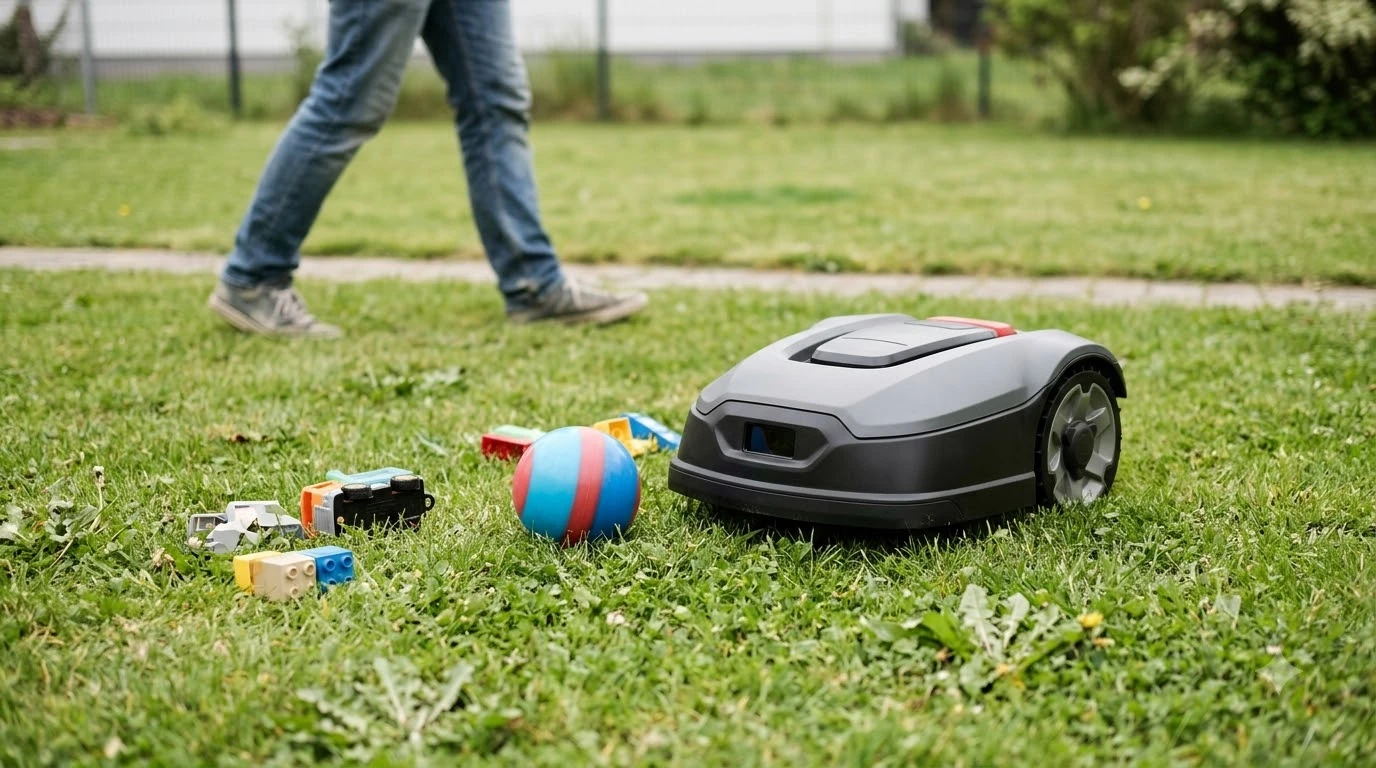

The best robot mower with obstacle avoidance is the one whose sensor type fits your yard, because no model reliably detects every object. Bump and lift sensors react after contact, while radar, ultrasonic and camera systems react before contact on selected models only, so the sensor list matters more than the brand name.
The short answer
- Bump and lift sensors: react after contact. The mower stops, reverses and steers to one side, and a lift turns the blades off.
- Radar or ultrasonic: react before contact on selected models. Husqvarna lists radar on the 405XE NERA, 410XE NERA, 430X NERA, 450X NERA and 435X AWD, and ultrasonic on the 435X AWD NERA.
- Cameras: depend on light, lens condition and distance judgment. Ecovacs says its GOAT camera can misjudge taller objects as far away.
- Limits: small, flat or low objects and tall grass can be missed by every sensor type.
- Safety: Husqvarna says object avoidance “is not a safety feature.”
Choosing the best robot mower with obstacle avoidance: what to compare
When you shop for the best robot mower with obstacle avoidance, compare the sensor type, the detection limits and whether the feature can be switched off, because those three decide how a mower behaves in your yard. Sensor type sets when the mower reacts, the limits show what it can miss, and the controls show how much you can adjust. Model names alone do not tell you which system a mower uses, and our explainer on how robot mowers avoid obstacles covers the basics.
- Sensor type: bump, lift, tilt, radar, ultrasonic or camera.
- Reaction timing: after contact or before contact.
- Model fit: whether your exact model has the sensor at all.
- Known limits: small, low or flat objects, tall grass and lighting.
- Controls: whether avoidance can be turned off, and where the switch sits.
- Boundary buffer: how close to the wire or virtual boundary avoidance stops working.
Bump and lift sensors react after contact
Bump sensors are the most basic layer, and they work only after the mower touches something. PCWorld calls them the simplest option, describing a mower that taps an obstruction and then works its way around it. On a Husqvarna Automower, the collision sensor sits next to the rear wheels. It stops forward movement, then the mower reverses and turns to either side before it resumes.
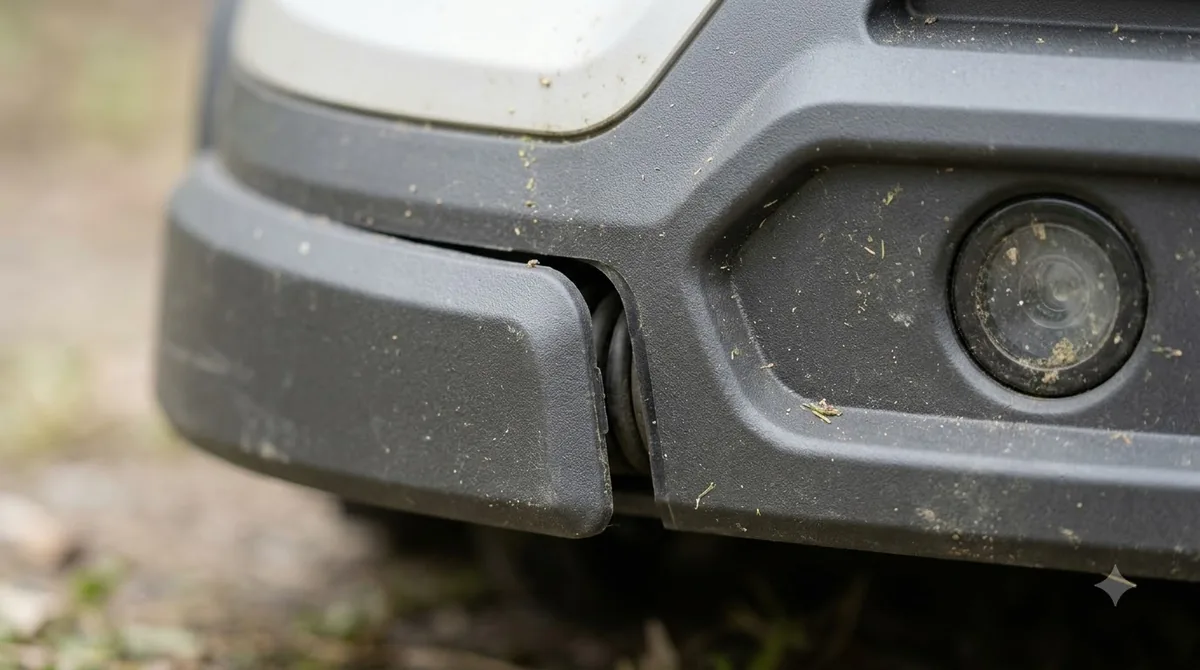
Lift and tilt sensors cover a different risk. The lift sensor sits at the front, and if the mower is raised off the ground while it is active, the blades switch off. The Automower tries to restart roughly 20 seconds after it is put back in its normal position. The tilt sensor sits on the rear chassis. If the mower is lifted from the rear while the rear cover is open, the blades stay off until it is returned to the correct position.
PCWorld’s author also notes that a Husqvarna 435X AWD, a bump-based model, left scuff marks from years of use. That is one reviewer’s observation, not a lab test, and a reminder that contact-based avoidance means the mower touches things.
Radar and ultrasonic detect objects before contact
Radar and ultrasonic sensors scan the area ahead and change the mower’s path when an object is detected, rather than waiting for a bump. Husqvarna’s support article offers the feature on selected models only, and states that other Automower models lack the required sensors. The model list above is the first thing to check on any spec sheet when you compare the best robot mower with obstacle avoidance options.
The feature can be switched on or off. In the Automower Connect app, go to More, then Settings, then Accessories, and use the slider. If the option does not appear, Husqvarna advises updating the mower firmware and the app. Our reading is that this control matters most in yards with tall grass, which the next sections cover.
Camera systems depend on light and lens condition
Camera-based avoidance is common on boundary wire-free mowers. PCWorld describes a front-mounted camera as the most common technology on those models. Cameras recognize objects from images rather than waiting for contact, and our guide to how vision robot mowers work goes deeper.
Ecovacs, in its help page for the GOAT mower, lists specific limits. The camera uses a single lens, so it lacks human-like depth perception, and taller objects on the ground can be misjudged as far away, which means avoidance is not triggered. Performance drops in low light, intense sunlight, rain and on uneven ground. The same page says the system does not detect obstacles to the sides or rear of the mower, and that visual avoidance must be switched on manually in the app.
Lymow, a camera-system vendor, says lighting changes can affect image quality and depth estimation. That is marketing from a company that sells a camera-based system, so treat it as the vendor’s view rather than an independent test.
Where every sensor type falls short
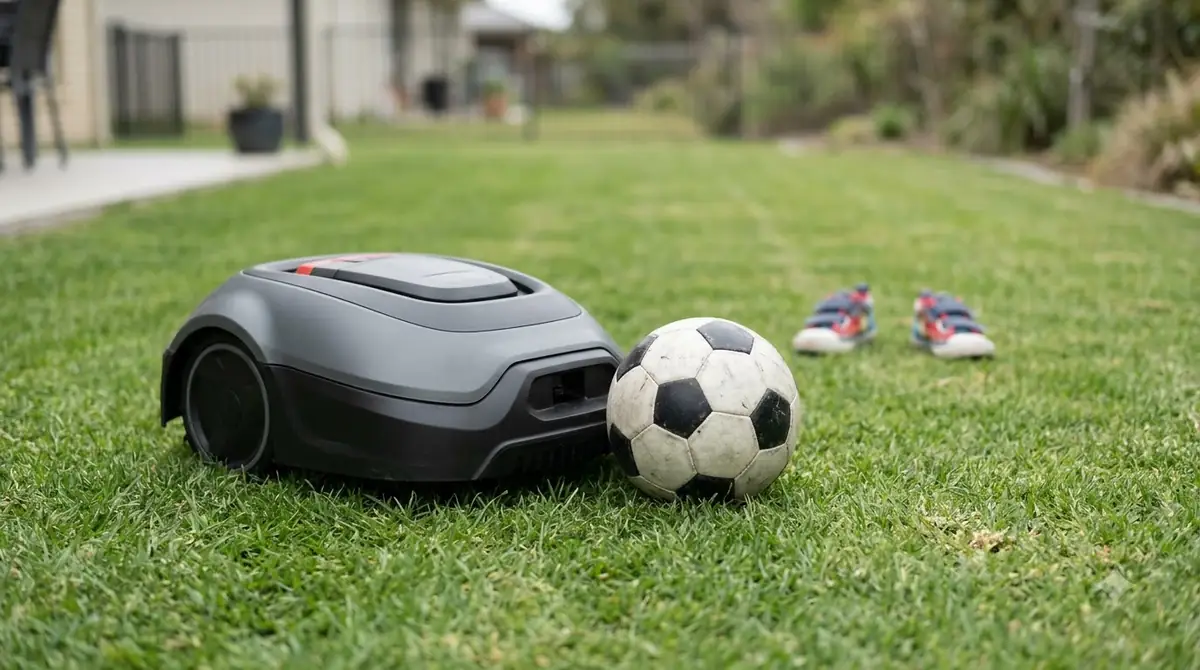
Even the best robot mower with obstacle avoidance misses some objects with every sensor type, so the limits matter as much as the feature list. Husqvarna says small objects are harder to detect, especially in tall grass, and gives golf balls as an example. Flat objects, or objects very close to the ground, may not be detected at all.
- Tall grass: sensors may read grass, flowers or dandelions as obstacles, which can leave uncut patches.
- Boundary zone: avoidance is disabled within 60 cm (2 feet) of the virtual boundary on EPOS installations, and within 90 cm (3 feet) of the boundary wire.
- Camera limits: low light, bright sun, rain and uneven ground reduce accuracy.
Husqvarna is direct about the safety side. Its support article says that while object avoidance is effective at detecting objects on the lawn, it “is not a safety feature,” and there is no guarantee that objects will not be run over. Our reading is that the feature reduces collisions, but it should not replace clearing toys, hoses and small items from the mowing area, as described in our note on robot mower safety around kids and pets.
Sensor types side by side
The table sums up what each sensor type does and where its documented limits sit for any robot mower with obstacle avoidance. Read it with the limits in mind, because the sensor names alone do not show how a mower will behave on your lawn.
| Sensor type | When it reacts | Documented limits |
|---|---|---|
| Bump (collision) | After contact | Reacts only once the mower touches an object |
| Lift and tilt | When lifted or tilted | Stops the blades on pickup or tilt, not on objects in the path |
| Radar | Before contact, on selected models | Tall grass and flowers can be read as objects; Lymow, a vendor, says radar struggles with low objects such as hoses |
| Ultrasonic | Before contact, on selected models | Small objects in tall grass are harder to detect; flat or low objects may be missed |
| Camera | Before contact, on AI vision models | Single-lens depth limits; low light, rain, sunlight and uneven ground reduce accuracy |
What to check before you buy
Check the sensor list, the manual’s limits, the boundary buffer, the on/off control and your yard’s grass and objects before you buy the best robot mower with obstacle avoidance. The steps below cover those checks in order, and each one can rule a model in or out.
- Sensor list. Confirm that the exact model lists the radar, ultrasonic, camera or bump and lift sensors you want.
- Limits. Read what the manual says about small, flat or low objects and about tall grass.
- Boundary buffer. Check how close to the wire or virtual boundary avoidance stops working, and plan for that strip.
- Controls. Find where avoidance is switched on or off, and whether firmware or app updates are needed.
- Your yard. List tall grass, low toys, hoses and dark or wet areas, then decide where avoidance may need to be off or where no-go zones are needed.
Ecovacs recommends no-go zones around valuable items and in spots where a mower often gets stuck, and our guide shows how to set up no-go zones. Our reading is that a yard with many low objects and tall grass should not rely on any single sensor type, so the best robot mower with obstacle avoidance for that yard may be the one whose limits you can work around. Pair the mower with no-go zones and a clear lawn.
Frequently asked questions
Can a robot mower with obstacle avoidance run over a toy?
It can, so do not rely on the feature alone. Husqvarna says object avoidance is not a safety feature and that there is no guarantee objects will not be run over. Pick up toys and hoses before each mowing run.
Does obstacle avoidance work right next to the boundary?
Not in the strip nearest the boundary. Husqvarna says avoidance is disabled within 90 cm (3 feet) of a boundary wire, and within 60 cm (2 feet) of the virtual boundary on EPOS installations. Keep toys and hoses clear of that edge strip as well.
Do camera-based robot mowers work at night?
Not reliably. Ecovacs says its GOAT does not support low-light operation, and that avoidance is less effective in low light, intense sunlight or rain. Check your model’s manual before relying on camera detection in dim or wet conditions.
Should I turn obstacle avoidance off in tall grass?
Husqvarna suggests it in some cases. Its support article says that on lawns with very high grass or tall dandelions, you may want to disable object avoidance temporarily, because sensors can read vegetation as objects and leave uncut patches.
Sources
- Husqvarna object avoidance support article (manufacturer): model list, detection limits, boundary buffer, on/off setting and the safety statement.
- Husqvarna, how Automower sensors work (manufacturer): collision, lift and tilt sensor placement and behavior.
- Ecovacs GOAT help page (manufacturer; Polish-language page, translated for this article): camera limits, low-light note and no-go zone advice.
- PCWorld, how robot lawn mowers cut grass without whacking off your toes (Ed Oswald, June 26, 2024): bump, lift and camera overview and one reviewer’s observation.
- Lymow, obstacle avoidance solution (vendor marketing, cited as the vendor’s view): radar and camera limits. lymow.com
 Up next8 min readBest Robot MowersBest Robot Mower With Ultrasonic Sensors: 5 Checks Before You BuyUpdated Nov 11, 2026
 9 min readBest Robot MowersHow Do Robot Mowers Avoid Obstacles?Updated Nov 11, 2026
 8 min readBest Robot MowersDo Robot Mowers Work in the Rain? Sensors, Delays and LimitsUpdated Nov 11, 2026
 8 min readBest Robot MowersHow Do Robot Lawn Mowers Work? Wire, Sensors and Docking ExplainedUpdated Nov 11, 2026
 8 min readBest Robot MowersBest Robot Lawn Mower for 5 Acres: What to Check Before You BuyUpdated Nov 11, 2026
 7 min readBest Robot MowersBest Robot Mower for Thick Grass: 5 Things to CheckUpdated Nov 11, 2026