
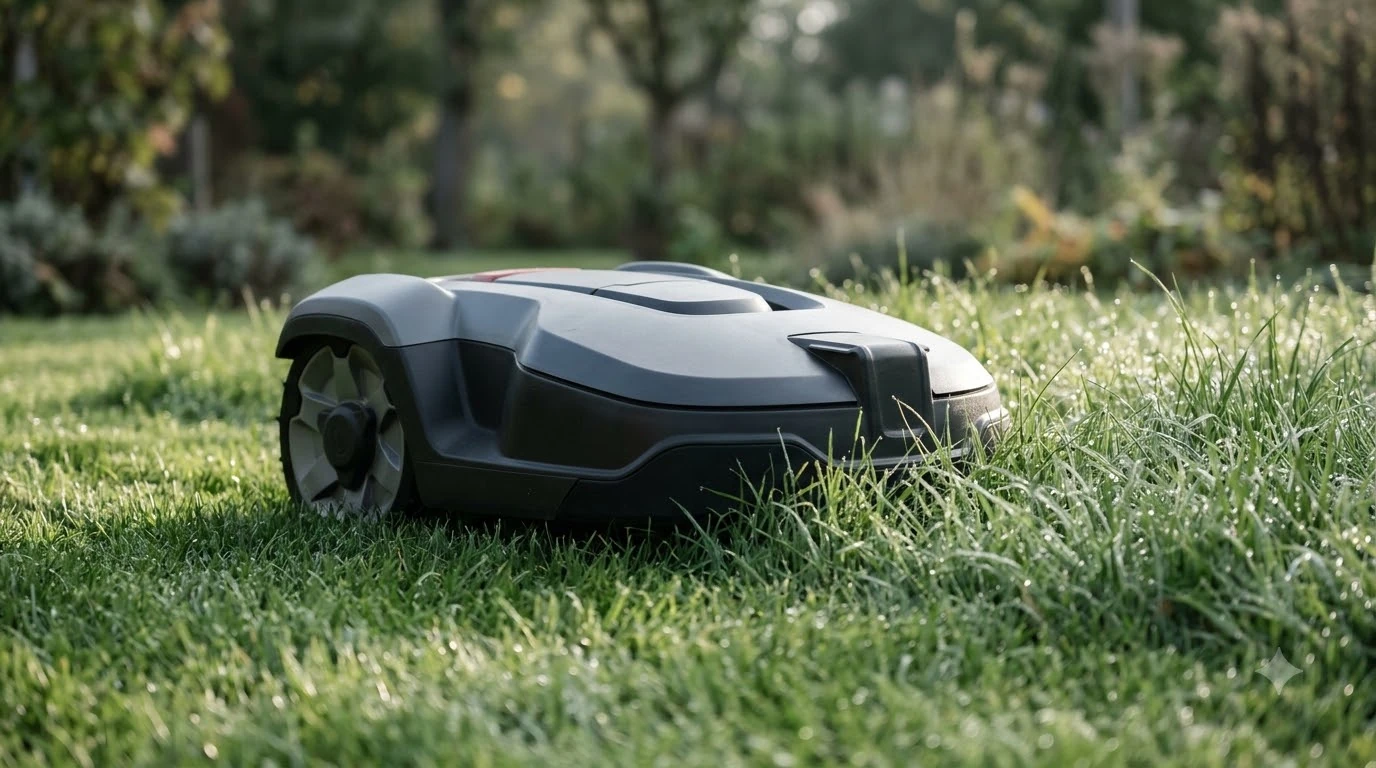

There is no single best robot mower for thick grass, but the right choice starts with how much grass a mower removes in one pass. University turf guidance says never remove more than one-third of the grass height at one mowing, so a model for thick or tall grass needs a cutting height range and a schedule that can keep up. As of 2026-11-10, this guide explains what to check, using extension research on cutting height.
The short answer
- Follow the one-third rule. Remove no more than one-third of the grass height at any single mowing.
- Match the height to the grass. Bermudagrass, zoysiagrass and tall fescue each have a different recommended range.
- Raise the cut when grass is too tall, then lower it in steps over several mowings.
- Check the mower’s cutting height range, blades and schedule before you buy, because those decide how it handles long grass.
Why thick grass is hard on any mower
Thick grass is not only harder to cut. When a mower takes off too much height at once, the grass is stressed and the cut looks damaged. The University of Arizona Cooperative Extension describes this as scalping, which gives turf a burned look and leaves it open to weeds, disease and insects. The same guide warns that dull blades tear and shred leaves, so the blade condition matters as much as the motor.
A dense lawn has its own benefit. Clemson’s Home and Garden Information Center notes that a dense turf keeps out weeds by competing for sunlight and nutrients. The goal is not to cut thick grass as hard as possible. It is to keep the lawn at a steady height that stays dense.
Set the cutting height by grass species
Each grass has a recommended height range, and it is set by the species, not by the mower. Clemson’s table gives these ranges in inches.
| Grass | Clemson recommended height (in) |
|---|---|
| Tall fescue (winter / summer) | 2 to 3 / 3 to 3.5 |
| Fine fescue (winter / summer) | 1.5 to 2.5 / 2.5 to 3 |
| Centipedegrass | 1.5 to 2 |
| Zoysiagrass | 1 to 2 |
| Common bermudagrass | 1 to 2 |
| Hybrid bermudagrass | 0.5 to 1.5 |
The University of Kentucky gives narrower ranges for some of the same grasses: one-half to one inch for bermudagrass, three-fourths to one inch for zoysia, and two to two and one-half inches for tall fescue. The two sources do not agree exactly, so use your regional extension service as the final check.
Best robot mower for thick grass and the one-third rule
The one-third rule is the core of the advice. The University of Arizona puts it as “never remove more than one-third (1/3) of the height of the lawn at any mowing event,” and Clemson uses almost the same wording. Kentucky describes it as a rule of thumb of one-third to one-half, so one-third is the safer number. Our guide to the one-third rule for mowing explains it in more detail.
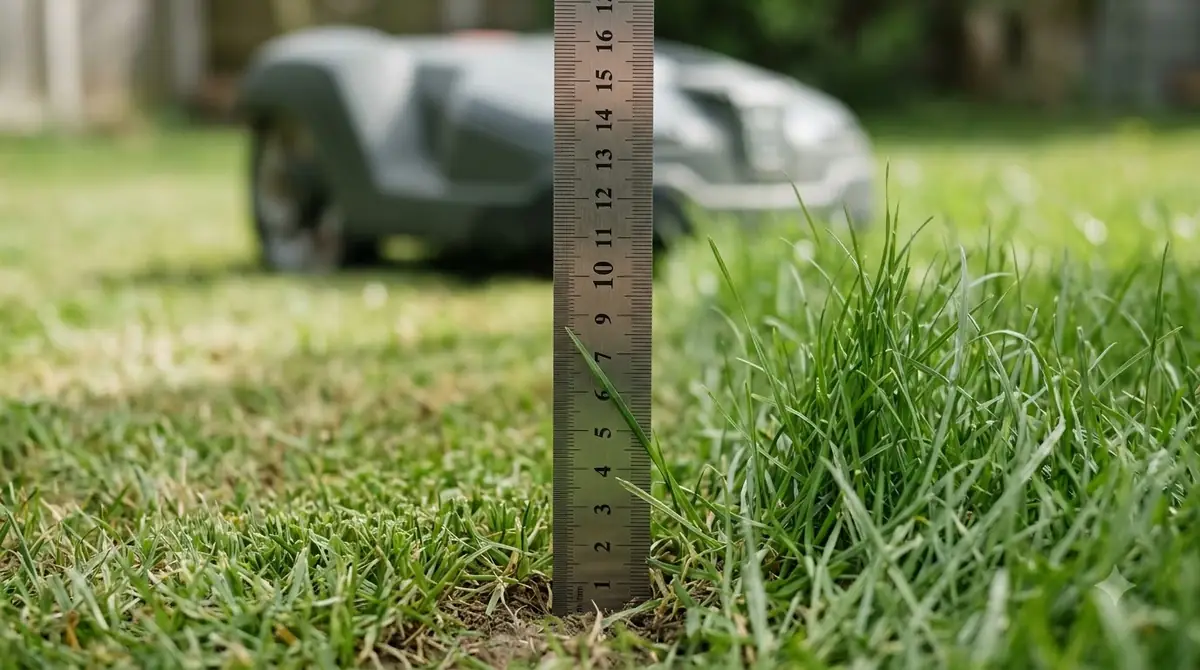
Here is how the rule works in practice. Suppose the lawn has grown to 4 inches and you want it at 2 to 2.5 inches. One-third of 4 inches is 1.33 inches, so the first pass should leave the grass no lower than 2.67 inches. Our reading is that a second pass a few days later can bring it down the rest of the way. The arithmetic is simple, but it is the reason a mower with a wide height range is useful: it lets you start high and lower the setting step by step.
The Arizona guide gives a related check. The next cut is due when the grass is about 33 percent taller than its base height, so for a turf with a 2-inch base the next mowing should happen at about 2.67 inches.
Handle grass that has grown too tall
Clemson advises raising the cutting height when grass gets too tall between mowings, then lowering it gradually to the recommended height. If the lawn is far past that point, read how to cut an overgrown lawn before a robot mower takes over. Kentucky gives the same advice in its own words: raise the mowing height so you do not cut off too much grass at one time.
The Arizona guide adds two situations where a taller cut helps. During summer heat stress, raising the height gives roots more growth and shades the base of the plant. Under trees or on the north side of a building, grass gets less light, so allowing it to grow taller can help. Our reading is that the best robot mower for thick grass is one that cuts often and short, so the grass never reaches the point where one pass has to remove more than a third.
Blades, clippings and wet grass
Blade condition affects thick grass more than most buyers expect. The Arizona guide says a dull blade causes scalping, torn leaves and a damaged appearance, so blades should be sharp and properly adjusted. Our reading is that a mower working through thick grass puts more strain on its blades, so regular blade checks matter more on a thick lawn, and the guide to robot mower blade replacement shows what to look for.

Wet grass is the other common problem. The same Arizona guide says to avoid mowing wet turf, because it balls up and clogs the blades and deck. For a robot mower, our reading is that a schedule that keeps it off wet grass is more useful than extra cutting power. The guide advises collecting clippings when they are excessive, when the turf is diseased, or when weeds are setting seed. More on this is in our note on robot mowers and wet grass.
What to check on a robot mower before you buy
When you look for the best robot mower for thick grass, our reading is that the following checks matter more than any single number on a box. We did not read manufacturer spec sheets for this guide, so confirm every figure with the maker before you buy.
- Cutting height range. Look for a range that covers your grass’s recommended height and reaches higher settings for the first cut after a long gap. Our guide to a robot mower with adjustable cutting height covers that spec.
- Stated slope rating. Read it as a limit under ideal conditions, and compare it with the slopes in your own yard.
- Blade replacement. Check how blades are changed and how often the maker recommends it, since dull blades cause scalping.
- Schedule control. Make sure you can set run times that keep the mower off wet grass and let it cut often and short.
- Deck and clipping handling. Look at how easily the underside can be cleaned after a thick cut, since clogged decks cut poorly.
In short, the best robot mower for thick grass is the one whose height range, blades and schedule let it follow the one-third rule on dry grass.
Frequently asked questions
Is there a best robot mower for thick grass?
No single model is best for every lawn. The University of Arizona and Clemson both advise removing no more than one-third of the grass height at one mowing, so the right mower is one whose height range and schedule fit your grass.
What cutting height should I use for thick grass?
It depends on the species. Clemson lists 1 to 2 inches for zoysiagrass and common bermudagrass and 2 to 3 inches for tall fescue in winter. Check your regional extension guide because the sources differ slightly.
What should I do if the grass has grown too tall?
Raise the cutting height first so you do not remove too much at once, then lower it gradually to the recommended height over several mowings, as Clemson and the University of Kentucky both advise.
Does wet grass affect a robot mower?
Yes. The University of Arizona says wet turf balls up and clogs blades and the deck. Our reading is that scheduling the mower to avoid wet grass is a practical way to protect the cut.
Sources
- Mowing Turfgrasses in the Desert (AZ1681) (University of Arizona Cooperative Extension): one-third rule, scalping, dull blades, wet turf and the desert base height table.
- Mowing height guidance (Clemson Home and Garden Information Center): recommended heights by grass, the one-third rule and raising the cut for overgrown lawns.
- Mowing grass for best results (University of Kentucky): rule of thumb for removing grass height and heights for bermudagrass, zoysia and tall fescue.
 Up next8 min readBest Robot MowersBest Robot Mower That Handles Tall Grass: 5 Things to CheckUpdated Nov 11, 2026
 8 min readBest Robot MowersBest Robot Lawn Mower for 5 Acres: What to Check Before You BuyUpdated Nov 11, 2026
 8 min readBest Robot MowersBest Robot Mower With Ultrasonic Sensors: 5 Checks Before You BuyUpdated Nov 11, 2026
 8 min readBest Robot MowersDo You Need a Grass Collector on a Robot Mower?Updated Nov 11, 2026
 9 min readBest Robot MowersBest Robot Mower With Obstacle Avoidance: 5 Sensor TypesUpdated Nov 11, 2026
 8 min readBest Robot MowersWhat Size Robot Mower Do I Need for 1.5 Acres?Updated Nov 11, 2026