
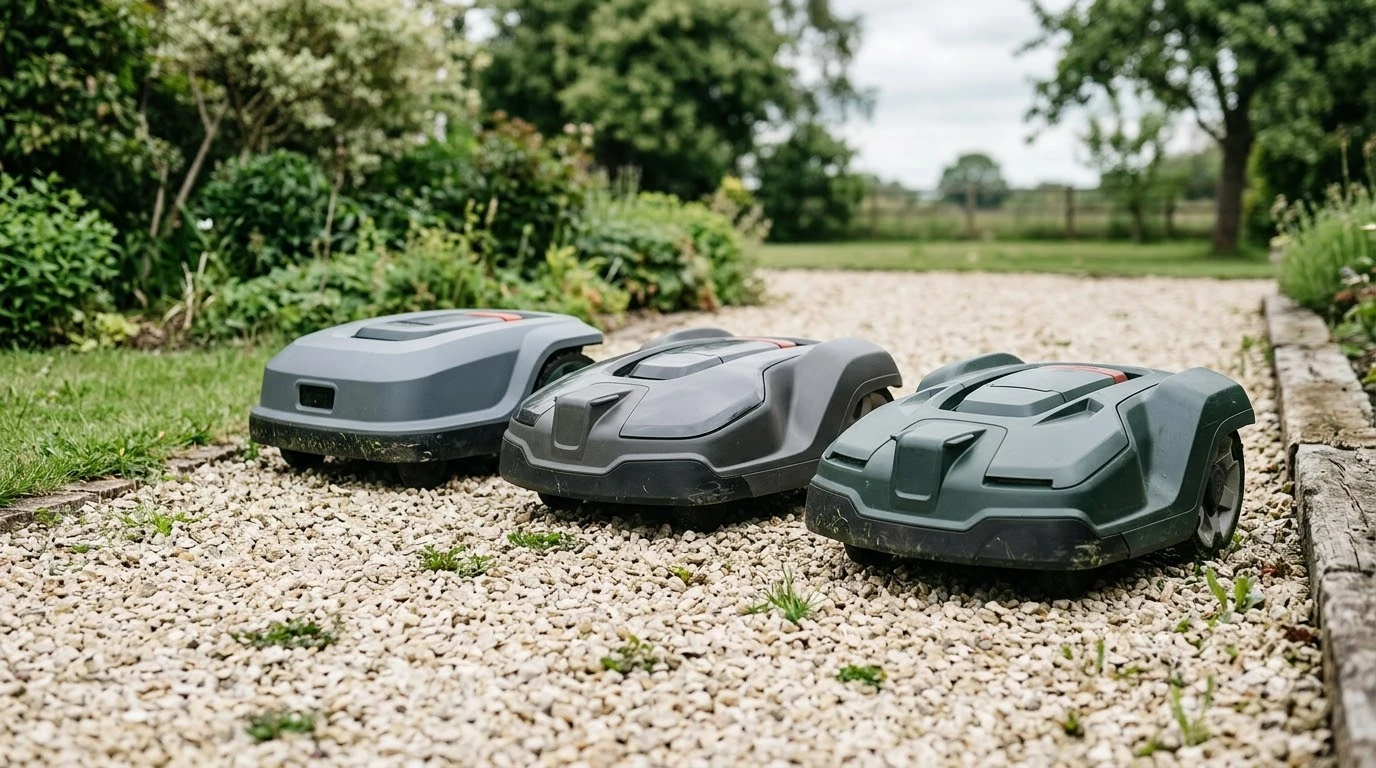

Which robot mower works best around hedges and shrubs depends mainly on how it navigates. A buried boundary wire needs a fixed clearance from every hedge, a GPS or RTK mower loses satellite signal under dense foliage, and a camera mower needs to see grass. The sources below set out the numbers, so you can judge a model against your own yard rather than a ranking.
The short answer
- Wire mowers: Husqvarna’s wire guide sets 30 cm from a flowerbed-height edge and 35 cm from a wall-height obstacle.
- GPS and RTK mowers: dense foliage can block, weaken and reflect satellite signal, which can cause pauses and uneven mowing.
- Camera mowers: Husqvarna says they can keep mowing weak-signal spots if they see grass and hold a good position.
- Charging station: keep hedges and buildings at least 6 m in front of the dock so they do not block the satellite signal.
How hedges and shrubs affect each navigation type
Hedges and shrubs cause different problems depending on how a mower positions itself, so which robot mower works best around hedges and shrubs depends on the problem your yard triggers. A wire mower is affected mostly by where the wire is laid, because the wire keeps the mower inside the lawn edge. A satellite mower is affected by what sits between its receiver and the open sky. A camera mower depends on visible grass and a usable view of the edge.
Our reading is that a yard with tall, dense hedges is a harder case for any navigation type than a yard with low, open borders. No single type avoids the problem entirely, so the trade-off is which weakness your yard is least likely to trigger.
Boundary wire: how far to keep from hedges and shrubs
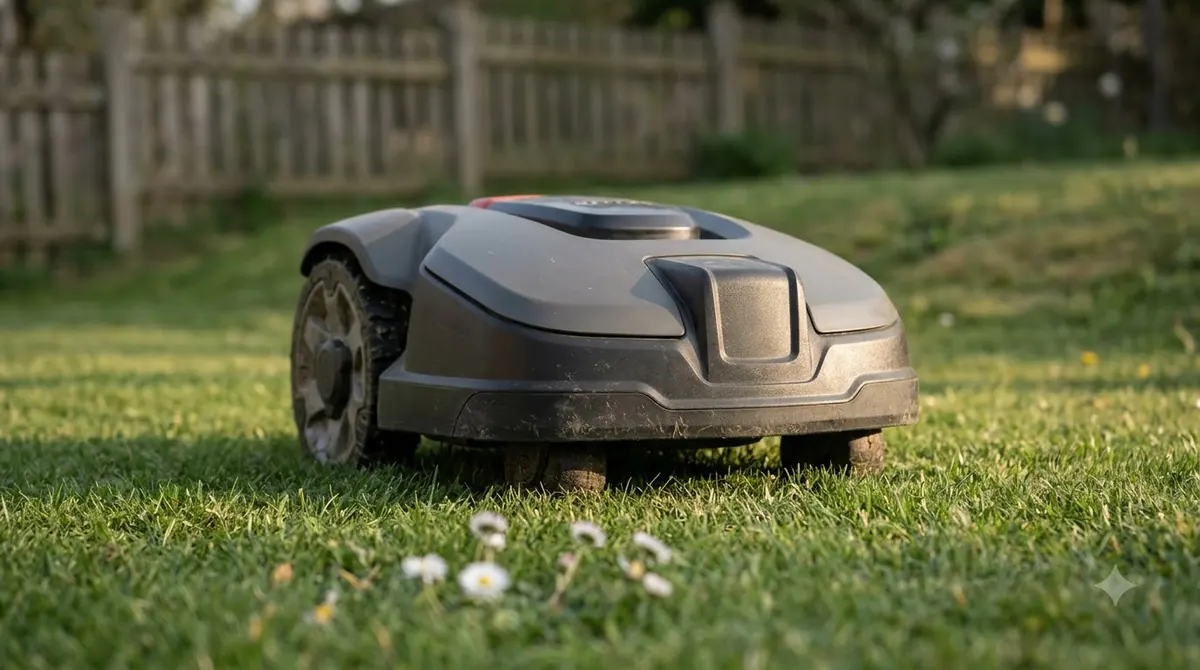
Husqvarna’s wire installation guide sets the clearance by obstacle height rather than by plant type. It gives 10 cm from obstacles lower than 1 cm, such as a pathway, 30 cm from obstacles between 1 and 3.5 cm high, such as a flowerbed, and 35 cm from obstacles higher than 3.5 cm, such as a wall. Any mower that follows a buried loop depends on these clearances being respected during installation; our guide to laying boundary wire around trees and obstacles covers the layout in more detail.
| Obstacle height | Example in the guide | Wire distance |
|---|---|---|
| Lower than 1 cm | Pathway | 10 cm |
| 1 to 3.5 cm | Flowerbed | 30 cm |
| Higher than 3.5 cm | Wall | 35 cm |
The guide does not give a fixed figure for trees. For islands around an obstacle such as a tree, it tells you to use the cardboard ruler supplied in the mower box to measure the wire distance. Hedges are not named either. Our reading is to treat a hedge that rises well above the lawn edge as a wall-height obstacle, and to use the 30 cm figure only where the hedge is low enough to behave like a flowerbed border. Confirm the choice against your model’s manual before you lay the wire. For a wire system, that clearance is the main answer to which robot mower works best around hedges and shrubs.
GPS and RTK mowers under dense foliage
Satellite-based mowers are the group most exposed to foliage. A robot-mower vendor’s explanation says trees block, weaken and reflect satellite signals, and that reflected signals make the mower’s position harder to judge. The same explanation lists symptoms such as pausing, slowing, route correction, uneven mowing and trouble docking.
Recovery differs by system. According to that vendor, some mowers recover quickly once the signal returns, while others stop until it improves. The same source gives its view that vision combined with RTK may reduce disruption compared with RTK alone. If you are placing an antenna near trees, read where to place an RTK antenna in a yard with trees. That is a vendor opinion, not a test result, and we have no independent data that measures how much a given hedge reduces signal quality.
Vision mowers near shrub edges
Camera mowers work differently. Husqvarna’s wire-free installation guide says mowers with cameras use AI vision to keep mowing areas where satellite signal is weak, as long as the mower can see grass and has a good enough position. A shrub that hides the grass edge gives the camera less to follow, so a clean, visible border matters more for this type.
Our reading is that vision reduces the penalty of a weak signal, but it does not remove the need to keep the edge clear. Trim overhanging shrub growth that blocks the view of the lawn, and check the mower’s manual for any settings that affect edge behavior. For a yard with many shrub borders, that edge view is a fair way to judge which robot mower works best around hedges and shrubs.
Narrow gaps and tree crowns near the boundary
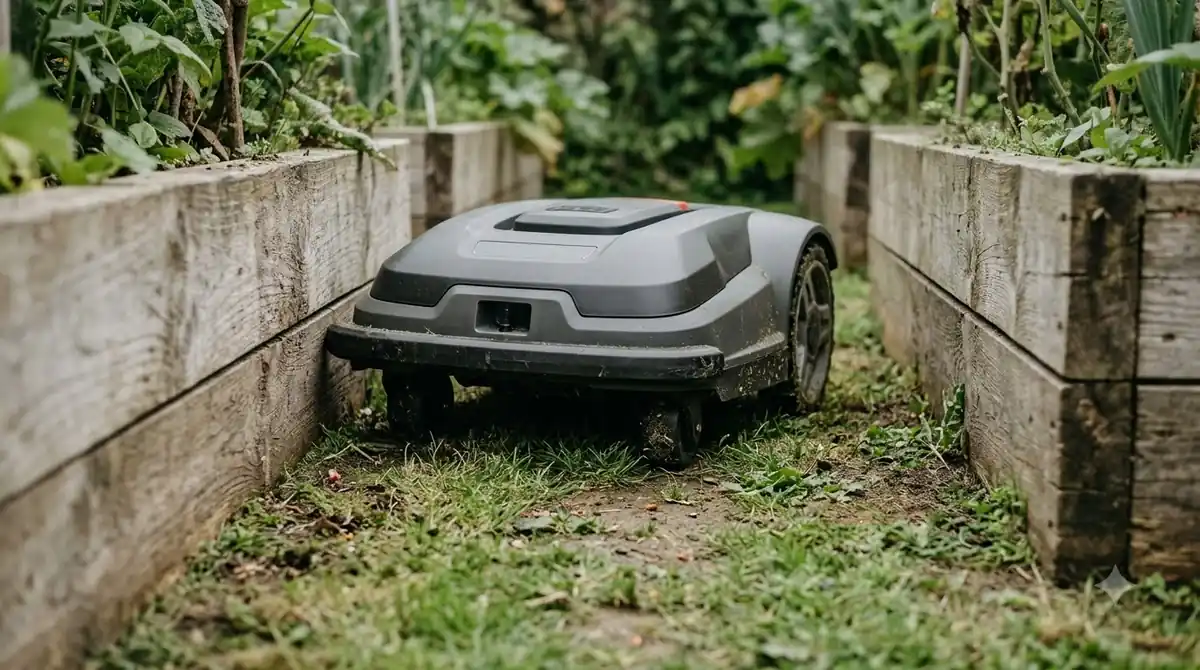
The same installation guide lists two common weak spots. The first is an area narrower than 4 m with elevated objects on either side, such as two hedges with a path between them. The second is a tree where the distance between the crown and the boundary is less than 4 m (see how a robot mower handles trees). The guide also notes that coverage can be affected near densely clustered trees.
For mowers without vision, the guide suggests laying a loop of wire through difficult spots to reduce interruptions, or moving the virtual boundary further from the edge in those areas. In narrow passages, a transport path lets the mower pass through without mowing.
Heads up
The 4 m figure comes from one manufacturer’s guide. Treat it as a planning check, and confirm the minimum width in your model’s manual.
Charging station placement near hedges
The station needs a clear view of the sky. Husqvarna’s wire-free guide says it should not sit under trees or a roof, and that elevated objects such as hedges or buildings should be at least 6 m in front of the charging station so they do not block the satellite signal to the docking point.
If you use a reference station for RTK, the same guide asks for at least 135 degrees of clear sky above it. It also says the mower does not need a line of sight to the reference station in order to mow.
Which robot mower works best around hedges and shrubs: what to check
No single answer to which robot mower works best around hedges and shrubs fits every hedge layout. Use the checks below to narrow the field, then compare the figures in each model’s manual rather than a general ranking.
- Navigation type: decide whether wire, RTK or vision suits your yard, and note which weakness your hedges would trigger.
- Hedge height and distance: measure from each hedge face to the lawn edge, then apply the wire clearance for its height.
- Gaps and tree crowns: flag any passage narrower than 4 m between tall objects, and any tree crown closer than 4 m to the boundary.
- Sky view at the dock: confirm there is no tree or roof over the station, and that hedges sit at least 6 m in front of it.
- Manual figures: the numbers here come from manufacturer guides, not from our own tests. Check the figures for the exact model before you buy.
Frequently asked questions
Do robot mowers cut right up to a hedge?
Wire mowers stay inside the boundary wire, and the wire is placed 10 to 35 cm from obstacles depending on their height. Our reading is that a narrow strip next to a hedge is usually left for hand trimming; see what cut to edge distance means.
Do hedges block GPS on a robot mower?
Dense foliage can weaken and reflect satellite signal, which is the main risk for RTK mowers. The sources we read do not give a density threshold, so the effect depends on the hedge and on the sky view around it.
How far should boundary wire be from a hedge?
Husqvarna’s guide sets 30 cm for a flowerbed-height obstacle and 35 cm for a wall-height obstacle. It does not name hedges, so check your model’s manual for the figure that applies.
Is vision better than RTK near shrubs?
Neither is better in every yard. Husqvarna says camera mowers can keep working in weak-signal spots when they see grass. A vendor view is that vision combined with RTK may reduce disruption. We have no independent test data comparing the two.
Sources
- Automower wire installation (Husqvarna): wire clearances by obstacle height, islands around trees.
- Plan wire-free lawn mower installation (Husqvarna): 6 m charging station clearance, narrow gaps, tree crown distance, reference station sky view, vision in weak-signal areas.
- RTK robot mower signal loss and trees (Mowrator, vendor blog): how foliage affects satellite signal and the symptoms it causes.
 Up next10 min readBest Robot MowersRobot Mower No RTK Antenna: How Navigation Works Without OneUpdated Nov 16, 2026
 8 min readBest Robot MowersBest Robot Lawn Mower That Works With Alexa: What the Brands DocumentUpdated Nov 11, 2026
 7 min readBest Robot MowersSelf Charging Robot Lawn Mower: How Auto Return WorksUpdated Nov 13, 2026
 8 min readBest Robot MowersBest Robot Lawn Mower That Works With Google Home in 2026Updated Nov 11, 2026
 6 min readBest Robot MowersBest Budget Robot Lawn Mower That Actually Works: What to CheckUpdated Nov 11, 2026
 8 min readBest Robot MowersBest Robot Mower That Works in the Rain: What to Check Before You BuyUpdated Nov 11, 2026