
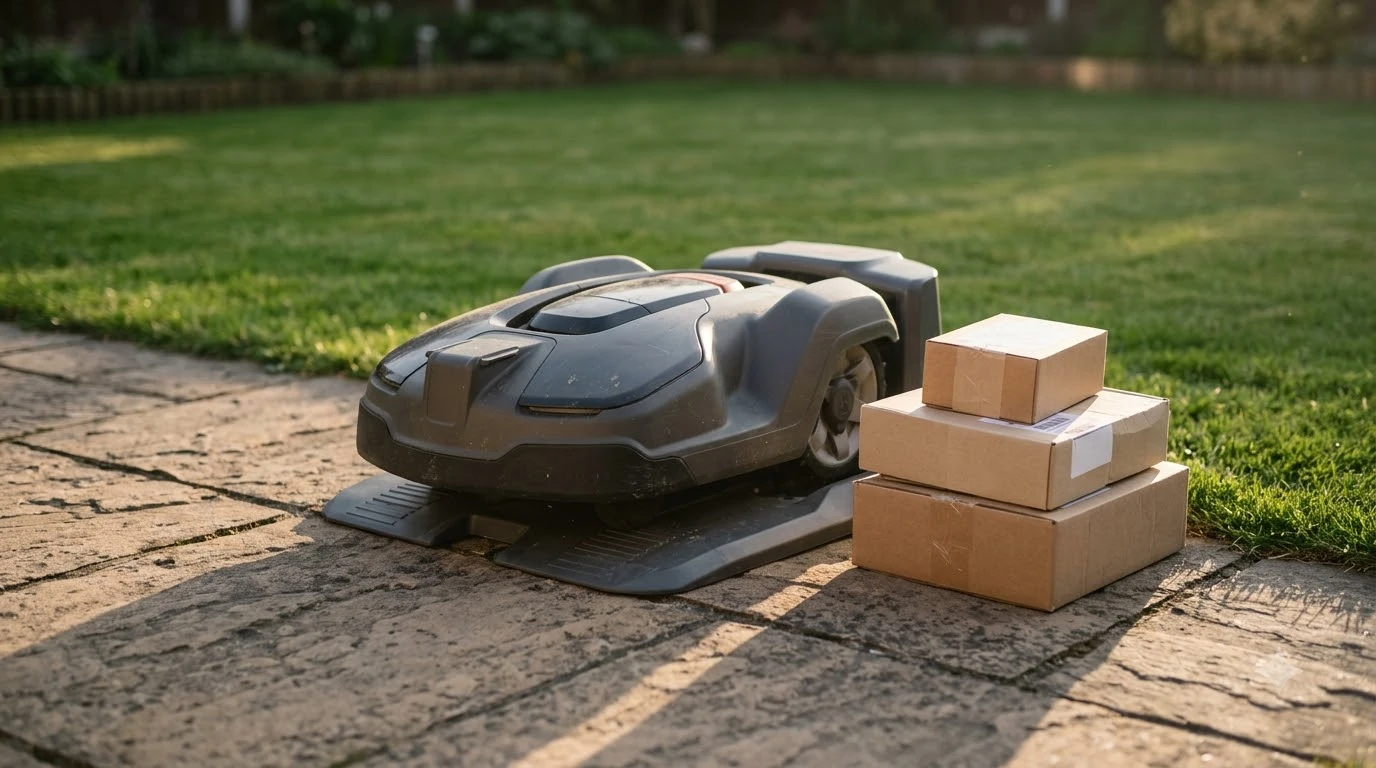

The best heavy-duty turf staples for securing dock mats are 6-inch to 12-inch galvanized steel U-shaped or circle-top pins built from thick 8-gauge to 11-gauge wire. Robotic lawn mowers follow identical paths into and out of their charging stations daily, creating localized wheel shear that tears up standard lawn grass unless a protective mesh or reinforcement mat sits firmly anchored underneath. Light plastic pegs supplied with boundary wire kits bend or pop loose under repeated turning torque, whereas thick galvanized steel pins lock the mat flush against the soil so mower blades and drive wheels pass smoothly over the entrance zone.
The short answer
- Wire thickness matters most: Choose 8-gauge to 11-gauge steel rather than thin 14-gauge or 15-gauge garden pins, because lower gauge numbers mean thicker wire that resists bending under a rubber mallet.
- Match length to soil density: Six-inch staples hold well in firm, loamy yards, while 8-inch to 12-inch lengths prevent pull-out in sandy, loose, or wet turf.
- Galvanized coatings prevent rust: Hot-dip or electro-galvanized finishes protect steel fasteners from moisture and lawn fertilizers over multiple mowing seasons.
- Head style affects grip and safety: Square-top U-staples and wide circle-top pins distribute downward pressure across plastic or rubber dock mats without slicing through the mesh.
- Flush seating protects mower blades: Every staple crown must sit completely flat against the mat surface so spinning cutting discs never catch exposed metal.
Why dock mats need heavy-duty turf staples
Repeated wheel traffic around a robotic mower charging base wears down natural grass faster than any other spot in the yard, making a firmly anchored protection mat essential.
According to Cleva Europe, fixed charging docks require a robotic mower to trace the exact same navigation path back to its charging pins every single day, leading to concentrated turf wear at the dock entrance. Many robot mower operator manuals—including the Northern Tool Robotic Mower Operator’s Manual—explicitly recommend fortifying soft or uneven ground around the docking station with a grass protection mesh so the repeated stress of the drive wheels does not rut the soil.
Once you lay a rubber honeycomb mat or polyethylene turf reinforcement mesh in front of the base, the fastener holding it down becomes the weakest link. As the mower pivots to align with the charging contacts, its lugged rear wheels exert lateral shear force across the mat. Thin plastic boundary-wire pegs lack the shaft rigidity to resist sideways leverage, allowing edges to curl upward into the path of the cutting deck.
Types of heavy-duty turf staples and pins
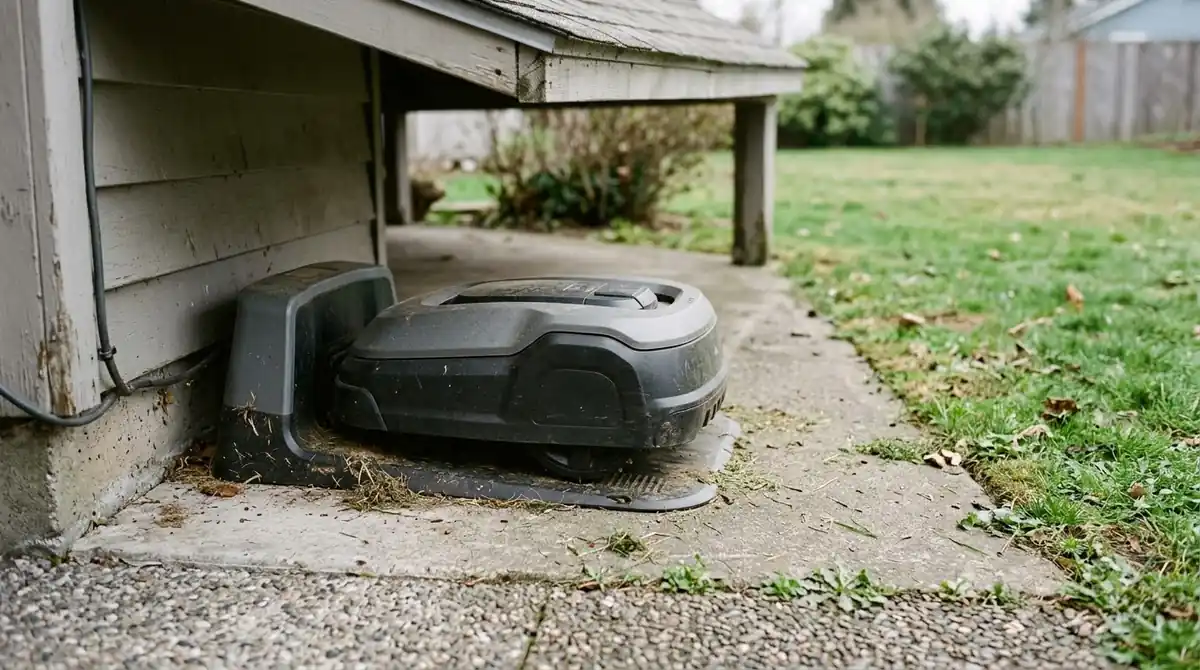
Heavy-duty landscape fasteners come in three primary head geometries, each suited to different mat materials and soil conditions.
In the turf and erosion-control industry, wire thickness is measured by gauge, where a lower gauge number indicates a thicker, stiffer steel shaft. While standard consumer garden pins often use 11-gauge or thinner wire, commercial turf reinforcement staples step up to 9-gauge or 8-gauge steel for rocky or high-traffic ground.
| Fastener Type | Typical Gauge | Common Lengths | Best Dock Mat Pairing |
|---|---|---|---|
| Square-top U-staple | 11-gauge to 9-gauge | 6 in. to 12 in. | Plastic grass protection grids and woven turf reinforcement mats |
| Round-top U-pin | 11-gauge to 8-gauge | 6 in. to 12 in. | Thick rubber honeycomb dock mats and high-stress front edges |
| Circle-top sod pin | 8-gauge to 11-gauge | 6 in. to 8 in. | Wide-aperture mesh where extra surface clamping prevents pull-through |
| Spiral turf nail | Thick shank (approx. 3.7 mm to 4 mm) | 6 in. to 7 in. | Dense synthetic turf pads over compacted crushed-stone bases |
Square-top U-staples feature a flat, one-inch to two-inch wide crown with two parallel legs. That flat bridge presses evenly across the ribs of plastic grass protection grids without rocking. Round-top pins curve smoothly at the apex, which helps deflect mower tires if a wheel skims over a fastener head. Circle-top pins add a wide loop at the top that increases surface contact on open-cell mats and gives you a broader target when tapping the pin home.
What to look for when choosing dock mat staples
Selecting the right staple specs prevents bent legs during installation, premature rust, and magnetic interference with your mower’s docking sensors.
- Wire gauge and steel stiffness: Look for 11-gauge steel as a baseline for normal backyard loam, and step up to 9-gauge or 8-gauge wire if your lawn contains hard clay, gravel, or tree roots. Thicker steel transfers hammer blows straight into the soil instead of buckling at the crown.
- Shaft length and holding depth: Standard 6-inch staples provide reliable anchoring in firm soil, whereas 8-inch to 12-inch lengths are engineered for loose, sandy, or frequently saturated turf where short pins work loose.
- Galvanized corrosion resistance: Dock entrances stay damp from morning dew, irrigation overspray, and shaded placements. Galvanized steel coatings resist rust far longer than bare uncoated steel, keeping the staple intact for years rather than staining the mat with iron oxide.
- Chisel-pointed leg tips: Angled, bevel-cut ends slice cleanly through existing grass roots and thatch rather than pushing turf fibers down into the hole, which makes seating the crown flush much easier.
- Boundary wire clearance: Most robotic mowers route their guide wire or perimeter loop directly underneath or beside the docking plate. Keep metal staples several inches away from active signal wires so you do not nick insulation or distort low-frequency docking signals.
Heads up
Never drive steel turf staples directly over a buried boundary wire or guide wire. Even if the staple prongs miss the copper core, a closed metal loop sitting tight against the cable can attenuate the inductive signal your robot uses to find its charging contacts.
How to fit and maintain dock mat staples
Proper spacing and flush installation keep the dock mat immobile while protecting your mower’s underside and cutting blades.
Before laying a mat, check your mower’s minimum cutting height and dock clearance. Many robotic mowers operate at cutting heights as low as 20 mm (about 0.8 inches), meaning any raised staple crown poses a strike hazard to spinning razor blades. Guidelines from the Minnesota Pollution Control Agency for turf reinforcement mats emphasize grading the soil smooth and ensuring mats lie completely flat with zero bulges before anchoring.
- Mow and level the approach zone. Cut the grass short around the docking station and fill any wheel ruts with screened topsoil so the mat sits flat against firm ground.
- Map out boundary and guide wires. Confirm the exact path of your perimeter and guide cables underneath the mat zone so you can mark safe staple-free corridors.
- Position the mat and pre-seat perimeter pins. Lay the protection mat flush with the front lip of the charging base, slightly pinch the staple legs together for tension, and push staples by hand along the outer corners.
- Space staples tightly along high-torque edges. Place staples every 12 inches around the mat perimeter and every 3 to 4 inches along the front entry edge where mower wheels climb onto the mat.
- Drive crowns flush with a rubber mallet. Tap each staple straight down until the top bar rests slightly below the upper surface of the mat ribs, avoiding heavy blows that crack plastic grids.
- Run a test dock cycle and inspect seasonally. Send the mower home automatically to verify smooth wheel traction and clean contact alignment. Check the mat every spring and after heavy rainstorms for frost heave or lifted corners, tapping any proud staples back down immediately.
Frequently asked questions
Can I use plastic boundary wire pegs to hold down a dock mat?
Plastic pegs work fine for pinning lightweight perimeter cables, but they rarely hold dock mats securely over time. Their flexible shafts bend under wheel torque and tend to pop out during freeze-thaw cycles, creating a tripping hazard for the mower deck.
What gauge turf staple is best for hard or rocky soil around a docking station?
Choose 8-gauge or 9-gauge galvanized steel staples for compacted clay, gravel-rich soil, or root-heavy yards. Thicker wire resists buckling when driven with a mallet, whereas 11-gauge staples perform best in standard loamy soil.
How far apart should I space staples on a robot mower dock mat?
Space staples roughly 12 inches apart along the sides and back of the mat, and tighten spacing to every 3 to 4 inches along the leading front edge where the mower’s wheels climb onto the surface. Add extra pins near the center if the mat flexes when the mower turns.
Will metal turf staples interfere with my robotic mower’s charging signal?
Galvanized steel staples will not disrupt docking signals as long as you keep them several inches away from the boundary wire, guide wire, and the induction loop built into the charging base plate.
Sources
- Robotic Mower Operator’s Manual (Northern Tool): referenced for docking station slope limits and manufacturer recommendations to use grass protection mesh on soft surfaces.
- Erosion prevention practices – turf reinforcement mats (Minnesota Pollution Control Agency): referenced for soil preparation, flat-contact mat placement, and anchor spacing guidelines.
- How To Install Weed Block Landscape Fabric Using Ground Staples (Eaton Brothers): referenced for staple gauge and length matching across normal and hard soil types.
- Robot Lawn Mowers: Drop and Mow vs. Auto Charging (Cleva Europe): referenced for repetitive docking path turf wear dynamics.
 Up next9 min readGearChoosing the Best Heavy-Duty Plastic Shed Ramp for Robot Mower EntryUpdated Nov 19, 2026
 9 min readGearBest Robot Mower Dock Mat: What 2 Makers SpecifyUpdated Nov 16, 2026
 7 min readGearRobot Mower Wire Stapler Tool: Pegs, Tension and Staple DepthUpdated Nov 20, 2026
 9 min readGearBest Solar-Powered Security Light for a Robot Mower Dock: Fit and Setup GuideUpdated Nov 19, 2026
 9 min readGearBest Outdoor Smart Plug with Energy Monitoring for Mower Docks: Buyer’s GuideUpdated Nov 19, 2026
 8 min readGearChoosing the Best Stainless Steel Anti-Theft Ground Anchor for Mower DocksUpdated Nov 19, 2026