
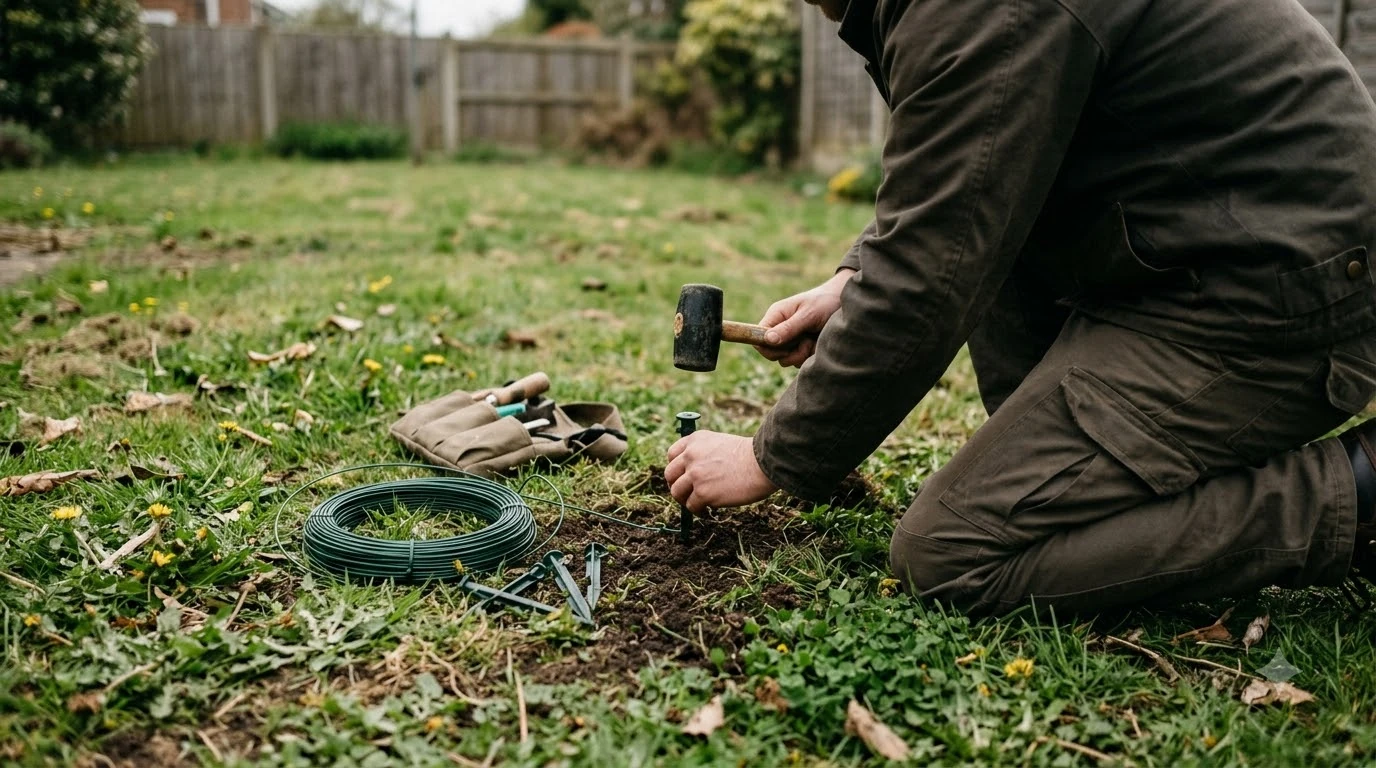

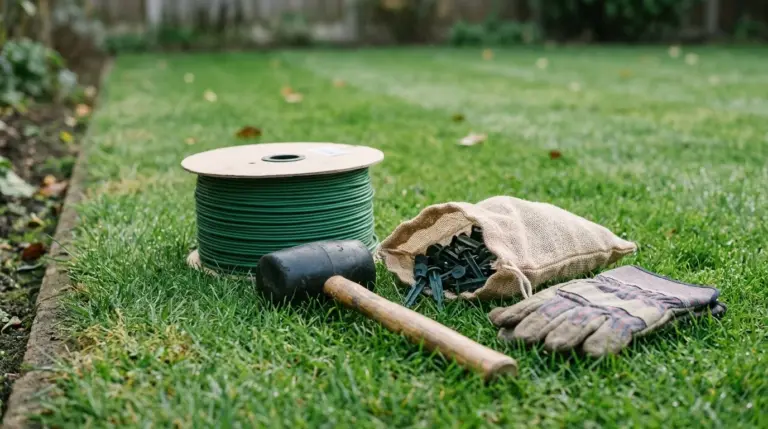
A robot mower wire stapler tool is a hand tool for driving boundary wire staples or pegs into the lawn, and the job is done well with the pegs supplied by the manufacturer, a hammer or plastic mallet, and enough care to keep the wire tight and undamaged. We did not find a single standard stapler product that manufacturers name for this job. What matters is the technique: deep, firm staples that hold the wire without strain.
The short answer
- Use the supplied pegs. Manufacturer manuals describe installing with the pegs that come in the kit.
- Drive them with a hammer or plastic mallet. A plastic mallet is gentler on the wire and the peg heads.
- Push staples deep. A staple that sits high can lift and pull the wire into the mower’s path.
- Keep the wire tight, not strained. Loose wire can be caught by the mower, while over-tight wire can break.
- Mow first. Cut the grass short so the wire lies flat and the staples seat properly.
What a robot mower wire stapler tool actually does
A wire stapler, or staple driver, is a small tool that holds a staple or peg and drives it into the soil in one press. Its job is to hold the boundary wire against the ground at regular points. The wire itself is a low-voltage loop, so the stapler does not carry power or change the signal. It only has to keep the loop in its planned place. Staples are only as good as the cable underneath them, so start from the boundary wire to staple down that suits your garden size.
Many owners do not buy a special stapler. They use the supplied pegs with a hammer or mallet, which does the same job for a modest installation. A stapler is a convenience for long runs where the same motion is repeated many times.
Choose the right fastener first
The tool follows the fastener. Robot mower kits usually include the pegs or staples designed for that system, and their length and shape suit the wire’s grip. Use those rather than generic garden stakes, which may be too thin to hold the wire or too long to seat properly.
Check the manual before you buy any extra fasteners. Mismatched staples can work loose, and a loose staple lets the wire lift into the mower’s path.

Using a hammer or mallet with the pegs
The simplest method is a hammer or a plastic mallet and the supplied pegs. Start each peg by hand, keep it upright, then drive it in with a few firm taps until the head sits flush with the wire. A plastic mallet is the better choice on fine lawns, since it is less likely to mark the peg head or spring the wire. In spots where a staple will not bite, such as against a hard edge, UV-resistant ties for loose sections can hold the cable in place instead.
Work with care when driving each peg. The wire should not be under strain as you push, because a peg that pulls the wire can stretch or break the conductor. Stop and check after each few pegs.
Deep staples and wire tension
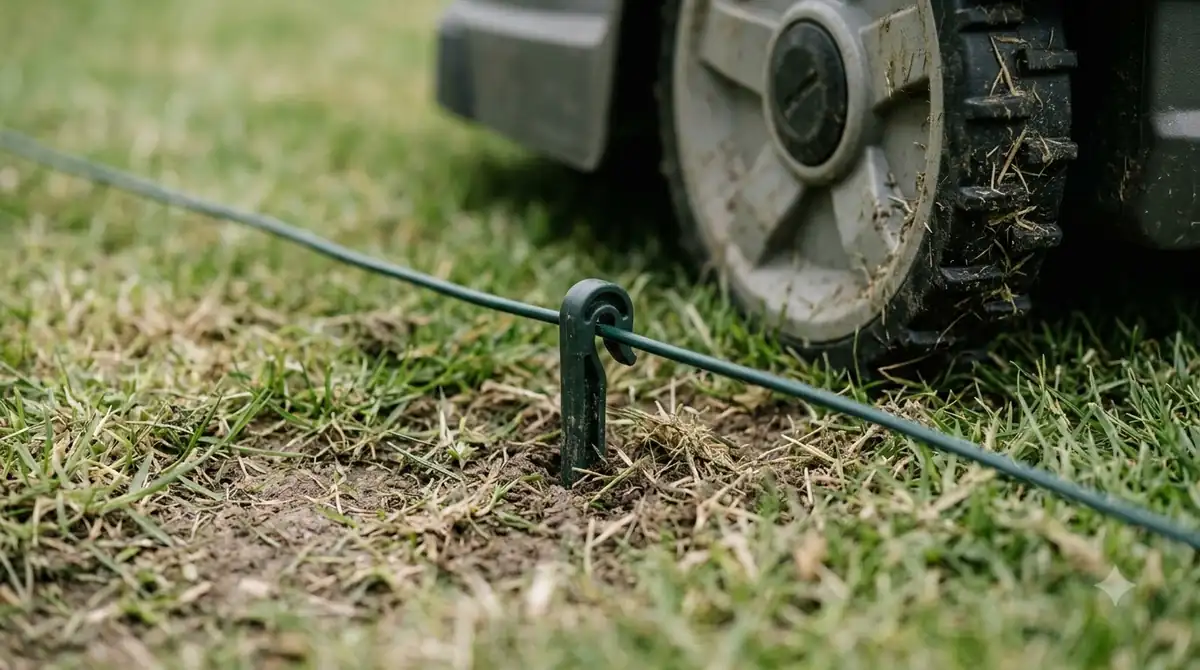
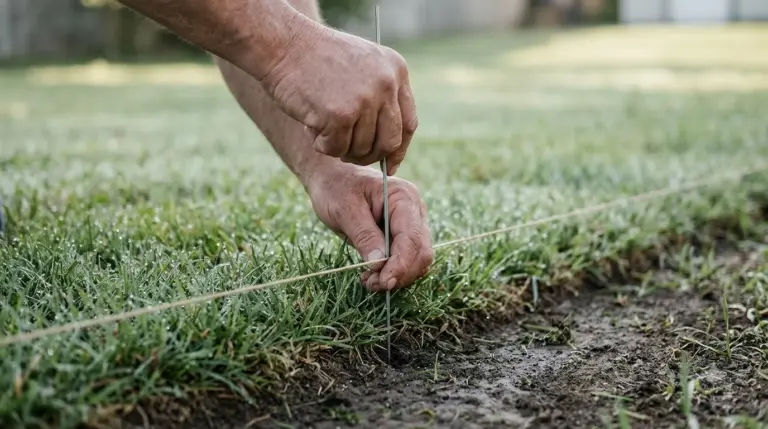
Push every staple deep into the ground. Husqvarna’s guidance on preventing wire breaks says staples should be placed deep in the ground, and a staple that stands proud can catch the mower or lift the wire. Check each staple after you drive it, and tap any that have risen. Staples set too deep can pinch the cable, which is why tensioning the wire before fixing it with a light pull is preferred to forcing it down.
Tension is the other half. The wire should lie tight against the ground so it cannot be lifted or caught, but it should not be stretched. Keep a steady, even hold as you move along the run, and avoid sharp bends, which stress the wire and can crack the insulation.
Heads up
Do not coil extra wire outside the loop. Loose coils near the lawn can disrupt the mower, so trim the surplus or lay it along the boundary instead.
Prepare the lawn before stapling
Mow the lawn before you lay the wire. Long grass hides the path and can lift the wire, so the staples do not seat firmly. Cut the grass short along the planned route, and clear rocks, roots, and sharp objects that could cut the wire or prevent a peg from going in straight. Walking the lawn and marking the route with flags first makes stapling faster because the corners are already decided.
Soft or compacted soil needs extra attention. Stakes can rise over time in soft ground, so push them back down periodically.
Corners, curves, and obstacles
Corners need more staples than straight runs. A tight curve needs closer spacing so the wire holds its shape, and a loose curve can pull out of line. Around flower beds and trees, use extra pegs to keep the wire from drifting into the bed. Keep the spacing even along the whole run rather than bunching pegs in one place.
Burying as an alternative
Some owners bury the wire instead of stapling it. Husqvarna’s guidance on wire breaks notes that the wire can be buried in a shallow slit cut with a spade, which suits uneven lawns or owners who want the wire hidden. Burying is cleaner to look at, but it is harder to repair if a break occurs, so test the loop before you bury it. Where a hard edge makes stapling awkward, edging for burying the wire is another route that keeps the cable out of sight.
| Method | Tools | Good for | Trade-off |
|---|---|---|---|
| Supplied pegs with mallet | Hammer or plastic mallet | Most yards | Slower on long runs |
| Staple or peg driver | Driver tool plus pegs | Long, repeated runs | Needs matching pegs |
| Buried in a slit | Spade | Uneven or hidden wire | Harder to repair |
The table summarizes the main options. Choose by the length of the run and how you want the lawn to look.
Checking the work
After the wire is down, walk the full loop and look for lifted staples, kinks, and any wire that has been pulled tight across a bed. Then run a signal test from the charging station before you finish. A staple fix is quicker before the mower has run once than after a fault shows up in the app. After the loop is stapled, locating the wire once it is placed is a useful way to confirm the route matches the plan.
Frequently asked questions
Do I need a special stapler for robot mower wire?
No. Many owners use the supplied pegs with a hammer or plastic mallet. A driver tool is a convenience for long runs, not a requirement.
Can I use ordinary garden stakes instead of the supplied pegs?
It is better to use the pegs supplied for your system. Mismatched stakes may not hold the wire firmly or may seat too high.
How deep should the staples go?
Deep enough that the staple holds the wire flat to the ground without standing proud. Check each one after driving it, and tap down any that rise.
Should I mow before stapling the wire?
Yes. Cut the grass short along the route so the wire lies flat and the staples seat properly.
Sources
- Husqvarna: tips to prevent wire break in an Automower installation (manufacturer): staple depth, mowing before installation, sharp bends, stakes rising in soft ground, and burying the wire in a slit.
- Husqvarna support on wire installation tips (manufacturer): guidance on wire installation and layout for boundary-wire systems.
 Up next8 min readGearBest Wire Laying Machine for Robot Mower: 3 to 7 cm DepthUpdated Nov 14, 2026
 10 min readGearBest Perimeter Wire and Pegs for Husqvarna AutomowerUpdated Nov 13, 2026
 9 min readGearBest Robot Mower Wire Pegs: 1 Metre Spacing and CountUpdated Nov 11, 2026
 7 min readGearRobot Mower Guide Wire Installation Tool: What You NeedUpdated Nov 20, 2026
 9 min readGearRobot Mower Wire Break Finder Tool: Options ComparedUpdated Nov 19, 2026
 8 min readGearBest Heavy-Duty Turf Staples for Securing Dock Mats on Robot Mower LawnsUpdated Nov 19, 2026