


How to adjust cutting height after overseeding with a robot mower? Keep your mower at a low 1.5- to 2-inch setting before and immediately after spreading seed so sunlight reaches the soil, then raise the deck gradually in small increments over several weeks until your turf hits its normal 3- to 3.5-inch target height. Most owners assume they should park their bot for a month after overseeding, yet letting established grass tower over new sprouts starves seedlings of light and space. Managing that transition with scheduled height changes protects fragile roots while keeping existing blades trimmed.
The short answer
- Prep low before seeding: Drop your robot mower to 1.5 to 2 inches prior to overseeding to thin out shade and improve seed-to-soil contact.
- Keep trimming established grass: Continue mowing at 1.5 to 2 inches right after seeding so existing turf does not smother germinating sprouts.
- Protect bare renovation patches: Exclude completely bare soil zones or pause the bot temporarily if heavy wheel turns tear soft, damp earth.
- Step up height gradually: Once new seedlings reach cutting height, raise the deck in small steps over several weeks toward a 3- to 3.5-inch finish.
- Follow the one-third rule: Never remove more than one-third of the grass blade length in a single pass, and always run sharp razor blades.
Why cutting height management matters after overseeding
Balancing cutting height after overseeding keeps established turf from shading out young seedlings while preventing mechanical damage to shallow new roots.
A lawn after overseeding contains two very different plant populations competing in the same soil. Mature grass already has deep roots and grows fast once you start watering the seedbed multiple times a day. Meanwhile, fresh grass seed sits right at the soil surface, needing warmth, moisture, and direct sunlight to germinate and anchor.
According to Iowa State University Extension, continuing to mow at a short height of 1.5 to 2 inches after overseeding reduces competition from established turfgrass so new seedlings receive the light they need. If you park your robot mower for three or four weeks, the older grass quickly grows to 4 or 5 inches, forming a dense canopy that blocks sunlight and traps excess humidity. Worse, when you finally restart the bot on overgrown grass, heavy clippings can mat down and suffocate tender sprouts.
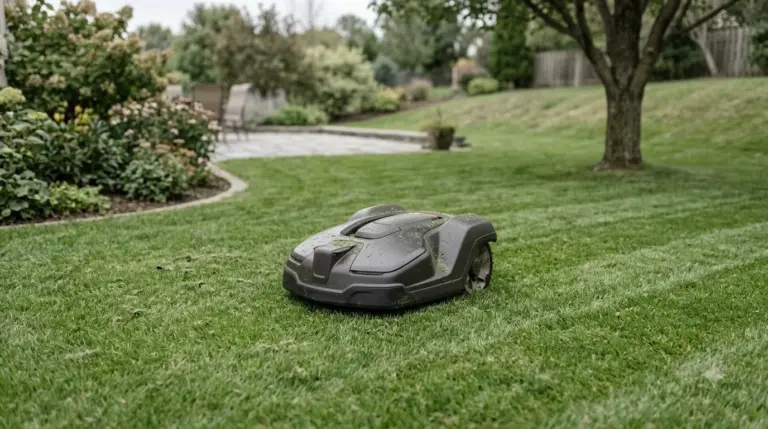
Robot mowers handle this transition differently than traditional walk-behind gas or battery mowers. Because autonomous mowers clip tiny tips every day or two, they avoid dumping heavy clumps of grass onto the seedbed. However, their frequent wheel traffic and tight zero-turn pivots on wet, freshly watered soil can dislodge seeds or uproot seedlings that have not yet knitted into the turf.

Step-by-step schedule for adjusting cutting height
Follow a phased height schedule that starts low for seed germination and climbs steadily as seedlings mature into established turf.
Different turf species germinate at different speeds—perennial ryegrass often sprouts within a week, while Kentucky bluegrass can take two to three weeks—so watch blade height rather than relying strictly on calendar dates. Guidance from Nebraska Extension in Lancaster County outlines maintaining an overseeded lawn at 1.5 to 2 inches for a few weeks before gradually raising the deck to a long-term height of 3 to 3.5 inches.
| Overseeding stage | Target cutting height | Robot mower setting and action |
|---|---|---|
| Pre-seeding prep | 1.5 to 2 inches | Lower deck in stages before aerating and spreading seed so light reaches the soil. |
| Germination (weeks 1 to 2) | 1.5 to 2 inches | Keep trimming established grass low; pause or zone off muddy bare patches during peak watering. |
| Early seedling growth (weeks 3 to 4) | 2 to 2.5 inches | Raise cutting height by one notch or 5 to 10 mm once new sprouts reach the blades. |
| Establishment (weeks 5 to 6) | 2.5 to 3 inches | Increase height again as roots anchor and daily misting shifts to deeper, less frequent watering. |
| Mature maintenance | 3 to 3.5 inches | Return to standard seasonal height while observing the one-third blade removal rule. |
Some standard residential robot mowers cap out around 2.4 inches (60 mm) or 2.8 inches (70 mm), whereas high-cut models reach 3.5 to 4 inches. If your mower maxes out below 3 inches, set it to its highest available position during the final establishment phase.
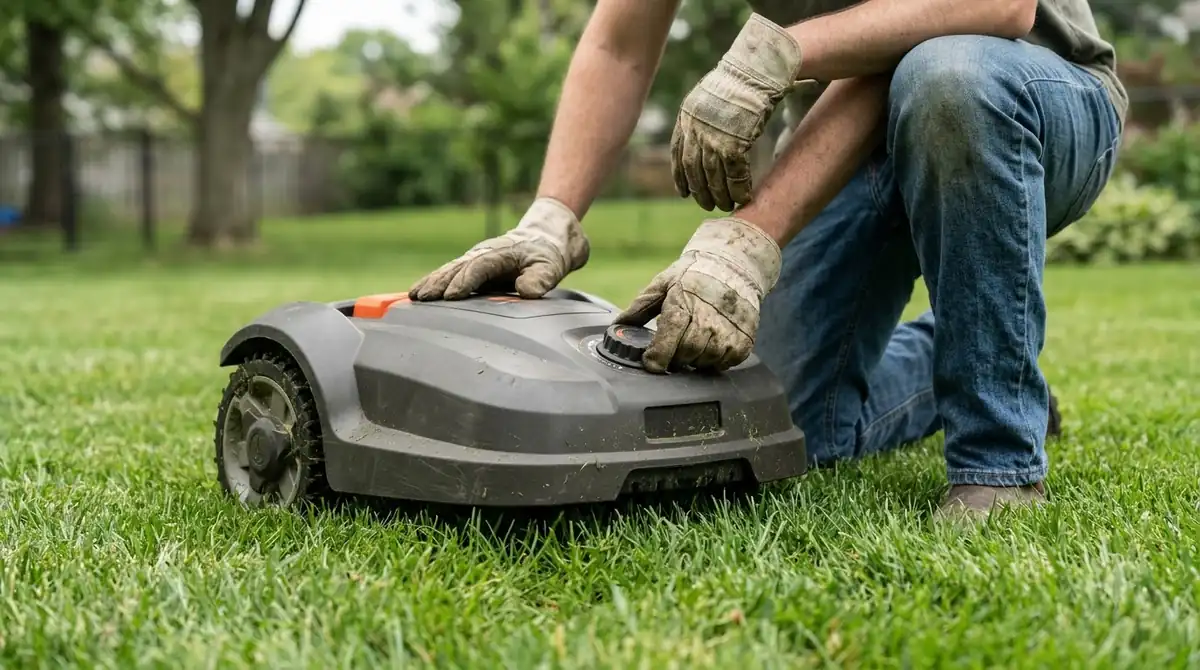
How to adjust cutting height on your robot mower
Changing deck height takes less than two minutes, though the exact procedure depends on whether your mower uses an electronic app slider or a manual dial.
Most RTK-guided and flagship boundary-wire mowers feature motorized cutting decks controlled directly from a smartphone app, while many compact or entry-level models rely on a physical rotary knob under the top hatch. Whichever design you own, make sure the blades are completely stationary before changing settings or inspecting the deck.
- Install fresh razor blades before seeding. Dull blades shred tender new grass tips instead of slicing them cleanly, which pulls shallow seedlings straight out of damp soil. Swap in a new set of blades before your overseeding project begins.
- Send the mower to its charging dock or press STOP. For manual-adjustment models such as the Husqvarna Automower 305, 310 Mark II, or 315 Mark II, press the STOP button and open the top hatch to access the height adjustment knob.
- Adjust via app or mechanical dial. On app-controlled models, open your mower’s settings menu (for example, More > Settings > Cutting height in Automower Connect) and move the slider to your target millimeter or inch value. On manual models, turn the dial toward the desired height indicator.
- Set zone-specific heights if supported. If your mower supports virtual work areas or multi-zone mapping, keep heavily shaded or high-traffic zones slightly higher while maintaining 1.5 to 2 inches across overseeded turf.
- Verify clearance over uneven ground. After lowering the deck for pre-seeding or early post-seeding cuts, watch the first pass over bumps or tree roots to ensure the spinning disc does not scalp high spots or strike exposed soil.
Heads up
Freshly overseeded lawns require frequent watering to keep the top layer of soil moist, which creates slick mud in thin spots. Reduce mowing frequency temporarily or use virtual no-go zones over bare patches until seedlings root firmly enough to withstand wheel turns.
Managing traction, schedules, and watering alongside height changes
Pairing your cutting height adjustments with smarter scheduling and irrigation timing prevents wheel ruts and seedling stress.
Even at the right cutting height, a robot mower running its normal 12-hour daily schedule on a saturated seedbed will churn up mud. Wet soil sticks to drive wheels, reducing traction on slopes and causing the mower to slip and tear young grass during perimeter turns.
- Mow during dry windows: Time your robot mower to run in the late afternoon or early evening after the surface has dried slightly, rather than right after morning misting cycles.
- Reduce passes per week: Drop from daily mowing to two or three sessions per week during the first three weeks after seeding. This trims fast-growing existing grass while cutting wheel traffic in half.
- Turn off aggressive edge-cutting routines: Border passes force the mower to pivot repeatedly along perimeter wires or virtual boundaries, which quickly wears ruts into soft edges.
- Transition irrigation before raising the deck: As seedlings approach 2 to 3 inches, Nebraska Extension advises tapering back from frequent daily misting to deeper watering two or three times per week, which firms up the soil surface before you step up the cutting height.
Frequently asked questions
Should I turn off my robot mower immediately after overseeding?
No, unless you have completely bare soil across the entire yard. For standard overseeding into existing grass, university turf extensions recommend continuing to mow at 1.5 to 2 inches so mature grass does not block sunlight from reaching the new seeds. Simply reduce how often the bot runs and keep it off muddy bare spots.
How much should I raise the cutting height each time?
Increase the height in small steps of roughly 0.25 to 0.5 inches (about 5 to 10 mm) every week or two once new seedlings reach the current blade height. Stepping up gradually keeps established grass in check while letting young plants thicken and build deeper roots.
What if my robot mower cannot cut as high as 3.5 inches?
Many standard robot mowers have a maximum cutting height between 2.4 and 2.8 inches (60 to 70 mm). If your model tops out below 3 inches, raise it to its highest setting during the final stage of establishment and keep your mowing schedule frequent enough that it never removes more than one-third of the blade at once.
Can a robot mower vacuum up my grass seed?
No. Unlike rotary walk-behind mowers with high-lift bagging blades that create strong upward suction, robot mowers use small, lightweight pivoting razor blades that create minimal airflow. As long as your seed has been raked or watered into the soil surface, the cutting disc will not pull it off the ground.
Sources
- Overseeding a Lawn (Iowa State University Extension): Pre-seeding and post-seeding mowing height targets (1.5 to 2 inches) and gradual progression to 3 inches.
- How to Overseed for a Healthy Lawn (Week-by-Week Guide) (University of Nebraska-Lincoln Extension): Irrigation tapering schedules, one-third blade rule, and long-term 3- to 3.5-inch height guidance.
- How to set the cutting height when using AIM Technology (Husqvarna Support): App-based global and work-area cutting height adjustment steps.
- Automower 305, 310 Mark II, 315 Mark II cutting height adjustment (Husqvarna Support): Manual hatch and height dial adjustment procedure.
 Up next9 min readLearnHow to Adjust Robot Mower Collision Sensitivity in the AppUpdated Nov 19, 2026
 8 min readLearnCrabgrass Control With a Robot Mower: What Mowing Height DoesUpdated Nov 12, 2026
 7 min readLearnWhat Height Should a Robot Mower Cut Grass?Updated Nov 10, 2026
 7 min readLearnBest Mowing Height for a Robot Mowed LawnUpdated Nov 11, 2026
 9 min readLearnHow to dry out a robot mower after heavy dew safelyUpdated Nov 19, 2026
 9 min readLearnCan a Robot Mower Run Over a Garden Hose Without Cutting It?Updated Nov 19, 2026