
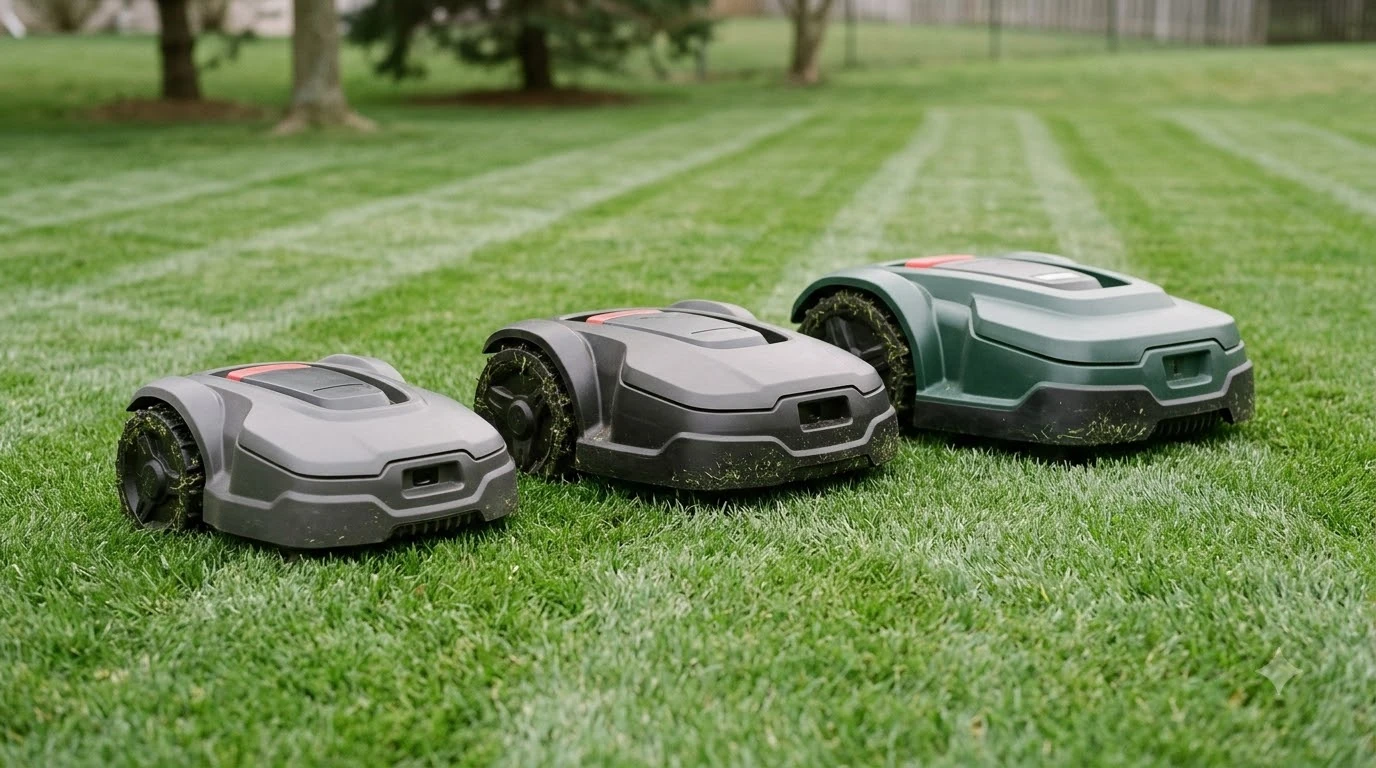

The Anthbot M5 vs Mammotion YUKA comparison turns mostly on navigation, on the slope figures each brand publishes, and on how each one states coverage. The Anthbot M5 LiDAR version uses 360° LiDAR with dual vision, while the YUKA 1500 and 2000 spec sheet lists 3D vision with RTK. The comparison below uses only the figures on the pages we read, so each row is one source’s claim, not a result from a side-by-side test.
The short answer
- Navigation. The Anthbot M5 LiDAR version is described as needing no perimeter wire and no RTK station. The YUKA 1500 and 2000 use 3D vision with RTK, which means a base station to place and maintain.
- Slope. Anthbot lists 45% (about 24°). The YUKA 1500 and 2000 sheet lists 28° without the sweeper and gives no percentage. The two figures use different units and different conditions.
- Area. Anthbot gives a recommended 500 m² (1/8 acre). Mammotion gives a maximum mowing size of 1500 m² or 2000 m², depending on the model.
- Battery. The M5 has a 2.5 Ah (45 Wh) battery and a reviewer-reported 40 minutes of mowing per charge. The YUKA sheet lists 4.5 Ah, or 9 Ah with the sweeper, but no runtime.
- Our reading. In this Anthbot M5 vs Mammotion YUKA pairing, the sources we read do not show a winner. The better fit depends on your lawn size, your slope, how many obstacles you have, and whether you need a sweeper.
Which YUKA this comparison covers
The YUKA name covers more than one spec sheet, and the sources do not use the same model names. Mammotion’s support page covers the YUKA 1500 and YUKA 2000. A 2025 Notebookcheck review covers the YUKA 1000 and YUKA 2000. Mammotion’s budget guide covers the YUKA Mini 600 and the YUKA mini 2 1000H, which are smaller machines with a different navigation setup. Our YUKA vs YUKA Mini comparison covers those two against each other.
This Anthbot M5 vs Mammotion YUKA comparison uses the YUKA 1500 and 2000 support sheet, because it is the one official page we read with cutting, slope, battery and IP figures. Check the model number on the box and the regional spec sheet before you use any figure here.
Anthbot M5 vs Mammotion YUKA spec comparison at a glance
The table lists each figure as the source gives it. Where a source is silent, the cell says so.
| Spec | Anthbot M5 (LiDAR version) | Mammotion YUKA 1500 / 2000 |
|---|---|---|
| Navigation | 360° LiDAR plus dual vision, with a 150° HDR AI camera at the front | 3D vision and RTK |
| Cutting width | 20 cm (5 blades) | 32 cm |
| Cutting height | 30 to 70 mm, set in the app | 30 to 100 mm (US); 20 to 90 mm (EU, UK, AU) |
| Max slope | 45% (about 24°) | 28° without sweeper; no percentage given |
| Area | 500 m² recommended (1/8 acre) | Maximum 1500 m² or 2000 m², by model |
| Battery | 2.5 Ah (45 Wh) | 4.5 Ah; 9 Ah with sweeper |
| Runtime and charging | 40 minutes of mowing; 60 minutes to charge (reviewer-reported) | Not stated on the sheet we read |
| IP rating | IPX6 | IPX6 mower and dock; IPX7 RTK station |
| Noise | No dB figure on the page we read | Almost 70 dB with sweeper, in one reviewer test of the YUKA 1000 and 2000 |
Heads up
Anthbot’s official product page returned an error when we tried to read it, so every Anthbot figure here comes from one independent M5 LiDAR review. Treat those numbers as the review’s reading of the product until you can check the brand’s own sheet for your version.
Navigation: LiDAR and vision against vision and RTK
Navigation is the first difference most buyers notice, because it decides how much setup the mower needs. The Anthbot M5 LiDAR version is described by its reviewer as working without a perimeter wire or an RTK station, using a 360° LiDAR sensor and a dual camera system. The reviewer found it reliable under heavy tree cover and near tall fences, where satellite signal can be weak.
The YUKA 1500 and 2000 sheet lists 3D vision and RTK. RTK depends on a base station, which Mammotion rates at IPX7, so the station needs a clear sky and a fixed position. The YUKA Mini 600 is a different machine and is described as running on UltraSense AI Vision with no boundary wire.
Our reading: a LiDAR setup trades some of the precision that RTK gives. The Anthbot reviewer said LiDAR is less exact than RTK in narrow passages and can snake a little more. If your yard has long narrow paths or many gaps, that difference matters more than any single spec figure. For the wider picture, see our guide to RTK vs LiDAR vs vision robot mowers.
Slope: why the 45% and 28° figures do not line up
The Anthbot M5 is listed at 45%, which is about 24 degrees. The YUKA 1500 and 2000 sheet lists 28 degrees without the sweeper and gives no percentage. The sweeper figure on that page reads as “18%(10°”, which looks cut off, so we do not use it as a firm number.
On the face of it, 28 degrees is a steeper angle than 24 degrees. But the two brands state slope differently, and the sources do not say how each was measured. A reviewer ramp test of the YUKA 1000 and 2000 reported 45% (24°), which is a different model from the 1500 and 2000 sheet. We would not read any of these as a winner. Check the figure your model’s manual gives and the slope of your actual lawn. Our explainer on how robot mower slope ratings work covers percent versus degrees.
Battery, runtime and charging
The two brands publish battery in different ways. Anthbot gives 2.5 Ah (45 Wh), a 40-minute mowing time per charge and a 60-minute charge, as reported by the reviewer. Mammotion gives 4.5 Ah, or 9 Ah with the sweeper, and does not give a runtime on the sheet we read.
Amp-hours do not turn directly into mowing area, because the mower’s power draw, grass height and slope all change how far it goes on a charge. The reviewer test of the YUKA 1000 and 2000 reported about 230 m² per charge and just under two hours without the sweeper. That is a different model and a different test, so use it only as context. For the general picture of run time per charge, see our guide to robot mower battery life.
Cutting width, height and area
The YUKA deck is wider on paper, at 32 cm against 20 cm for the Anthbot M5. A wider deck covers more ground per pass, but it also needs more room in narrow gaps. Both machines overlap in cutting height, from 30 to 70 mm for the Anthbot and 30 to 100 mm for the US YUKA sheet.
Area is where the wording differs most. Anthbot gives a recommended figure of 500 m², while Mammotion gives a maximum mowing size of 1500 m² or 2000 m². Those are not the same kind of number, so do not compare them as if they were. The YUKA Mini 600 is listed at up to 0.15 acre and the mini 2 1000H at 0.25 acre, which is a smaller tier again.
Weather rating and upkeep
Both machines carry an IPX6 rating for the mower. Mammotion adds IPX6 for the dock and IPX7 for the RTK station. The Anthbot reviewer advised hosing the mower down under light spray and avoiding pressure washers, which is a sensible rule for either machine.
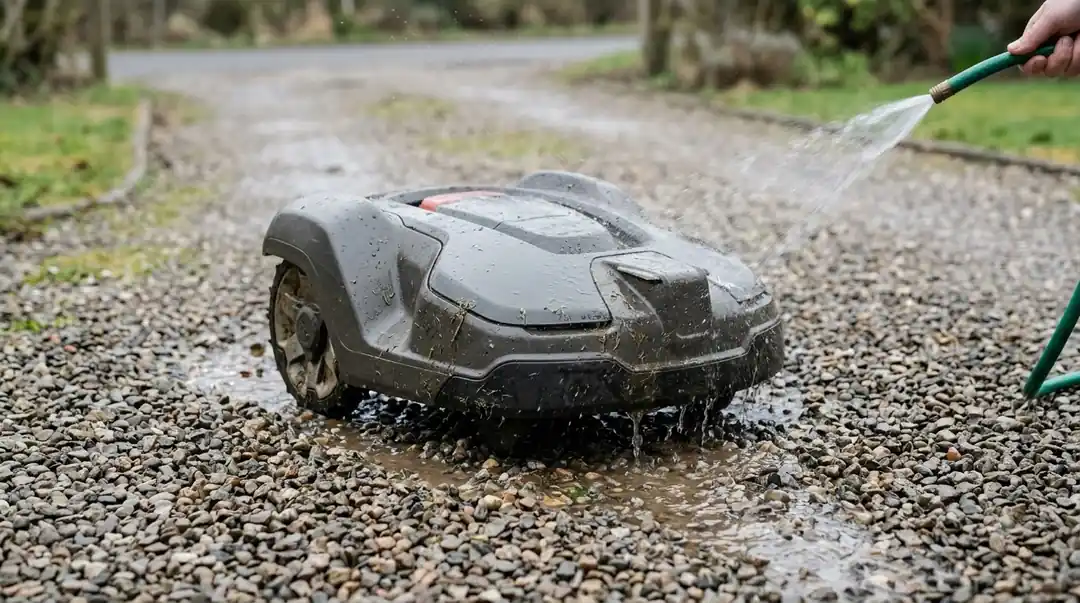
Upkeep is a practical difference. Wet grass and clippings collect under the deck, and a sweeper adds another part to clean. The sweeper also changes the battery figure and the noise level, so it is worth deciding early whether you need it.
Setup and what to check before buying
A spec sheet for the Anthbot M5 vs Mammotion YUKA does not replace a check of your own yard. Use this list before you choose.
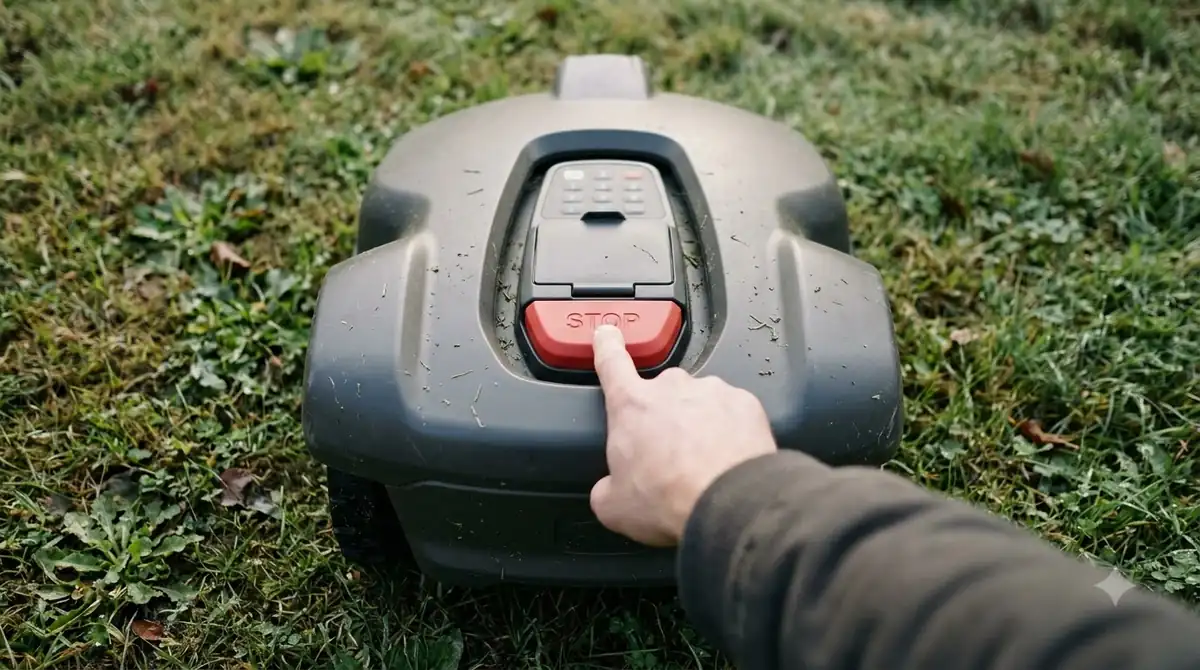
- Confirm the model. Read the model number on the box and the regional sheet, because the YUKA family and the Anthbot M5 both come in more than one version.
- Measure the lawn. Compare your area with the recommended 500 m² for the Anthbot and the 1500 or 2000 m² maximum for the YUKA.
- Measure the slope. Check the steepest section of your lawn against the figure in the manual for your version, not only the headline number.
- Decide on navigation. A LiDAR setup needs no base station. An RTK setup needs a base station placed where it has a clear view of the sky.
- Check the ongoing costs. The Anthbot reviewer noted that remote 4G access costs extra after a limited included period. Look at the fee schedule for your model before you buy.
Who each option suits (our reading)
For the Anthbot M5 vs Mammotion YUKA decision, these notes are our reading of the sources, not a ranking. The Anthbot M5 LiDAR version may suit a buyer who wants no boundary wire and no base station, and whose yard has tree cover or narrow paths. The YUKA 1500 and 2000 may suit a buyer with a larger lawn who is comfortable placing an RTK station and wants the wider deck and the published sweeper option.
Neither one is the right answer for every yard. The best test is to compare the rows in the table against your own lawn’s size, slope and layout.
Frequently asked questions
In an Anthbot M5 vs Mammotion YUKA matchup, which is better?
The sources we read do not show a winner. They use different navigation, different slope wording and different area figures, and no source tests the two under the same conditions. Compare the rows that match your lawn.
Does the Anthbot M5 need a boundary wire or an RTK station?
The LiDAR version is described as needing neither, using 360° LiDAR and dual vision. The reviewer noted that LiDAR is less precise than RTK in narrow passages.
Which mower has the steeper slope rating?
The Anthbot M5 is listed at 45%, about 24 degrees. The YUKA 1500 and 2000 sheet lists 28 degrees without the sweeper and gives no percentage. The units and test conditions differ, so the figures are not a like-for-like ranking.
Does the YUKA need the sweeper?
The sweeper is an option on the sheet we read, and it changes the battery figure. A reviewer of the YUKA 1000 and 2000 reported a noise level of almost 70 dB with the sweeper, and found that it collected most leaves and clippings. Decide based on whether you need leaf pickup.
Sources
- Mammotion support, YUKA specs (Mammotion): cutting width and height, slope, battery, IP ratings and navigation for the YUKA 1500 and 2000.
- Anthbot M5 LiDAR review (easylawnmowing): the M5 spec table, the reviewer’s pros and cons, and the reviewer’s report of its own tests.
- YUKA 2025 review (Notebookcheck): reviewer ramp test, noise and runtime for the YUKA 1000 and 2000.
- Best robot lawn mower under 1000 (Mammotion): coverage and navigation for the YUKA Mini 600 and mini 2 1000H.
 Up next6 min readReviews & CompareAnthbot M5 Slope Limit: What 45 Percent Means on Your LawnUpdated Nov 14, 2026
 7 min readReviews & CompareAnthbot M9 vs Mammotion YUKA Mini: What the Published Specs ShowUpdated Nov 15, 2026
 8 min readReviews & CompareMammotion YUKA Mini vs eufy E15: Specs, Slope and Lawn SizeUpdated Nov 11, 2026
 8 min readReviews & CompareMammotion YUKA Review: Specs, Slope and CoverageUpdated Nov 11, 2026
 8 min readReviews & CompareMammotion YUKA Pros and Cons: Specs, Slope and CoverageUpdated Nov 17, 2026
 7 min readReviews & CompareSegway Navimow i110N vs Anthbot M5: Specs ComparedUpdated Nov 13, 2026