
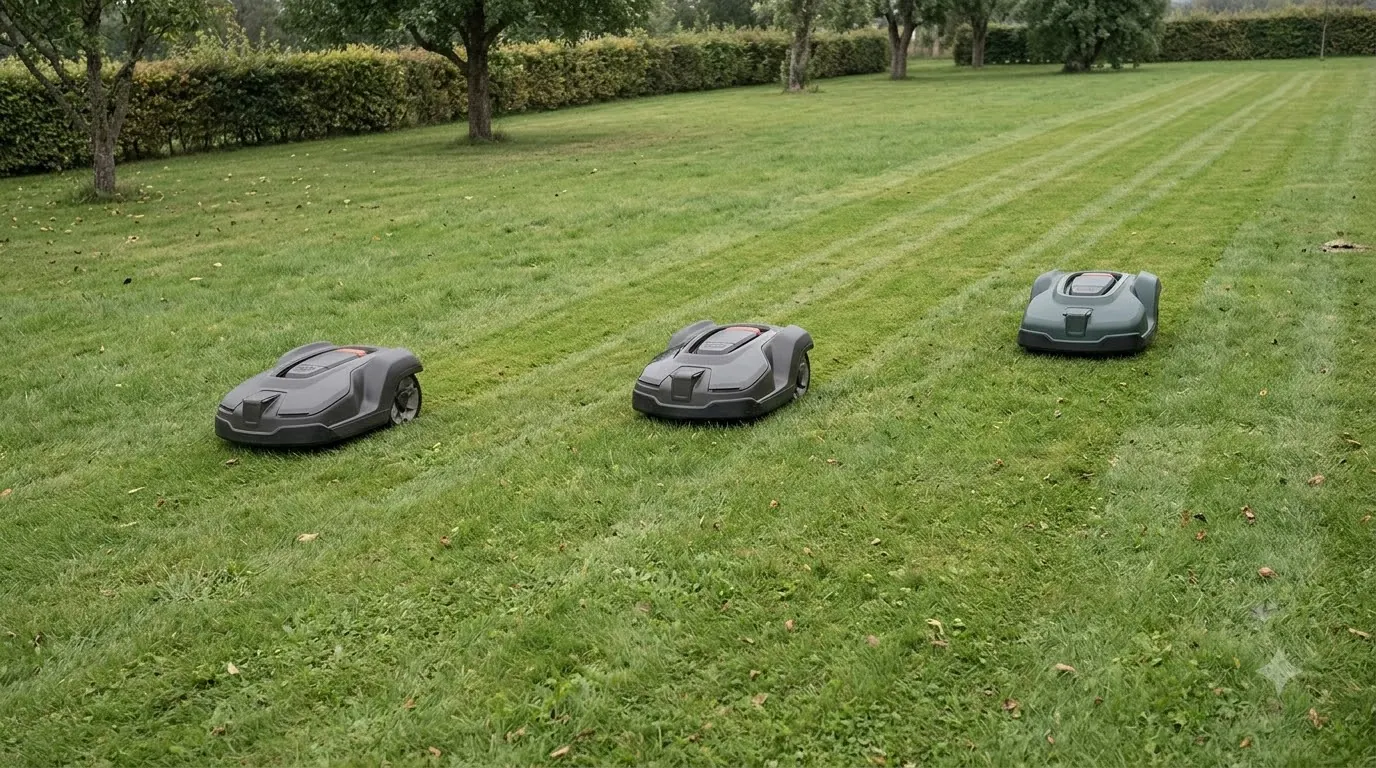

Are Ecovacs GOAT mowers good? For some yards, yes, but the answer depends on deck width, slope rating and sky view. Ecovacs’ US pages list three GOAT models with different decks, navigation systems and slope ratings. As of Nov 2026, none of the product pages we read states a warranty length, so the value question has to be settled against your own lawn. This guide sorts the manufacturer figures into a decision check. It does not report any hands-on testing.
The short answer
- Likely a fit: a lawn near the O1000 RTK’s 1/4-acre rating, with the steepest working area under 24 degrees and open sky for the RTK version.
- Likely a stronger fit: a larger lawn with the A2000 LiDAR PRO, which has a 12.96-inch main deck and a 27-degree work-area rating.
- Not answered by the pages we read: warranty length and any independent test data for these models.
- Check the variant: the two O1000 versions share a deck and slope rating but differ on navigation, noise, battery and runtime.
The three GOAT models Ecovacs lists
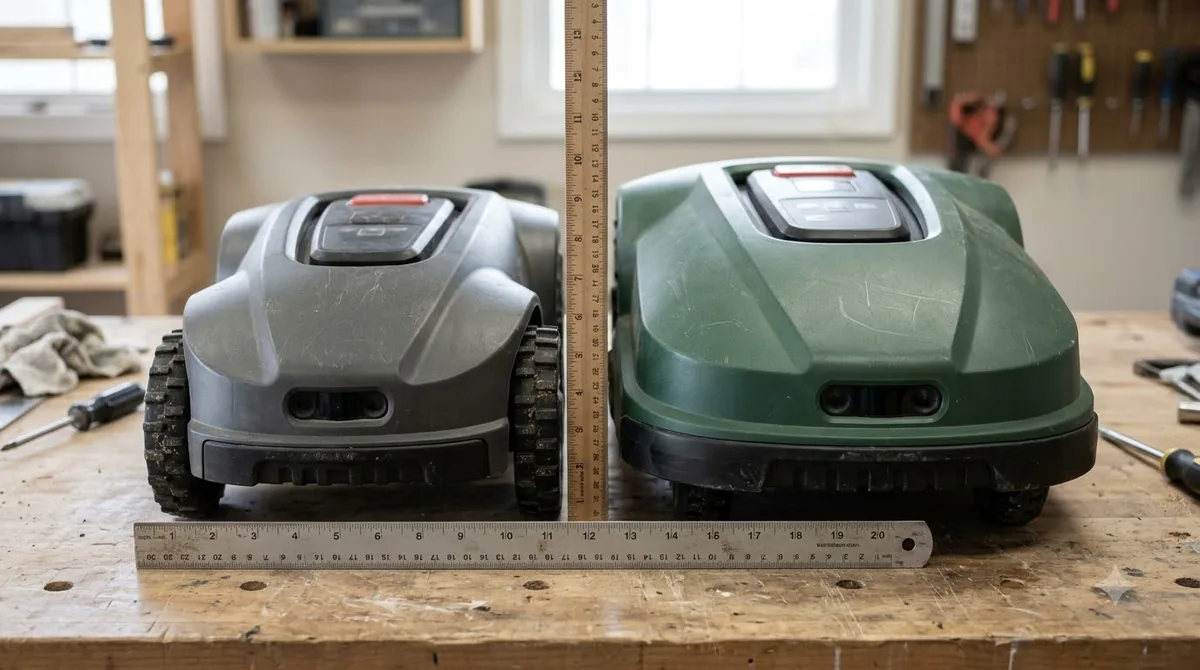
Ecovacs’ US pages list three GOAT models we read: the GOAT O1000 RTK, the GOAT O1000 LiDAR PRO and the GOAT A2000 LiDAR PRO. The two O1000 models use the same 8.66-inch main deck. The A2000 LiDAR PRO is built around a wider 12.96-inch main deck, with a 7.09-inch trimmer.
Are Ecovacs GOAT mowers good on paper? Every figure below is a manufacturer claim from those pages. No independent lab report for these three models appeared in the pages we read, so treat the numbers as Ecovacs’ own specifications.

Cutting width and slope: the numbers that limit a yard
Slope and deck width set the first limits on a lawn. The O1000 RTK’s spec table lists a cutting height of 1.2 to 3.2 inches, and its page rates the work area at 45 percent, which the page converts to 24 degrees. At a virtual boundary, the rating drops to 17 percent.
| Model (Ecovacs spec page) | Main deck | Work-area slope | Boundary slope | Cutting height (spec table) |
|---|---|---|---|---|
| GOAT O1000 RTK | 8.66 in | 45% (24 degrees) | 17% | 1.2 to 3.2 in |
| GOAT O1000 LiDAR PRO | 8.66 in | 45% (24 degrees) | 17% | 1.18 to 3.15 in |
| GOAT A2000 LiDAR PRO | 12.96 in | 50% (27 degrees) | 20% | 1.18 to 3.54 in |
The A2000 rating is higher, and its deck is about half as wide again. Our reading: a wider deck usually covers ground faster, but it has less room to steer around beds and tight corners. Ecovacs’ O1000 RTK page gives the rating as a percentage and a degree figure. Our reading: measure your steepest working area in degrees, not percent, before you compare it with 24 or 27 degrees.
The height ranges also differ between sources on the same page. The O1000 LiDAR PRO’s feature text says 1.2 to 3.1 inches, while its spec table says 1.18 to 3.15 inches. If the exact height matters for your grass, confirm the setting steps with Ecovacs before you buy.
Navigation: RTK positioning versus LiDAR boundaries
The two navigation systems fail in different places. The O1000 RTK pairs RTK positioning with a camera and 3D ToF sensing, and its page describes it as “RTK + Camera + 3D ToF.” The O1000 LiDAR PRO uses multiline LiDAR with a rotating 360-degree LiDAR and 3D ToF, and its page says it works without users needing to put up physical wires. The A2000 LiDAR PRO uses HoloScope 360 dual-LiDAR, multiline LiDAR and 3D ToF with an AI camera for obstacles.
The RTK model’s setup time is also unclear on its own page. The key features say five minutes, while the product listing says 15 minutes for the wire-free setup. Our reading: plan for the longer figure until Ecovacs confirms which one applies to your kit.
The sky-view question is the main difference between the two systems. Ecovacs’ own RTK-versus-LiDAR article, dated December 11, 2025, says an RTK mower needs its base station set up in an open, unobstructed area. It also says that if a lawn is heavily shaded by tree canopies or sits between buildings, RTK accuracy may drop due to satellite signal interference. The same article’s comparison table lists LiDAR as unaffected by shade or structures.
Our reading: for the RTK version, walk your yard and note where trees, the house or a garage would block the sky. If that covers much of the lawn, the LiDAR PRO models are the variants to compare. Our guides on what to check when Ecovacs GOAT RTK signal is lost and how to set up the Ecovacs GOAT O1000 cover the setup side.
Runtime, noise and battery
Runtime sets how long one charge lasts, and how long the Ecovacs GOAT O1000 battery lasts is covered separately. The O1000 RTK is listed at about 65 minutes of continuous mowing and about 100 minutes to charge, from an 18-volt, 4,000 mAh battery. The O1000 LiDAR PRO is listed at 90 minutes of mowing and 70 minutes to charge, from an 18-volt, 5,200 mAh battery.
The A2000 LiDAR PRO is listed at 50 minutes of mowing and 50 minutes to charge, from a 32-volt, 3,000 mAh battery. Its page does not list a noise figure, so noise cannot be compared directly with the two O1000 versions.
Noise figures are listed as 57 dBA for the O1000 RTK, and 61 dBA for the O1000 LiDAR PRO main body with 81 dBA for its trimmer. The pages do not state the distance or test conditions behind those numbers, so compare them only with each other.
Are Ecovacs GOAT mowers good for your yard?
A GOAT mower fits best when your lawn sits inside the rating for the model you choose. Three checks, in this order, will settle most of the decision.
- Measure the lawn. Compare your mowable area, not the whole yard, with the 1/4-acre rating for the O1000 RTK or the larger lawn range for the A2000.
- Measure the steepest working area. Convert it to degrees and compare it with 24 degrees for the O1000 models or 27 degrees for the A2000.
- Check the sky. If trees or buildings block much of the lawn, weigh the LiDAR PRO models against the RTK version.
The rest of this section explains the figures behind those checks.
The O1000 RTK covers up to 1/4 acre, which is 10,890 square feet, according to its page; we did not record an acreage for the O1000 LiDAR PRO. At the listed efficient rate of about 1,938 square feet per hour, a full 1/4-acre lawn works out to roughly 5.6 hours for one pass. That is a rough figure that leaves out turns, obstacles and charging breaks.
The A2000 LiDAR PRO’s page calls it a mower for large lawns but gives no acreage. Its spec table lists 2,691 to 4,306 square feet per hour, depending on mowing speed. Our reading: if your lawn is clearly larger than 1/4 acre, look at the A2000 first, and then confirm its boundary and slope limits against your yard. Ecovacs’ A2000 LiDAR PRO page is the source for its deck, slope and efficiency figures.
What the spec sheets do not tell you
The pages we read do not state a warranty length for any of the three models. Each one links to a Returns and Warranties page instead. Retailer listings and comparison sites give conflicting warranty figures, so we did not use any of them in this guide.
- Warranty: read the Ecovacs warranty terms for your model before you buy; Ecovacs GOAT spare parts and warranty coverage lists what Ecovacs publishes.
- Independent testing: no independent lab or long-term reliability test for these models appeared in the pages we read.
- Price: prices change by seller and bundle, so this guide does not include a dollar figure. Compare the current price on the day you buy.
So are Ecovacs GOAT mowers good? On the published specs the three models look capable for the lawn sizes and slopes they list, but the pages we read leave warranty and independent testing unanswered, so those two checks come before the purchase.
Frequently asked questions
Are Ecovacs GOAT mowers good for a 1/4-acre lawn?
The O1000 RTK is rated for up to 1/4 acre, or about 10,890 square feet, according to Ecovacs’ page. Usable mowing area is smaller than the total yard, because beds, trees and the house take up space.
What slope can a GOAT mower handle?
The O1000 models rate the work area at 45 percent, or 24 degrees, and the A2000 LiDAR PRO rates it at 50 percent, or 27 degrees. The virtual boundary limits are lower, at 17 percent for the O1000 models and 20 percent for the A2000.
Do GOAT mowers need boundary wires?
The O1000 LiDAR PRO page says users do not need to put up physical wires. The RTK page gives two setup times, 5 and 15 minutes, so check the setup guide before you plan your yard.
How long is the warranty on a GOAT mower?
None of the three product pages we read states a warranty length. Each links to a Returns and Warranties page. Confirm the warranty terms for your exact model with Ecovacs or the seller before you buy.
Sources
- Ecovacs GOAT O1000 RTK product page (Ecovacs, manufacturer): deck, height, slope, coverage, efficiency, noise, battery, runtime, navigation.
- Ecovacs GOAT O1000 LiDAR PRO product page (Ecovacs, manufacturer): deck, height, slope, noise, battery, runtime, navigation and boundary claims.
- Ecovacs GOAT A2000 LiDAR PRO product page (Ecovacs, manufacturer): deck, height, slope, efficiency, battery, runtime and navigation.
- Ecovacs blog: LiDAR vs RTK robot lawn mowers (Ecovacs, manufacturer, dated 2025-12-11): RTK base station placement and accuracy under tree canopy and between buildings.
 Up next8 min readReviews & CompareEcovacs GOAT O1000 RTK vs Ecovacs GOAT A1600 RTK: What the Specs ShowUpdated Nov 11, 2026
 9 min readReviews & CompareIs Mammotion a Good Brand? What the Warranty and Reviews ShowUpdated Nov 15, 2026
 7 min readReviews & CompareIs Segway Navimow Good? What the Warranty, Reviews and Limits ShowUpdated Nov 16, 2026
 8 min readReviews & CompareECOVACS GOAT A3000 LiDAR PRO Review: Specs, Limits and What to CheckUpdated Nov 16, 2026
 9 min readReviews & CompareEcovacs GOAT A2000 LiDAR PRO Review: Specs, Mapping and LimitsUpdated Nov 16, 2026
 11 min readReviews & CompareEcovacs GOAT O1000 LiDAR PRO vs Navimow i110N: Specs ComparedUpdated Nov 16, 2026