
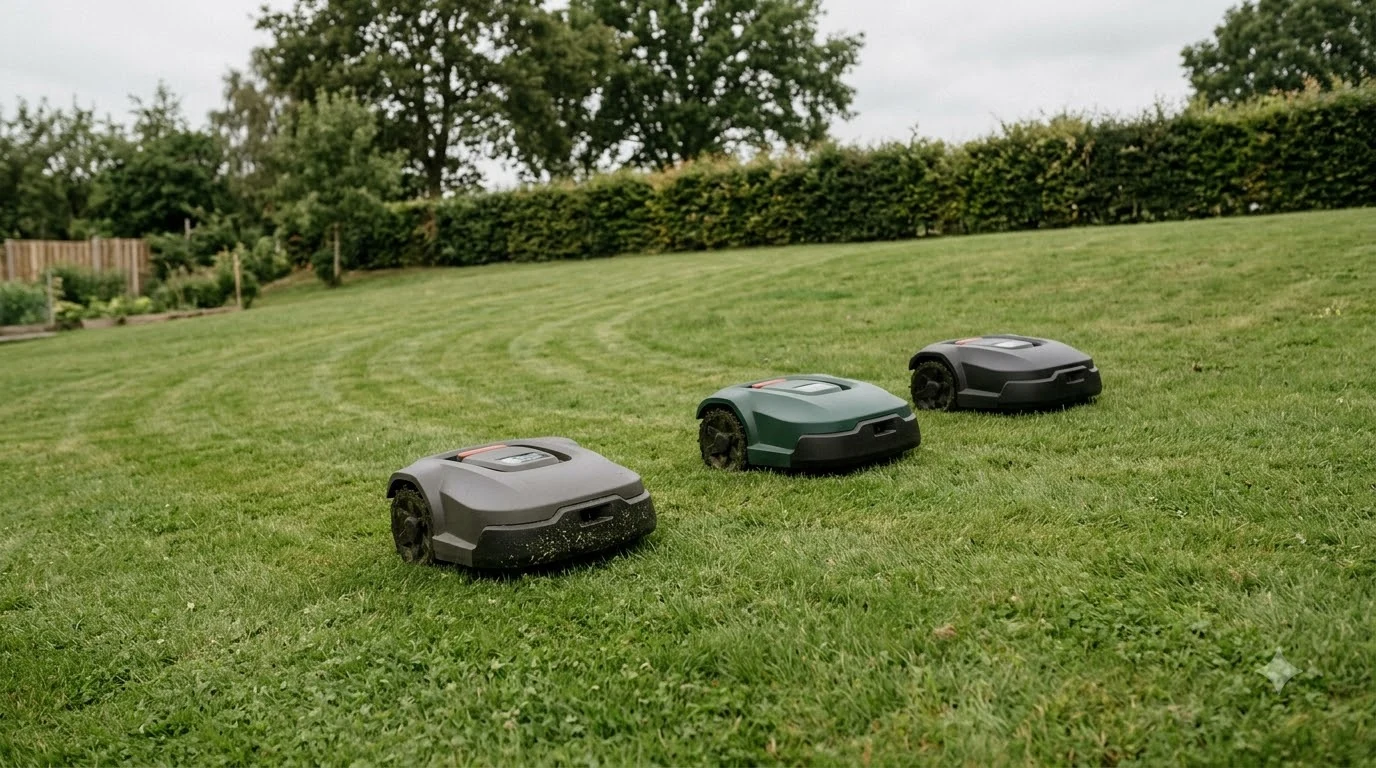

Ecovacs GOAT O series vs A series is mostly a question of lawn size. The O-series is the narrow-path line, while the A-series covers bigger lawns with wider cutting decks. As of November 2026, ECOVACS rates the GOAT O1000 LiDAR PRO for 1,200 m2 and the A2000 and A3000 for 2,400 and 3,300 m2.
In the Ecovacs GOAT O series vs A series choice, navigation is not the main split. The official pages for all three models describe LiDAR mapping without a physical boundary wire, so the decision comes down to coverage, deck width and the tightest gaps on your lawn.
The short answer
- Smaller lawn with tight gaps: the O1000 LiDAR PRO, rated for 1,200 m2 with a 31.50-inch narrow passage.
- Mid-size to large lawn: the A2000 LiDAR PRO, rated for 2,400 m2 with a 12.96-inch deck.
- Largest lawn in this comparison: the A3000 LiDAR PRO, rated for 3,300 m2 with a 33 cm deck.
Ecovacs GOAT O series vs A series: quick verdict
The O-series gives up coverage and deck width in return for maneuverability. If your yard is mostly open lawn, an A-series model fits better. If it has narrow paths and many obstacles, the O1000 is the model with the tightest passage rating in this comparison.
| Model | Best for | Key fact from the spec page |
|---|---|---|
| O1000 LiDAR PRO | Smaller lawns with narrow gaps | 1,200 m2 rated coverage, 31.50-inch narrow passage |
| A2000 LiDAR PRO | Mid-size to large lawns | 2,400 m2 rated coverage, 12.96-inch cutting width |
| A3000 LiDAR PRO | The largest lawns in this comparison | 3,300 m2 rated coverage, 33 cm cutting width |

Coverage area and mowing speed
For the ecovacs goat o series vs a series question, the O1000 LiDAR PRO is rated for 1,200 m2, which is half the A2000 at 2,400 m2 and well under the A3000 at 3,300 m2. These figures come from the ECOVACS help center list of adaptation areas, and they are the numbers to compare against your lawn measurement.
If your lawn sits just above a rating, the next model up is the one to check. A lawn of about 1,300 m2, for example, is above the O1000 rating, so the A2000 is the first model here that fits on paper.
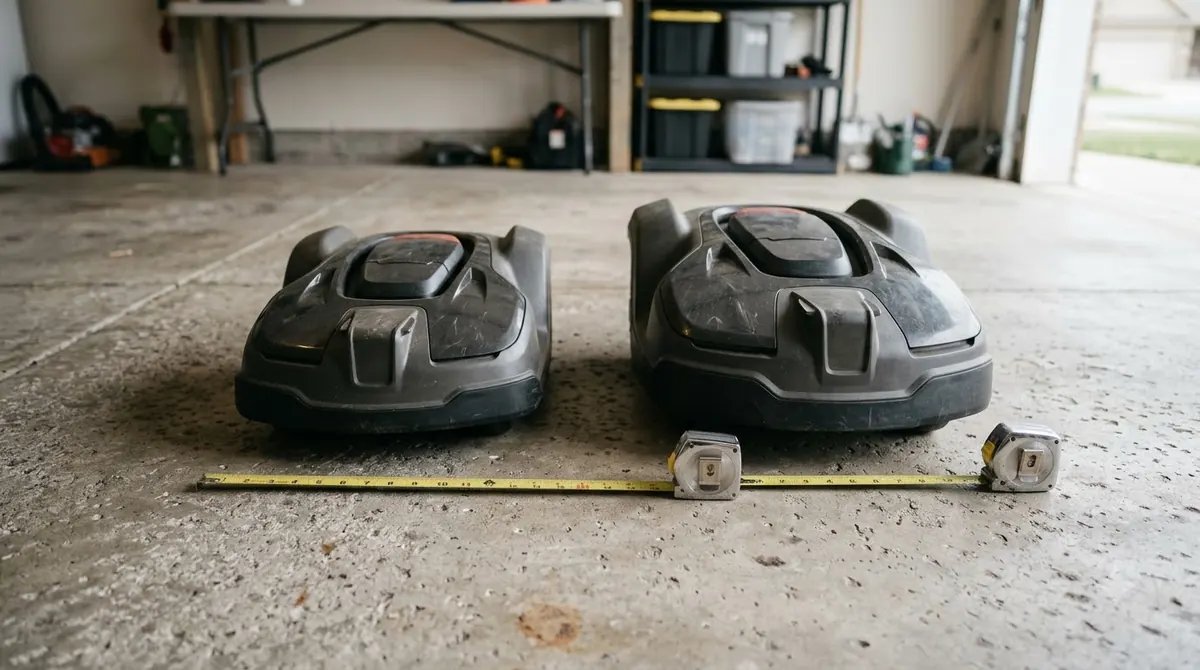
Mowing speed is a separate number, and it does not set a size limit. The O1000 page lists about 120 m2 per hour in delicate mode and about 180 m2 per hour in efficient mode. The A3000 page gives 250 to 400 m2 per hour, and the A2000 page gives 2,691 to 4,306 square feet per hour. Our reading is that mowing rate tells you how fast a mower works, not how large a lawn it can finish.
Cutting width and height range
The O1000 has an 8.66-inch main deck, while the A2000 is 12.96 inches and the A3000 is 33 cm, about 13 inches. A wider deck covers more ground on each pass, which fits the higher coverage ratings of the A-series in any Ecovacs GOAT O series vs A series spec comparison. Our reading is that a narrower deck is the easier choice around beds, edging and tight corners, though the spec pages do not say so directly.
| Model | Main deck width | Cutting height range |
|---|---|---|
| O1000 LiDAR PRO | 8.66 in | 1.18 to 3.15 in |
| A2000 LiDAR PRO | 12.96 in | 1.18 to 3.54 in |
| A3000 LiDAR PRO | 33 cm (about 13 in) | 30 to 90 mm (about 1.18 to 3.54 in) |
Heads up
The O1000 page gives its height range two ways. The spec table lists 1.18 to 3.15 inches, while the marketing text says 1.2 to 3.1 inches. Use the spec table if you need an exact setting.
All three ranges start at about 1.2 inches, so none of these models is a fit for very low cutting heights. Compare the range with the grass you have before you assume a lower setting is available.
Narrow passages, slopes and navigation
The O1000 has the narrowest passage rating here at 31.50 inches, while the A2000 is rated at 2.95 feet, about 35 inches. The passage rating matters most when the mower must reach the main lawn through a side gate or a narrow path. Check the rating against the narrowest point on your route, not against the average width of the yard. The A3000 page lists a passage figure with a unit that looks like a labeling error, so confirm that value with ECOVACS before relying on it.
- Work-area slope: 45 percent (24 degrees) for the O1000, and 50 percent (27 degrees) for both the A2000 and A3000.
- Virtual boundary slope: a maximum of 17 percent on the O1000 and 20 percent on the A2000 and A3000.
- Navigation: the O1000 page describes dual LiDAR mapping, and the A2000 and A3000 pages describe multiline LiDAR, all without physical boundary wires.
- RTK: the official O1000 LiDAR PRO page does not list RTK. The A3000 page markets itself as “Smarter Than RTK” and says it uses no GPS.
Some retailer listings still use an RTK name for the O1000, so confirm the exact model on the official page before you buy. Our Ecovacs GOAT O1000 RTK review covers that naming question in more detail, and what to check when a GOAT loses its RTK signal applies if you end up with an RTK-based unit.
Noise and obstacle detection
The O1000 is rated at 61 dBA for its main body and the A3000 at 62 dBA, while the A2000 page does not list a noise figure. The trimmers are louder, at 81 dBA for the O1000 and 82 dBA for the A3000. Our reading is that a one-decibel gap between 61 and 62 dBA is too small to separate the O1000 and A3000 on noise.
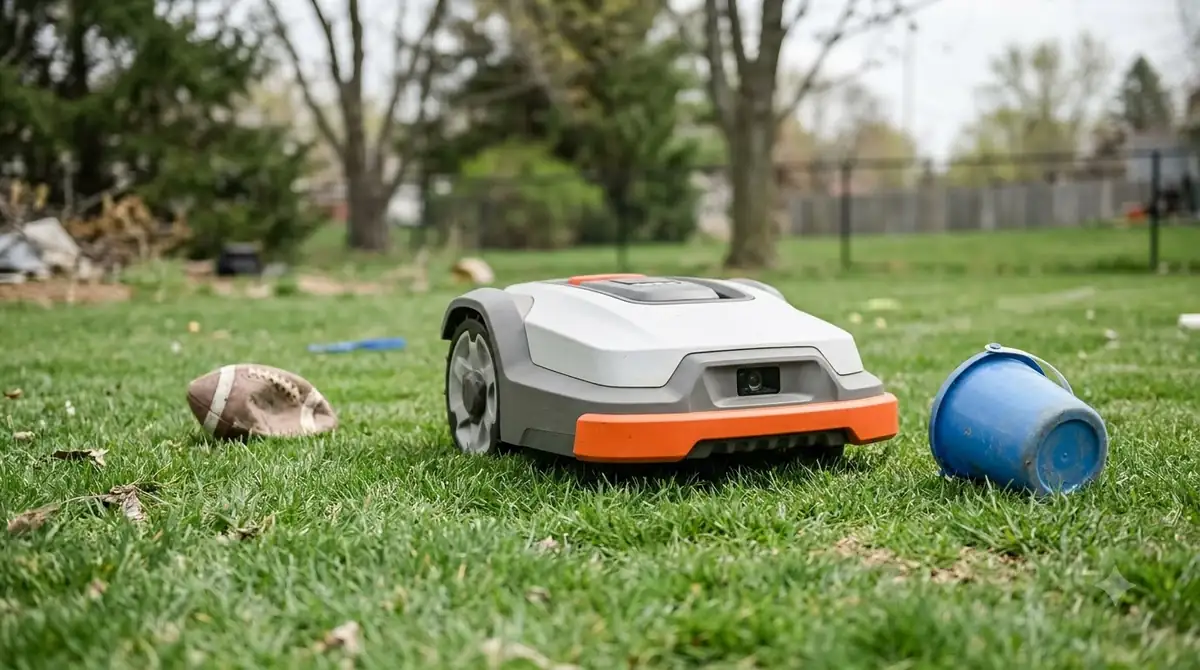
The O1000 and A2000 pages both claim detection of more than 200 obstacle types, with stable avoidance at a distance of 1.97 inches. The A3000 page does not repeat that figure in the sources we read. These are manufacturer claims. No independent test data was available for this comparison, so treat them as the starting point for your own check.
Which series fits your lawn
Choose the O1000 for a smaller lawn with narrow gaps, and choose an A-series model when open lawn area is the main concern. For most buyers, the ecovacs goat o series vs a series decision starts with the rated coverage figure and then moves to the narrowest gap. Work through these checks before you decide.
- Measure the lawn. Compare your area with the rated figures: up to 1,200 m2 for the O1000, up to 2,400 m2 for the A2000, and up to 3,300 m2 for the A3000.
- Measure the narrowest gap. Compare it with each model’s passage rating, starting with the O1000 at 31.50 inches.
- Measure the steepest area. Compare it with the work-area slope rating and the virtual boundary limit, which is lower on the O1000.
- Confirm the exact model. Retailer names differ, so match the model number on the official spec page.
- Check warranty terms. The product pages link to returns and warranty pages but do not state a term, so read those pages before you buy.
Compare the spec sheet for the exact model you plan to buy, since listing names and mowing rates vary between sellers. Read this Ecovacs GOAT O series vs A series comparison as a starting point, not a final answer. The official ECOVACS pages are the most reliable starting point. For a wider view of the brand, see our guide to which Ecovacs GOAT model to buy, and if you pick the O1000, how to set up the Ecovacs GOAT O1000 walks through the first install.
Frequently asked questions
Is the GOAT O1000 an RTK mower?
The official US product page for the O1000 LiDAR PRO does not list RTK. It describes dual LiDAR navigation with no physical boundary wire. Some retailers still use an RTK name, so confirm the model number before buying.
Which GOAT model covers the most lawn?
The A3000 covers the most area in this comparison, with a rated coverage of 3,300 m2 in the ECOVACS help center. The A2000 is rated for 2,400 m2 and the O1000 LiDAR PRO for 1,200 m2.
Why are the A-series decks wider than the O1000?
The A2000 has a 12.96-inch cutting width and the A3000 has a 33 cm width, while the O1000 has an 8.66-inch deck. Our reading is that the narrower O1000 deck suits tight spaces, while the wider A-series decks cover more ground on each pass.
Do these pages list a warranty term?
No. The O1000, A2000 and A3000 product pages link to general returns and warranty pages without stating a term. Read the warranty page for the exact model before you buy.
Sources
- GOAT O1000 LiDAR PRO product page (ECOVACS): specs for the O1000, including width, slope, passage, navigation and noise.
- GOAT A2000 LiDAR PRO product page (ECOVACS): cutting width, height range, slope and passage for the A2000.
- GOAT A3000 LiDAR PRO product page (ECOVACS): cutting width, height range, slope, navigation and noise for the A3000.
- ECOVACS help center adaptation area list (ECOVACS): rated coverage area for each GOAT model, .
 Up next9 min readReviews & CompareMammotion YUKA vs LUBA: Which Series Fits Your Yard?Updated Nov 16, 2026
 8 min readReviews & CompareECOVACS GOAT A3000 LiDAR PRO Review: Specs, Limits and What to CheckUpdated Nov 16, 2026
 9 min readReviews & CompareEcovacs GOAT A2000 LiDAR PRO Review: Specs, Mapping and LimitsUpdated Nov 16, 2026
 8 min readReviews & CompareEcovacs GOAT O1000 LiDAR PRO Review: LiDAR + Edge TrimmerUpdated Nov 16, 2026
 8 min readReviews & CompareAre Ecovacs GOAT Mowers Good? What the Specs ShowUpdated Nov 16, 2026
 7 min readReviews & CompareMOVA LiDAX Ultra 1000 vs ECOVACS GOAT O1000 LiDAR PRO: Which Fits Your Lawn?Updated Nov 16, 2026