
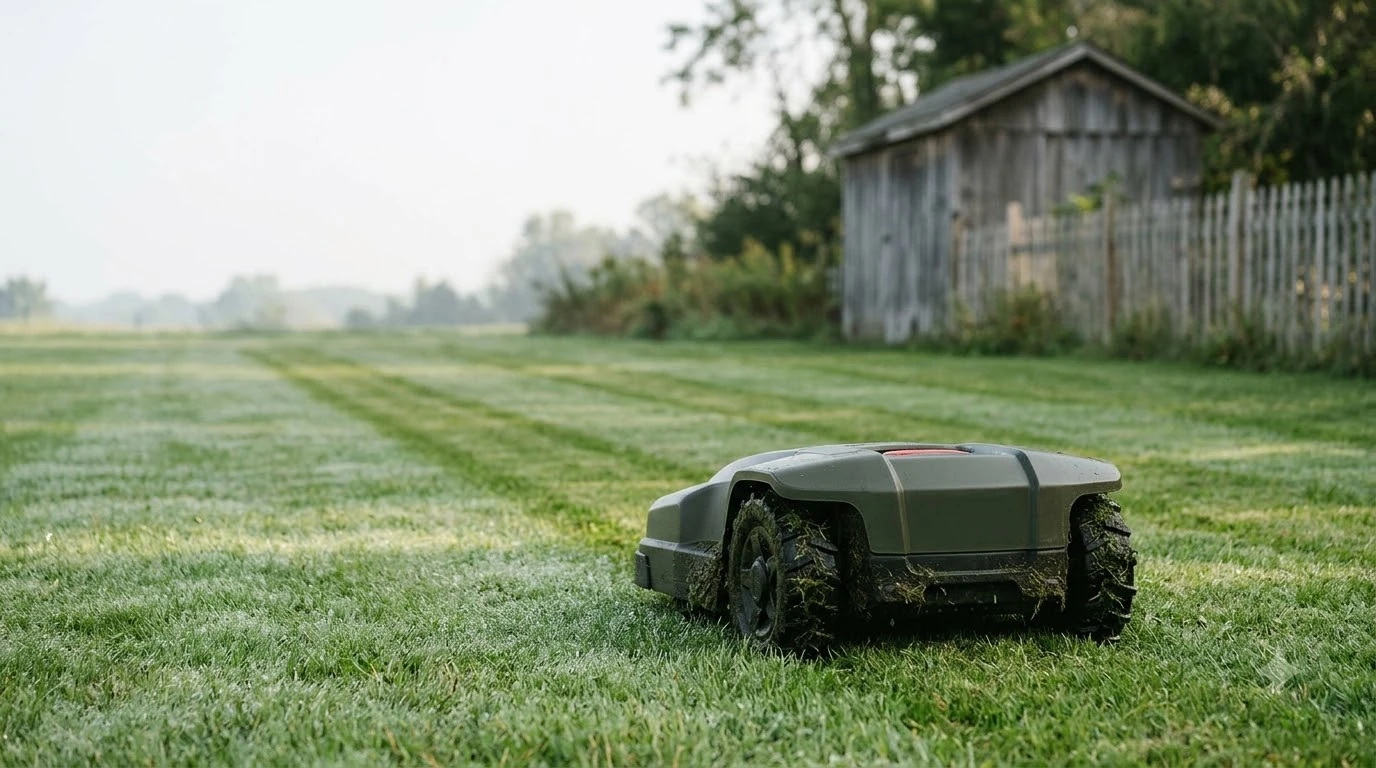

Is the Sunseeker X7 worth it? Yes for an open, sunny yard with some slope, and a weaker buy for a heavily shaded lot. The manufacturer’s published specs and two independent reviews point the same way: the mower performs well when its RTK base station has a clear view of the sky, and it struggles where that view is blocked. Figures are as of November 2026.
The short answer
- Verdict: worth considering for an open lawn with clear sky and slopes within the rating; a poor fit for shaded or tree-covered yards.
- Slope: the manufacturer rates it at 70% (35 degrees), while Bob Vila’s reviewer lists a 28-degree figure, so check your steepest section.
- Cutting: up to 35 cm wide, with a 20 to 100 mm height range, according to the manufacturer.
- Main weakness: Reviewed.com says it “struggles in shaded spaces” and recommends other mowers for shady yards.
- Not published: a decibel rating, battery runtime, charge time, warranty length and price on the manufacturer’s product page.
Is the Sunseeker X7 worth it? The verdict by yard type
The X7 is worth a look when your yard is open, sunny and has some slope, because both reviews praise its mowing and obstacle handling in those conditions. It is a weaker choice when trees or tall buildings block the sky over the base station. So, is the Sunseeker X7 worth it? It depends on your yard far more than on the spec sheet.
Reviewed.com gives a conditional verdict: “Yes, if you have clear skies and don’t mind making an investment.” Bob Vila’s reviewer calls the X7 a “worthwhile investment in my opinion,” especially for medium to large yards, and gives it 4.6 out of 5 while noting that it is premium-priced. The two reviews describe different versions of the mower, so treat each verdict as a verdict on that version, not on the whole brand.
Sunseeker X7 specs that support the decision
The manufacturer’s product page covers the X7 family and lists the figures below. Several useful numbers are missing from the page, and the table marks them.
| Spec | Manufacturer page | What the reviews add |
|---|---|---|
| Cutting width | Up to 35 cm (about 13.8 in) | Bob Vila lists 14 in on its earlier spec sheet |
| Cutting height | 20 to 100 mm (about 0.8 to 3.9 in) | Bob Vila lists 0.8 to 4 in |
| Mowing area | Up to 6,000 m² (about 1.5 acres) | Bob Vila lists up to 0.75 acres on its earlier spec sheet |
| Slope | 70% / 35 degrees | Bob Vila lists 28 degrees |
| Navigation | AONavi: RTK-GNSS with VSLAM visual mapping, accuracy “down to the centimeter” | Reviewers note the RTK antenna needs a clear view of the sky |
| Obstacle detection | Vision AI with binocular cameras, “over 200 types” of obstacle | Reviewed.com lists “great obstacle avoidance” as a pro |
| Drive | All-wheel drive, independent front suspension, permanent magnet motors | No review disputes the drive layout |
| Noise, battery, warranty, price | Not stated | See the noise and runtime section below |
The box contents on the manufacturer page include the mower, a charging station, an RTK base station with its holder, chargers for both stations, mounting hardware, a user manual, and spare blades with screws. Our reading: the RTK base station is a separate piece of equipment you must place well, so it belongs in any value comparison.
Cutting height and deck size: enough for most lawns?
The 20 to 100 mm range covers a wide spread of grass heights, and the 35 cm deck gives a reasonable cutting width for a robot of this class. Height matters more than width for lawn health.
Clemson Cooperative Extension advises that you “remove no more than one-third of the grass height at any one mowing.” Its table lists tall fescue at 2 to 3 for winter and 3 to 3.5 for summer, and centipedegrass at 1.5 to 2, with heights given in inches. Our reading: the X7’s 100 mm (about 3.9 in) ceiling sits above the summer range for tall fescue, so most cool-season lawns fit inside it. Warm-season lawns that need a low cut also fit within the 20 mm floor.
Slope: the 70% rating and the 28-degree figure
Is the Sunseeker X7 worth it on a steep lot? The manufacturer rates the X7 at 70% (35 degrees) and attributes that climbing ability to its all-wheel drive and independent front suspension. A 28-degree maximum, as Bob Vila reports, is about 53% on the same scale, so the two figures are not interchangeable. Neither source gives test conditions.
Reviewed.com says its reviewer found the mower handled slopes, curving edges and dips “with ease.” That is useful, but it is one reviewer’s experience on one yard. Our reading: treat the rating as a ceiling, and read what a 70 percent slope limit really means before you rely on it. Wet grass, loose soil and a steep edge at a turn can all cut traction below the figure on the box, so measure your steepest section before you rely on it.
Navigation and the RTK sky-view requirement
The X7 needs no boundary wire. Its AONavi system pairs RTK-GNSS satellite positioning with VSLAM visual mapping, and the manufacturer says positioning accuracy reaches down to the centimeter. Vision AI uses binocular cameras to detect static obstacles, moving objects such as pets or people, and overhead hazards like low branches and wires.
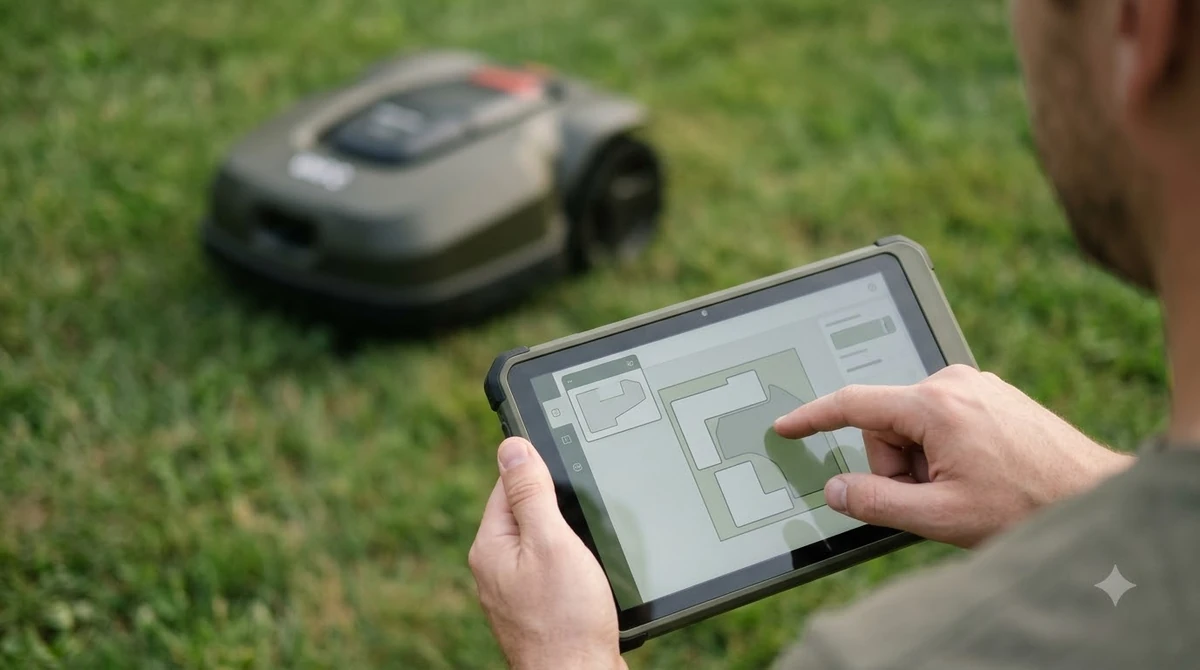
The trade-off is the base station. If you are new to the term, what an RTK base station does is explained in a separate guide. Bob Vila’s reviewer says the RTK base station “needs a full direct view of the sky to work properly,” and called that a minor inconvenience because the antenna can sit in an open spot or on a roof. That is a fair point for an open lawn, but it is the single requirement that decides most shaded yards. Reviewed.com lists “hands-off wireless mapping” among the pros, which fits a model that maps by driving the mower around the yard.
Setup and the app: where the reviews disagree
Reviewers do not agree on setup. Bob Vila’s reviewer found the X7 easy to set up, even for a beginner, with the app guiding the connection of the base station and mower to Wi-Fi, followed by a yard map made by driving the mower around. That reviewer found the printed manuals hard to follow.
Reviewed.com describes the setup as cumbersome. A separate roundup of Sunseeker X7 problems and complaints covers these reports in more detail. Its reviewer reports that the mower failed repeatedly until the RTK antenna was moved to a new spot and the yard was remapped. The same review says the app’s error messages were vague: in one case it said only that there had been an error, and the cause turned out to be a wood chip stuck in the blades. Our reading: the gap between these accounts probably reflects the model version and the yard, so ask which version the seller is offering and where the base station will sit.
Shade: the factor that decides most verdicts
Shade is the weakest point in the reviews. Reviewed.com lists “struggles in shaded spaces” among the cons and says its reviewer found finding a spot with enough clear sky for the antenna the hardest part of using the mower. The eventual placement in that review left the antenna in front of the house.
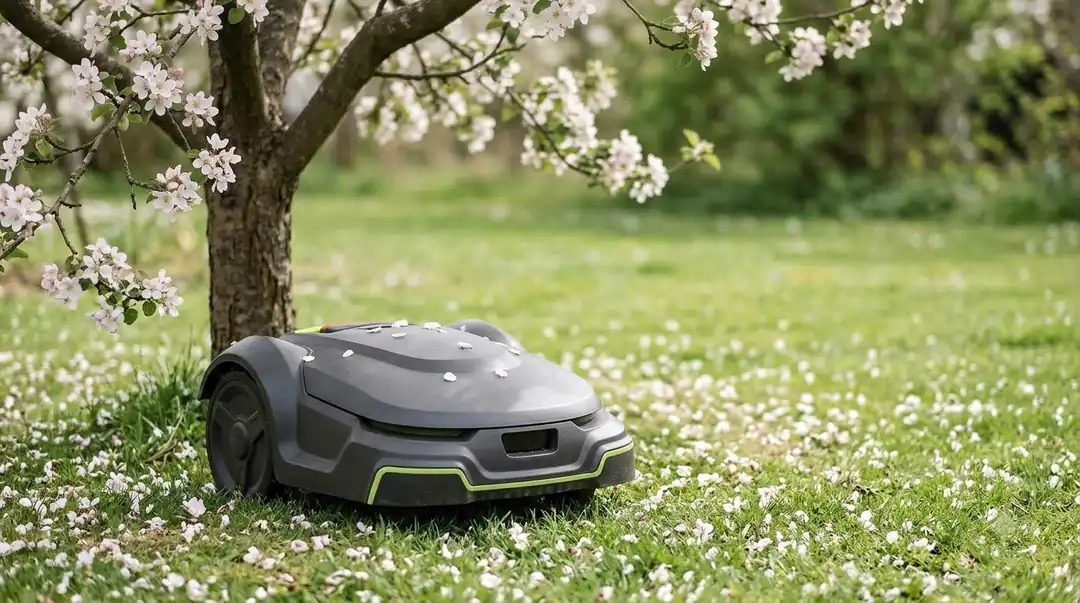
Reviewed.com’s verdict is explicit: shady yards are better served by other mowers. Our reading: is the Sunseeker X7 worth it under trees? Probably not. Our guide on whether robot mowers need a clear view of the sky covers the placement problem. If trees or tall walls block the sky over the planned base station spot, expect the setup difficulty Reviewed.com describes, and treat the X7 as a poor fit for that lot. A sunny yard with a few shaded corners is a different case, and the reviews do not quantify how many shaded spots the mower can handle.
Noise, runtime and warranty: what is not published
The manufacturer gives no decibel rating, no battery runtime, no charge time, no warranty length and no price on its product page. That leaves buyers with reviewers’ descriptions instead of measurements.
Reviewed.com calls the motor “ultra-quiet” and says it did not disturb the household or neighbors overnight, which is a subjective description. Bob Vila says the brushless motor is quieter in operation but gives no number. Bob Vila reports about one hour of runtime per charge on moderate settings and a 75-minute charge time, and estimates about 17 hours of work to cover the 0.75 acres of its earlier spec sheet. That 17-hour figure is the reviewer’s estimate, not a measured result. Our reading: on a large lot, ask the seller for a runtime figure and a measured noise rating before you commit, and get the warranty length in writing.
Who the Sunseeker X7 is worth it for (our reading)
Is the Sunseeker X7 worth it for you? It suits an open, sunny lot with some slope, where you want wire-free mapping and can place an RTK base station with a clear view of the sky. Bob Vila’s reviewer recommends it for medium to large yards, which matches the mower’s 6,000 m² rated area.
It is a weaker buy for a heavily shaded lot, a yard under dense tree cover, or a buyer who needs a published noise or runtime figure before purchase. A small yard may leave much of the mower’s capacity unused, so compare the price against your real mowing area, and see whether robot mowers are worth it for small yards at all.
Before you buy, check these points with the seller:
- Sky view. Confirm the base station can sit in a spot with a clear view of the sky.
- Steepest slope. Measure your steepest section and compare it with the 35-degree rating.
- Version. Confirm which X7 model and generation you are buying, since the reviews cover different versions.
- Runtime and noise. Ask for measured figures for your yard size.
- Warranty. Get the length and coverage in writing.

Frequently asked questions
Is the Sunseeker X7 worth it for a small yard?
Neither review gives a verdict for a small yard. Bob Vila’s reviewer recommends the X7 for medium to large yards. For a small lot, compare the price with the area you actually need to mow.
Does the Sunseeker X7 need a boundary wire?
No. The X7 uses RTK-GNSS positioning with visual mapping and wire-free boundaries. The RTK base station still needs a clear view of the sky to work properly.
Does the Sunseeker X7 work under trees?
Reviewed.com reports that the X7 Plus Gen 2 struggles in shaded spaces and recommends other mowers for shady yards. Under a dense canopy, expect weaker performance and a harder setup.
How steep a slope can the Sunseeker X7 climb?
The manufacturer rates the X7 at 70% (35 degrees). Bob Vila reports a 28-degree figure for its earlier spec sheet. Both are maximum ratings, so measure your steepest section and allow for wet or loose ground.
Sources
- Sunseeker Elite X7 product page (manufacturer): cutting width, height range, slope rating, mowing area, AONavi navigation, obstacle detection, drive system and box contents.
- Reviewed.com Sunseeker robot lawn mower review (publisher): model tested, conditional verdict, shade, setup, app errors, missed spots and noise description.
- Bob Vila Sunseeker robotic lawn mower review (publisher): earlier spec sheet, 28-degree slope figure, runtime and charge time, RTK sky-view requirement and verdict.
- Mowing Lawns, Clemson Home and Garden Information Center (university extension): the one-third mowing rule and the grass height table.
 Up next8 min readReviews & CompareIs the Sunseeker Elite X5 Worth It? Verdict by Yard TypeUpdated Nov 16, 2026
 6 min readReviews & CompareIs the Anthbot Genie Worth It? A Yard-Size VerdictUpdated Nov 17, 2026
 8 min readReviews & CompareSunseeker X7 Alternatives: Robot Mowers to CompareUpdated Nov 16, 2026
 8 min readReviews & CompareDreame A2 vs Sunseeker X7: Specs, Sensors and Who Each SuitsUpdated Nov 12, 2026
 8 min readReviews & CompareSunseeker X7 Problems and Complaints: What Reviews and Specs ShowUpdated Nov 14, 2026
 8 min readReviews & CompareMammotion LUBA 3 AWD vs Sunseeker X7: Published Specs ComparedUpdated Nov 11, 2026