
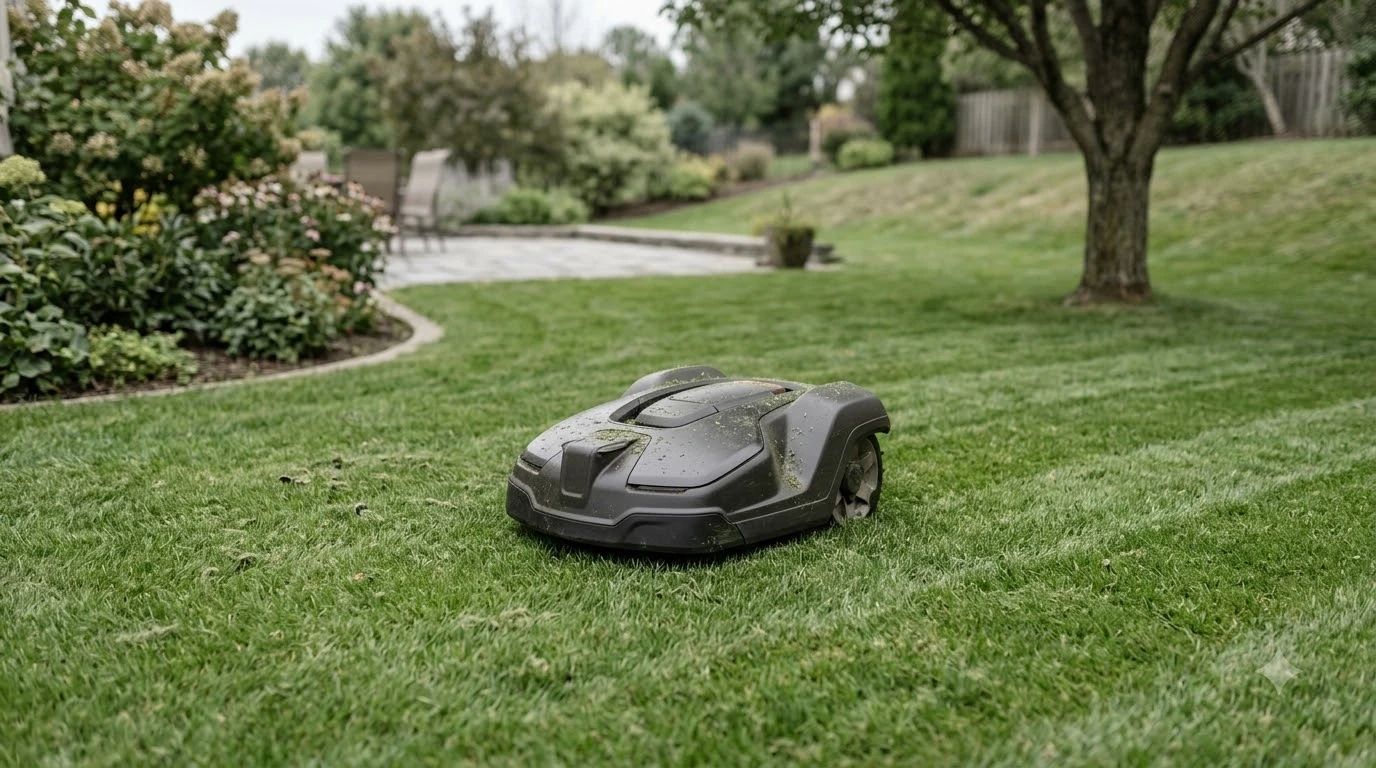

A random pattern vs systematic robot mower choice comes down to how the mower plans its path. Random mowers run straight until a boundary wire, obstacle or sensor alert turns them. Systematic mowers cut planned rows, and Mammotion says that mode uses navigation such as GPS or RTK.
The short answer
- Random mode: runs straight until a trigger, then turns. Mammotion calls it less efficient, with more overlap and no predictable path.
- Systematic mode: parallel, checkerboard or triangle patterns. Husqvarna says it suits flat, open areas with few obstacles.
- Naming differs: Husqvarna calls its random-type mode “irregular,” so check the app’s mode list rather than the label alone.
- Our reading: in a random pattern vs systematic robot mower decision, check yard shape, slope and positioning needs before comparing features.
How a random pattern robot mower moves
A random pattern mower travels in a straight line until it meets a boundary wire, an obstacle or a sensor alert, then changes direction. Mammotion describes random mowing as the most common pattern, and it has no fixed grid or set rows.
The trade-off in a random pattern vs systematic robot mower choice is efficiency. Mammotion lists less efficient mowing, more overlap and no predictable path as the main disadvantages of random mowing, in its guide to lawn mowing patterns. The same page says random mowing eventually achieves full coverage when performed frequently, but it gives no timeframe, so the time to full coverage on your lawn is not stated.
Husqvarna uses a different label for a similar idea. Its irregular mode cuts the lawn “uniformly from all directions,” and Husqvarna says that mode is ideal for lawns with slopes, complex work areas and many obstacles. The name does not tell you the navigation method, so read the mode description in the app.
For a random mower, the trigger list is the first thing to understand. A wire, an obstacle or a sensor alert decides each turn, so placing boundary wire, no-go areas and obstacles carefully makes the mower turn where you expect.
What a systematic pattern robot mower cuts
A systematic mower cuts in parallel tracks, and Husqvarna lists three patterns: parallel, checkerboard and triangle. Each one creates a striped effect, which is why stripes matter in this comparison, but the angle between sessions changes how the stripes look and where the edges get cut.
In parallel mode, each session starts in the same designated corner and moves in the same direction. Checkerboard turns the next session 90 degrees from the previous one. Triangle turns it 60 degrees, and Husqvarna says its stripes are less visible than parallel or checkerboard stripes.
| Pattern | Turn between sessions | Stripe visibility (Husqvarna) | Edge note (Husqvarna) |
|---|---|---|---|
| Parallel | Same direction, same start corner | Striped effect | Can leave edges uncut |
| Checkerboard | 90 degrees | Striped effect | Covers edges from multiple angles |
| Triangle | 60 degrees | Less visible than parallel or checkerboard | Covers edges from multiple angles |
Mammotion describes its zigzag mode as straight, parallel rows across the lawn, and its chessboard mode as horizontal and vertical passes that form a grid. Both are systematic patterns, so the difference you see on the lawn depends on which angle the app uses between sessions. Our reading: in a random pattern vs systematic robot mower comparison, check the angle setting in each app rather than assuming all systematic modes look alike.
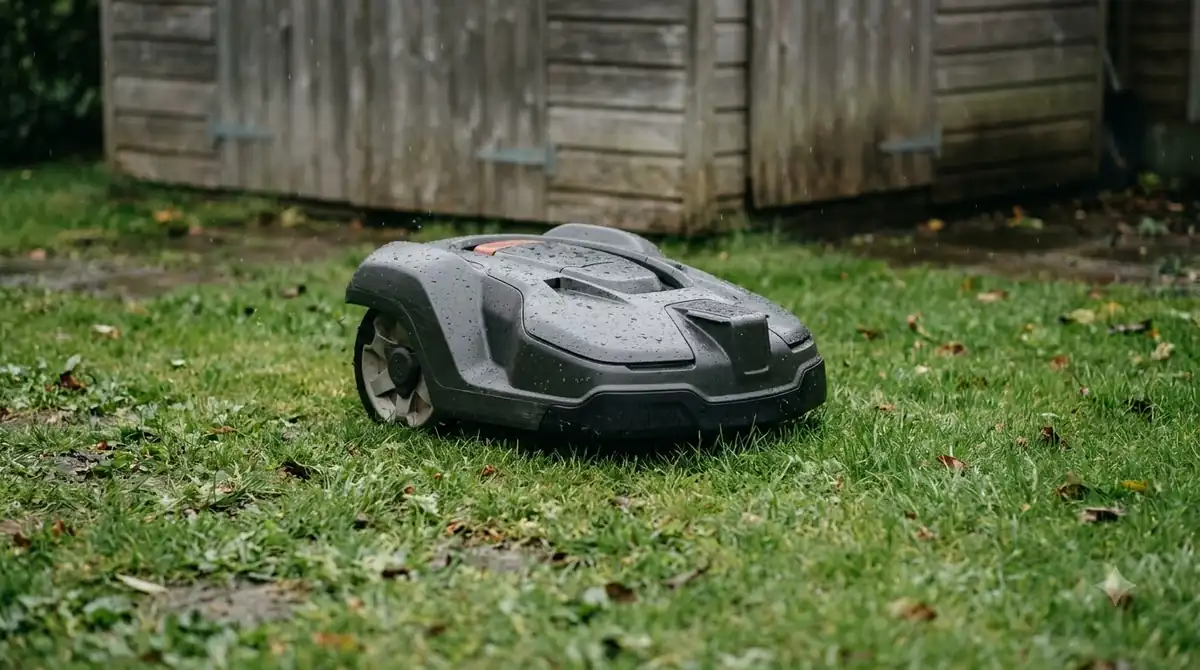
Stripe clarity is where the decision often starts. Parallel passes repeat the same direction, which makes the stripes easier to see, and Husqvarna says that same parallel pattern can leave edges uncut.
Why systematic mowing often depends on GPS or RTK
Systematic rows need the mower to know where it is, and Mammotion says systematic patterns use advanced navigation such as GPS or RTK to cut the lawn in organized rows. Mammotion calls this pattern far more efficient, reducing overlap and finishing faster, but the page gives no measured figures to back that claim.
RTK is one way to get that position fix (see how RTK works on a robot mower). A Sunseeker RTK explainer, written by a vendor, says RTK can reach “within a few centimeters,” while phone GPS is “within 5-10 meters.” Those are the vendor’s own numbers, and no independent accuracy test is cited on that page.
Mammotion also notes that RTK and GNSS reliability can be limited in complex terrain, and that vision or LiDAR systems may handle obstacles better, with slightly less pattern accuracy (our RTK, LiDAR and vision comparison covers that trade-off). Those are the vendor’s trade-offs, so weigh them against your own yard layout.
The same Sunseeker page says an RTK base station needs a clear sky view of about 160 degrees vertically, and that heavy tree cover, walls and roof overhangs can weaken accuracy. Positioning is where the comparison gets technical. Our reading: if your lawn sits under mature trees or beside a tall house wall, check the base placement plan before you assume the systematic mode will work well.
Edges, obstacles and slopes
Husqvarna says a parallel pattern, where the mower runs only in one direction, can leave edges uncut. Checkerboard and triangle cover the edges from multiple angles, and Husqvarna recommends a final mowing along the perimeter to remove uncut grass along the boundary and obstacles. This edge gap is one of the clearest differences between the two approaches.
Husqvarna describes systematic mowing as most suitable for flat, open areas with few obstacles. On slopes, its guidance is to mow straight up the slope when possible (check the robot mower slope rating first), and it notes that a 45-degree pattern angle to the slope can help on inclines.

Obstacles also leave gaps, and that matters for either mode. Husqvarna says any area less than 1 metre (3.3 feet) between an unexpected obstacle and the virtual boundary will remain uncut, so strips near beds and posts may need a manual trim.
Random pattern vs systematic robot mower for your yard
For a random pattern vs systematic robot mower decision, start with the yard’s shape. Systematic modes fit flat, open lawns with few obstacles, while random or irregular modes fit yards with slopes, beds and tight corners.
- Flat, open lawn: systematic patterns give the clearest striped effect, according to Husqvarna’s suitability note, and the straight stripe patterns guide covers that goal.
- Many beds, trees or tight corners: random or irregular mode is the brand’s own suggestion for complex areas.
- Sloped yard: check the slope rating and the mode guidance, since Husqvarna advises mowing straight up the slope.
- No RTK or clear sky view: random mowing reaches full coverage when run frequently, though Mammotion gives no timeframe.
- Even coverage over time: Mammotion advises switching the mowing direction each week to keep coverage even.
Neither mode is a shortcut around setup. A systematic mode still depends on the boundary, the base or signal, and any slope limit, so the pattern choice should follow those checks rather than replace them.

What to check before you buy
Before you buy, confirm the mode list, whether systematic mode needs GPS or RTK, how the brand handles edges and the slope limit for your yard. These checks matter more than the pattern name on the box, whatever random pattern vs systematic robot mower label the listing uses.
- Mode list. Confirm the app offers parallel, checkerboard or triangle, plus an irregular or random option.
- Positioning. Ask whether systematic mode needs GPS or RTK, and where a base station must sit to see the sky.
- Edges and obstacles. Check how the brand handles edge cutting and the uncut strip near obstacles.
- Slope limit. Match the slope rating and the recommended pattern angle to the steepest part of your yard.
Our reading: in a random pattern vs systematic robot mower decision, the positioning method and slope limit matter more than the pattern name. Start with the yard’s shape and obstacles, then pick the model whose modes and navigation match that yard.
Frequently asked questions
Does random mowing cover the whole lawn?
Mammotion says random mowing eventually achieves full coverage when it is performed frequently. The page gives no timeframe, so run time and lawn size decide how long full coverage takes. Run frequency matters most here. Changing the mowing direction each week, as Mammotion advises, helps spread the passes evenly.
Does a systematic mode always need GPS?
Mammotion says systematic patterns use advanced navigation such as GPS or RTK to cut organized rows. That is the source’s stated method, so check the model’s spec sheet for its positioning method before you assume the mode will suit your yard.
Why do edges stay uncut?
Husqvarna says a parallel pattern, which runs in one direction, can leave edges uncut. A final perimeter pass removes uncut grass along the boundary and obstacles. Areas under 1 metre between an obstacle and the virtual boundary remain uncut, so trim those spots by hand. Edge coverage is a useful check before you buy.
Which pattern gives the clearest stripes?
Husqvarna describes parallel, checkerboard and triangle as creating a striped effect, and says triangle stripes are less visible than the other two. If stripes matter most, the systematic modes are the better fit, though stripe clarity also depends on mowing height and grass type.
Sources
- What is systematic mowing? (Husqvarna): parallel, checkerboard and triangle angles, suitability, edges, perimeter pass, 1 metre rule and slope guidance.
- Lawn mowing patterns for robotic lawn mowers (Mammotion): random and systematic definitions, efficiency claims, zigzag and chessboard, weekly direction change.
- What is RTK technology? (Sunseeker, vendor): GPS and RTK accuracy claims, base station sky view and signal limits.
 Up next8 min readReviews & CompareLymow One Problems and Complaints: What the Sources ShowUpdated Nov 14, 2026
 9 min readReviews & CompareMammotion Luba 3 AWD Pros and Cons: What the Sources ShowUpdated Nov 13, 2026
 8 min readReviews & CompareRobot Mower vs Electric Lawn Mower: What the Sources ShowUpdated Nov 11, 2026
 8 min readReviews & CompareRobot Mower Annual Maintenance Cost: What the Sources ShowUpdated Nov 12, 2026
 7 min readReviews & CompareSunseeker Elite X5 Problems and Complaints: What the Sources ShowUpdated Nov 15, 2026
 8 min readReviews & CompareHusqvarna Automower 410iQ Problems and Complaints: What Published Sources ShowUpdated Nov 16, 2026