
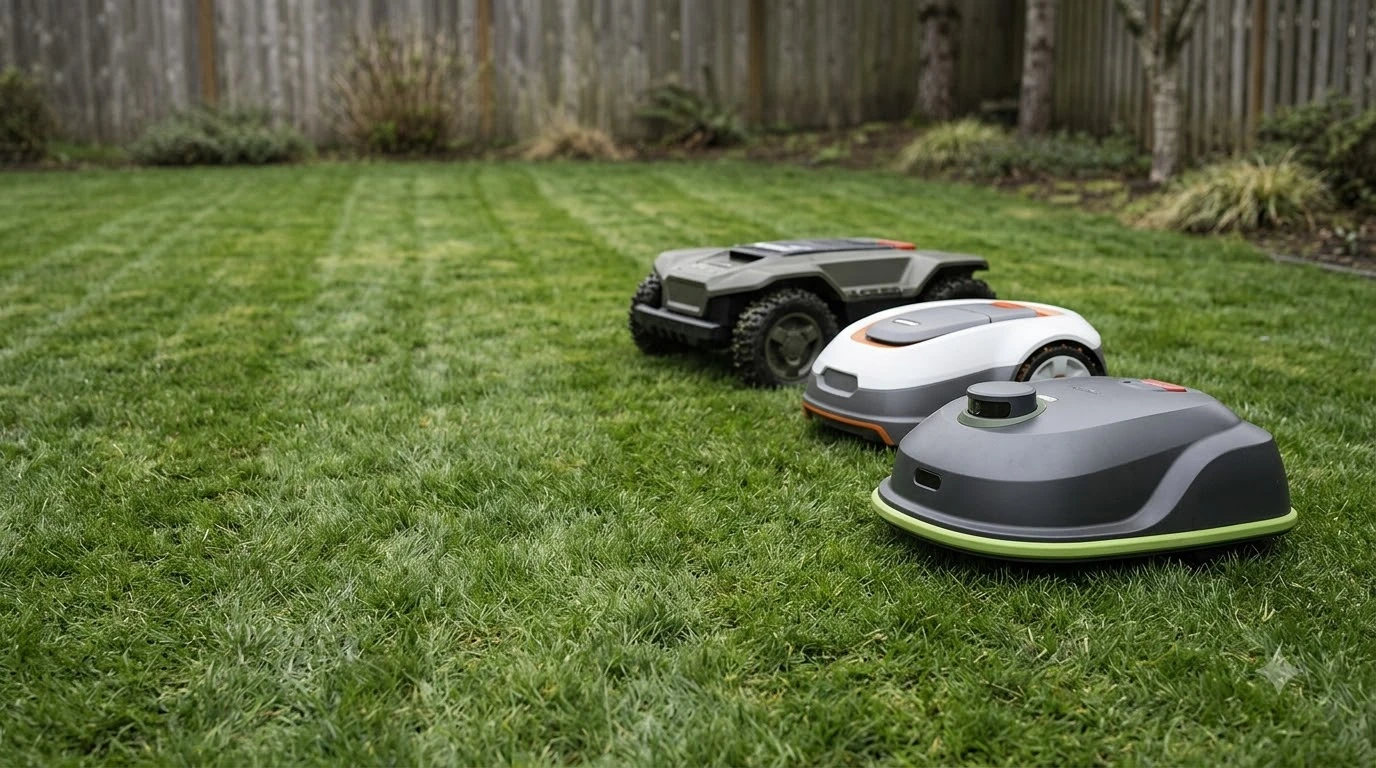

In the segway navimow i110n vs ecovacs goat o1000 rtk comparison, both mowers are sold as wire-free robot lawn mowers, but their published specs differ on cutting width, slope rating and navigation. The i110n is listed with a 7.1-inch cutting width and a 16-degree maximum slope in a 2024 review. The O1000 RTK’s US spec page lists an 8.66-inch deck and a 45% (24-degree) slope rating in the work area. The two sets of figures come from sources of different ages, so read them as a checklist rather than a scoreboard.
The short answer
- Cutting width: Navimow i110n 7.1 in (PCWorld, 2024); GOAT O1000 RTK 8.66 in (Ecovacs US spec page).
- Slope: the i110n is listed at 16 degrees (about 29%); the O1000 RTK at 45% (24 degrees) in its work area.
- Lawn size: both are listed for lawns up to about 1/4 acre.
- Navigation: both are described as wire-free with RTK positioning and a camera; the O1000 RTK also lists 3D ToF sensing.
- Battery: the i110n lists a longer run time (120 minutes) than the O1000 RTK (about 65 minutes of continuous mowing).
Heads up
The i110n figures come from a 2024 review and an undated consensus review, not from a current Segway spec page. The official Segway US product page redirected to a third-party reseller during our research, so we did not use it. Check the i110n listing as of Nov 2026 before relying on any number here. This article is based on published sources only. We did not test either mower.
Cutting width and cutting height
The wider deck on the O1000 RTK is the most visible difference in the published specs. The Ecovacs US page lists a cutting width of 8.66 inches and a cutting height of 1.2 to 3.2 inches in its spec table, with a marketing range of 3 to 8 cm in 0.5 cm steps. The O1000 RTK spec page gives these numbers as of Nov 2026.
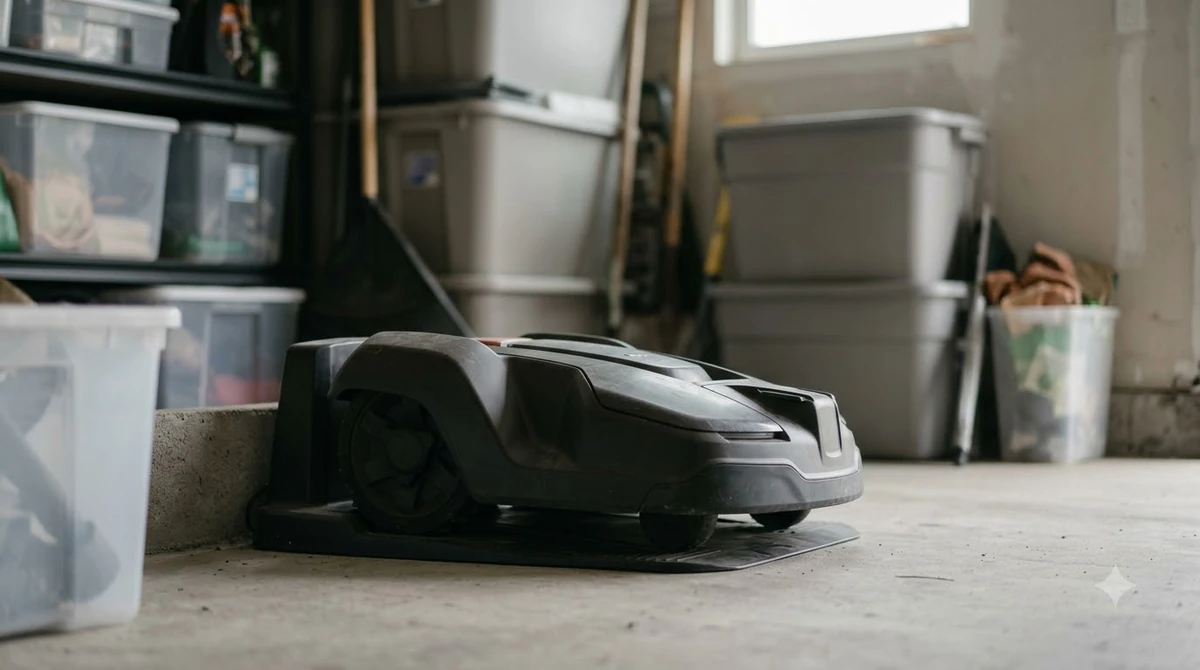
PCWorld’s 2024 review lists the i110n at a 7.1-inch (18 cm) cutting width and a 2 to 3.6-inch cutting height. The two height ranges overlap between about 2 and 3.2 inches, so for most common grass heights both mowers’ ranges cover the setting you need.
Our reading: in the Segway Navimow i110n vs Ecovacs GOAT O1000 RTK comparison, confirm your target height is inside both ranges before comparing anything else. A wider deck covers more ground per pass, but neither source gives a like-for-like mowing rate, so we cannot say how much faster either mower cuts. The O1000 RTK page does list about 1,507 ft2 per hour in delicate mode and about 1,938 ft2 per hour in efficient mode. The i110n sources we read do not give a comparable figure.
Slope ratings and what they mean
The two slope numbers are the largest gap in the published specs, and they are easy to misread. The O1000 RTK page gives 45% (24 degrees) for its work area and a separate 17% limit for its virtual boundary, which the page does not convert to degrees. The i110n is listed at 16 degrees in PCWorld and 29% in Smart Home Explorer. Those two figures agree, since 16 degrees is about a 29% grade.
PCWorld’s reviewer also reports that the i110n is front-wheel drive and struggled on steep slopes, and that its cliff detection was inadequate. These are reviewer observations, not manufacturer specifications. PCWorld’s review is the source for them. Our reading: a 45% rating and a 29% rating are not directly comparable, because each maker defines its work area and test conditions differently. Measure the steepest part of your lawn with a level app before you decide. Our guide to how robot mower slope ratings are explained covers how makers define them, and there is a step-by-step guide to measuring your yard slope.
Navigation without a boundary wire
Both mowers are sold as wire-free, so neither needs a buried perimeter wire. The O1000 RTK page describes RTK positioning with a camera and 3D ToF sensing, which it calls LiDAR-enhanced RTK. It lists 3D ToF and an AI camera for obstacle avoidance, and virtual boundaries for no-go zones. Smart Home Explorer describes the i110n as wire-free RTK with a camera system it calls VisionFence.

Two points from the sources are worth checking. PCWorld’s reviewer says line of sight to the GPS antenna is not required for the i110n, and calls its navigation strong for its price class. That is a reviewer’s opinion, and the O1000 RTK page does not address the same point. Satellite-based positioning generally depends on a view of the sky, so a yard with tall trees or walls may need more attention with either model. This is general RTK behavior, not a spec from either source. Our reading: map the yard’s shade and tree cover before choosing RTK over a wire-based system, and read how RTK, LiDAR and vision navigation compare if you are unsure which suits your lawn.
Lawn size, noise and battery
Both models are listed for lawns up to about 1/4 acre, so lawn size does not separate them on paper. Noise is close: PCWorld lists the i110n at 58 dB, and the O1000 RTK page lists 57 dBA. These two units are not strictly the same scale, so treat the gap as small rather than exact.
Battery figures differ more. The i110n sources list a 5.1 Ah battery with a 120-minute full run time and a 180-minute charge. The O1000 RTK page lists an 18 V, 4000 mAh battery with about 65 minutes of continuous mowing and a charge of about 100 minutes. Our reading: in the Segway Navimow i110n vs Ecovacs GOAT O1000 RTK battery figures, a longer listed run time matters most on a larger lawn, while a shorter charge time matters if you need the mower back on the grass quickly after a rain delay. For the Segway side, see how long the Segway Navimow i110n battery lasts.
Segway Navimow i110n vs Ecovacs GOAT O1000 RTK: who each option suits (our reading)
The published specs do not name a winner, and the better fit depends on your lawn. The table below lists the figures from each source side by side, with the source date noted in each cell.
| Spec | Segway Navimow i110n | Ecovacs GOAT O1000 RTK |
|---|---|---|
| Cutting width | 7.1 in (18 cm), PCWorld 2024 | 8.66 in, Ecovacs US page, Nov 2026 |
| Cutting height | 2 to 3.6 in, PCWorld 2024 | 1.2 to 3.2 in, Ecovacs US page |
| Max slope | 16 degrees (about 29%), PCWorld and Smart Home Explorer | 45% (24 degrees) work area; 17% virtual boundary |
| Lawn size | Up to about 1/4 acre | Up to 1/4 acre |
| Navigation | Wire-free RTK with camera (VisionFence) | RTK with camera and 3D ToF |
| Noise | 58 dB | 57 dBA |
| Run time | 120 min full charge | About 65 min continuous mowing |
| Charge time | 180 min | About 100 min |
| Warranty | Not stated on the pages we read | Not stated on the spec page; links to the support page |
Our reading: the O1000 RTK fits a yard where the wider deck, the 45% work-area rating and the 3D ToF obstacle sensing matter to you, as long as the warranty and charging times suit your setup. The i110n fits a flatter lawn up to about 1/4 acre where the longer listed run time is the bigger priority and the lower slope rating is not a constraint. For a decision between the Segway Navimow i110n and the Ecovacs GOAT O1000 RTK, neither choice should rest on these figures alone. Check the listings for current warranty terms and prices before you buy.

Frequently asked questions
Segway Navimow i110n vs Ecovacs GOAT O1000 RTK: which is the better mower?
The sources we read do not name a winner, and we did not test either mower. The better fit depends on lawn size, slope and which of the published specs matter most to you.
Do either of these mowers need a boundary wire?
Both are described as wire-free. The O1000 RTK page describes virtual boundaries for no-go zones, and the i110n is described as using a camera-based fence called VisionFence.
Why do the slope numbers look so different?
A percent grade and an angle in degrees describe the same thing in different units. The i110n’s 16 degrees is about 29%, while the O1000 RTK’s 45% is 24 degrees. The two makers also describe their ratings differently, so check each listing’s definition.
How current are the Segway Navimow i110n vs Ecovacs GOAT O1000 RTK specs?
The O1000 RTK figures come from the Ecovacs US spec page, read as of Nov 2026. The i110n figures come from 2024 and undated reviews, because the official Segway page was not readable during our research. Check both current listings before buying.
Sources
- Ecovacs GOAT O1000 RTK, US spec page (manufacturer): cutting width, cutting height, slope, coverage, efficiency, navigation, noise, battery and run time.
- PCWorld, Segway Navimow i110n review (publication, 2024): cutting width and height, slope, battery, noise, IP66 rating, drive and cliff detection comments.
- Smart Home Explorer, Segway Navimow i110n (publication): lawn size, slope cross-check and navigation description. The page states the publisher did not test the mower.
 Up next9 min readReviews & CompareEcovacs GOAT O1000 RTK Review: What the Published Specs SayUpdated Nov 11, 2026
 11 min readReviews & CompareEcovacs GOAT O1000 LiDAR PRO vs Navimow i110N: Specs ComparedUpdated Nov 16, 2026
 8 min readReviews & CompareEcovacs GOAT O1000 RTK vs Ecovacs GOAT A1600 RTK: What the Specs ShowUpdated Nov 11, 2026
 8 min readReviews & CompareEcovacs GOAT O1000 vs Mammotion LUBA 3: Spec ComparisonUpdated Nov 11, 2026
 7 min readReviews & CompareEcovacs GOAT A1600 RTK vs Dreame A1 Pro: Sourced Spec ComparisonUpdated Nov 11, 2026
 12 min readReviews & CompareIs the Ecovacs GOAT A1600 RTK Worth It? Specs, Limits and Trade-offsUpdated Nov 11, 2026