
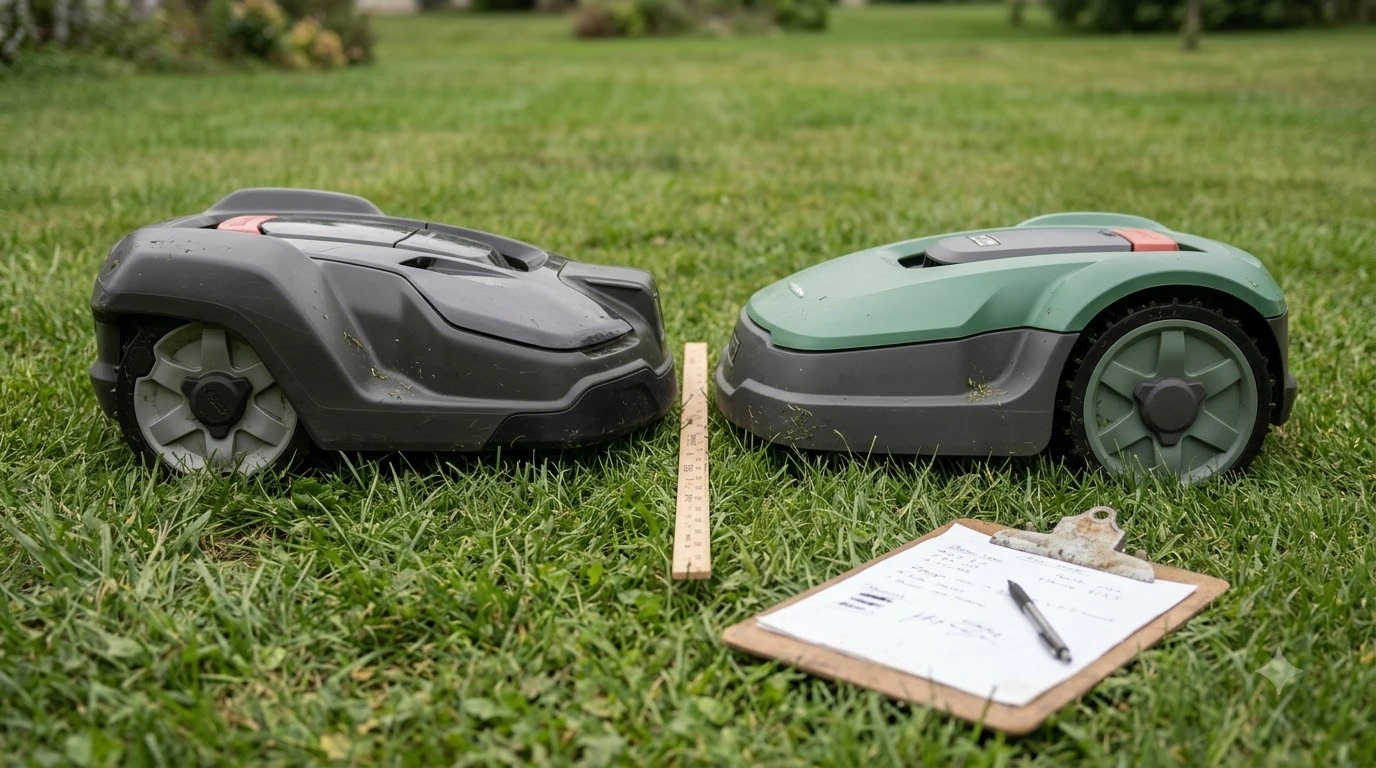

The sunseeker elite x5 vs dreame a1 pro matchup comes down to a choice between all-wheel-drive hill climbing with camera-plus-RTK positioning and a simpler LiDAR mower built for faster setup. Both wire-free robot mowers cover up to 2,000 square meters (about 0.5 acres) and use a 22 cm cutting disc, but they handle slopes, mapping, and obstacles differently. Choosing the right one depends on your yard’s terrain, tree cover, and how much initial setup work you want to take on.
The short answer
- Navigation hardware: The Sunseeker Elite X5 relies on AONavi (RTK-GNSS satellite positioning paired with binocular VSLAM cameras), while the Dreame A1 Pro uses a single 3D LiDAR sensor without an external antenna.
- Slope handling: Sunseeker rates the X5 for grades up to 60% (30 degrees) with all-wheel drive; Dreame rates the rear-drive A1 Pro for grades up to 45% (24 degrees).
- Cutting deck and height: Both cut a 22 cm path, though the X5 adjusts from 20 to 60 mm (manual on the original X5, app-controlled on Gen 2) and the A1 Pro adjusts from 30 to 70 mm via its app or onboard dial.
- Setup and maintenance: Reviewers report that the Dreame A1 Pro sets up quickly without antenna placement, whereas the Sunseeker X5 can demand careful antenna positioning and occasional map adjustments.
- Weather protection: The Dreame A1 Pro carries an IPX6 water-resistance rating for hose rinsing, compared with IPX5 on the Sunseeker Elite X5.
How the Sunseeker Elite X5 and Dreame A1 Pro compare on specs
On paper, these two wire-free mowers target the same half-acre yard size while taking opposite engineering paths for traction, sensing, and deck control.
According to Sunseeker Elite’s official product specifications and Dreame’s A1 Pro product page, both machines cap out at 2,000 square meters (roughly 0.5 acres) of mowing area and run on 5 Ah lithium-ion batteries. Each unit spins a 22 cm cutting disc, automatically returns to dock when rain starts or battery reserves dip, and skips buried perimeter wires entirely.
Beneath those shared basics, the hardware diverges. Sunseeker builds the Elite X5 around an all-wheel-drive chassis with a steerable rear wheel, independent front suspension, and a floating cutting disc designed to follow dips in uneven turf. Dreame equips the A1 Pro with rear-wheel drive, larger off-road rear tires, and an onboard color display with a rotary jog wheel alongside app controls.
| Specification | Sunseeker Elite X5 (Gen 1 / Gen 2) | Dreame A1 Pro |
|---|---|---|
| Max mowing area | Up to 2,000 sq m (about 0.5 acres) | Up to 2,000 sq m (about 0.5 acres) |
| Navigation system | AONavi (RTK-GNSS + binocular VSLAM; nRTK + iToF on Gen 2) | OmniSense 3D LiDAR (360° × 59° field of view, 70 m range) |
| Drivetrain | All-wheel drive (AWD) with rear steering motor | Rear-wheel drive with off-road rear tires |
| Max slope rating | 60% (30°) | 45% (24°) |
| Cutting width | 22 cm (8.7 in) | 22 cm (8.7 in) |
| Cutting height range | 20–60 mm (manual on Gen 1; electronic on Gen 2) | 30–70 mm (electronic via app or onboard dial) |
| Battery & charging | 5 Ah battery, 3 A charger | 5 Ah battery, ~65-minute charge time |
| Waterproof rating | IPX5 | IPX6 |
| Listed noise level | Around 60 dB | Around 59 dB (50–55 dB measured in tests) |
| Weight | 11.8 kg (26 lbs) | 12.6 kg (27.8 lbs) |
Note that Sunseeker sells both an original X5 with a local RTK base antenna and a newer X5 Gen 2 variant () that shifts to network RTK over a built-in 4G-GPS module, adds a night-vision iToF sensor, and upgrades to electronic height adjustment.
Navigation, setup, and obstacle avoidance
The biggest day-to-day difference between these mowers lies in how they map your yard and dodge forgotten lawn gear.
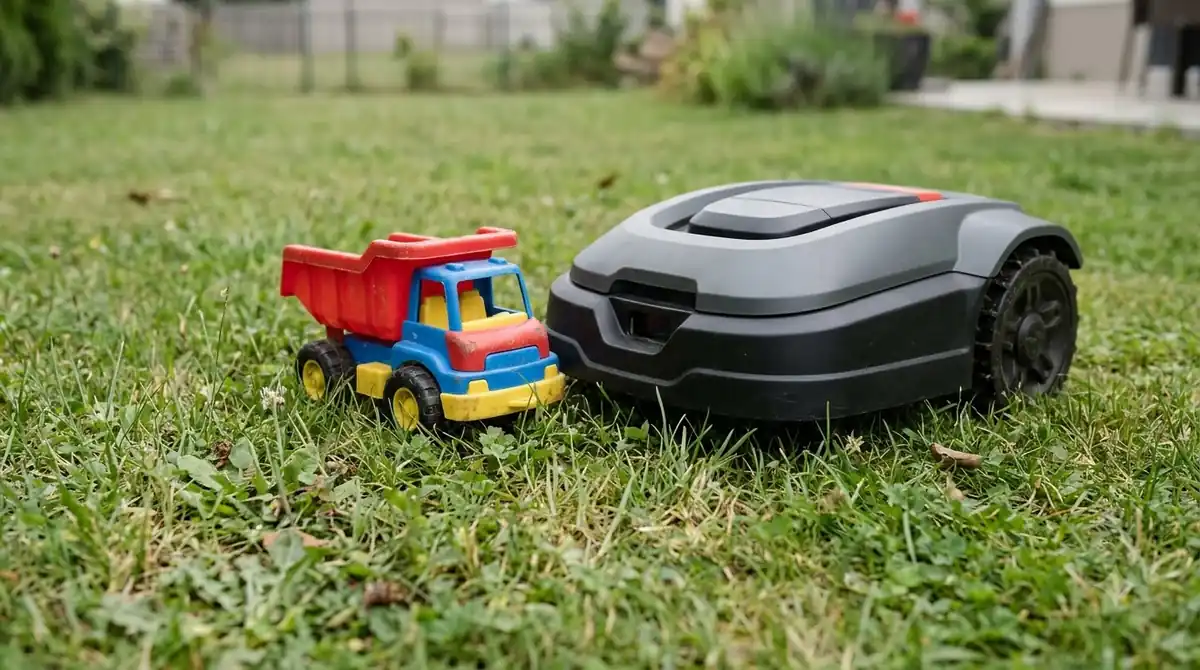
Sunseeker’s AONavi system pairs satellite RTK corrections with dual binocular cameras running VSLAM visual mapping. In theory, satellite data keeps straight lines accurate down to the centimeter while the cameras carry the mower through tree shade where satellite signals weaken. In practice, reviewers note trade-offs. In its June 2025 review of the original X5, Računalniške novice reported that the mower handled day-to-day mowing reliably after initial boundary learning, though the camera-dependent VSLAM system would not start mowing at night or in poor visibility. Reviewing the X5 Gen 2 in October 2026, New Atlas found that walking the perimeter and positioning the receiving antenna required patience, and noted occasional connectivity drops and map shifts even as Vision AI 2.0 successfully avoided sprinklers, rocks, and a portable chicken run.
Dreame eliminates satellite antennas altogether. The A1 Pro mounts a 360-degree 3D LiDAR turret on top of the mower that scans up to 70 meters away to build a 3D point-cloud map. Because LiDAR emits its own laser pulses rather than relying on sunlight or sky view, Dreame states it works identically in bright sun, shade, or complete darkness. In Notebookcheck’s July 2025 review, testers highlighted the straightforward setup—driving the mower around the lawn edge once via smartphone remote—and praised its systematic, quiet operation. However, Notebookcheck also pointed out a limitation of camera-free LiDAR: the A1 Pro did not consistently detect a low-profile hedgehog dummy during testing, meaning small flat items left in tall grass can still pose a challenge.
Heads up
If you are looking at the Sunseeker Elite X5 Gen 2 check ongoing connectivity terms before buying: Sunseeker includes 24 months of NetRTK and 4G service with the mower, after which continued network-assisted operation requires an annual subscription renewal.
Mowing performance, slopes, and lawn finish
Both robots leave tidy parallel stripes on flat lawns, yet steep banks and rough turf separate their mechanical designs.
With three driven wheels, independent front suspension, and a floating cutting deck, the Sunseeker Elite X5 is engineered for uneven ground and steep grades up to 60% (30 degrees). The floating disc rides up and down over bumps rather than scalping high spots, and Sunseeker’s edge-cutting design trims within roughly 3 cm of borders. New Atlas observed that this edge reach cut manual string-trimming time down to just a couple of minutes on a half-acre lot, and confirmed the mower climbed easily from low concrete walkways onto thicker turf.
The Dreame A1 Pro tops out at a 45% (24-degree) slope rating and uses a fixed-height cutting deck rather than a floating one. Still, independent reviewers found its cut quality high on typical suburban lawns. Notebookcheck measured power draw during a full charge cycle at roughly 80 Wh and noted the mower covered about 150 square meters per charge in standard mode while running at a measured 50 to 55 dB at one meter. Dreame also lets owners switch between standard parallel lanes, chessboard patterns, and cross-angle cuts in the app, and its 30 to 70 mm height range accommodates taller cool-season grasses better than Sunseeker’s 60 mm ceiling.
Pros and cons of each mower
Independent testing and manufacturer specifications highlight clear strengths and compromises on both sides.
Sunseeker Elite X5 pros (per Sunseeker Elite and New Atlas):
- Strong slope traction: All-wheel drive and rugged tires climb grades up to 60% (30°), outpacing most two-wheel-drive competitors.
- Floating deck and close edges: The floating disc follows uneven ground without scalping, and edge cutting trims close to hard borders.
- Camera-based object recognition: Dual cameras identify sprinklers, toys, and yard gear without relying solely on physical bumpers.
- Low cut capability: Adjusts down to 20 mm for homeowners who maintain short warm-season turf.
Sunseeker Elite X5 cons (per Računalniške novice and New Atlas):
- Fussy initial setup: Walking boundaries and finding an interference-free spot for the antenna can take trial and error.
- Signal and map quirks: Reviewers reported periodic connectivity drops and occasional map drift requiring re-adjustment.
- Lighting or subscription limits: Original X5 models pause VSLAM operation in the dark, while Gen 2 models require a paid renewal after two years for NetRTK/4G service.
Dreame A1 Pro pros (per Dreame and Notebookcheck):
- Antenna-free LiDAR setup: Maps the yard with a single remote-controlled perimeter lap and needs no external RTK beacon.
- Day-and-night consistency: 3D LiDAR works in heavy tree canopy, glare, or darkness without losing positioning.
- Taller grass range and easy rinsing: Cuts up to 70 mm high with app-based height adjustment and carries an IPX6 rating for hose cleaning.
- Quiet, efficient running: Measured at 50 to 55 dB in testing with low standby power consumption.
Dreame A1 Pro cons (per Notebookcheck):
- Lower slope limit: Two-wheel rear drive caps out at 45% (24°) and lacks the all-wheel grip of the Sunseeker X5.
- No optical camera for tiny objects: LiDAR alone can miss very low objects like small animal dummies or flat toys in thicker grass.
- Fixed cutting deck: Does not float independently over sharp humps and dips the way Sunseeker’s disc does.
Who it suits
Your yard’s layout and your tolerance for setup complexity point clearly toward one model or the other.
The Sunseeker Elite X5 suits homeowners who:
- Have steep slopes between 45% and 60% (24° to 30°) or bumpy, uneven turf where all-wheel drive and a floating deck prevent wheel spin and scalping.
- Want minimal string-trimming along walkways and borders thanks to close edge cutting.
- Keep short grass down to 20 mm and don’t mind spending extra time fine-tuning antenna placement and app zones during the first week.
The Dreame A1 Pro suits homeowners who:
- Want a straightforward, antenna-free installation without mounting an RTK station or worrying about satellite line-of-sight under mature trees.
- Have flatter or moderately sloped yards under 45% (24°) and prefer taller grass heights up to 70 mm.
- Value quiet nighttime mowing, higher IPX6 water resistance for quick hose cleanups, and no recurring satellite network subscription.
Frequently asked questions
Does the Dreame A1 Pro need an RTK antenna or boundary wire?
No. According to Dreame’s official specifications, the A1 Pro uses an onboard 360-degree 3D LiDAR sensor for positioning and virtual boundaries, so you do not need to bury perimeter wire or mount an external RTK reference antenna.
Can the Sunseeker Elite X5 mow at night?
It depends on the version. Reviewers of the original Sunseeker Elite X5 noted that its camera-based VSLAM navigation requires daylight and will not start in the dark, whereas Sunseeker’s X5 Gen 2 adds an infrared iToF depth sensor designed for 24-hour day and night operation.
Which mower handles steeper hills better?
The Sunseeker Elite X5 has the higher published slope rating at 60% (30 degrees) using an all-wheel-drive system, while the rear-wheel-drive Dreame A1 Pro is rated for slopes up to 45% (24 degrees).
What is the maximum lawn size for both mowers?
Both the Sunseeker Elite X5 and the Dreame A1 Pro are rated by their manufacturers for lawns up to 2,000 square meters, which equals roughly 0.5 acres.
Sources
- Sunseeker Elite X5 Product Page (Sunseeker Elite): used for official X5 specifications including 2,000 sq m coverage, AONavi RTK+VSLAM navigation, AWD 60% slope rating, 22 cm cutting width, and 20–60 mm cutting height.
- Sunseeker Elite X5 Gen 2 Product Page (Sunseeker Elite): used for Gen 2 updates including Network RTK with 4G-GPS, iToF night sensor, 3 cm edge cutting, and electronic height adjustment.
- Dreame Robotic Lawn Mower A1 Pro Product Page (Dreame): used for official A1 Pro specs including 2,000 sq m area, OmniSense 3D LiDAR range, 45% slope limit, 30–70 mm cutting height, 65-minute charge time, and IPX6 rating.
- Dreame A1 Pro robotic lawnmower review (Notebookcheck): used for independent test measurements on noise (50–55 dB), single-charge coverage (150 sq m), power draw, setup workflow, and small-object detection limits.
- Review: Sunseeker Elite X5 Gen 2 robo mower adds new navigation (New Atlas): used for real-world observations on perimeter mapping, antenna placement, connectivity drops, edge trimming, and obstacle avoidance.
 Up next8 min readReviews & CompareSunseeker Elite X5 Pros and Cons: What the Specs and Reviews ShowUpdated Nov 16, 2026
 8 min readReviews & CompareSunseeker Elite X5 vs Segway Navimow i110N: Which Fits Your LawnUpdated Nov 11, 2026
 9 min readReviews & CompareSunseeker Elite X5 Review: Specs, Versions and LimitsUpdated Nov 12, 2026
 8 min readReviews & CompareSunseeker X7 vs Sunseeker Elite X5: Honest Spec ComparisonUpdated Nov 11, 2026
 7 min readReviews & CompareDreame A1 Pro vs Dreame A2: Which Robot Mower Fits Your Lawn?Updated Nov 11, 2026
 8 min readReviews & CompareIs the Sunseeker Elite X5 Worth It? Verdict by Yard TypeUpdated Nov 16, 2026