
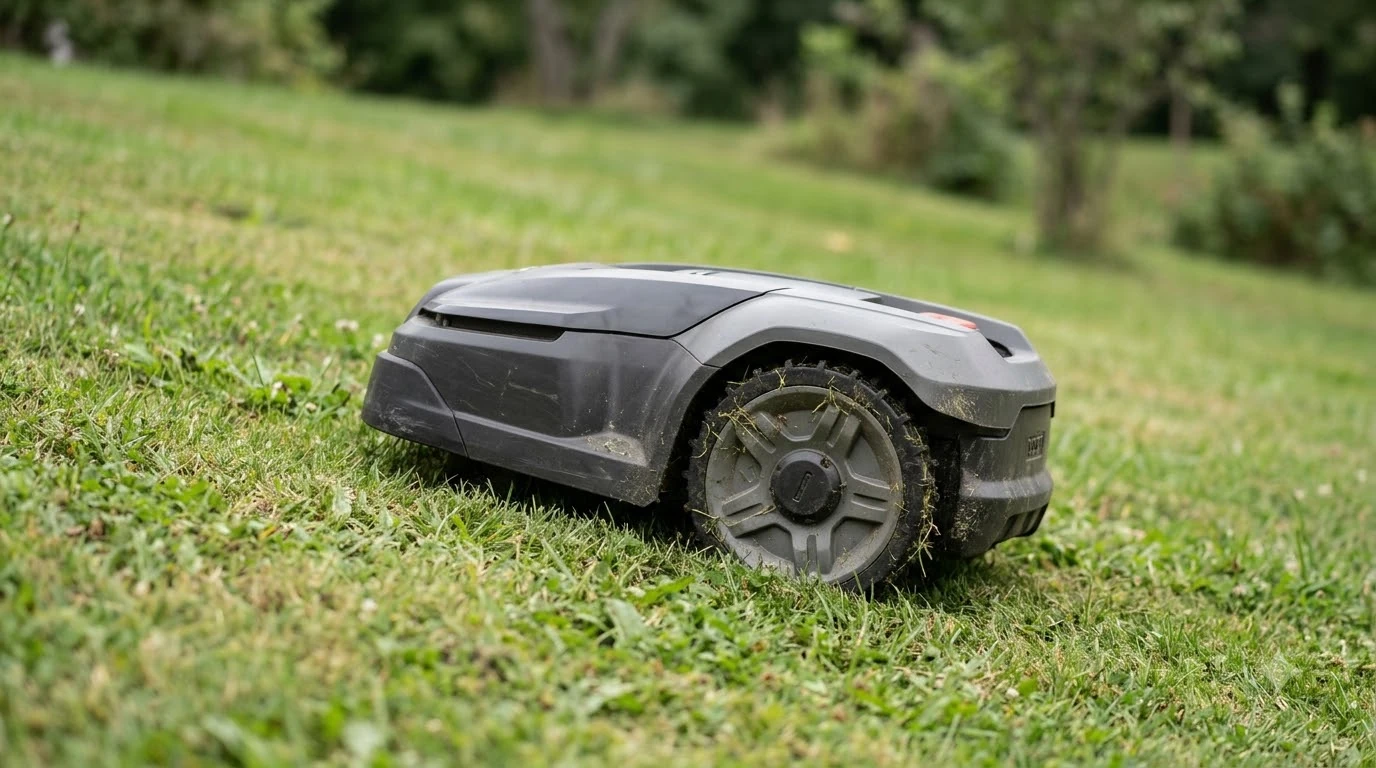

No source we read can say which robot mower handles slopes best tested, because no independent test compares models on the same slope. The published ratings are the best starting point. Husqvarna’s support page lists rated work-area slopes from 25% to 70% depending on the model, as of November 2026.
Read those ratings as a ceiling for the mowing area, not a target for every day. The lower boundary limit, the drive type, and wet grass matter just as much at the edges of a real lawn.
The short answer
- Rated slope: 25% to 70% depending on model, with the 435X AWD at the top of the Husqvarna range.
- Boundary limit: lower than the work-area limit on every listed model, from 10% to 50%.
- Ceiling, not target: the Eufy vendor blog calls the rated maximum an absolute limit.
- Our reading: decide by your steepest real slope and its wet-weather use, not by the headline number.
Which robot mower handles slopes best tested: start with the rated numbers
Robot mower slope ratings are published as a percentage of rise over run, and each model carries two numbers: one for the work area and a smaller one for slopes at the boundary wire. The table below uses the limits in Husqvarna’s steep-slope installation guide for a representative set of its models.
| Husqvarna model | Work-area max slope | Boundary max slope |
|---|---|---|
| Aspire R4 | 25% | 10% |
| 105 | 25% | 15% |
| 305, 310, 315 | 40% | 15% |
| 320 NERA, 430X NERA, 450X NERA | 50% | 25% |
| 435X AWD | 70% | 50% |
The page also gives the slope formula: slope (%) = vertical height / horizontal distance x 100. A rise of 15 cm over 100 cm is a 15% slope. When a page gives only one number, check whether it refers to the work area or the boundary before comparing two figures.
Percent vs degrees: converting the rating
Some vendors publish degrees and others publish percent, and the two are not interchangeable. A percent is a ratio, while a degree is an angle. Iowa State University Extension gives the conversion 1:12 = 8.33%, and its landscape guidance treats slopes of 20% or more as steep, with about 30% or more too steep to mow turfgrass.
Using the standard tangent relationship, our own calculation puts 25% at about 14 degrees, 50% at about 26.6 degrees, and 70% at about 35 degrees. Be wary of vendor tables that pair a percent with a degree value that does not match the tangent; one vendor blog we read pairs 40% with 18 degrees, which does not fit the arithmetic.
Work area vs boundary: the limit that matters at the edge
The boundary limit is the number that often decides whether a mower can work a whole yard. On the Husqvarna table, the outer boundary rating is lower than the work-area rating for every model, so a steep edge can be the binding constraint even when the middle of the lawn is fine.
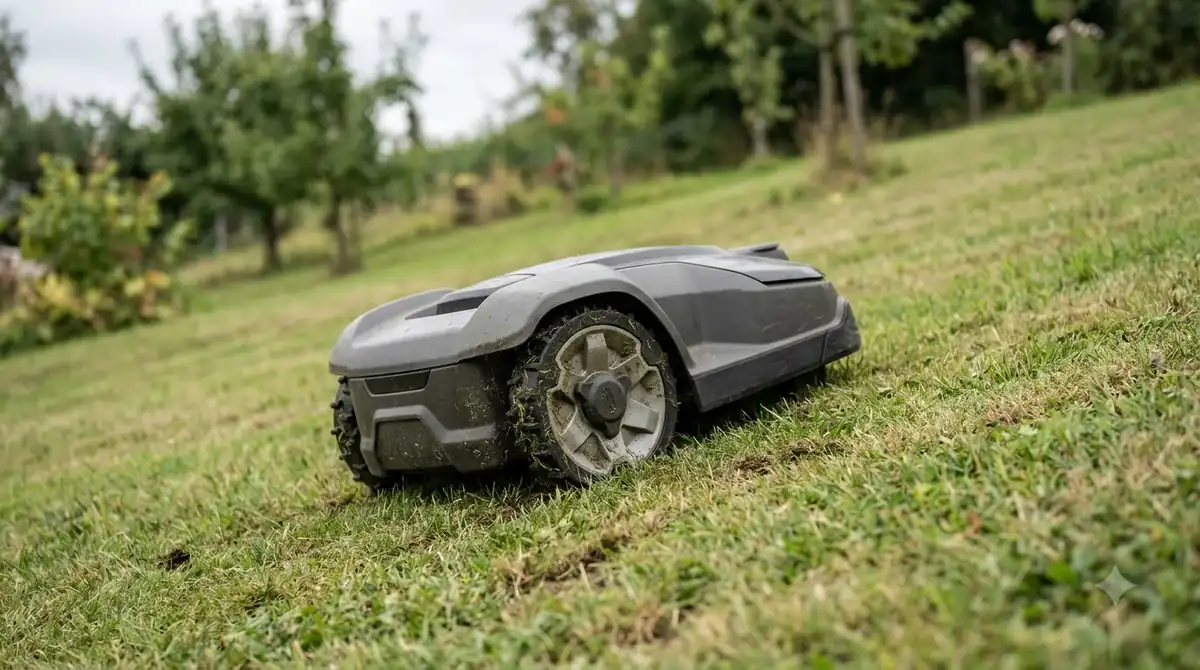
Husqvarna’s guidance on physical wire installations says to lay the guide wire diagonally across the slope for better traction and less grass wear. On the AWD models, the guide wire can run straight or diagonally from the bottom to the top of the slope. The company also asks for at least 50 cm (1.6 ft) of level ground between flat areas and steep slopes, and for 1.5 m (5 ft) between the boundary wire and obstacles on slopes up to 50%.
On the 435X AWD’s 50% to 70% range, the same guidance says to avoid obstacles on the slope itself and to keep 1.5 m between the bottom of the slope and the boundary wire. Our reading is that a yard with a steep edge close to a fence, pond, or path needs more room than the headline rating suggests.
AWD vs 2WD on climbs and wet grass
Drive type is where the vendors disagree most. Husqvarna’s 435X AWD is rated to 70%, while several 2WD models in the same range are rated lower, which is consistent with the extra driven wheels helping on climbs. The rating difference alone does not show how each drive type behaves on the same slope, so which robot mower handles slopes best tested depends on drive type as much as on the number. Our comparison of AWD versus 2WD on hills goes further.
Mammotion, which sells both drive types, says 2WD models can slip on soft, wet, or muddy ground, while AWD models handle wet grass with less slipping. That is a vendor view and should be read as such. Honda, a manufacturer of its own robot mowers, notes that its Miimo rear wheels use a broad tread designed to shed mud and keep grip in wet conditions, and that turning across a slope, mowing near edges, and moving on wet grass are harder than a straight climb.
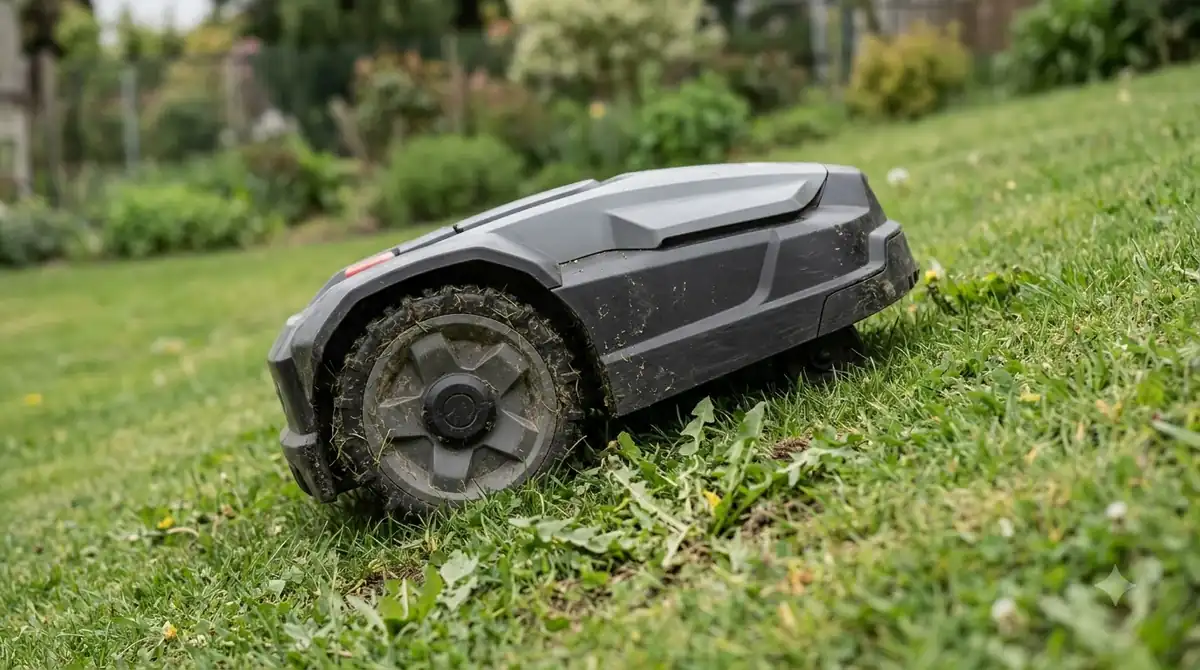
Optional spikes and traction wheels are another route. Robomow says special tires or spikes are often available as optional accessories, and that drive wheels are usually larger for better grip. See traction spikes for robot mower slopes for the accessory side. Our reading is that a 2WD mower on a steep, wet slope may need a traction accessory before it matches an AWD model.
Wet grass and the rated limit
Wet grass is the factor most likely to beat the rating. Eufy’s vendor blog says damp turf reduces tire grip and that a mower can slide even within its rated limit. It also says that running at the top of the limit strains the motor, drains the battery faster, and increases tire slip, so the rated maximum is not a daily target.
The same concern appears in Honda’s manufacturer guidance, which says wet grass reduces grip for any mower regardless of its incline rating, and that if a mower tips or loses grip it can miss areas, stall, or simply stop. Slipping is also a safety question; whether robot mowers slide on wet slopes and whether they tip over on hills each have their own guide.
Heads up
None of the vendor sources we read describes a test method, sample size, or lawn conditions for its slope or wet-grass claims. Treat each one as a manufacturer statement, not a result we verified ourselves.
What to check before you buy
Use the published numbers to narrow down which robot mower handles slopes best tested for your yard, then check the details that a headline rating hides. The steps below are our reading of what to verify, not a ranking of models.
- Measure your steepest real slope. Use a level or a phone incline tool, and record the percent, not a guess; how to measure yard slope shows the method.
- Compare the boundary limit. If the steepest part of the lawn sits next to the boundary wire, the boundary number governs that area.
- Check the drive type and wet-weather use. Ask whether the model is AWD or 2WD and whether the traction accessories are offered.
- Plan the layout. Keep a flat transition, a diagonal guide wire, and clearance from obstacles on slopes near the limit.
- Ask about the rated limit under wet conditions. Use the rating as a ceiling and leave margin for rain and damp soil.
Frequently asked questions
Is there an independent test that ranks robot mowers on slopes?
Not in the sources we read, so which robot mower handles slopes best tested stays an open question. The slope figures are published by manufacturers, and none of the sources we checked compares models on the same slope under the same conditions.
What slope can a robot mower handle?
Husqvarna’s current table lists 25% to 70% depending on model. The figure is a work-area rating, and the boundary rating is lower on every listed model.
Is the rated slope a daily target?
No. The Eufy vendor blog describes the rated maximum as an absolute limit, since running at the top of the range strains the motor and drains the battery faster.
Does AWD matter on wet grass?
Mammotion says AWD models handle wet grass with less slipping than 2WD models, and Honda notes that wet grass reduces grip for any mower. Those are manufacturer views, so check the drive type against your own slope.
Sources
- Husqvarna support: how to optimise an Automower installation for steep slopes (manufacturer): model limits, slope formula, AWD clearance, transition distance, guide wire direction.
- Iowa State University Extension: gardening on slopes and hillsides (university extension): 1:12 = 8.33%, steepness thresholds, stakes for slopes above 10%.
- Honda UK: can robotic lawn mowers handle slopes and uneven gardens (manufacturer): broad-tread wheels, harder maneuvers on slopes and wet grass.
- Eufy: robot lawn mower slope limits (vendor blog): rated maximum as a limit, wet grass, battery effect.
- Mammotion: 2WD vs 4WD robot mower (vendor blog, read as a vendor view): 2WD and AWD on wet ground.
 Up next8 min readReviews & CompareWhich Robot Mower Is the Quietest Tested? A Spec GuideUpdated Nov 11, 2026
 7 min readReviews & CompareHookii Neomow X SE Review: 0.75-Acre Specs and Slope LimitsUpdated Nov 11, 2026
 7 min readReviews & CompareMOVA LiDAX Ultra 2000 Review: Specs, Slope and LimitsUpdated Nov 11, 2026
 8 min readReviews & CompareMammotion YUKA Mini vs eufy E15: Specs, Slope and Lawn SizeUpdated Nov 11, 2026
 8 min readReviews & Compareeufy E15 vs Worx Landroid Vision: Lawn Size, Slope and SpecsUpdated Nov 11, 2026
 9 min readReviews & CompareSunseeker X7 Review: Specs, Slope, Shade and SetupUpdated Nov 11, 2026