
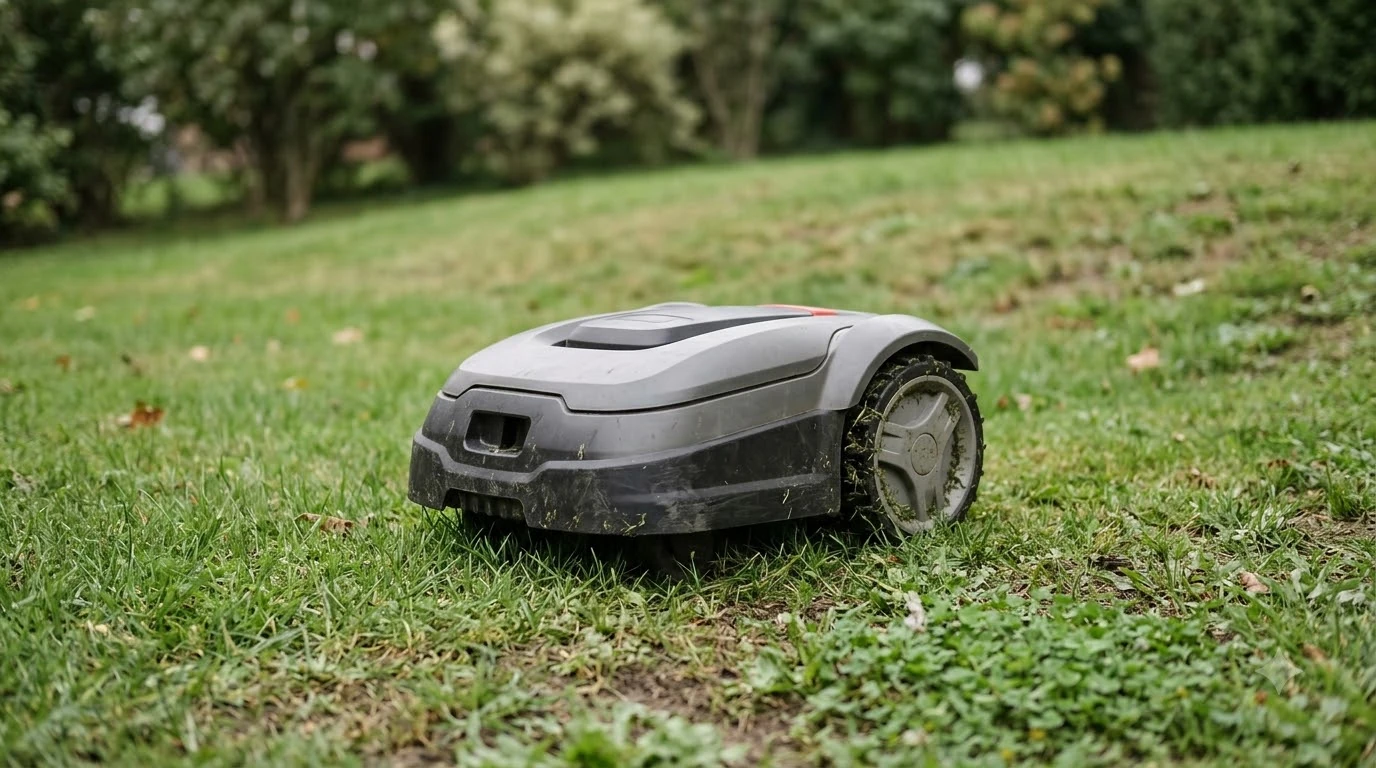

Which robot mower is the quietest tested? None can be named from the published numbers we could verify. The two manufacturer ratings we checked are 54 dB for the Eufy E15 and E18 and 61 dB(A) perceived for the Husqvarna Automower 450XH, but neither page gives a distance or test condition, and the two numbers are not written in the same unit. We also found no independent, like-for-like test of robot mowers in our sources, so this guide explains how to read a noise rating before you compare any two models.
The short answer
- No verified ranking. For which robot mower is the quietest tested, we did not find an independent test that measures several robot mowers under the same conditions, so we cannot name a quietest model.
- Eufy E15 and E18: the Eufy support page gives an operating noise level of 54 dB, with no distance or condition stated.
- Husqvarna Automower 450XH: the Canadian product page lists “sound level perceived” at 61 dB(A), with no condition stated.
- Compare only matching ratings. The unit, distance and operating condition must be the same. Under the rule Robomow cites, the level drops about 6 dB each time distance doubles.
- Hearing thresholds from NIDCD and OSHA apply to exposure over time, so one rating is not a health test by itself.
Which robot mower is the quietest tested: why specs fall short
A spec sheet gives one number, but the number only means something when you know how it was measured. Robomow, a robot mower maker, notes in its own noise guide that manufacturers often leave distance out of their dB specs, and that legal noise limits are usually applied at the property boundary rather than at the mower. That single gap is enough to stop a clean ranking.
The two ratings we could check show the problem. Eufy states 54 dB for operating noise. Husqvarna states 61 dB(A) for sound level perceived on its Canadian page. The gap of about 7 dB looks like a clear winner for Eufy, but neither page says how far away the reading was taken, whether the mower was in a particular mode, or whether the figure was measured or rated. Our reading is that a difference of this size cannot settle a verdict on its own.
dB vs dBA: reading the unit
Decibels (dB) are the basic unit for sound level. dBA adds an A-weighting, a filter that adjusts the scale to match how loud sounds seem to human ears. Health guidance from NIDCD and OSHA is written in dBA, so a rating given in plain dB cannot be dropped straight into those thresholds without checking how it was measured. The Eufy page writes “dB” with no weighting label. The Husqvarna page writes “dB(A)”. That is the first thing to check on any spec sheet.
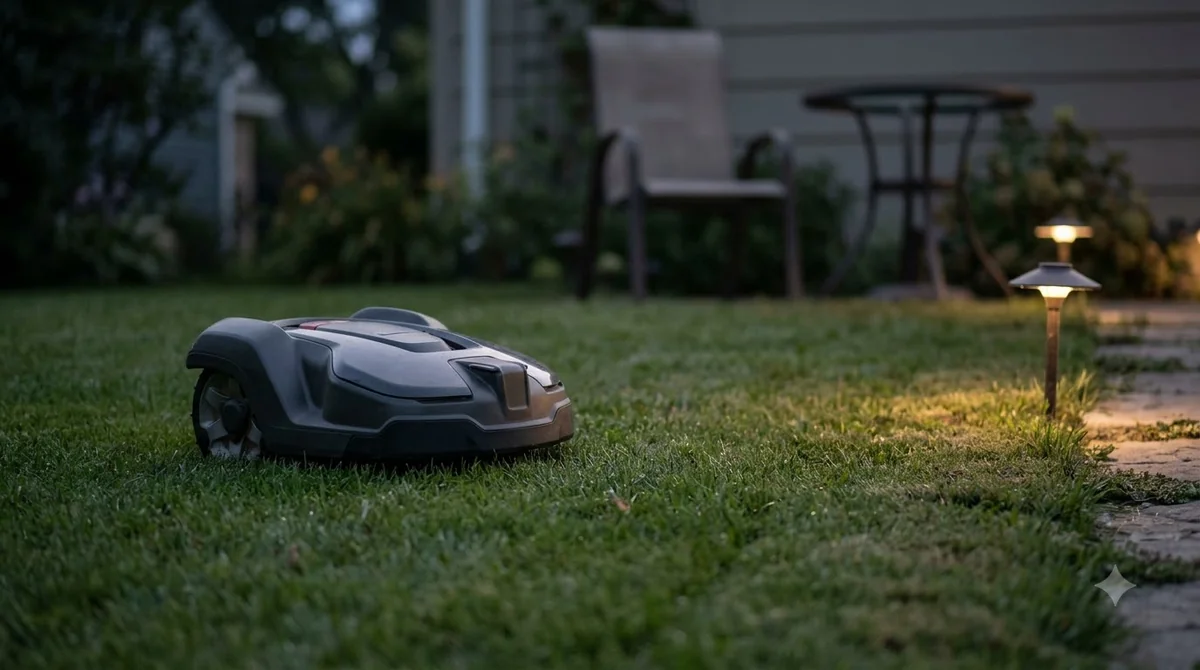
The table below puts the ratings we verified next to the reference points used in this guide. It is a reading aid, not a comparison of models.
| Rating | What the page says | What is missing |
|---|---|---|
| Eufy E15 and E18 | Operating noise level 54 dB | Distance, operating condition, weighting label |
| Husqvarna Automower 450XH | Sound level perceived 61 dB(A) | Test condition; measured or guaranteed value not found on that page |
| Robomow guidance | 60 dB or less usually avoids neighbor quarrels | Distance at which the figure applies |
Robomow’s own guidance treats 60 dB or less as the level that usually avoids quarrels with neighbors, and calls 70 dB much louder than 60 dB. That is a manufacturer’s rule of thumb, not a regulatory limit, and it still depends on where the reading was taken.
How distance changes a rating
Sound level falls as you move away from the source. Robomow states that the level drops about 6 dB each time distance doubles, and gives an illustrative example: a mower rated 60 dB at 5 m would read about 54 dB at 10 m. The same rule works in reverse, so a rating taken close to the machine looks louder than the same machine heard from across a yard.
When you ask which robot mower is the quietest tested, distance is the first missing detail, and it matters for the Eufy and Husqvarna numbers. A 7 dB gap is roughly what one would expect from a change in measuring distance of about double. Our reading is that a rating with no distance attached tells you how loud the mower is at that unstated distance, and nothing more. Two products with different distances on their spec sheets cannot be ranked by those figures alone.
Distance also meets the property line. Robomow notes that legal limits apply at the property boundary, so a night schedule is worth checking against local hours; see whether a robot mower can mow in the dark. Noise is defined by the EPA as unwanted or disturbing sound, and local ordinances set their own hours and limits. We did not check a specific city’s rules, so the right step is to read your own local noise ordinance.
What the hearing thresholds say
NIDCD gives everyday reference points: normal conversation sits at about 60 to 70 dBA, and motorcycles at 80 to 110 dBA. It says sounds at or below 70 dBA are unlikely to cause hearing loss even after long exposure, and that long or repeated exposure at or above 85 dBA can. NIDCD names lawn mowers as a common home source of harmful noise, but it does not give a dB value for them.
OSHA sets workplace limits in dBA: a permissible exposure of 90 dBA over an 8-hour day, and an 85 dBA time-weighted average that triggers a hearing conservation program. OSHA uses a 5 dBA exchange rate, while NIOSH recommends 3 dBA. Those are occupational rules, not a test for a backyard appliance, but they show why the unit and the exposure time both matter. A mower rated in the 50s or low 60s dBA at a stated distance sits below NIDCD’s 70 dBA line. A rating given only in plain dB, with no distance, cannot be placed on that line with confidence.
Heads up
We did not verify a dB figure for gas or electric mowers, so this guide makes no comparison between robot mowers and other mower types. The Robomow claim that robot mowers are substantially quieter than electric or gasoline units has no numbers attached, and we have not used it as a measured result.
Comparing two ratings: steps
Use the same checks each time you ask which robot mower is the quietest tested. If two ratings fail the same checks, they cannot be ranked against each other.
- Confirm the unit. dB and dB(A) are not interchangeable. Note which one the page uses.
- Find the distance. A rating with no distance is a single-point claim.
- Check the operating condition. If the page names an operating mode, record it and compare only like with like.
- Check whether the value is measured, rated or perceived. The Husqvarna page uses “perceived”; the Eufy page does not say.
- Look for a written source. If the figure is missing these details, ask the manufacturer in writing for the test method before you rely on it.
Who a quieter rating suits
Our reading is that a lower rating matters most where the mower runs close to neighbors, in an HOA with noise rules, or in a yard that borders a bedroom window. Our guide to robot mowers for HOA neighborhoods covers the rules side.
Those are the cases where a few decibels, and the distance at which they are heard, can change whether the machine is a nuisance. In a large, isolated yard the gap between two ratings in the mid-50s to low-60s is unlikely to be what decides the purchase. The better test is whether the spec sheet gives enough information to check the number at all. If a mower already runs too loudly for your yard, how to reduce robot mower noise lists practical fixes, and a robot mower spec comparison shows how noise sits beside coverage and slope.
Frequently asked questions
Which robot mower is the quietest tested?
Not one we could verify. The Eufy E15 and E18 list 54 dB and the Husqvarna Automower 450XH lists 61 dB(A) perceived, but neither page states distance or test condition, and we found no independent test that measures several mowers under the same conditions.
Is 60 dB loud for a robot mower?
Robomow’s guidance treats 60 dB or less as the level that usually avoids neighbor complaints. NIDCD puts normal conversation at about 60 to 70 dBA, so 60 dB is in the range of everyday speech at close range, and the distance of the reading still matters.
Can a robot mower damage hearing?
NIDCD says sounds at or below 70 dBA are unlikely to cause hearing loss even after long exposure, and long or repeated exposure at or above 85 dBA can cause it. Ratings in the 50s to low 60s are below the 70 dBA line when they are given in dBA at a stated distance.
Where do I check noise rules for my yard?
Start with your city or county noise ordinance and your HOA rules. Robomow notes that legal limits are usually applied at the property boundary, so the rule that matters is the one measured at your line, not at the mower.
Sources
- Eufy support: E15 and E18 noise level (Eufy): the 54 dB operating noise figure.
- Husqvarna Automower 450XH specifications (Canada) (Husqvarna): the 61 dB(A) sound level perceived.
- How loud is a robotic mower? (Robomow): the 60 dB guidance, the 6 dB per doubling rule and the property-boundary point.
- Noise-Induced Hearing Loss (NIDCD, NIH): everyday dBA levels and the 70 and 85 dBA thresholds.
- Noise (OSHA): 90 dBA limit, 85 dBA trigger and exchange rates.
- Clean Air Act Title IV: Noise Pollution (EPA): the definition of noise.
 Up next8 min readReviews & CompareWhich Robot Mower Handles Slopes Best Tested? Specs ExplainedUpdated Nov 11, 2026
 9 min readReviews & CompareMammotion Yuka Mini Pros and Cons: What the Specs SupportUpdated Nov 11, 2026
 7 min readReviews & CompareLymow One Review: What the Sourced Specs Say Before You BuyUpdated Nov 11, 2026
 8 min readReviews & CompareMammotion YUKA Mini vs eufy E15: Specs, Slope and Lawn SizeUpdated Nov 11, 2026
 7 min readReviews & CompareHookii Neomow X SE Review: 0.75-Acre Specs and Slope LimitsUpdated Nov 11, 2026
 7 min readReviews & CompareMOVA LiDAX Ultra 2000 Review: Specs, Slope and LimitsUpdated Nov 11, 2026