
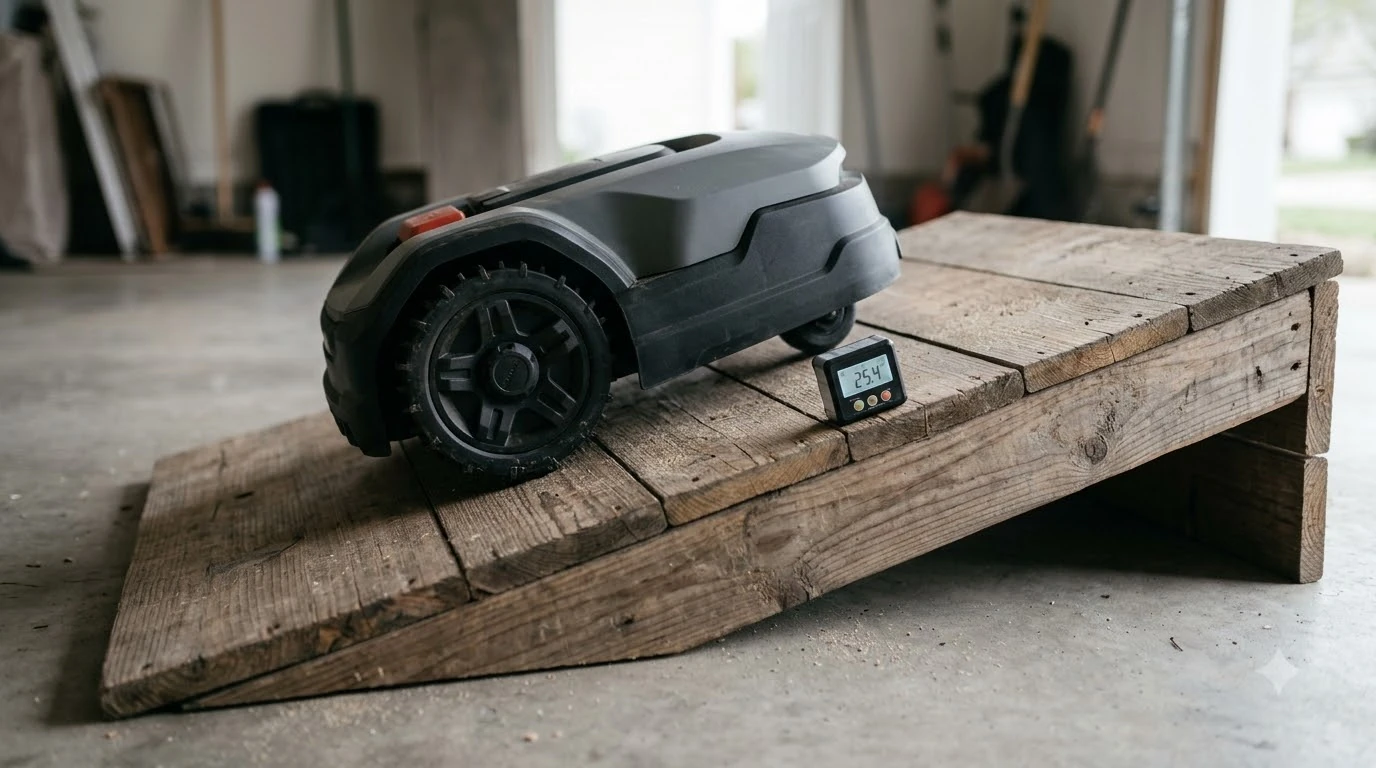

Robot mower spec comparison coverage slope noise starts with three numbers: the lawn size a mower is rated for, the slope it can climb, and its noise level in dB(A). Manufacturers do not publish these the same way. Some give acres, others square meters. Some give one slope figure, others split it between the work area and the boundary wire. A fair side-by-side needs the same units and a note on which figure applies where. This explainer shows what the published figures say for a few brands, and where they cannot be compared directly.
The short answer
- Coverage: the rated lawn size is usually given in acres or square meters with a +/-20% margin. Some pages add a lower figure for irregular lawns.
- Slope: read two numbers, one for the work area and one at the boundary wire. Husqvarna lists the 435X AWD at 70% inside and 50% at the boundary.
- Noise: Husqvarna lists 60 dB(A) for the 435X AWD and 62 dB(A) for the 420 iQ. The Navimow X430 review lists 68 dB(A). None of these states a measurement distance.
- Compare like with like: same units, same test notes, and the same boundary type.
Coverage: how the lawn-size rating is written
Coverage is a rated lawn size, and the rating carries a margin. Husqvarna’s US pages rate the Automower 420 iQ at 1 acre for a lawn size of +/-20%, and at 0.5 acre for irregular areas. The 435X AWD is rated at 0.9 acre on the same basis. Husqvarna’s US range page runs from the 410 iQ at 0.5 acre up to the CEORA at 6 acre, with the 440 iQ at 2 acre and the 580 EPOS at 2 acre in between.
In any robot mower spec comparison, the +/-20% note means the number is a planning figure, not a hard limit you can reach exactly. It also means two brands that both say 1 acre do not always mean the same thing if one of them adds an irregular-area figure and the other does not.
Worx writes its ratings in square meters on its European listing. The entries run from 300 m2 for the WR303E to 4,000 m2 for the WR344E, with the Landroid L1000 listed at up to 1,000 m2. Converted, 300 m2 is about 0.07 acre, 1,000 m2 is about 0.25 acre, and 4,000 m2 is about 0.99 acre. Our reading: a buyer who measured the lawn in acres should convert every rating to one unit before comparing them.
A rating for a regular shape does not tell you how a long, narrow or bent lawn will be covered. The irregular-area figure on the 420 iQ page is one sign that the manufacturer expects shape to matter. Check the lawn shape against the rating, not only the total size. For the definition behind the number, see how robot mower coverage ratings work.
Slope: work area and boundary limits
Slope is two numbers, and the boundary figure is usually lower. Husqvarna’s UK support article says standard models manage slopes of 25 to 50 percent, or 14 to 26 degrees, depending on the model. The 435X AWD is rated up to 70 percent, or 35 degrees. The article lists the work area and boundary limits separately. For the 435X AWD, that means 70 percent in the work area and 50 percent at the boundary.
The US 420 iQ page follows the same split: 45 percent inside the installation, which its FAQ describes as about 24 degrees, and 15 percent at the boundary. A reader who looks only at the highest number can overestimate how far the mower will go on a steep section near the wire. A separate guide covers slope ratings explained in percent and degrees.
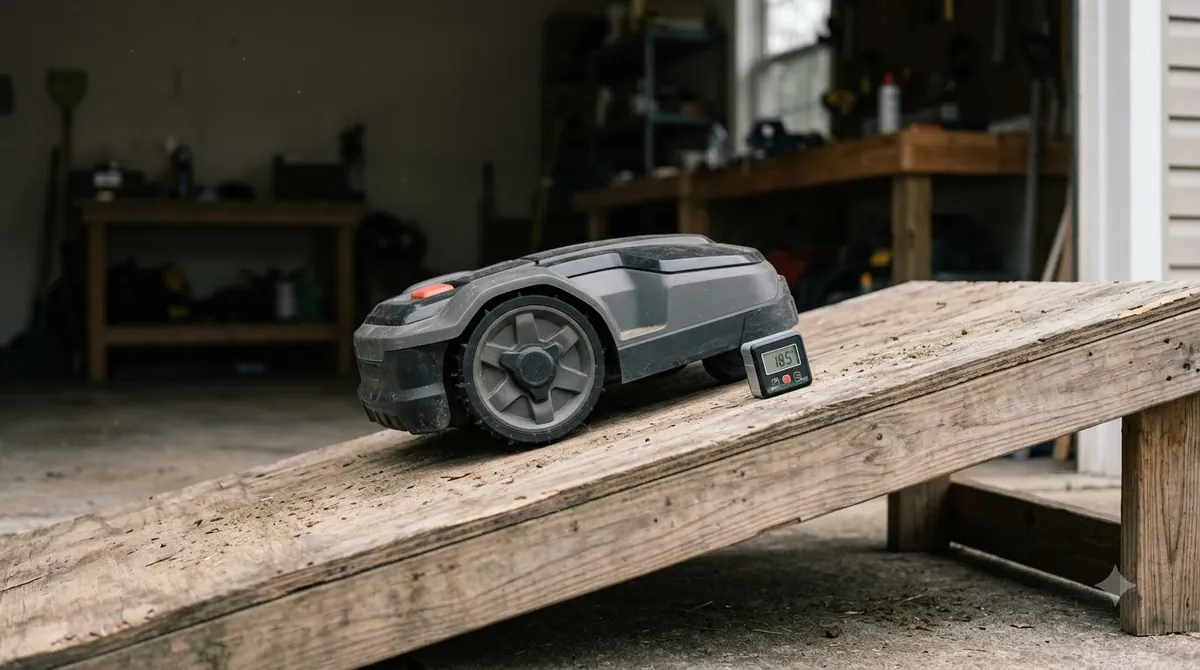
For AWD models on slopes between 50 and 70 percent, Husqvarna advises keeping 1.5 m (5 ft) from the bottom of the slope to the boundary wire. Our reading: plan a steep yard around the boundary limit, not the work-area number. If drive type matters on your hills, compare AWD and 2WD robot mowers on hills as well.
The Navimow X430 review lists 84 percent, or 40 degrees, for the 4WD version. The reviewer marks that figure as a manufacturer claim and says the reviewer’s own slope tests are not finished. Degree conversions in this article are our arithmetic from the tangent: 15 percent is about 8.5 degrees, 45 percent about 24 degrees, and 70 percent about 35 degrees.

Noise: dB(A) figures and test conditions
Noise figures are useful only when the test method is the same. Husqvarna lists 60 dB(A) for the 435X AWD under the label “sound level perceived,” and 62 dB(A) for the 420 iQ. Neither page gives a measurement distance, a cutting mode or a load condition. The Navimow X430 review gives 68 dB(A) with no distance or condition, and the reviewer says the sound measurements are still in progress.
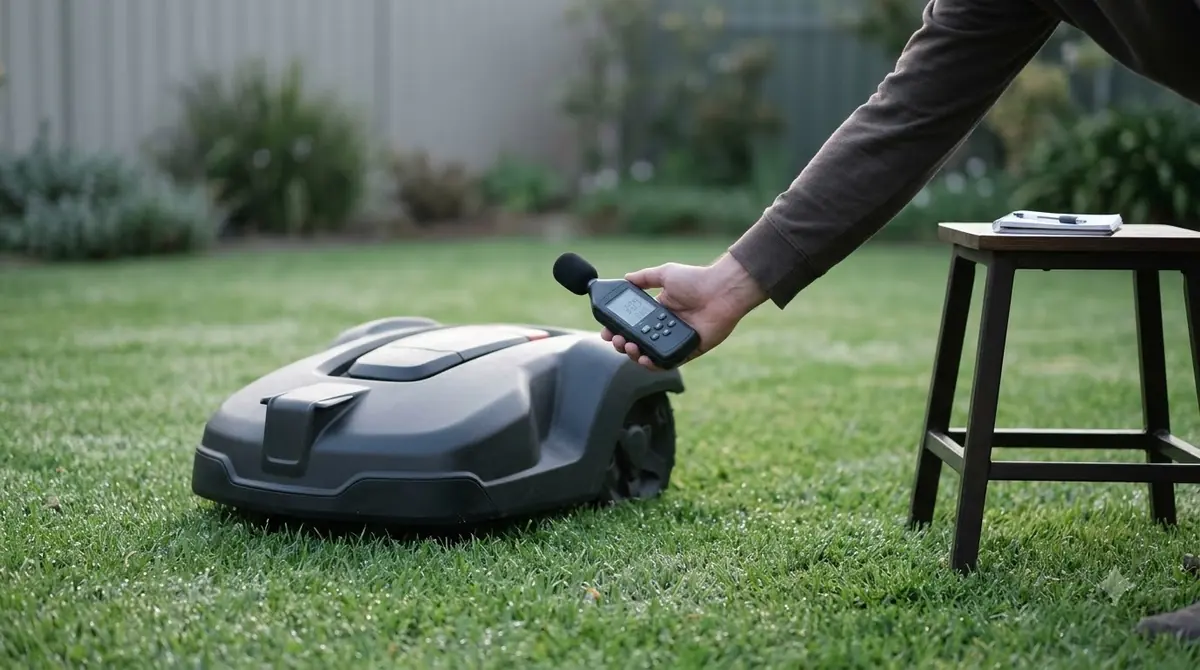
On these pages the 435X AWD reads 2 dB below the 420 iQ and 8 dB below the X430. Those gaps cannot be read as a measured ranking, because the test conditions are missing or different. Our reading: in a robot mower spec comparison (coverage, slope, noise), a dB(A) figure with no distance should be treated as the brand’s own claim, so look for a second source that uses the same method. For everyday context, read how loud robot mowers are.
Robot mower spec comparison: coverage, slope, noise side by side
Only the Husqvarna product pages and the Navimow review give all three numbers for the same model. The Worx listing gives area only. The table below puts the robot mower spec comparison (coverage, slope, noise) in one place, using only figures from the pages listed in the sources.
| Model | Lawn size (listed) | Slope: work area / boundary | Noise | Boundary | Source type |
|---|---|---|---|---|---|
| Husqvarna Automower 435X AWD | 0.9 acre (+/-20%) | 70% / 50% | 60 dB(A), no condition given | Physical wire | Manufacturer page |
| Husqvarna Automower 420 iQ | 1 acre (+/-20%); 0.5 acre irregular | 45% (about 24 degrees) / 15% | 62 dB(A), no condition given | Physical and virtual wire | Manufacturer page |
| Navimow X430 (X4 series) | 1 acre | 84% (40 degrees), manufacturer claim per review | 68 dB(A), no distance given | Wire-free | Third-party review |
| Worx Landroid WR206E | 600 m2 | Not shown on listing | Not shown on listing | Not shown on listing | Manufacturer listing |
The table shows where the gaps are. The Worx entry has a clear area rating but no slope or noise figure on the listing page, so a buyer needs its model page or manual before comparing it with the others.
Why the same spec can mean different things
Read the footnote before the number. Four details change what a figure means:
- Work area or boundary. Husqvarna lists them separately, so a single slope number may hide a lower limit at the wire.
- Rated area or margin. A +/-20% rating and a plain number are not the same claim.
- Manufacturer claim or reviewer test. The X430 slope figure is labelled a claim in the review, so it is not yet independently checked.
- Boundary type. Physical wire, virtual wire and wire-free setups differ in how the mower finds its limits, and the slope rating for the wire may change with it.
How to build your own comparison
Use a fixed checklist so every brand gets the same fields in your own robot mower spec comparison (coverage, slope, noise). The steps below work on any spec sheet, and a guide on how to read robot mower specs covers the terms.
- Record the area rating and its unit. Convert acres and square meters to one unit. One acre is about 4,047 m2.
- Note two slope numbers. Write the work-area figure and the boundary figure, in percent and in degrees if both are given.
- Note the boundary type. Check whether the slope limit changes with physical wire, virtual wire or wire-free setup.
- Copy the dB(A) figure and its conditions. If the page gives no distance or cutting mode, mark the figure as unverified.
- Label each source. Mark it as manufacturer page, support article, listing or review.
- Check the manual for your model and region. Specs can differ by market, so the manual for the exact model is the final reference.
Who each option suits (our reading)
A robot mower spec comparison (coverage, slope, noise) points to different strengths, not a single winner. The 435X AWD has the highest slope limit confirmed on a manufacturer page in this set, which suits a yard with steep sections if you accept a physical boundary wire and the 1.5 m buffer from the bottom of the slope. The 420 iQ suits a flatter lawn close to 1 acre, and its virtual-wire option is worth checking if the yard layout makes wire hard to run. The X430 review’s figures suit a wire-free buyer on a large lawn, but its slope and noise numbers should wait for the reviewer’s own tests before you rely on them.
Frequently asked questions
Is a higher coverage rating always better?
Not necessarily. The rating is a planning figure with a +/-20% margin, and irregular lawns can get a lower number. Match the rating to your measured lawn, with room to spare for shape and obstacles.
Why does one mower have two slope numbers?
Husqvarna splits the figure into the work area and the boundary wire. On the 435X AWD the limits are 70 percent inside and 50 percent at the boundary, so the wire-side number is the one to plan around on a steep section.
Is 60 dB(A) quieter than 68 dB(A)?
The published figures say so, but the pages do not give the same test conditions or distances. Treat the gap as a rough hint, not a measured ranking, and look for a source that states how the sound was measured.
Which spec should I trust most?
A manufacturer page for the exact model and region, followed by the manual, is the most reliable source. Figures from reviews are useful for context, but check whether the reviewer measured them or repeated the manufacturer’s claim.
Sources
- Husqvarna Automower 435X AWD product page (manufacturer): slope limits, lawn size and sound level.
- Husqvarna Automower 420 iQ product page (manufacturer): slope limits, lawn size, irregular-area rating and sound level.
- Husqvarna support article on steep-slope installation (manufacturer): slope tiers and the 1.5 m buffer to the boundary wire.
- Husqvarna robotic lawn mower range page (manufacturer): lawn-size ratings and boundary types by model.
- Worx Landroid robotic mower listing (manufacturer): area capacity by model in square meters.
- LawnCareGuides review of the Navimow X430 (third-party review): the 84 percent slope and 68 dB(A) figures as the reviewer reports them.
 Up next8 min readReviews & CompareRobot Mower Comparison Chart 2026: Which Specs Decide the ChoiceUpdated Nov 11, 2026
 8 min readReviews & CompareSunseeker X7 vs Sunseeker Elite X5: Honest Spec ComparisonUpdated Nov 11, 2026
 7 min readReviews & CompareWorx Landroid vs Segway Navimow: Slope, Navigation and SpecsUpdated Nov 11, 2026
 8 min readReviews & Compareeufy E15 vs Worx Landroid Vision: Lawn Size, Slope and SpecsUpdated Nov 11, 2026
 7 min readReviews & CompareMOVA LiDAX Ultra 2000 Review: Specs, Slope and LimitsUpdated Nov 11, 2026
 7 min readReviews & CompareHookii Neomow X SE Review: 0.75-Acre Specs and Slope LimitsUpdated Nov 11, 2026