
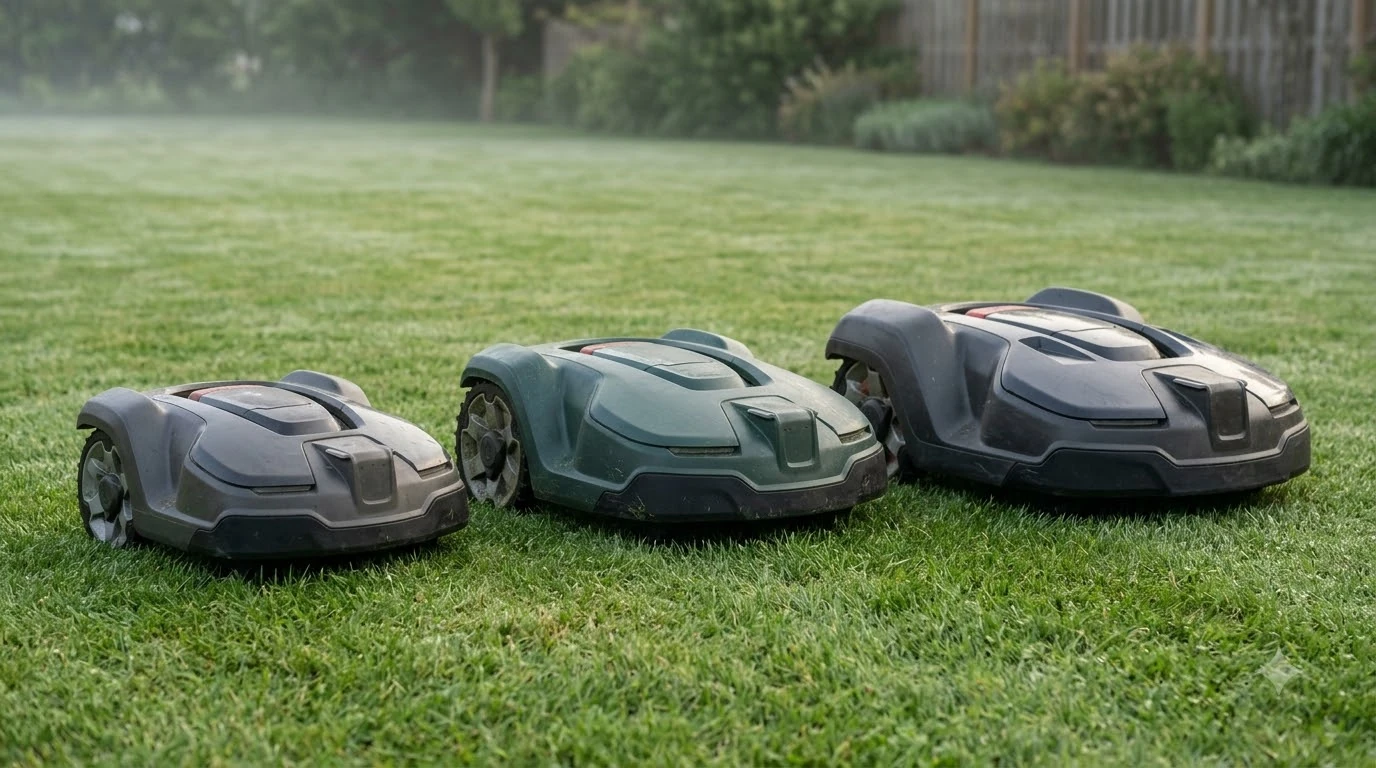

Robot mower comparison chart 2026: line up lawn capacity, slope, navigation, cutting height and warranty side by side. Those five specs decide whether a model fits a yard, and most charts publish them for every model. The numbers come from each maker, so read them with the limits and tolerances they state.
The short answer
- Lawn capacity: compare the rated area, and add the maker’s stated tolerance before you decide.
- Slope: convert percent and degrees to one unit, because makers do not always publish both.
- Navigation: boundary wire, RTK, LiDAR and vision need different things from your yard.
- Cutting height and warranty: check the range you need and the years of cover, then confirm them on the model’s spec sheet.
Robot mower comparison chart 2026: the five specs to line up
A useful chart lists the same five fields for every model, so you can compare them in one pass. Lawn capacity and slope set the size and terrain a mower can handle. Navigation sets what it needs around the lawn. Cutting height and warranty round out the picture.
| Spec | What to look for | Example figures from the sources read |
|---|---|---|
| Lawn capacity | Maximum area the maker rates | Husqvarna rates the Automower 410 iQ at up to 0.5 acre and the 440 iQ at 2 acres |
| Slope | Maximum gradient, usually in percent | Husqvarna lists 70% for the 435 iQ AWD; Mammotion lists 45% (24 degrees) for three of its comparison models |
| Navigation | Wire, satellite, LiDAR or vision | Husqvarna lists physical wire or virtual wire by model; Mammotion lists RTK, LiDAR and AI vision by model |
| Cutting height | Adjustable range in millimeters | Mammotion lists 25 to 70 mm for the LUBA 3 AWD and 20 to 100 mm for the Robomow RK1000 |
| Warranty | Years of cover | Mammotion lists 3 years for the LUBA 3 AWD and 2 years for the Navimow i2 AWD |
The figures above come from two makers. Mammotion’s comparison table is marked as current as of February 3, 2026, and it notes that data may vary by region, so check the date before you rely on it. Its full comparison is on Mammotion’s best robot lawn mower page.

How navigation type changes the chart
Navigation type is the first column to read on any robot mower comparison chart, because it decides what the mower needs around the lawn. Wire-based models follow a physical or virtual boundary, while satellite and sensor models find their own position. Each option trades installation work against exposure to weather, trees and obstacles. Our explainer on RTK vs LiDAR vs vision robot mowers goes deeper.
A boundary wire is the oldest method. Segway’s UK guide says setup means “digging or pinning it around the entire mowing area, which can take hours,” and a cut wire stops the mower with an error. Wire-based systems are not affected by tree cover or satellite conditions, according to the Robot Mower Fit guide. The trade-off is labor at the start and repairs later, as our guide to wire-free vs boundary wire robot mowers explains. For a full comparison of installation effort, see the Segway Navimow UK guide on boundary wire, RTK and LiDAR.
RTK removes the perimeter wire but depends on the sky. The base station needs a clear view of the sky and a reliable power source, and Segway says heavy tree cover, tall hedges or buildings can block the signal. Correction also comes in several forms: some models need an antenna on the property, others use a maker’s correction service, and some use network RTK over the mobile network with nothing mounted in the yard, according to Robot Mower Fit.
LiDAR fires thousands of laser pulses per second to build a 3D map around the mower, so it does not need a wire or a satellite view. It has limits of its own. Segway says rain, fog or a dirty lens can reduce accuracy, and that LiDAR alone is not enough for large-scale positioning on very large, open lawns. Our reading is that high-end models often pair LiDAR with RTK for that reason.
| Method | What the yard or mower needs | Limit named in the sources |
|---|---|---|
| Boundary wire | Wire laid around the lawn | Setup can take hours; tools, pets and rodents can damage the wire |
| RTK | Base station or correction service, with a clear sky | Heavy tree cover, tall hedges and buildings can block the signal |
| LiDAR | Sensor on the mower, no satellite view needed | Rain, fog or a dirty lens can reduce accuracy; limited range on very large open lawns |
| Vision | Cameras and AI, no perimeter wire | No numeric limit found in the sources read |
Vision is the newest of the four on the chart. Wikipedia notes that Volta launched the first commercially available mower using visual perception without a perimeter wire in 2019. The sources read did not give a numeric limit for vision, so compare it on the maker’s own spec sheet.
Lawn size and slope: compare in one unit
Lawn size and slope ratings are easy to misread, so convert them to one unit before comparing two models. Husqvarna’s US page lists lawn capacity for each model, with a tolerance of plus or minus 20%. A model rated at 1 acre can therefore cover roughly 0.8 to 1.2 acres in practice, which matters when your lawn sits near a rating boundary. The robot mower coverage rating explained guide covers that tolerance. The page lists the 420 iQ at 1 acre, the 435X AWD at 0.9 acre and the 580 EPOS at 2 acres, all with that tolerance.
Slope is where charts most often mix units. Husqvarna lists up to 70% for the 435 iQ AWD and gives no degree figures. Mammotion pairs percent with degrees, listing 80% as 38.6 degrees, 45% as 24 degrees and 30% as 16.7 degrees. Percent is rise over run, so these pairs match the usual conversion, and they give you a way to compare the two systems. For more on how makers state it, see robot mower slope ratings explained. Husqvarna’s product filter also shows slope values from 45% to 68%, but it does not say which model has which value.
Where a comparison chart can mislead you
A robot mower comparison chart is only as reliable as its source, and several figures in the sources read here do not line up. Check these points before you treat any single number as settled.
- Accuracy without numbers: Mammotion describes its positioning as centimeter-level but gives no centimeter figure for any model.
- Conflicting coverage: Mammotion’s comparison table lists the Gardena Sileno Minimo at 250 to 500 square meters, while its own Gardena section says 250 to 1,500 square meters.
- Announced, not specified: the 2 to 3 cm accuracy that Wikipedia attributes to Husqvarna comes from a 2020 announcement, not from a current spec sheet.
- Missing data: the Segway UK guide does not state accuracy in cm, mapping time, slope or lawn size for its models.
Our reading is that a robot mower comparison chart is most useful when every figure comes from the same source and the same date. Mixing a maker’s table with a retailer’s list can hide these differences.
What to check before you buy
Use a robot mower comparison chart as a shortlist, then confirm each model on its own spec sheet. Work through these steps in order, because the first two often rule out models quickly. Our guide to reading a robot mower spec sheet explains the fields.
- Measure the lawn. Work out the area in square meters or acres, then compare it with the rated capacity after the stated tolerance.
- Look at the sky. If trees, tall hedges or buildings cover the base station site, an RTK model may struggle, so consider wire or LiDAR.
- Decide on wire. Choose boundary wire if you accept the installation work, or a wire-free system if you do not.
- Convert the slope. Put every model’s slope in percent, using the degree figure when only degrees are given.
- Check cutting height and warranty last. These usually matter once the first four points have narrowed the list.
Frequently asked questions
What should a robot mower comparison chart 2026 include?
At minimum, it should list lawn capacity, slope, navigation type, cutting height and warranty for each model. Husqvarna and Mammotion both publish these fields, though not for every model. Compare them only when they come from the same source and date.
Is 45% slope the same as 24 degrees?
Close to it. Slope percent is rise over run, so 45% works out to about 24 degrees, which matches the pairing Mammotion lists. Still, check how each maker measures its rating, because the figure applies to the stated test conditions.
Do RTK robot mowers always need a base station?
No. According to Robot Mower Fit, some models need an antenna on the property, some use a maker’s correction service, and others use network RTK over the mobile network with nothing mounted in the yard. Check which method each model uses before you buy.
Is LiDAR better than RTK under trees?
Neither is better everywhere. Segway says heavy tree cover can block RTK signals, while LiDAR does not depend on satellites but can lose accuracy in rain, fog or with a dirty lens. Our reading is that yards with heavy tree cover favor LiDAR, and open lawns favor RTK.
Sources
- Husqvarna US, robotic lawn mowers (manufacturer): lawn size ratings, tolerance, slope and boundary options.
- Mammotion EU, best robot lawn mower comparison (manufacturer, table dated February 3, 2026): slope pairs, cutting height, warranty and the Gardena conflict.
- Segway Navimow UK, boundary wired, RTK or LiDAR robot mower (manufacturer): wire setup, RTK sky view and LiDAR limits.
- Robot Mower Fit, how robot mowers navigate (independent guide): correction methods and wire-based systems.
- Wikipedia, robotic lawn mower (reference): the Volta 2019 vision mower and the 2020 Husqvarna accuracy announcement.
 Up next9 min readReviews & CompareRobot Mower Spec Comparison: Coverage, Slope and NoiseUpdated Nov 11, 2026
 8 min readReviews & CompareSunseeker X7 vs Sunseeker Elite X5: Honest Spec ComparisonUpdated Nov 11, 2026
 8 min readReviews & CompareWorx Landroid vs Husqvarna Robot Mower: What the Specs ShowUpdated Nov 11, 2026
 8 min readReviews & CompareMammotion vs Segway Navimow Robot Mower: 5 Specs ComparedUpdated Nov 11, 2026
 8 min readReviews & CompareChinese Robot Mower Brands vs Husqvarna: What the Specs ShowUpdated Nov 11, 2026
 9 min readReviews & CompareGardena vs Husqvarna Robot Mower: What the Spec Sheets ShowUpdated Nov 11, 2026