
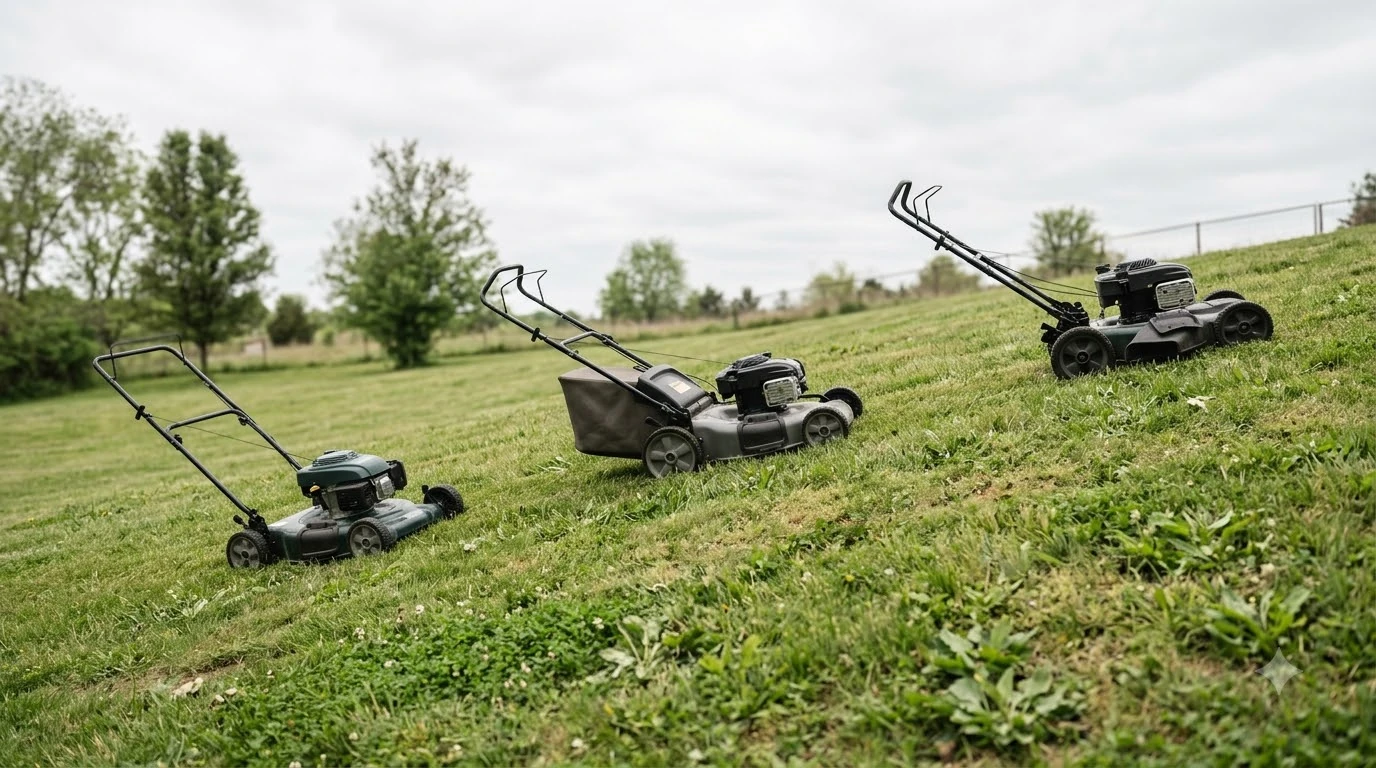

The best robot lawn mower for rough terrain is the one whose slope rating clears your steepest section with a margin, and whose drive system and ground clearance suit bumps, roots and wet grass. Measure your steepest slope before you shop, then compare it with the rated figure. Most product guides agree on the basic rules, but their exact rankings vary, so use the figures below as a checklist rather than a ranking.
The short answer
- Measure first: find your steepest section, then buy a mower rated at least 5 to 10 degrees above it, as eufy’s buying guide advises.
- Drive system: 2WD suits flat but bumpy yards. AWD or 4WD is the usual choice for slopes around 30 degrees and up. Tracks suit steep, wet or soft ground.
- Read the rating carefully: Husqvarna lists the Automower 430X NERA at 25% slope performance at the boundary and 50% inside the installed area.
- Wheels and clearance: larger wheels with off-road treads handle roots and ruts better than smooth small wheels.
Why rough terrain is harder for a robot mower
Rough terrain makes a robot mower work harder in three ways at once. Slopes shift weight toward the rear wheels and reduce grip, bumps and roots lift wheels off the ground, and soft or wet patches let the wheels spin. A mower that handles a flat lawn well can still stall, slide or miss patches on the same yard after rain. Rough ground often comes with a slope, so the robot mower picks for hilly lawns are a natural next read. Loose stone and uneven fill are one of the main causes of stalls, as getting stuck on a rocky yard explains.
That is why a single headline number is not enough. A robot that copes with a gentle rolling lawn may struggle on a short steep bank, and a mower with strong grip may still fail on a lawn full of raised tree roots if its wheels are small and smooth.
How to read a slope rating
Slope ratings come in two units, degrees and percent, and they are easy to mix up. Percent is the rise over the run multiplied by 100, while degrees measure the angle. A 20-degree slope is about 36%, a 30-degree slope is about 58%, and a 45-degree slope is 100%. Always confirm which unit a listing uses before you compare two models. Slope ratings only apply to smooth turf, so the rated climbing limits on a hill help you read the numbers.
Eufy’s guide says most entry-level robot mowers handle inclines of about 20 to 25 degrees, which it calls fine for rolling lawns, and that AWD or 4WD models handle 35 to 38 degrees. Its advice is to pick a model rated at least 5 to 10 degrees above your steepest slope, so the mower is never working at its limit. Eufy’s own tables give slightly different percentages for the same model in different sections, so check the manufacturer’s spec sheet before you buy.
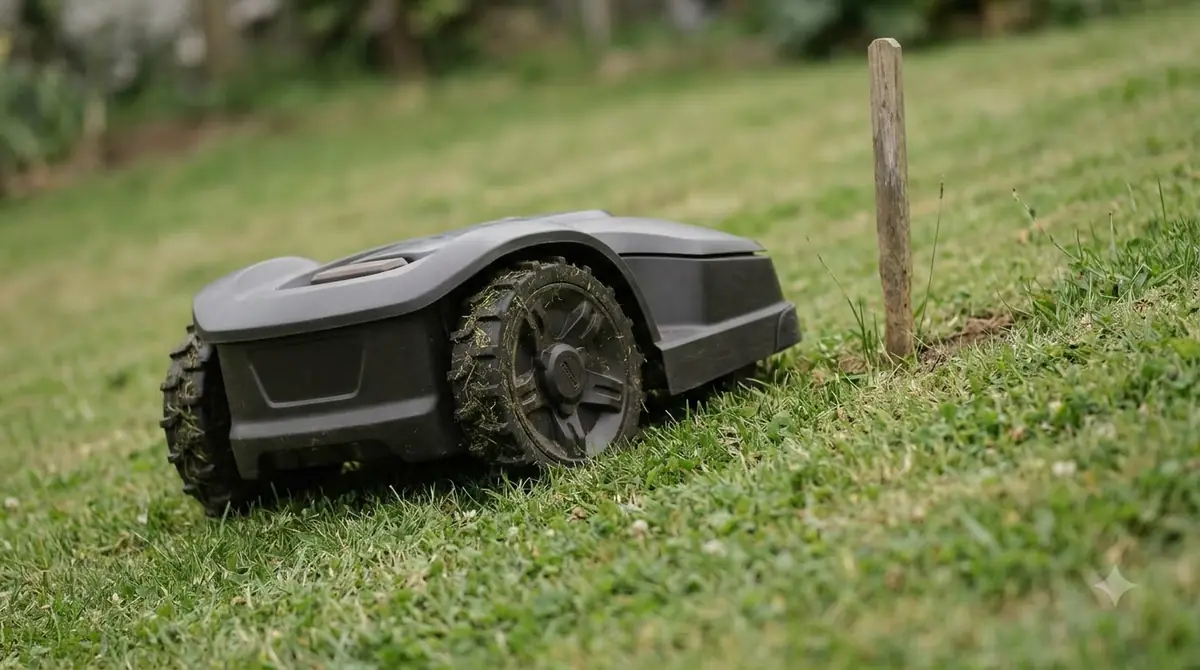
Drive systems: 2WD, AWD, 4WD and tracks
Drive system matters more than most buyers expect. Eufy’s guide sorts it into three tiers: 2WD for flat yards, AWD or 4WD for slopes of about 30 degrees and up, and track drive for steep, wet terrain. The same guide calls track systems ideal for extreme conditions but not necessary for most lawns, which is a fair summary of the trade-off. For drive systems that hold grip on a bumpy hillside, the AWD mower picks for a hilly backyard are a useful comparison. Drive systems matter most on difficult ground, and robot mowers for steep hills narrows that to steep slopes.
Tracks spread weight over a wider footprint, so they usually grip better on soft ground and can climb over small obstacles. Lymow, a track-drive maker, says its tracks reduce ground pressure and resist sideways slide on cross-slopes. Those are the company’s own claims, and the same page says wheeled AWD models are more maneuverable in tight spaces. Weigh that trade-off against the shape of your yard, not only the steepest point.
Wheels, clearance and bumpy ground
Wheel size and tread decide how a mower handles roots, ruts and uneven soil. Eufy suggests wheels of 20 to 25 cm and off-road or spiked treads over smooth ones for better traction. A wider wheelbase and a lower center of gravity also improve stability on sloped ground, which reduces the risk of tipping.
Some makers sell optional kits for rough ground. Husqvarna lists a Terrain Kit and a Wheel Brush Kit among accessories for the 430X NERA, but its product page does not say what either kit changes, so check the kit description before you assume it solves a traction problem.
Installing on uneven ground
Installation can be the hardest part of a steep or bumpy yard. Husqvarna’s charging station guide asks for a level surface and says that if a steep slope splits the work area into two parts, the station should go in the lower section. Keep the station on level ground and do not fix it to the ground until every wire is in place and the setup has been tested. Stepped ground needs its own wire plan, which the terraced yard installation notes lay out. When the uneven ground is also a hillside, the hillside lawn setup guide covers the boundary and pattern choices.
Wire-free systems avoid laying boundary wire along a slope, which can be slow and fiddly. Whichever setup you choose, plan the boundary so the mower can reach the charging station from the lower part of the lawn.
Best robot lawn mower for rough terrain: what to check before you buy
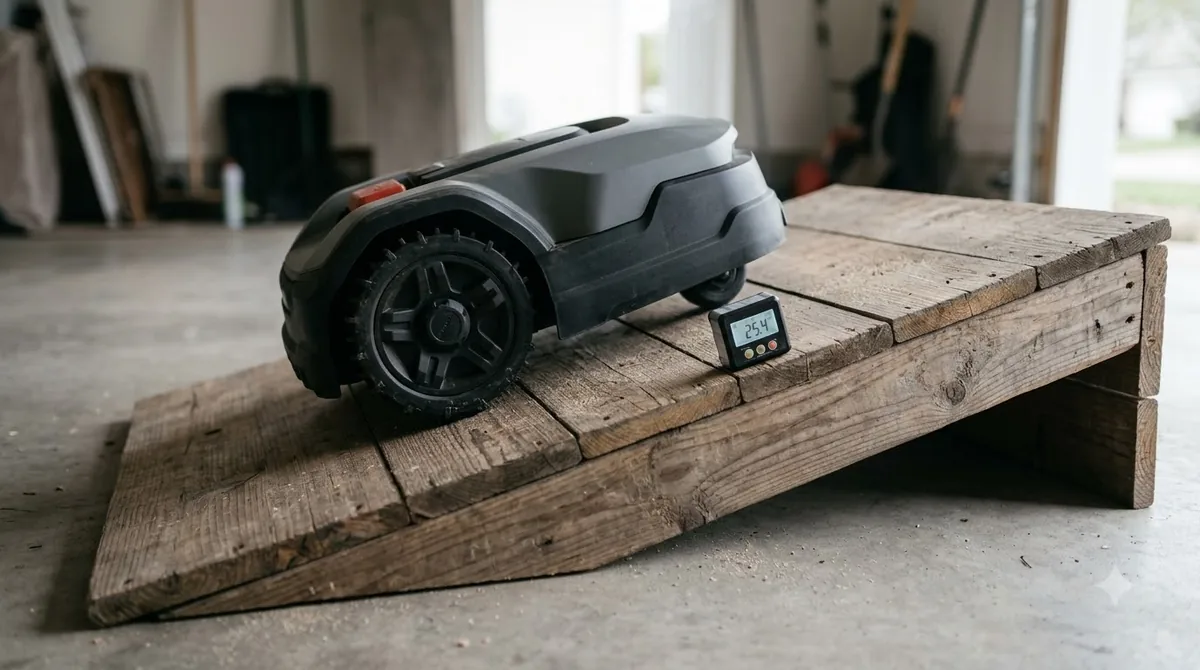
Use this short list before you choose a model. Measure your steepest section with a phone clinometer app or a level and ruler. Compare that figure with the rating in both units, and check whether the rating applies at the boundary or inside the installed area. Decide between 2WD, AWD or tracks based on the steepest and wettest spots, not the average. Look at wheel size and tread, and whether the maker lists a kit for rough ground. Finally, read the warranty and parts availability for your region, since rough-yard use wears wheels and blades faster.
As of Nov 2026, specifications and regional availability change often, so confirm the current model’s figures on the maker’s site before you buy.
Related reads: If you are weighing a mower for rough ground, the tipping risk on hills is worth understanding first.
Frequently asked questions
Is a 45-degree rating enough for a rough lawn?
A 45-degree rating is a best-case figure from the maker. Lymow lists 45 degrees for its One Plus, which is a manufacturer claim. Keep a margin of 5 to 10 degrees above your steepest slope, and check how the rating is measured.
Do I need AWD if my lawn is bumpy but not steep?
Not always. Eufy’s guide recommends 2WD for flat yards, so a bumpy but gentle lawn may be fine with a 2WD model that has good tread and ground clearance. Choose AWD if the bumps sit on a slope.
Are tracks always better on rough ground?
No. Eufy describes track drive as ideal for extreme conditions but not necessary for most lawns. Tracks can be less maneuverable in tight spaces, so they make most sense for steep, wet or soft yards.
How can I measure my lawn’s slope?
A phone clinometer app gives an angle directly. You can also use a long straight board, a spirit level and a ruler: divide the rise by the run and multiply by 100 for a percentage. Measure the steepest line you expect the mower to cross.
Sources
- Best Robot Mower for Hills buyer’s guide (eufy): slope bands, drive types, wheel size and measuring advice.
- Automower 430X NERA product page (Husqvarna): 25% slope at the boundary, 50% inside the installation, 3,200 m² capacity.
- Automower charging station and mower house guide (Husqvarna): level surface and placement on sloped lawns.
- Best robot mower for uneven hilly terrain 2026 (Lymow): track and AWD comparison; the slope and grip figures are the company’s own claims.
 Up next8 min readBy YardRobot Lawn Mower for a 35 Percent Slope: What to Check Before You BuyUpdated Nov 11, 2026
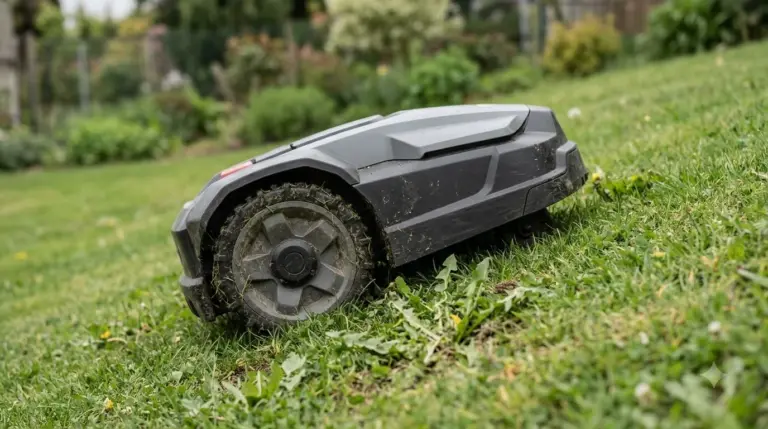 7 min readBy YardRobot Lawn Mower for a 25 Percent Slope: What to Check Before You BuyUpdated Nov 11, 2026
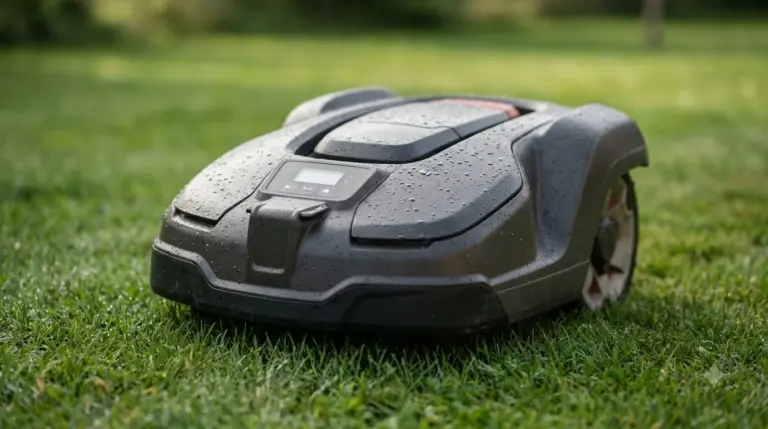 8 min readBy YardRobot Mower for Soggy Lawn: What to Check Before You BuyUpdated Nov 11, 2026
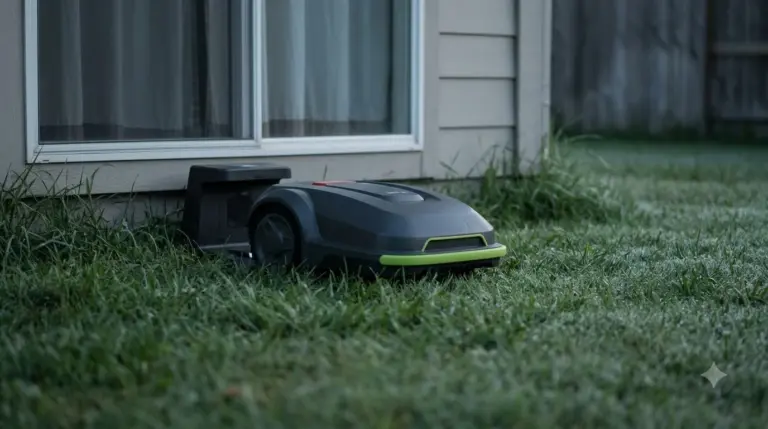 8 min readBy YardBest Robot Mower for a Townhouse Yard: Layout Checks Before You BuyUpdated Nov 13, 2026
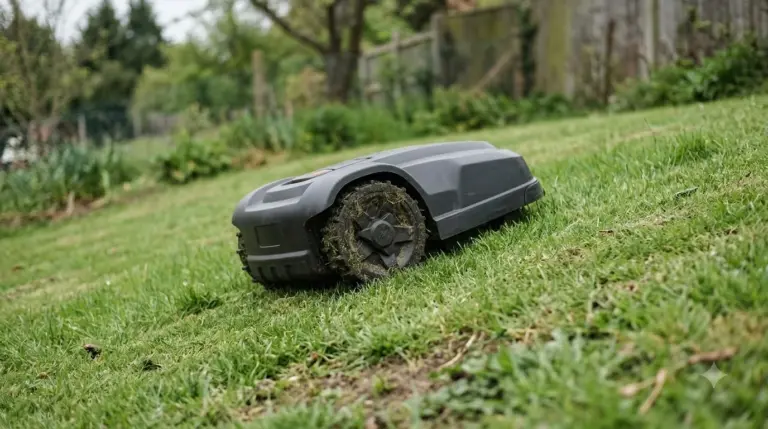 9 min readBy YardBest AWD Robot Mower for Hilly Backyard: 6 Things to Check Before You BuyUpdated Nov 13, 2026
 7 min readBy YardBest Robot Mower for Perennial Ryegrass: What to Check Before You BuyUpdated Nov 11, 2026