
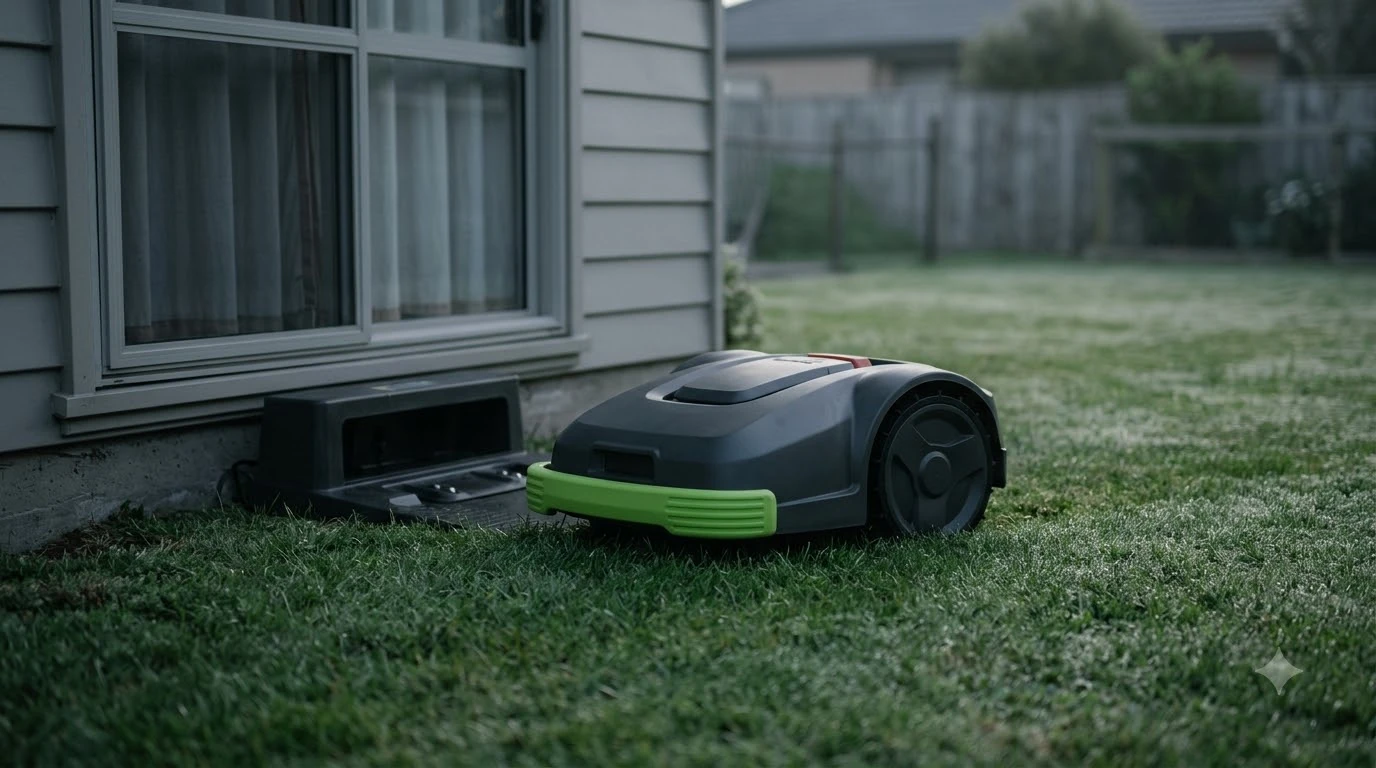

There is no single best robot mower for a mobile home lot, so the right pick depends on the lot’s width, its shape beside the home and its slope. As of November 2026, the manufacturer guidance we read gives fixed numbers for passages, corridor settings and size bands, and those numbers are what you should measure your lot against before you buy.
The short answer
- Measure width first: Husqvarna recommends at least 2 m (6 ft 6 in) between boundary wires in a passage without a guide wire, and 60 cm (24 in) with one.
- Size is a band, not a line: Mammotion places compact lawns up to 500 m² (about 5,380 sq ft) in its entry-level tier.
- Slope can decide the model: the bands we read run from up to 20 percent to over 50 percent, and only some AWD models handle the steepest.
- No mobile-home rule exists: none of the manufacturer pages we read is written for mobile home lots, so the checks below apply the general rules to your layout.
Why a mobile home lot needs its own check
Our reading is that a mobile home lot is often smaller than a typical suburban yard, and the grass is usually split into narrow strips along the sides of the unit, around steps and skirting, and between the home and the lot line. Those strips matter more to a robot mower than the total square footage, because the mower has to turn, back out and find its way through each gap.
When you compare the best robot mower for a mobile home lot, our reading is that the lot should be checked in three parts: the total area, the narrowest passage a mower must cross, and the steepest slope it must climb. Each one can rule out a model on its own, so it is worth measuring all three before you compare brands.
Lot size bands and what they mean
Manufacturers do not agree on one size scale, so it helps to compare them on the same unit. Mammotion’s buyer guide puts “small courtyards, townhouses and compact suburban lawns” in the up-to-500 m² band, where entry-level models are generally enough. The 500 to 1,000 m² band covers average suburban homes, and the same guide points those lots toward mid-range models.
Ecovacs describes “small lawn” differently. Its buying guide says the term varies by region and ranges from 1,000 to 10,000 square feet, and it gives the average US yard as about 23,301 square feet. Our reading is that most mobile home lots sit well below that average, so the entry tier is where to start looking, provided the layout checks below also pass. For the numbers behind small lots, see our page on the minimum yard size for a robot mower.
| Lot size band | Square meters | About square feet | Typical fit (per Mammotion) |
|---|---|---|---|
| Compact | Up to 500 | Up to 5,380 | Entry-level models |
| Average suburban | 500 to 1,000 | 5,380 to 10,760 | Mid-range models |
| Larger | 1,000 to 2,000 | 10,760 to 21,530 | Higher capacity, faster charging |
Rated coverage is a best case, so the best robot mower for a mobile home lot is rarely the one with the biggest rated area. Robomow notes that real output can fall short of the rated maximum by up to 30 percent, depending on conditions it lists. Our reading is that a small lot should be matched to a model rated for noticeably more area than the lot actually has.
Passage width beside the home
The narrow side strip is usually the deciding factor on a mobile home lot, as our guide to robot mower narrow passage width also explains. Husqvarna’s passage guidance gives two numbers you can check against your own measurements. Without a guide wire, the recommended minimum distance between the boundary wires on each side of a passage is 2 m (6 ft 6 in). With a guide wire, the recommended minimum drops to 60 cm (24 in).
The same Husqvarna page says a guide wire should sit at least 30 cm (12 in) from the boundary wire. For its 435X AWD and 535 AWD models, it recommends a minimum passage width of 2 m (6 ft 6 in) for a good cutting result. So a side strip that is 2 m wide or more can usually be wired without a guide wire, while a narrower strip needs a guide wire or a different layout.
Heads up
Measure the gap between the wall or fence and the nearest obstacle, not the width of the grass you can see. Sheds, air conditioning units and steps narrow a passage more than the lot’s total width suggests.
Boundary wire or guide wire
A boundary wire marks the edge of the work area, and a guide wire is a separate loop that leads the mower through a passage. Husqvarna’s guidance treats the guide wire as the fix for narrow gaps, since it lets the mower pass through a space that would otherwise be too tight for a boundary-only setup.
Our reading is that a mobile home lot with two or more narrow side passages is a strong case for a guide wire design. Where the strips are wide enough, a boundary-only install is simpler to lay, and it avoids adding a second loop to a small area. The choice should follow the measured widths, not the lot size.
Corridor width settings
Some Husqvarna models let you adjust the corridor width, which controls how close the mower runs to the wires. Husqvarna’s page says the setting runs from 1 to 9, and the factory defaults are 6 for the boundary wire and 9 for the guide wire. A setting of 0 makes the mower drive over the middle of the guide wire.
The page also says this adjustment applies only to installations with a physical boundary wire, and that which corridor widths are available depends on the model. The menu path on the mower display is Installation, then Advanced, then Corridor width. If your mower often gets stuck in a tight strip, check whether your model offers this setting before you rewire the lot.
Slope and rated coverage
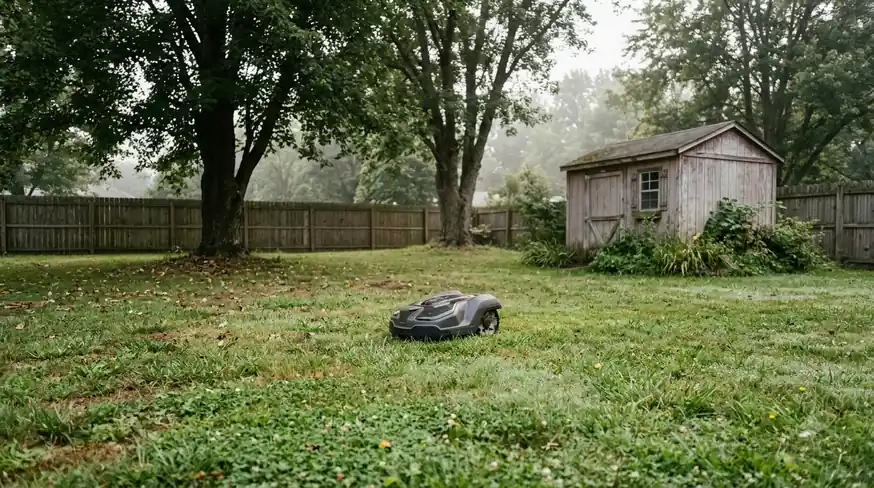
Slope matters on many lots because the steepest section is often the side strip running along a bank or a rise. Mammotion’s buyer guide groups slopes into bands: up to 20 percent for flat or gently sloping lawns, 35 to 50 percent for steeper residential blocks where climbing ability matters, and over 50 percent for only certain AWD models.
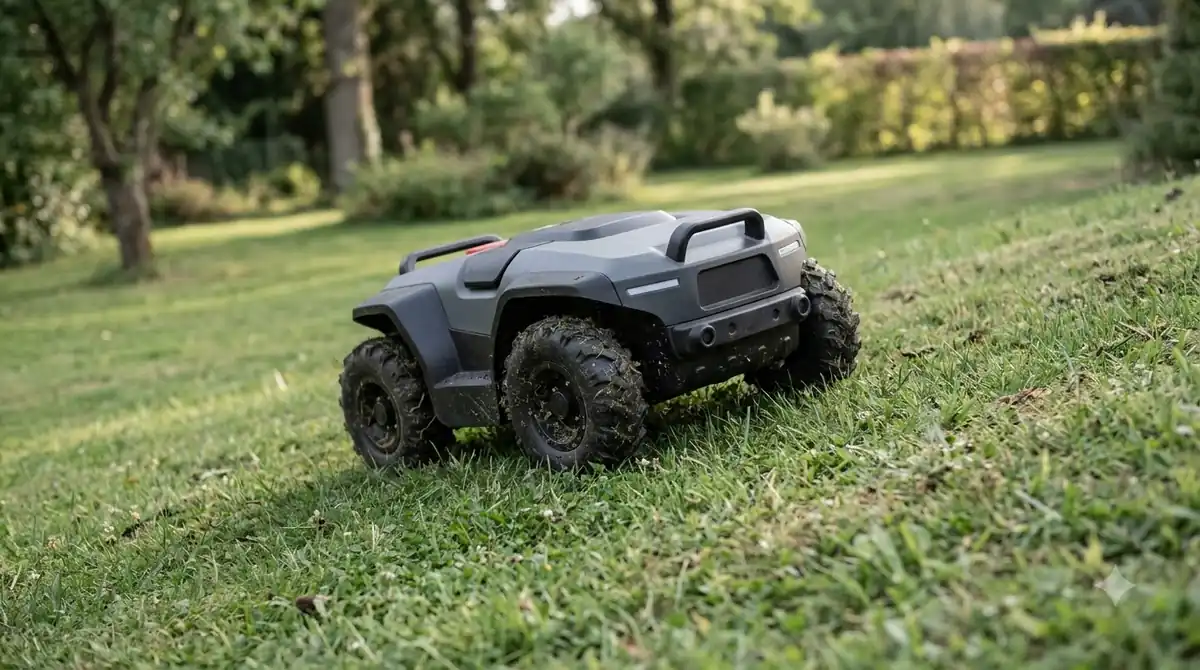
A small lot with one steep side can therefore be harder than a larger flat lot. Our reading is that the slope check should come before the size check when the lot has a noticeable grade, and that the best robot mower for a mobile home lot with a bank may need an AWD drive, since Mammotion says only certain AWD models are designed for slopes over 50 percent (compare AWD versus 2WD robot mowers for hills). To get your own number, follow how to measure yard slope.
How to choose the best robot mower for a mobile home lot
Work through the lot in this order, using a tape measure and a rough map of the house, fence and any steps.
- Total area. Measure the lawn in square meters or square feet, then match it to a size band with room to spare.
- Narrowest passage. Measure the gap at its tightest point. Compare it with 2 m without a guide wire, or 60 cm with one.
- Steepest section. Note the grade of the steepest strip and compare it with the slope bands above.
- Corridor control. Check whether the model has an adjustable corridor width if the lot has tight turns.
- Wire route. Plan where the boundary wire and any guide wire will run around the home, keeping at least 30 cm between a guide wire and the boundary wire, and estimate how much boundary wire you need before you order.
A model that passes all five checks is a reasonable candidate for the best robot mower for a mobile home lot on your street. One that fails the passage check is a poor fit however good its specs look, because the mower may never reach the far strip.
Frequently asked questions
Is there a size limit for the best robot mower for a mobile home lot?
No manufacturer we read publishes a minimum or a special rule for mobile home lots. The size bands are the closest guide, with compact lawns up to about 500 m² placed in the entry-level tier by Mammotion.
How wide does a side strip need to be?
Husqvarna recommends at least 2 m (6 ft 6 in) between boundary wires without a guide wire, and 60 cm (24 in) with one. Measure the narrowest point, including obstacles.
Can I change how close the mower runs to the wire?
Some Husqvarna models offer a corridor width setting from 1 to 9, with defaults of 6 for the boundary wire and 9 for the guide wire. Availability depends on the model, and the setting only applies to boundary-wire installations.
Does slope matter more than lot size?
On many lots it does. Mammotion’s bands separate lawns up to 20 percent from steeper blocks at 35 to 50 percent, where climbing ability matters. Our reading is to check the grade before the square footage.
Sources
- How to create a passage in an Automower boundary wire installation (Husqvarna): passage widths, guide wire spacing and the 435X AWD and 535 AWD note.
- How to adjust the corridor width in a boundary wire Automower installation (Husqvarna): setting range, defaults and menu path.
- How to choose a robot lawn mower (Mammotion): size and slope bands.
- Robot lawn mower for small lawn (Ecovacs): regional range of small lawns and the average US yard.
- Which robotic lawnmower is suitable for which lawn size (Robomow): rated output can fall short by up to 30 percent.
 Up next8 min readBy YardBest Robot Mower for a Duplex Yard: What to Check Before You BuyUpdated Nov 11, 2026
 7 min readBy YardRobot Lawn Mower for 45 Percent Slope: What to Check Before You BuyUpdated Nov 11, 2026
 8 min readBy YardLiDAR Robot Mower for a Wooded Lot: What Works and What to CheckUpdated Nov 11, 2026
 8 min readBy YardHow to Cut an Overgrown Lawn Before Using a Robot MowerUpdated Nov 11, 2026
 7 min readBy YardBest Robot Mower for Bahia Grass: Check the Cutting Range FirstUpdated Nov 11, 2026
 9 min readBy YardBest Robot Mower for a Small Backyard in the City: What to Check FirstUpdated Nov 11, 2026