


Can a robot mower work in a lawn with island beds? Yes, but only if the bed is protected by a boundary wire island or a stay-out zone. Without one of those rules, the mower treats the bed as open grass and will drive into it. Husqvarna’s support guides, read as of 2026-11-10, describe both methods, and the right one depends on whether your mower uses a boundary wire or a wire-free satellite system.
The short answer
- Wired mower: run a boundary wire island around the bed, or draw an AIM stay-out zone over it in the app.
- Wire-free mower: draw an EPOS stay-out zone over the bed, and add a wire around the zone only where satellite signal is weak.
- Clearance: Robomow’s guidance gives about 10 cm (4 in) from beds and hedges, but Husqvarna gives no distance, so confirm the figure in your model’s manual.
Can a robot mower work in a lawn with island beds? Only with a rule
A bed in the middle of a lawn is an obstacle, not a border. The wire loop or map defines where the mower may cut, and nothing excludes the bed unless you add that exclusion. Robomow’s installation guide says obstacles in the middle of an area “must also be demarcated with the boundary wire,” and adds that islands and flower beds running from the outer edge toward the centre of a lawn can be “quite a challenge.”
Our reading is that the difficulty is less about the bed itself and more about the route the mower must take to reach the lawn beyond it. A bed near the edge is simple to wire out. A bed that splits the lawn into two sections needs a passage, and passages carry their own width rules, covered in the layout section below.
How to wire an island around a bed
On a wired system, the island is a loop of boundary wire that runs out to the bed, around it, and back again. Husqvarna’s UK support article on Automower islands describes the method for a flower bed or rockery.
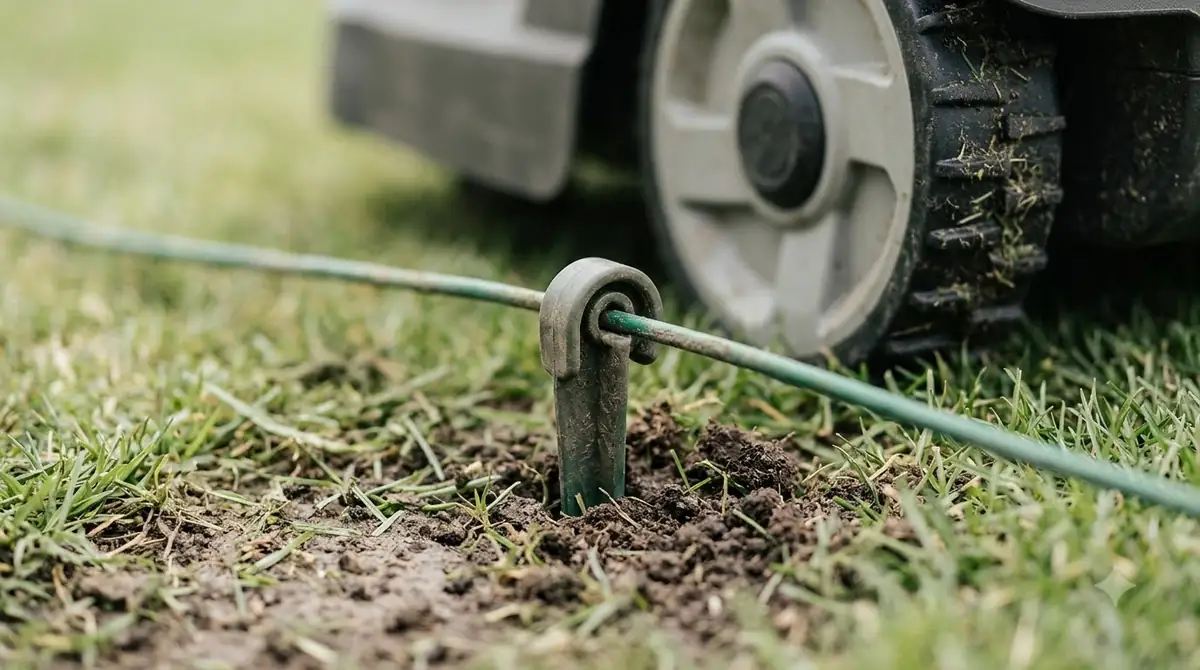
The steps are short, but a small error stops the mower, so follow them in order:
- Route the wire out and around. Run the wire from the boundary to the bed and around it, starting on the side nearest the direction you approach from. The guide says to “ensure you do not cross the wire.”
- Close the loop side by side. On the way back, lay the two wire runs close together. The guide says this cancels the signal, so the mower can pass over the wires.
- Check for crossed wires. The guide warns that if the wires cross, “the mower will not recognise the island and will stop.”
The Husqvarna steps give no distance between the wire and the bed, so they show the route, not a measurement. Our reading is that a test run with the mower on the actual lawn is the only reliable check on a new island before you rely on it.
How close can the wire run to a bed?
Robomow’s blog gives approximate clearances for common obstacles. These are useful as a starting point, but they come from one brand, so they are not a universal rule.
| Obstacle or path | Figure given | Source |
|---|---|---|
| Beds or hedges | Approx. 10 cm (about 4 in) | Robomow blog |
| Walls and tall stones | Approx. 35 cm (about 14 in) | Robomow blog |
| Passage to a separate zone | Wider than 70 cm (about 28 in) | Robomow blog |
| Island around a flower bed | No distance given | Husqvarna UK article |
Heads up
The sources do not agree on every number, and a figure from one brand may not match your model. A Robomow FAQ on island wire was seen only in a search result and was not read in full, so this guide does not use its figure. Check your own model’s manual before pegging wire close to a bed.
Our reading is that the 10 cm figure is a sensible planning number for a bed edge, but the manual for your mower should have the final say.
Use a stay-out zone on a wired Husqvarna mower
On wired Husqvarna models with AIM Technology, a stay-out zone drawn in the app can cover a bed without extra wire. This is often the simpler route when the bed is already in place.
Husqvarna’s AIM guide says stay-out zones “can be created almost anywhere on the lawn, except where the charging station or guide wire are located.” Those two exceptions matter. Covering the charging station stops the mower operating, and covering part of the guide wire stops it returning to the station.
- Zones can be switched, not scheduled. Zones can be turned on or off, but the guide says they cannot be scheduled.
- Use long wire sections. The guide advises including as long sections of boundary wire as possible inside the zone, which helps navigation.
- Know the limits. The feature applies only to installations with a physical boundary wire and to models that support AIM Technology.
A zone is a no-go rule for a bed, but it is not a fence. Husqvarna says areas such as a swimming pool or the street must be fenced with boundary wire plus a barrier at least 15 cm (6 in) high, never left to a zone alone. Our reading is that a zone suits a flower bed well, but a hazard like a pool needs a physical barrier.
Wire-free mowers and island beds
A wire-free mower protects a bed with an EPOS stay-out zone instead of a wire island. Husqvarna’s EPOS guide says that “EPOS stay-out zones are used to prevent the mower from entering sections of the lawn where it is not allowed to mow,” so a bed can be covered without any wire.
The same guide has two caveats. First, where satellite signal is weak, zone accuracy may be reduced, and the page recommends a boundary wire around the zones in those areas. Second, a wire island on its own does not stop entry, because the page says an EPOS stay-out zone “is always required for this purpose.”
The EPOS page gives no distances or placement limits for zones. Our reading is that you should check the edge of a new zone on the lawn, watching the mower’s path near the bed, before you trust it.
Plan the lawn layout before you wire
Passages and spacing decide whether an island bed fits the lawn at all. Before buying wire, sketch the lawn with the bed, the charging station and any narrow neck, then mark the outline with tape and cones to see where the mower will have room to turn.
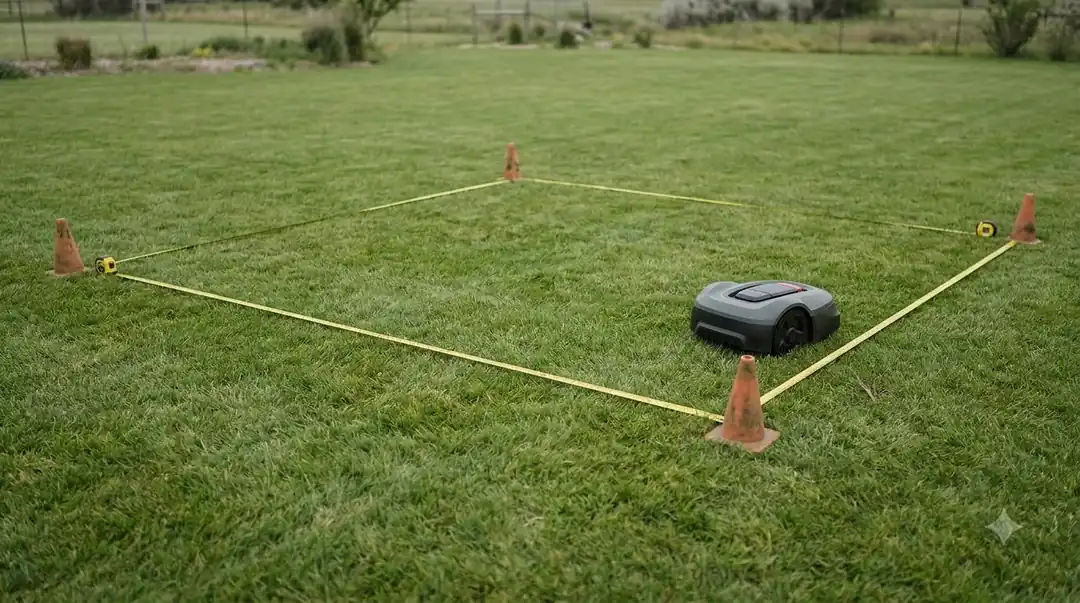
Robomow’s guide says a passage to a separate zone should be wider than 70 cm (about 28 in), and warns that narrower passages can cause “signal interference of the two boundary wires.” Husqvarna’s passage article gives different figures depending on the set-up: boundary wires on each side of a passage should be at least 2 m (6 ft 6 in) apart without a guide wire, and at least 60 cm (24 in) apart with one.
Our reading is that a bed beside a narrow neck is the layout most likely to need a guide wire, so decide on the passage width before you lay the island.
Common mistakes with island beds
Most failures with an island bed come from the wire layout or from a zone drawn in the wrong place. These are the points the sources flag most often.
- Crossed wires. The mower will not recognise the island and will stop.
- A zone over the charging station or guide wire. The mower stops operating or cannot return.
- Relying on a wire island alone on a wire-free mower. An EPOS zone is required for that purpose.
- Pegging wire without a check. With no distance given for some models, a test run is the only way to confirm the route.
Frequently asked questions
Can a robot mower work in a lawn with island beds if I do nothing?
Yes, unless the bed is protected. Without a wire island or a stay-out zone, the mower treats the bed as open lawn, so set the rule before the first mow.
Can I make an island with a wire-free mower?
Not with wire alone. Husqvarna’s EPOS guide says an EPOS stay-out zone is always required for that purpose, and it recommends a boundary wire around zones where satellite signal is weak.
How far should the wire run from the bed?
Robomow’s blog gives about 10 cm (about 4 in) from beds and hedges. Husqvarna’s island article gives no distance. The sources do not agree on every figure, so check your model’s manual.
Can a stay-out zone cover the charging station?
No. Husqvarna’s AIM guide says zones cannot be placed over the charging station or the guide wire, because covering the charging station stops the mower operating.
Sources
- How to create islands in an Automower installation (KA 01427) (Husqvarna UK support): island route, do-not-cross warning, closing the loop.
- Laying the lawn boundary wire (Robomow blog): obstacle demarcation, bed and wall clearances, passage width.
- Creating stay-out zones with AIM Technology (KA 01699) (Husqvarna UK support): zone placement limits, charging station and guide wire exceptions, 15 cm barrier.
- EPOS support guide (Husqvarna US): wire-free stay-out zones and the weak-signal caveat.
- How to create a passage in an Automower boundary wire installation (Husqvarna US support): passage widths with and without a guide wire.
 Up next9 min readBy YardChoosing and Setting Up a Robot Mower for a Yard With an Outdoor Kitchen IslandUpdated Nov 19, 2026
 8 min readBy YardHow Does a Robot Mower Handle Raised Garden Beds?Updated Nov 11, 2026
 9 min readBy YardWill a Robot Mower Get Stuck on a Lawn with Mulch Beds?Updated Nov 11, 2026
 8 min readBy YardRobot Mower Around Flower Beds: How to Keep It OutUpdated Nov 11, 2026
 9 min readBy YardBest Robot Mower for a Yard With Flower BedsUpdated Nov 11, 2026
 9 min readBy YardRobot Mower for Lawn With Mulch Beds: 5 Simple ChecksUpdated Nov 11, 2026