
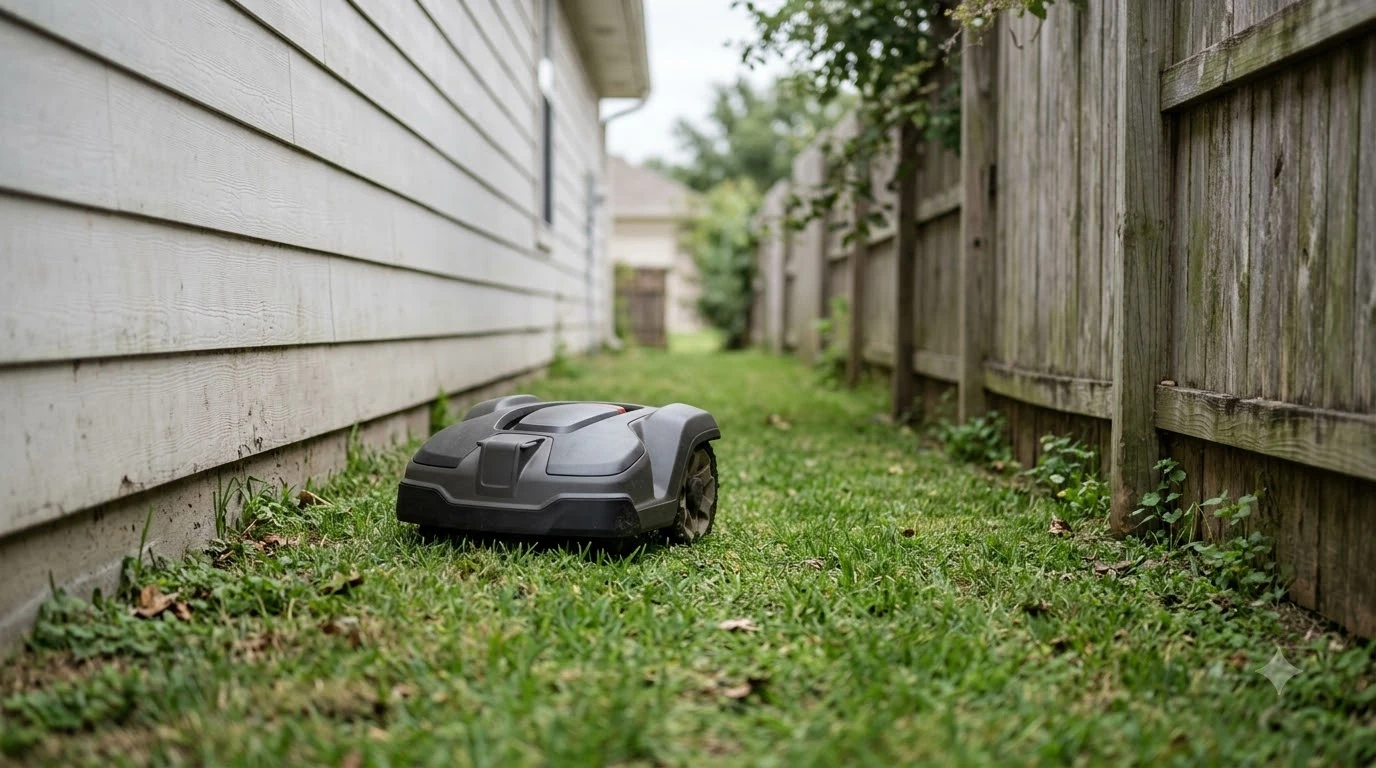

How do robot mowers deal with narrow paths? They follow the boundary wire through the gap, and the width they need depends on the wire setup. Husqvarna’s guidance asks for at least 2 m (6 ft 6 in) between boundary wires on each side of a passage without a guide wire, and 60 cm (24 in) with one. Robomow’s guidance asks for more than 70 cm, and Ecovacs reports trouble in passages under 1 m with high walls.
The short answer
- How it works: the mower follows boundary wires into the passage and back out, so the wire layout decides how robot mowers deal with narrow paths.
- Width without a guide wire: Husqvarna recommends at least 2 m (6 ft 6 in) between the wires on each side.
- Width with a guide wire: Husqvarna recommends at least 60 cm (24 in) between the boundary wires.
- Wire spacing: Robomow says a passage should be wider than 70 cm, or the two wires may interfere.
- Tight spots with high walls: Ecovacs reports problems under 1 m, and suggests guiding the mower by hand along the edge.
How do robot mowers deal with narrow paths?
So how do robot mowers deal with narrow paths in practice? They follow wire, not their own measurement of the gap. A passage is a gap in the working area where the boundary wire is routed so the mower can cross from one section of lawn to another.
The mower does not decide on its own where the passage is. It follows the wire, which the installer lays out to lead it in and out, so the answer to how do robot mowers deal with narrow paths is mostly settled on installation day. Husqvarna’s passage guidance describes creating a passage by running boundary wires on each side of the gap, which the mower then uses as its path. Husqvarna adds that all of its boundary wire Automower models handle passages automatically, except the Automower 105.
Spacing is the detail that matters most. Robomow’s installation guidance says a passage should be wider than 70 cm, because two boundary wires placed too close can interfere with each other. Our guide to laying boundary wire around trees and obstacles covers the routing side, including the choice between burying or pegging the wire. That is why the same gap can work for one installation and fail for another: the distance between the wires, not only the space between the fences or hedges, sets the limit.

Passage width by brand guidance
The figures we verified come from two manufacturers and one brand blog, and they describe different setups. No single number applies to every mower, so the table below lists each source with the condition it attaches. The question “how do robot mowers deal with narrow paths” has no single numeric answer.
| Source | Setup | Figure |
|---|---|---|
| Husqvarna Automower support | No guide wire | At least 2 m (6 ft 6 in) between the boundary wires on each side |
| Husqvarna Automower support | With a guide wire | At least 60 cm (24 in) between the boundary wires |
| Robomow blog | General guidance | Wider than 70 cm (about 28 in), or the two wires may interfere |
| Ecovacs GOAT help center | High-walled narrow passage | Clearance of 0.7 m; passages under 1 m wide with high walls can cause problems |
The Husqvarna figures differ mainly because of the guide wire, which is why the two numbers should not be compared as if they described the same layout. Check the manual for your own model before you trust any single figure.
Guide wires and corridor settings
A guide wire is an extra wire that leads the mower through a passage, and it lets the boundary wires sit closer together. For many yards, the answer to “how do robot mowers deal with narrow paths” comes down to whether a guide wire is installed.
Husqvarna’s passage guidance lowers the minimum from 2 m to 60 cm when a guide wire is used. Husqvarna also says to keep the guide wire at least 30 cm (12 in) from the boundary wire, and it notes that the mower always runs to the left of the guide wire when facing the charging station, so free space on that side matters. The charging station sets that direction, so where to put a robot mower charging station is worth settling first. The same page covers a troubleshooting case: if the mower gets stuck following the boundary or guide wire through a passage, the recommended fix is to adjust the corridor width.
Husqvarna also describes Systematic Passage Mowing, which needs a guide wire and is not available on every model. In a narrow passage the mower switches from random to systematic mowing, turns around at a dead end and mows back through. Husqvarna recommends a low percentage for how often it is used, to prevent grass wear in the passage.
Heads up
The 2 m and 60 cm figures are Husqvarna’s own guidance for its Automower line. For the Automower 435X AWD and 535 AWD, Husqvarna recommends a 2 m (6 ft 6 in) passage for a good cutting result. Other brands set different limits, so do not apply one brand’s number to another mower.
Our reading is that a guide wire is the first option to consider when a gap is close to the limit, since adjusting the corridor width afterward only helps once the wire layout is already in place.
Where narrow paths cause problems
Narrow passages are not only a wire question. When you ask how do robot mowers deal with narrow paths between high walls, the wire is not the only factor. Ecovacs says its GOAT mower can perform poorly in passages under 1 m wide with high walls, because weak positioning signals can leave it stuck. Its help page gives 0.7 m as the narrow-passage clearance for the mower.
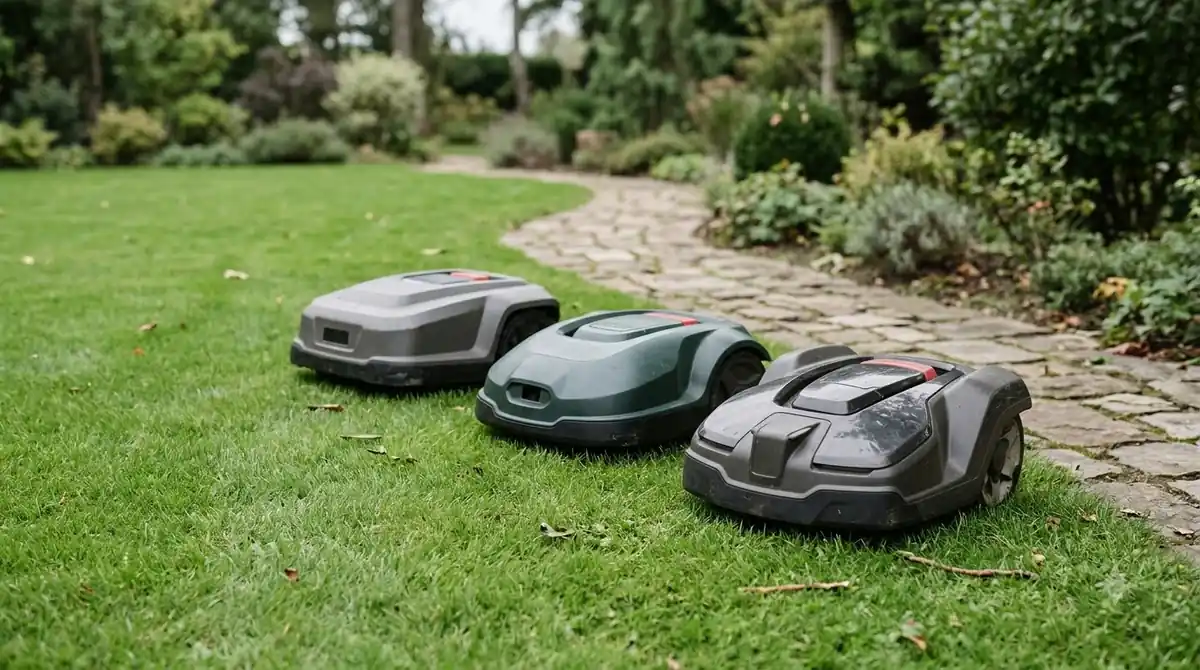
The suggested fix on that page is manual: guide the mower along the edge by hand through the tight section. Ecovacs does not give a wall height for the problem zone, so treat “high walls” as a general warning and compare the passage with the wall or fence heights on your own lawn.
What to check before you buy or install
These steps are our reading of the manufacturer guidance above. For the whole lawn rather than one gap, checking whether your yard suits a robot mower comes first. To work out how do robot mowers deal with narrow paths in your own yard, start with the measurements below.
- Measure the narrowest gap that the mower has to cross, meaning the distance between the points where the boundary wires will run, not between fences or hedges.
- Compare it with the model’s manual for the figure that applies with or without a guide wire.
- Plan the guide wire early if the gap is near the minimum, rather than after the mower gets stuck.
- Note high walls or fences beside the passage, since Ecovacs links its problem zone to that condition.
- Plan a manual pass for any section that the wire layout cannot cover well, as Ecovacs suggests.
Frequently asked questions
How do robot mowers deal with narrow paths without a guide wire?
Without a guide wire, Husqvarna recommends at least 2 m (6 ft 6 in) between the boundary wires on each side of a passage. With a guide wire, the figure is at least 60 cm (24 in). Other brands differ, so check the manual for your model.
Does a guide wire make a narrow passage work?
Husqvarna’s guidance lowers the minimum between the boundary wires to 60 cm when a guide wire is used, compared with 2 m without one. It is one of the main ways to make a tight passage workable.
Why does a robot mower get stuck in a narrow path?
Ecovacs attributes the trouble in passages under 1 m wide with high walls to weak positioning signals. Robomow’s guidance also says boundary wires placed too close together can interfere with each other.
Where does the guide wire go in a narrow passage?
Husqvarna says to keep the guide wire at least 30 cm (12 in) from the boundary wire. The mower runs to the left of it when facing the charging station, so leave free space on that side.
What should I do if the mower gets stuck in a passage?
Husqvarna’s troubleshooting advice is to adjust the corridor width. Ecovacs suggests guiding the mower by hand along the edge through the tight section.
Sources
- How to create a passage in an Automower boundary wire installation (Husqvarna): passage distances with and without a guide wire, corridor width fix.
- Why does GOAT perform poorly when mowing in a narrow path (Ecovacs help center): 0.7 m clearance, problem zone under 1 m with high walls, manual guiding fix.
- Laying the lawn boundary wire: how the robotic lawnmower works (Robomow): passage wider than 70 cm, wire interference.
 Up next8 min readBy YardCan a Robot Mower Work in a Yard With Gravel Path Crossings?Updated Nov 11, 2026
 8 min readBy YardRobot Mower for Narrow Side Yard Passages: What Widths Work?Updated Nov 11, 2026
 7 min readBy YardCan a Robot Mower Work in a Long Narrow Yard?Updated Nov 11, 2026
 8 min readBy YardHow Narrow Can a Robot Mower Passage Be? Simple 2026 RulesUpdated Nov 11, 2026
 8 min readBy YardCan a Robot Mower Handle a Lawn Full of Weeds?Updated Nov 11, 2026
 8 min readBy YardDo Robot Mowers Work on Bumpy Lawns? What to Know FirstUpdated Nov 11, 2026