

How often to mow St. Augustine grass depends on growth, but UF/IFAS says it typically needs weekly mowing in the growing season and less often in the cooler months. The limit that holds in every season is that no more than one-third of the leaf blade should come off in a single mowing. That rule and the height ranges below are the basis for a sound schedule.
St. Augustinegrass has coarse, wide leaves, so it is mowed higher than bermudagrass. Standard cultivars stay at 3.5 to 4 inches, while dwarf cultivars stay at 2 to 2.5 inches. This guide covers how often to mow St. Augustine grass under the timing rule, the height ranges and the seasonal changes.
The short answer
- How often to mow St. Augustine grass: about weekly in the growing season, and always before the next cut would remove more than one-third of the blade height.
- Standard cultivars: mow at 3.5 to 4 inches. Dwarf cultivars: mow at 2 to 2.5 inches.
- Worked example: at a 4-inch setting, mow before the grass grows above 6 inches.
- Winter: in north Florida, grass may not need mowing at all, depending on climate and species.
How often to mow St. Augustine grass depends on growth
The growth rate of the lawn decides how frequently to mow, and UF/IFAS says that rate is shaped by grass species, time of year, weather and management. That is why one fixed schedule does not fit every lawn, although the UF/IFAS grass guide (ENH5) says St. Augustinegrass typically needs weekly mowing during the growing season and less often in the cooler months. A lawn that grows fast after a rain will reach the cut point sooner than one in a dry spell. Our reading is that a short log of each cut and its height, kept for a few weeks, shows the pattern for your yard faster than any fixed calendar.
Winter is the clearest exception to a steady schedule. UF/IFAS says that in north Florida, grass may not need to be mowed during the winter months, depending on climate and grass species. St. Augustinegrass also goes into winter dormancy in parts of the state and turns brown or tan until spring, so the answer to how often to mow St. Augustine grass in winter is often no cuts until growth returns.
New sod or plugs follow a different start. UF/IFAS says the first mowing should wait until the grass is well rooted, generally 14 to 21 days after planting, and that the first cut should come once the grass is established enough to hold its roots.
The one-third rule sets the mowing interval
Mow often enough that no more than one-third of the blade height is removed per mowing. This one-third rule is the core test for how often to mow St. Augustine grass, and UF/IFAS repeats it in its homeowner guide for this grass. The rule works as a trigger: mow when the grass has grown to the point where a single cut would take more than a third.
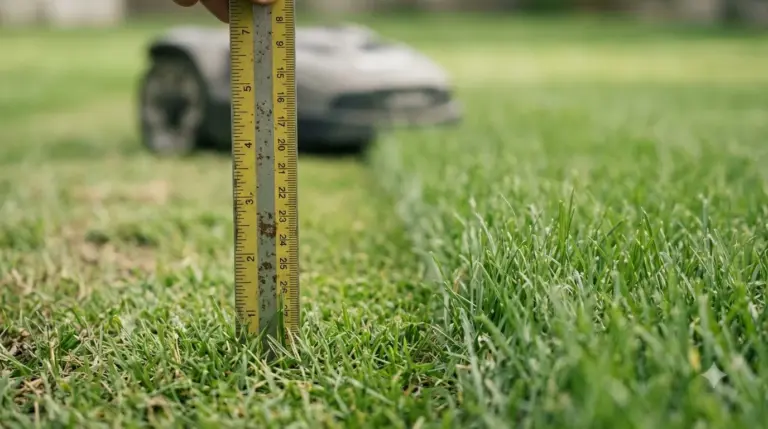
The UF/IFAS mowing guide, ENH10, gives a worked example for how often to mow St. Augustine grass. A lawn kept at 4 inches should be mowed before it grows above 6 inches. Letting the grass run past that point means one pass removes more than a third of the leaf, which is the pattern that stresses the turf.
Turf reacts to every cut. UF/IFAS notes that grass undergoes physiological stress with each mowing event, especially when too much leaf tissue comes off at once. Keeping each cut under one-third leaves enough leaf surface for photosynthesis, which is why the rule matters.
Clippings can usually stay on the lawn. UF/IFAS recommends leaving them on the ground to recycle nutrients, but it warns that infrequent mowing lets clippings clump. If clumps form, rake them or use a leaf blower to spread them out. Clippings rarely build thatch under most conditions. Thatch develops most in grass that is over-fertilized and over-watered, and UF/IFAS says a layer over 1 inch may need vertical mowing.
Mowing height for standard and dwarf cultivars
The cultivar you have sets the height, and that is the first input when you decide how often to mow St. Augustine grass. UF/IFAS lists an optimal range of 2.5 to 4.0 inches for St. Augustinegrass with a rotary mower, and the cultivar-specific heights sit inside that band. Check the cultivar name on your sod or seed tag before you set the deck, and see our guide to the best mowing height for St. Augustine grass for more on cultivars.
| Cultivar type | Mowing height | Examples named by UF/IFAS |
|---|---|---|
| Standard | 3.5 to 4 inches | BitterBlue, Classic, Floratam |
| Dwarf or semi-dwarf | 2 to 2.5 inches | Captiva, Delmar, Seville |
Dwarf types should not be held at the standard height, and standard types should not be cut down to a dwarf height to look neater. UF/IFAS says that repeatedly mowing below the recommended height increases stress on the lawn and discourages deep rooting. Most rotary mowers also cannot cut lower than 1 inch, so the mower you own sets a practical floor.
Height also shapes the root system. UF/IFAS says higher mowing heights develop a deeper root system, which gives the turf greater tolerance to drought, insects, disease, traffic and poor soil conditions.
Shade, heat and missed cuts
A missed or postponed cut can scalp St. Augustine grass, so changing how often to mow it after a weather delay needs care. UF/IFAS advises raising the height during moisture stress or in shade rather than cutting lower. Scalping, or cutting grass too short, means removing too much shoot tissue at one time, and UF/IFAS says it can cause long-term damage to the turf.
- After a missed week: our reading is that a higher setting on the first pass, then the target height on the next cut, keeps the removal near one-third.
- In shade: ENH5 says mowing height should be increased when the grass grows in shade.
- During drought: raise the height while the grass is under moisture stress, rather than cutting it shorter.
Blade condition and direction matter too. UF/IFAS advises sharpening the mower blade often enough to prevent tearing of the leaf, and mowing in a different direction each time, which reduces wear patterns and the chance of scalping. It also says never to mow wet turf with a rotary mower, because clippings can clog the machine.
Robot mower schedule for St. Augustine
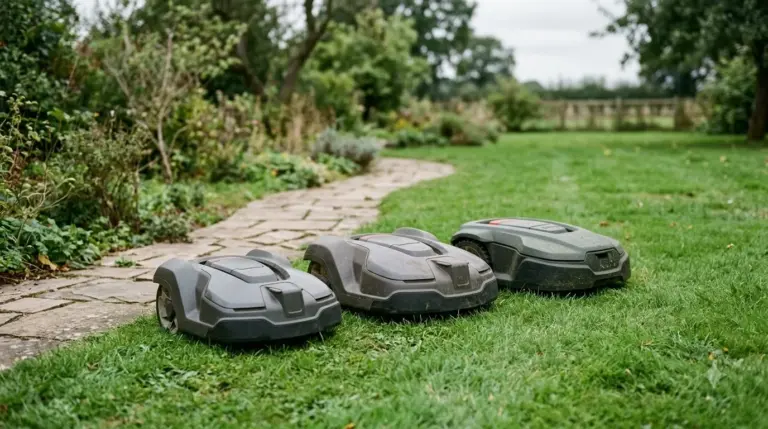
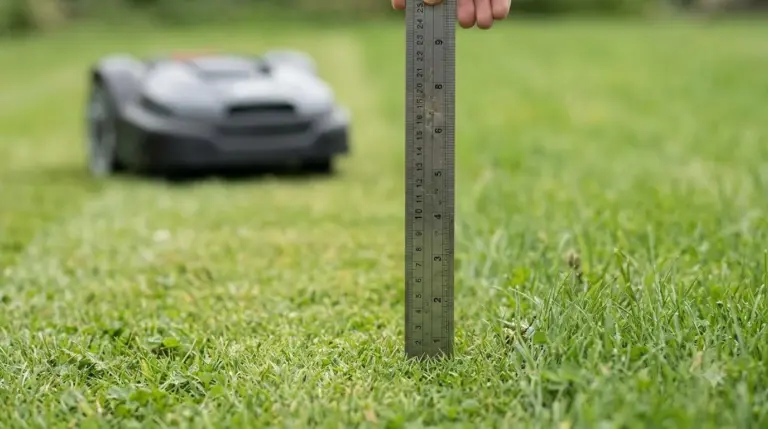
A robot mower cuts a little at a time, so for a robot the question is how often to mow St. Augustine grass through its run schedule, not how many days a week you mow. Our reading is that its run schedule should keep the grass below the one-third trigger for your cultivar.
UF/IFAS adds that lawns kept with autonomous (robotic) mowers can tolerate lower mowing heights, because the mower constantly removes very small portions of the leaf blade and does not cause scalping. Its research kept Floratam at 2.4 inches year-round with no negative effects, which is a research result, not a setting to copy without checking your own mower and cultivar.
Cultivar matters here too: ENH5 says ProVista grows slower than Floratam and requires less frequent mowing, while the prostrate habit of CitraBlue means its mowing height can be reduced, though thatch can build up.
- Spring and summer: run often enough that the grass never passes the trigger height for your cultivar.
- Fall: reduce runs as growth slows, and check the height every week or two.
- Winter: stop running once the grass is dormant, and restart when it greens up in spring (see when the robot mower season starts and ends).
Before buying, confirm that the mower’s lowest setting reaches the band your cultivar needs. A standard lawn is kept at 3.5 to 4 inches and a dwarf lawn at 2 to 2.5 inches. Our page on whether a robot mower can cut St. Augustine grass covers the fit in more detail.
For most lawns, the practical answer to how often to mow St. Augustine grass is to check the grass each week in spring and summer and cut when the next pass would take more than one-third of the blade. Our recommendation is to confirm the cultivar first, because it sets the height you cut at.
Frequently asked questions
How many times a week should I mow St. Augustine grass?
There is no fixed weekly number for how often to mow St. Augustine grass. UF/IFAS ties frequency to the growth rate, which depends on species, season, weather and management. Use the one-third rule as the test: mow when a cut would remove more than a third of the blade height.
Can I wait two weeks between mowings?
Only if the grass has not grown past the one-third limit, so check the height before you accept a long gap. UF/IFAS gives the example of a lawn kept at 4 inches that should be mowed before it grows above 6 inches. A two-week gap in fast growth can break that limit, so check the height first.
Should I mow St. Augustine grass in winter?
Often not. UF/IFAS says that in north Florida, grass may not need mowing in winter, depending on climate and species. Dormant grass in parts of the state turns brown or tan until spring, so a dormant lawn usually needs no cuts.
Does shade change how often I need to mow?
Shade changes the height more than the count when you ask how often to mow St. Augustine grass. UF/IFAS advises raising the mowing height when St. Augustinegrass grows in shade, which keeps each cut smaller relative to the leaf.
Sources
- Mowing Your Florida Lawn (ENH10) (UF/IFAS Extension): one-third rule, mowing frequency, the 4-inch example and the height table.
- St. Augustinegrass for Florida Lawns (ENH5) (UF/IFAS Extension): cultivar mowing heights, shade and moisture-stress height, missed-cut scalping.
- Homeowners Guide to St. Augustinegrass Management in Florida (UF/IFAS): standard and dwarf mowing heights, one-third rule, clippings.
 Up next8 min readBy YardBest Mowing Height for St Augustine GrassUpdated Nov 11, 2026
 10 min readBy YardCan a Robot Mower Cut St. Augustine Grass?Updated Nov 11, 2026
 8 min readBy YardHow Often to Mow Zoysia GrassUpdated Nov 11, 2026
 8 min readBy YardHow Often to Mow Buffalo Grass (Schedule and Height)Updated Nov 11, 2026
 8 min readBy YardHow Often to Mow Centipede GrassUpdated Nov 11, 2026
 8 min readBy YardHow Often to Mow Bermuda Grass by SeasonUpdated Nov 11, 2026