
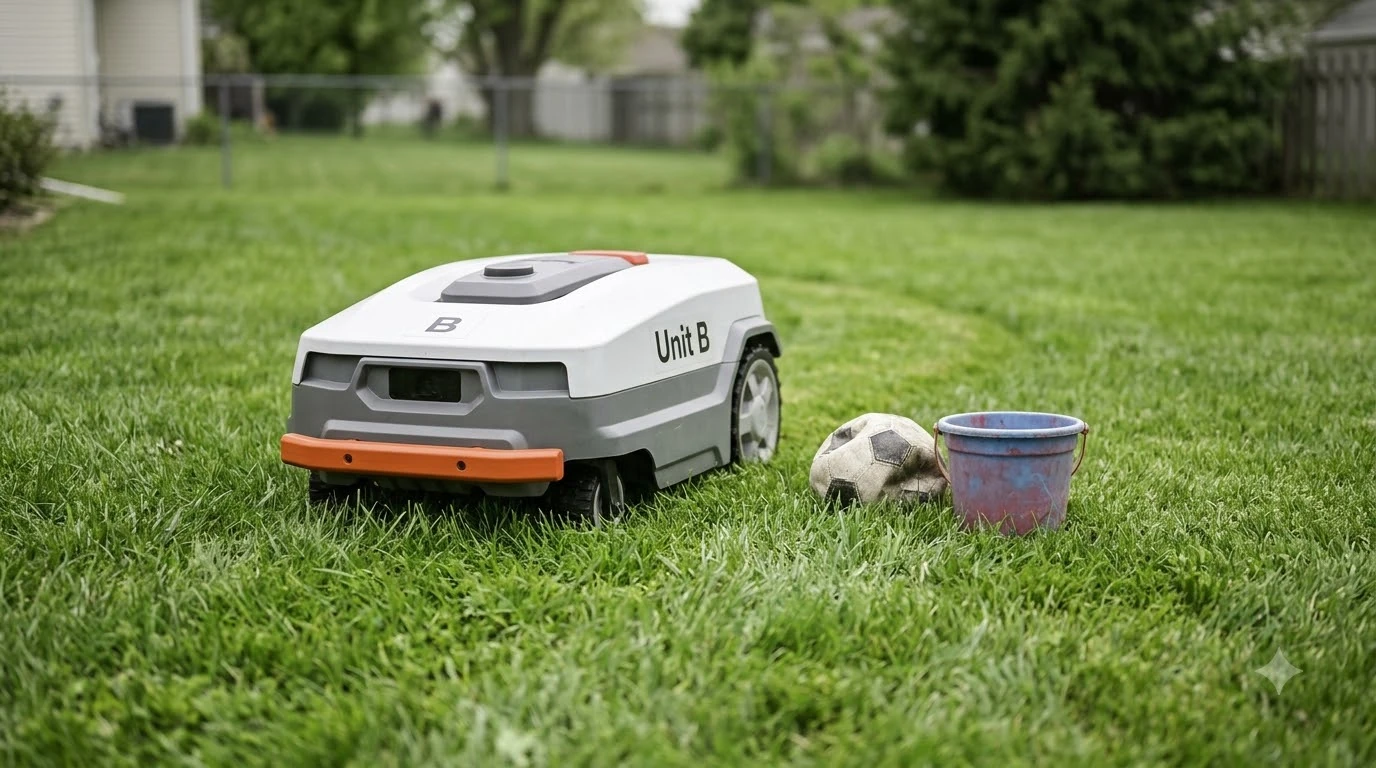

A robot mower for a lawn with utility boxes can mow around them if the boxes are tall enough to be seen and the lawn is set up to keep the mower away from them. Utility boxes are tall, boxy and fixed in place, so they are usually easier for a sensor to read than a flush cover. The risk is in the details: low boxes, corners, grass hiding the base, and gaps between the box and the boundary. Most setups are safest with a stay-out zone or a wire island around each box.
The short answer
- Tall box: a sensor has a better chance of detecting it and turning away before contact.
- Low or flat box: treat it like a flush cover, since flat or very close objects may be missed.
- Corners and edges: hard to read from a distance, so give them a wider margin.
- Safest setup: a wire island or a physical stay-out zone, not sensors alone.
Tall boxes are easier to avoid than low ones
A utility box is a metal or plastic cabinet that holds meters, valves or controls. Its footprint and height vary widely. A box that stands well above the turf gives a sensor a clear profile to read, while a short box at ground level looks much like the lawn to some sensors. Boxes are small fixtures in the lawn, and the mower picks for yards with utility fixtures cover the wider case. Short pedestals are even harder to see, as low pedestals and well caps explain.
Robomow’s user guide for its RT model states that rigid obstacles taller than 15 cm are bumped and avoided without a wire, while lower objects need a wire or a zone. That is a useful rule of thumb for utility boxes. If yours is taller than that, sensing has a chance to work. If it is shorter, plan on a fence from the start.
How sensors read a box and where they fall short
Husqvarna’s AI vision page sorts objects by risk. It notes that raised or legged objects can be hard to assess, and that the mower may try to pass under a raised section. A utility box on short legs or a raised base is one of those cases. The page advises a stay-out zone where there is a risk of getting stuck. Sensors treat a thin post differently from a wide box, as mailbox post sensing behavior shows.
Radar and ultrasonic sensors have a different limit. Husqvarna’s object avoidance page says they may miss objects that are flat or very close to the ground, and that avoidance is switched off within 60 cm of a virtual boundary and 90 cm of a boundary wire. In practice, a box placed right against the wire gets little warning, so it is better to keep it well inside the cutting area with a wire island around it.
Heads up
Tall grass changes everything. Husqvarna warns that objects hidden in high grass can be missed and can trap the mower. Trim a strip around each box, especially where grass grows up the base.
Robot mower for a lawn with utility boxes: corners and bases
A square box has corners that are easy to clip, and the base is where wiring, drains and vents often sit. Our reading is to think of the box’s full footprint, not just its face. Leave a clear strip at the base so the mower can turn before it reaches the walls. Posts with a base have similar corners, as lamp post corner handling explains.
- Measure the footprint. Record the width and depth at the base, not only the front face.
- Choose the method. Use a wire island for a box that cannot take a bump, and a stay-out zone for one that is off to the side.
- Keep the wires apart. Island wires must not cross, or the mower will not recognize the island and will stop.
- Check the gap. Keep the island wire clear of the box and allow for the 60 cm and 90 cm sensor cut-off near boundaries.
- Watch the first runs. Look for missed corners or scuffs on the box and adjust the zone if needed.
Stay-out zones for boxes you cannot fence
Some utility boxes sit near a driveway or a patio where a wire island is awkward. Husqvarna’s EPOS guidance recommends stay-out zones around trees, roots and stones, with a minimum size of 30 x 30 cm, and says the mower will not pass through one. A zone is a good choice for a box that is well marked. It is not a physical barrier, so keep a physical fence where the mower could reach a box with its blade. A barrel can be fenced the same way, as the rain barrel stay-out zone shows. Fixed objects you cannot fence need stay-out zones, as covered in robot mowers around a fire pit.
What to check before you buy
- Height data: ask the seller or read the manual on how the sensors treat low and tall objects.
- Island and zone support: confirm the model supports islands, and how many you can set.
- Grass control: plan a trim strip around each box before the mower is installed.
- Edges: check how close the wire can run to a wall or a box without triggering avoidance.
Read the installation section on fixed objects before you rely on the mower to handle the boxes without a fence.
Related reads: A larger object is handled with an island, as shed as an island shows.
Frequently asked questions
Will a robot mower bump into a utility box?
It may, especially if the box is low or sits close to the boundary wire. Tall boxes are easier to sense, but no sensor system is guaranteed. A wire island is the safer option.
What height makes a box easy for a robot mower to avoid?
Robomow’s RT guide says rigid obstacles taller than 15 cm are bumped and avoided without a wire. Lower objects need a wire or a zone.
Do I need a wire around a utility box next to the boundary?
Usually yes. Husqvarna’s sensors switch off avoidance within 90 cm of the boundary wire, so a box close to the edge gets little warning.
Can grass around a box stop the mower?
Yes. Husqvarna warns that objects hidden in high grass may be missed or may trap the mower. Trim the grass around the base before the first run.
Sources
- Husqvarna object detection and avoidance with AI vision (KA-70388) (manufacturer): raised or legged objects are hard to assess; stay-out zones where there is a risk of getting stuck.
- Husqvarna object avoidance with radar or ultrasonic sensors (KA-70110) (manufacturer): flat or low objects may be missed; avoidance switched off within 60 cm and 90 cm of boundaries.
- Robomow RT user guide (manufacturer): rigid obstacles taller than 15 cm are bumped and avoided without a wire.
- Husqvarna EPOS stay-out zones (KA-70385) (manufacturer): minimum zone size of 30 x 30 cm.
 Up next9 min readBy YardHow Does a Robot Mower Handle a Well Cap or Utility Pedestal in the Lawn?Updated Nov 12, 2026
 6 min readBy YardRobot Mower for a Lawn with a Putting Green: Fence It OffUpdated Nov 13, 2026
 6 min readBy YardRobot Mower for a Lawn with Voles: Signs, Limits, ControlUpdated Nov 13, 2026
 6 min readBy YardRobot Mower for a Lawn With a Mailbox PostUpdated Nov 13, 2026
 7 min readBy YardRobot Mower for a Lawn With a Cistern LidUpdated Nov 13, 2026
 8 min readBy YardRobot Mower for a Lawn with an RV Parking PadUpdated Nov 13, 2026