
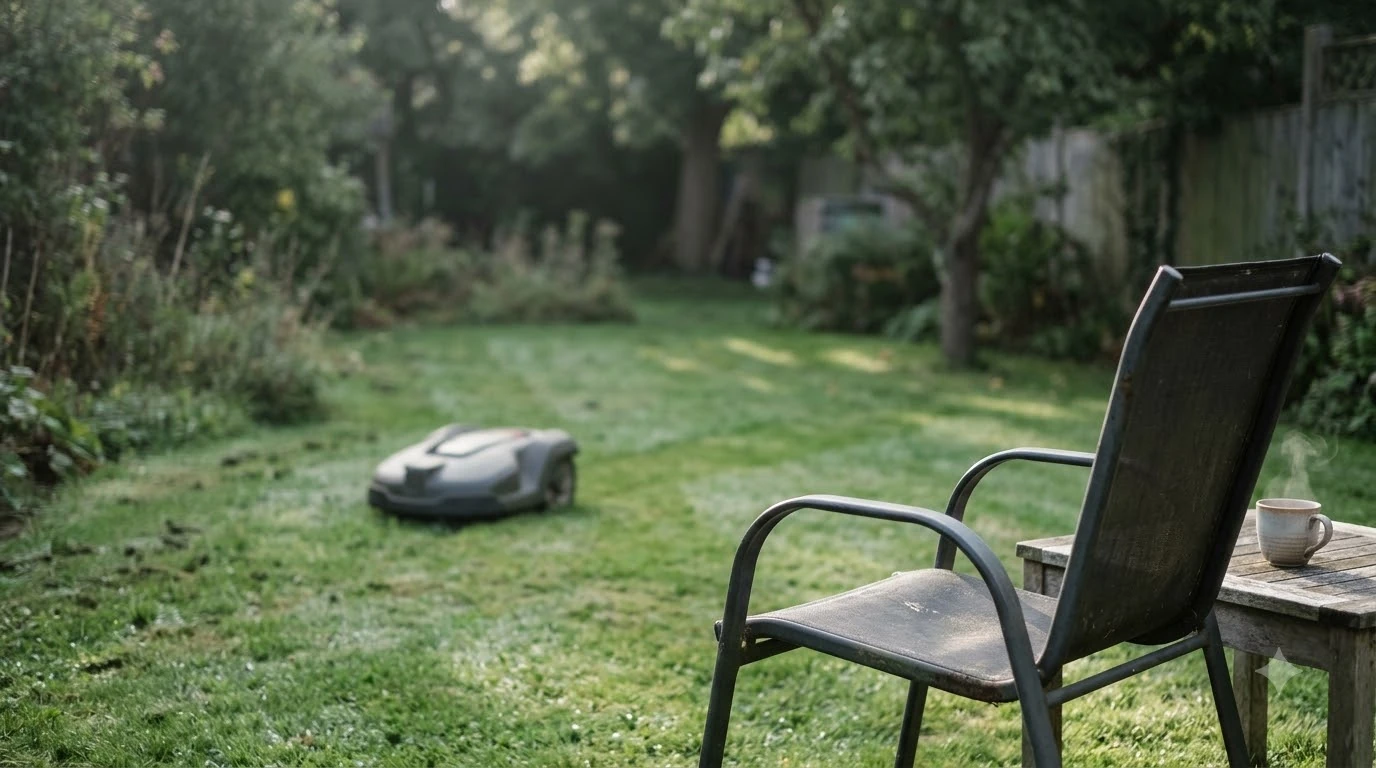

The best robot mower for a yard with a fire pit is the one you can fence off from the pit, because the sources we read describe object sensing, not heat sensing. Pick a model whose boundary tools let you draw a no-go area around the pit, then let the ashes cool for days before the mower runs nearby.
None of the manufacturer pages we read names fire pits, so the choice comes down to setup rather than a brand ranking. The owner carries most of the safety work, and the boundary plan matters as much as the mower itself.
The short answer
- Sensors: a fire pit is a solid object, so obstacle sensors can react to it, but none of the pages we read says the mower detects heat.
- Boundary: a wire island, an EPOS stay-out zone or a FlexiFence zone keeps the mower out of the pit area.
- Cooling: fire departments recommend at least four days of cooling in the burn spot, with one week as the minimum before ashes are moved.
- Ash container: a tightly covered metal container at least 10 feet from buildings and combustibles, never plastic.
What a robot mower’s sensors see around a fire pit
Sensor limits matter most when you compare the best robot mower for a yard with a fire pit, because a pit is something the mower can bump into or avoid. Bump sensors are the simplest form of detection, while ultrasonic and infrared sensors try to react before contact (more in how robot mowers avoid obstacles). Husqvarna’s object avoidance guide states that object avoidance “is not a safety feature. There is no guarantee that objects will not be run over.”
The same guide notes that small objects, objects lying flat or very close to the ground can be missed, and tall grass can be mistaken for an object. A pit rim or a low stone border may therefore be harder to detect than a bench or a tree trunk.
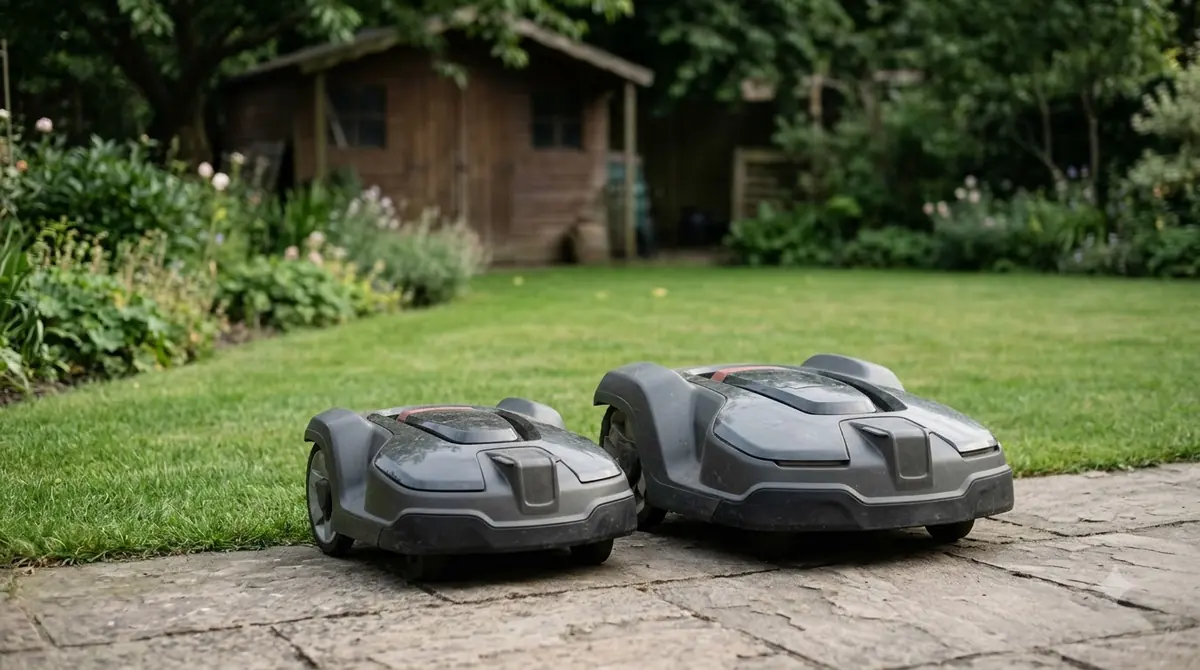
Our reading is that the sensors are built to detect objects, not temperature. Nothing in the manufacturer pages we read says the mower can sense hot ashes or embers, so do not count on it for that.
Which boundary tool fits a fire pit
Two boundary tools can keep the mower out of a pit area when you shop for the best robot mower for a yard with a fire pit, and a third option works where wire is hard to run. Each has a different limit to watch, and what a no-go zone is explains the basic idea.
| Option | How it works | Limit to watch |
|---|---|---|
| Wire island | A loop in the boundary wire around the pit. Husqvarna recommends islands for areas the mower should not enter, such as flower beds or rockeries. | The wire must not cross itself, or the mower will not recognise the island and will stop. |
| EPOS stay-out zone | A zone drawn in the app, without buried wire. Stay-out zones are recommended around trees, roots and stones. | Each zone must be at least 30 x 30 cm (1 x 1 ft), and it must not block a transport path or leave an area unreachable. |
| FlexiFence | A battery-powered zone the mower cannot enter, installed in the work area and not across a guide wire. | It does not operate when its battery is empty, and the mower can still cut in the zone if started before the battery is charged. |
For most yards with a fixed pit, a wire island or a stay-out zone is the simplest fit because it does not depend on a battery. FlexiFence is useful where you cannot run wire, but you must keep its battery charged. Husqvarna advises charging it to at least 60% every three months if it sits unused for a long time.
How to set the fire pit as a no-go area
Draw the no-go area first, then check that the mower can still reach the rest of the lawn. The steps below follow the rules in the manufacturer pages we read, and how to set up no-go zones on a robot mower covers the general routine.
- Measure the pit and its rim. Add a clear margin around the pit, because the mower should not get close to hot material.
- Draw the zone at least 30 x 30 cm. Stay-out zones smaller than this are not allowed, so make the zone wider if the pit is small.
- Check the transport path. A zone across the path to the charging station will stop the mower from reaching its base.
- Look for narrow gaps. A gap between the pit and a fence or bed can leave a strip the mower cannot reach, so avoid zones that cut off a passage.
- Watch the first runs. We recommend checking that the mower keeps clear of the zone during its first few runs, then reviewing the map if it gets close.

Let the ashes cool before the mower runs nearby
Fire departments recommend letting ashes cool in the burn area for at least four days, and one week as the minimum before moving them. City of Boise Fire’s hot ash guidance gives the same four-day cooling window and warns that coals can stay hot enough to reignite for many days.
The Crystal Lake Fire Protection District gives the same minimums and adds a warning that ashes can hold hot coals for a long time after the fire looks out. Treat every ash pile as hot, even when it feels cool to the touch.
Keep the ash container off the mowing route
Store ash in a metal container with a tight, non-flammable lid, placed at least 10 feet from buildings and combustibles.
Heads up
Boise Fire says never to empty hot ash into a plastic or paper bag, and both it and the Crystal Lake district put the metal container well clear of buildings.
Our reading is to keep the container outside the mower’s route, so the mower never has to pass it.
Who this setup suits and who should skip it
For a yard with a fixed pit and room for a boundary loop, the best robot mower for a yard with a fire pit is one that supports wire islands or stay-out zones. The setup is a good fit when the pit sits well inside the lawn and there is open space around it. Husqvarna’s island guidance applies to any area the mower should not enter, so the same logic covers a pit set in a flower bed or rockery.
- Good fit: a pit in an open lawn, with at least a clear margin on all sides for the zone.
- Harder fit: a pit in a narrow side passage, where a zone can cut off the lawn behind it. A yard with a swimming pool raises the same zone questions.
- Skip, in our reading: a pit where the zone would take up most of the lawn, because the mower then has little left to mow.
Scope boundary: this guide does not rank the best robot mower for a yard with a fire pit by model, because we did not find a manufacturer page that names fire pits. Check your model’s app guide for its exact zone rules.
Best robot mower for a yard with a fire pit: what to check before you buy
Several features matter more than the brand name when you look for the best robot mower for a yard with a fire pit.
- Which boundary tools the model supports: wire island, stay-out zone or FlexiFence.
- The minimum zone size and whether zones can be drawn in the app.
- How the model handles narrow passages and transport paths.
- The battery plan for any battery-powered zone.
- Whether the manufacturer’s guide mentions obstacles like tree roots and stones.
Frequently asked questions
Will a robot mower hit a hot fire pit?
A robot mower can bump into a fire pit as an object, but the manufacturer pages we read describe object detection, not heat detection. Keep the mower out of the pit area with a boundary tool so it never gets close to hot material.
Can a robot mower mow around a fire pit on its own?
Some models can avoid a pit as an object, but sensors can miss low or flat objects. The safer approach is a wire island or stay-out zone around the pit, so the mower never needs to detect it in the first place.
Is FlexiFence enough to keep the mower away from a fire pit?
FlexiFence can create a zone the mower will not enter, but it only works while its battery is charged. Husqvarna says it does not operate when the battery is empty, so a wire island is the steadier choice for a permanent pit.
How long should ashes cool before the mower runs nearby?
Fire departments recommend at least four days of cooling in the burn area, with one week as the minimum before moving ashes. Treat ashes as hot even when they feel cool, because coals can stay hot for a long time.
Sources
- Husqvarna object avoidance guide (manufacturer): object avoidance limits and the “not a safety feature” statement.
- Husqvarna EPOS stay-out zone guide (manufacturer): minimum zone size, transport paths and unreachable areas.
- Husqvarna boundary wire island guide (manufacturer): islands and wire crossing rules.
- Husqvarna FlexiFence guide (manufacturer): battery and placement rules.
- PCWorld on robot mower sensors (publisher): bump, ultrasonic and lift sensors.
- City of Boise Fire hot ash guidance (government): cooling times and container rules.
- Crystal Lake Fire Protection District ash safety (government): minimum cooling and clearance.
 Up next8 min readBy YardHow Does a Robot Mower Handle a Fire Pit?Updated Nov 11, 2026
 6 min readBy YardWill a Robot Mower Hit Fire Ant Mounds in the Lawn?Updated Nov 12, 2026
 9 min readBy YardCan You Use a Robot Mower for a Lawn With Red Imported Fire Ant Beds?Updated Nov 19, 2026
 6 min readBy YardBest Robot Mower for a Yard With Kids ToysUpdated Nov 14, 2026
 9 min readBy YardBest Robot Mower for a Yard With Garden FurnitureUpdated Nov 12, 2026
 8 min readBy YardBest Robot Mower for a Yard With a Dry Creek Bed: What to CheckUpdated Nov 12, 2026