
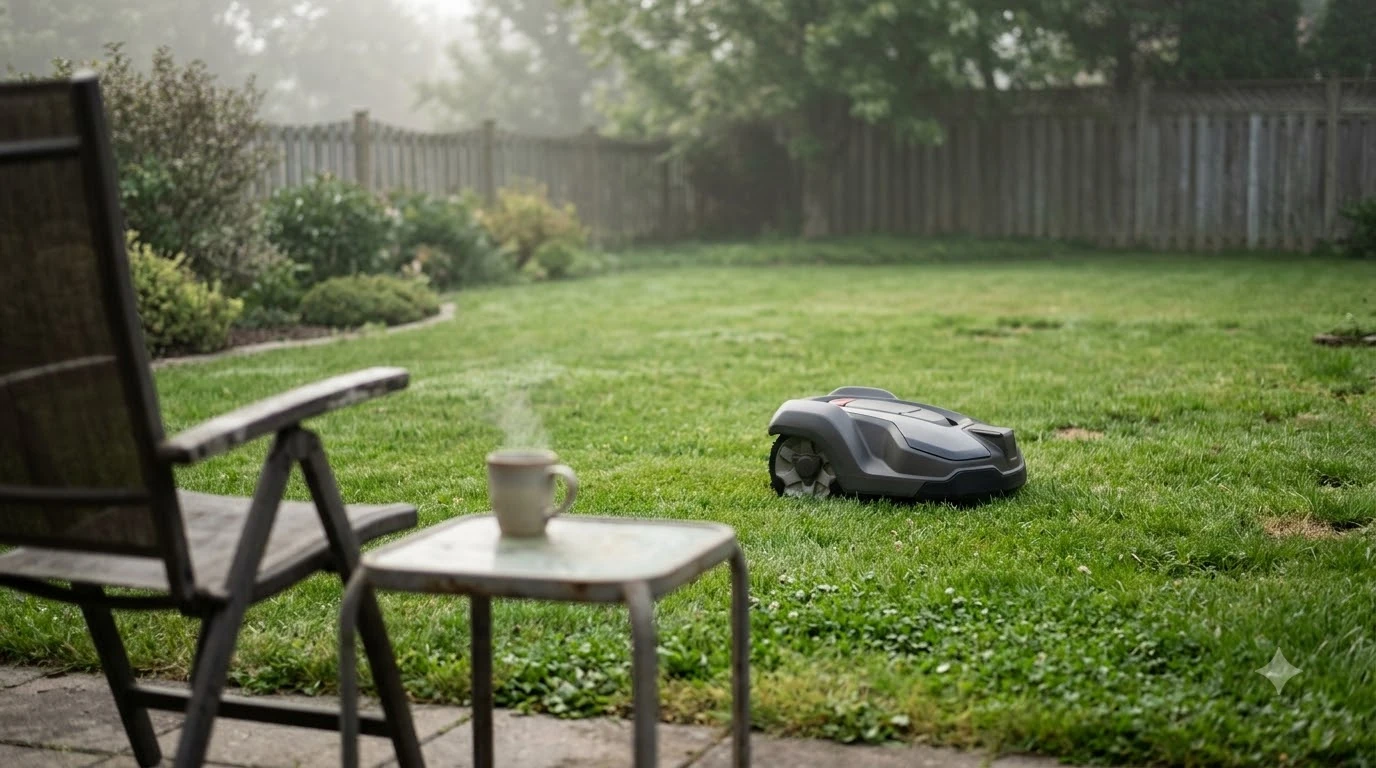

The best robot mower for a yard with garden furniture is the one that handles fixed objects safely, through obstacle sensing, a boundary wire island, or both. Furniture is a common trap for robot mowers, and no single model clears it on its own. As of November 2026, the support pages from Husqvarna, Worx and Robomow set the rules that matter most when furniture sits on the lawn.
The short answer
- Sensing: check whether the manual lists obstacle detection for rigid objects.
- Wire: fragile items such as flower beds need a wire island, while sturdier objects often do not.
- Clearance: Worx keeps island wire 26 cm from the obstacle, and Robomow gives about 10 cm for beds and 35 cm for walls.
- Habits: clear the mowing path and keep grass under the maximum height for your model.
Why garden furniture traps a robot mower
Outdoor furniture is one of the named causes of a trapped error. Husqvarna’s trapped error page lists four causes: the mower is stuck behind an obstacle such as outdoor furniture, the work area has narrow passages, the grass is too long, or grass chunks block the blade disc. Only the first of these is set by the yard layout itself, which is why furniture deserves planning before the mower is installed.
A chair pulled into the mowing path can stop a robot mower repeatedly, and the same spot may catch it again on the next run. If that sounds familiar, see why a robot mower gets stuck in the same spot. For that case, Husqvarna advises moving the mower to a clear area, removing the object and restarting. If the mower keeps hitting the same spot, the page suggests creating a stay-out zone or island around the problem area, and enlarging it if the mower still gets stuck.
Which furniture needs a wire island
Objects that cannot take a bump need an island of boundary wire, while sturdier objects often do not. Husqvarna’s island guidance names flower beds and rockeries as examples of areas to keep out of the mowing zone, and states that its mowers are designed to handle gentle bumps, so obstacles like trees do not always need to be fenced off.
In practice, that leaves three groups to sort your furniture into:
- Light, movable pieces such as chairs and planters can often be moved off the mowing path before each run.
- Fragile or low items such as flower beds, edging and stone features should be islanded with wire so the mower stays out.
- Heavy, fixed pieces such as a stone bench or built-in planter are the best candidates for a planned wire loop, laid before the mower runs.
Robomow’s boundary wire guide makes a related point: a border only a few centimeters high does not need wire, because the mower’s sensors detect and avoid it. That makes low furniture and tall objects different cases, so check the height of each piece before deciding.
Wire clearances around furniture
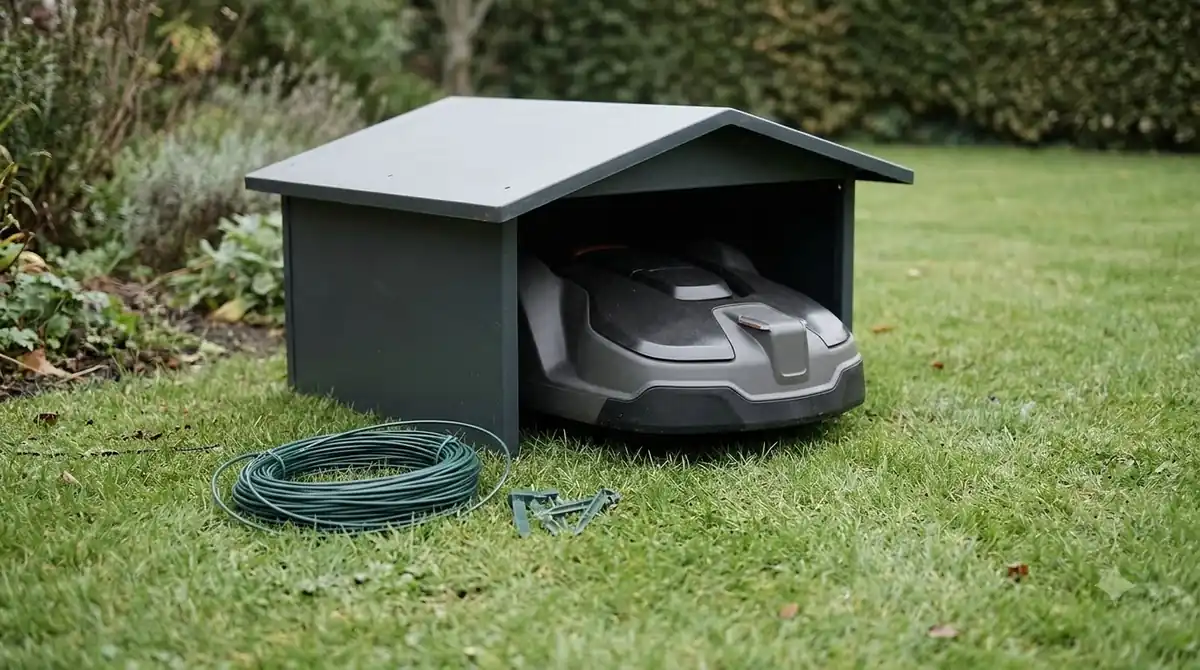
Clearance rules are the part of the install that most affects how close the mower gets to a piece of furniture. Worx’s island guide keeps the wire 26 cm from the obstacle while the island is formed, and runs the wire clockwise so the mower stays out. Robomow’s wire guide gives approximate distances for other obstacles, shown below.
| Obstacle | Approximate clearance from the wire | Source |
|---|---|---|
| Island around an object (Landroid Classic) | 26 cm from the obstacle | Worx setup guide |
| Beds or hedges | About 10 cm | Robomow wire guide |
| Slabs and paths at or below lawn level | About 10 cm | Robomow wire guide |
| Walls and tall stones | About 35 cm | Robomow wire guide |
| Pond | About 35 cm | Robomow wire guide |
Heads up
These are manufacturer figures for their own models, and the numbers differ between brands and models. Use them as a starting point and check the installation section of your mower’s manual before cutting the wire.
Wire layout rules matter as much as the distances. Robomow says the wire must not cross at any point, because crossing causes signal interference. Its guide also says obstacles in the middle of an area should be wired by running the wire from the edge to the obstacle, encircling it once, and returning on a run parallel to the outward lead. Worx gives the same no-crossing rule, asking that the two strands be kept side by side. Our guide to how to lay boundary wire around trees and obstacles walks through the same loop.
Yard habits that reduce furniture traps
Most furniture-related stops can be cut down with a few routine habits, and none of them needs a new mower. These habits matter as much as the model, since even the best robot mower for a yard with garden furniture still traps easily on a cluttered lawn. The steps below follow the manufacturer advice above, plus our reading of how they apply to a yard with furniture. For the wider checklist, see how to prepare your yard for a robot mower.
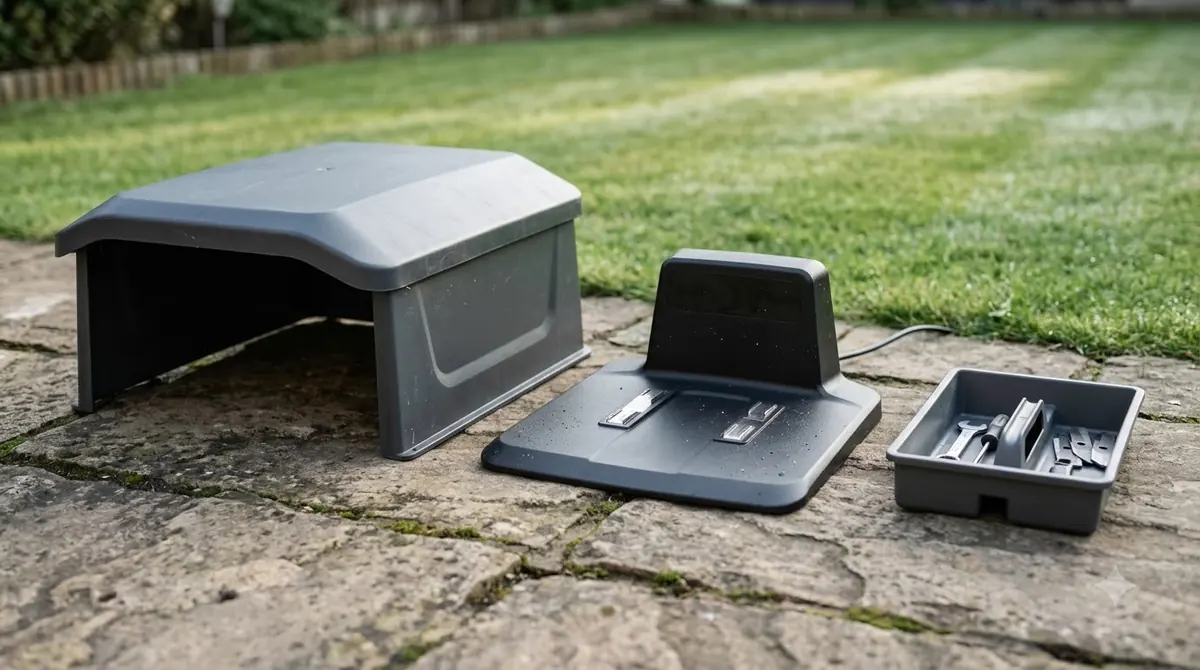
- Clear the mowing path before each run. Move loose chairs, planters and toys off the lawn, especially on the days the mower is scheduled to run.
- Keep the grass under the model maximum. Husqvarna says the maximum grass height depends on the model and ranges from 4 cm to 10 cm, so check your model’s figure before the spring growth period.
- Clean the blade disc. Grass chunks can stop the disc from rotating, which triggers a trapped error even when no furniture is in the way.
- Fence a recurring trap spot. If the mower keeps stopping at the same piece, add a stay-out zone or a small island around it, then widen the gap if the mower still gets stuck. The app-based version is covered in how to set up no-go zones on a robot mower.
Best robot mower for a yard with garden furniture: what to check first
Compare the manual’s features against the furniture in your yard before looking at brand names, because the best robot mower for a yard with garden furniture is the one whose manual covers those objects. The table below lists what each feature does with furniture on the lawn and where to find the figure in the manual. Models that lead on sensing are listed in best robot mower with obstacle avoidance.
| Feature | Why it matters with furniture | What to look for in the manual |
|---|---|---|
| Obstacle sensing | Detects rigid objects, so the mower can avoid pieces without a wire | Which objects the sensors detect and what the mower does on contact |
| Boundary wire islands | Keeps the mower away from fragile items such as beds | Island wiring steps and the clearance distance |
| Stay-out zones | Lets you fence a spot that keeps trapping the mower | Whether the app or the wire can set a zone without re-laying the loop |
| Maximum grass height | Long grass is a named cause of trapped errors | The model maximum, which Husqvarna gives as 4 to 10 cm across its range |
| Passage width | Narrow gaps between furniture and fences can trap the mower | The minimum passage width the manual states |
Our reading is that a model whose manual lacks a clear island method, or a stay-out zone, is harder to fit into a furniture-heavy yard. A model with clear sensing rules and a documented island method gives you more options when the layout changes.
Who each setup suits
For most owners, the best robot mower for a yard with garden furniture is the one that matches how the furniture is arranged. Yards with many movable pieces suit a mower that senses objects, with simple wire islands around beds and other fragile items. Yards with heavy, fixed furniture suit a planned wire loop laid before the first run, because the wire has to go around those pieces anyway.
Re-check the wire after any change to the yard. Moving a bench or adding a planter can put it inside a loop that was laid for the old layout. Husqvarna advises widening the gap around a repeat trap spot, and Robomow says obstacles should be outlined in a single stretch of wire, so plan additions before the wire is cut. A best robot mower for a yard with garden furniture only performs as well as the wire that matches the current layout.
This is planning logic built from the manufacturer pages above, not a test of any model, and the right setup depends on the yard. A larger or more complex yard may need more wire, longer install time and a closer look at the passages between pieces.
Frequently asked questions
Will a robot mower hit patio furniture?
It can get stuck behind it. Husqvarna lists outdoor furniture among the causes of a trapped error, so pieces in the mowing path should be moved or fenced before the mower runs.
Do I need wire around every chair?
No. Husqvarna says its mowers handle gentle bumps, so sturdy obstacles do not always need fencing. Fragile or low items such as flower beds are the ones to island with wire.
How far should the wire stay from a flower bed?
Robomow gives about 10 cm for beds and hedges. Worx uses 26 cm for its island wire on the Landroid Classic, so check the figure in your own model’s manual.
Does grass height matter near furniture?
Yes. Husqvarna names long grass as a trapped-error cause and gives a maximum grass height of 4 to 10 cm, depending on the model.
Sources
- Trapped Automower error message (Husqvarna): causes including outdoor furniture, narrow passages, long grass and grass chunks, plus the stay-out zone advice.
- How to create islands in a boundary wire Automower installation (Husqvarna): islands for flower beds and rockeries, and the gentle-bump tolerance of its mowers.
- Setup an Island (Worx, Landroid Classic wiki): 26 cm clearance, clockwise routing and the no-crossing rule.
- Laying the lawn boundary wire (Robomow): obstacle demarcation, approximate clearances and the no-crossing rule.
 Up next9 min readBy YardHow Does a Robot Mower Handle Garden Furniture?Updated Nov 11, 2026
 9 min readBy YardHow to Choose a Robot Mower for a Yard With a Garden ShedUpdated Nov 16, 2026
 8 min readBy YardCan a Robot Mower Work Around a Rain Garden?Updated Nov 12, 2026
 9 min readBy YardBest Robot Mower for a Cottage Garden Lawn: What to CheckUpdated Nov 12, 2026
 8 min readBy YardHow Does a Robot Mower Handle Raised Garden Beds?Updated Nov 11, 2026
 8 min readBy YardBest Robot Mower for a Yard With a Dry Creek Bed: What to CheckUpdated Nov 12, 2026