
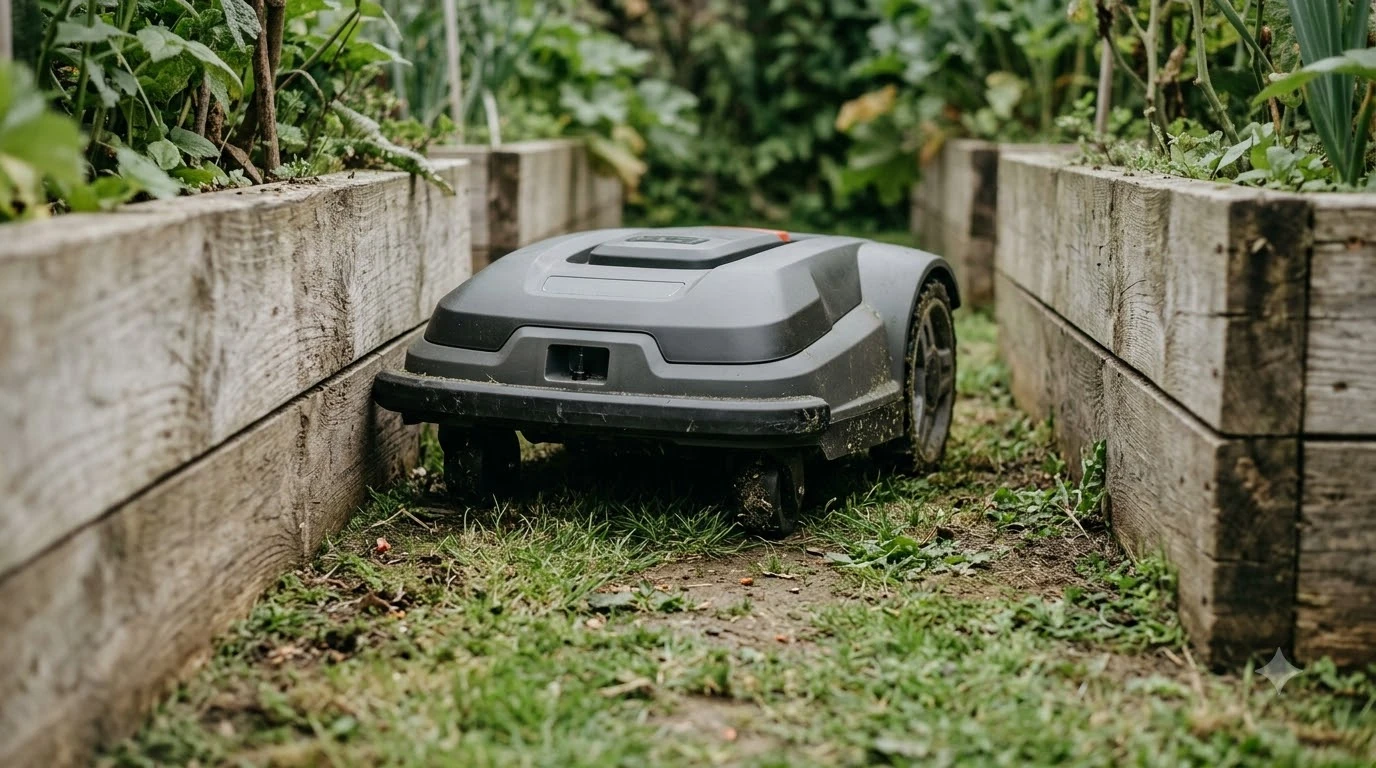

The best robot mower for a cottage garden lawn depends on a short list of checks: the narrowest passage, the shape of the borders, and how the mower finds its way. Sources checked as of November 2026 give specific widths for passages and guide wires, so you can measure your own lawn against them before you buy. Cottage gardens split the grass into curved edges, flower beds and narrow gaps, so a spec sheet for an open rectangular lawn does not settle the choice.
The short answer
- Measure the narrowest gap: Husqvarna’s support guide asks for at least 2 m (6 ft 6 in) between boundary wires on a passage, or 60 cm (24 in) when a guide wire is used.
- Check the cutting deck: reviewers report that some models cannot reach borders or cut close to fence lines, so deck position matters.
- Match the navigation to the beds: wire-free zones lose accuracy where satellite signal is weak, so a boundary wire may still be needed in those areas.
- Keep the clearance question open: none of the sources read for this guide gives a distance between a mower and a flower bed, so use your model’s manual for that number.
Why cottage garden lawns are harder for robot mowers
A robot mower works best on a simple area, and a cottage garden rarely offers one. Consumer Reports says a flat, rectangular yard is easier for a robot to navigate quickly than one with more slopes, rocks, trees or walkways that break up the mowing area. Cottage plots often combine several of those features, which divides the lawn into smaller grass areas.
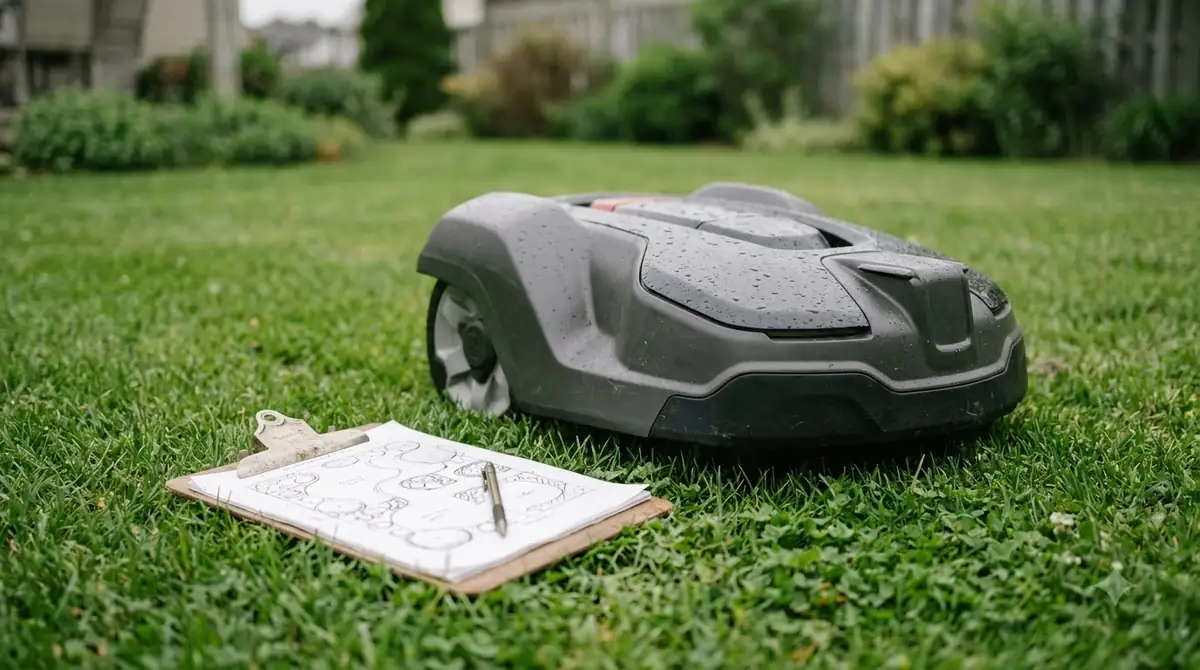
The landscape professionals’ association NAPLA lists the same problems in more detail. It describes flower beds and walls as barriers that may need a passageway, and it warns that paths at a different height from the lawn may be impassable for a mower. Its suggested fix is a ramp or slope that lets the mower cross the path. The same article advises leaving about 70 cm (roughly 28 in) of clearance so the mower can pass behind a tree.
Our reading is that the shape of your lawn should drive the shortlist for the best robot mower for a cottage garden lawn. Sketch the grass areas, the beds, the paths and the trees before you compare models, because those four features decide whether a mower can cover the whole plot.
Check the narrowest passage before anything else
The narrowest gap is the first number to measure, because it limits every other choice. Husqvarna’s UK support page on passages (see also our guide to robot mowers for narrow side-yard passages) gives the figures for its boundary-wire systems: 2 m (6 ft 6 in) between the boundary wires on each side of a passage, or 60 cm (24 in) when a guide wire is laid. The page names the Automower 105 as the stated exception to the 2 m rule.
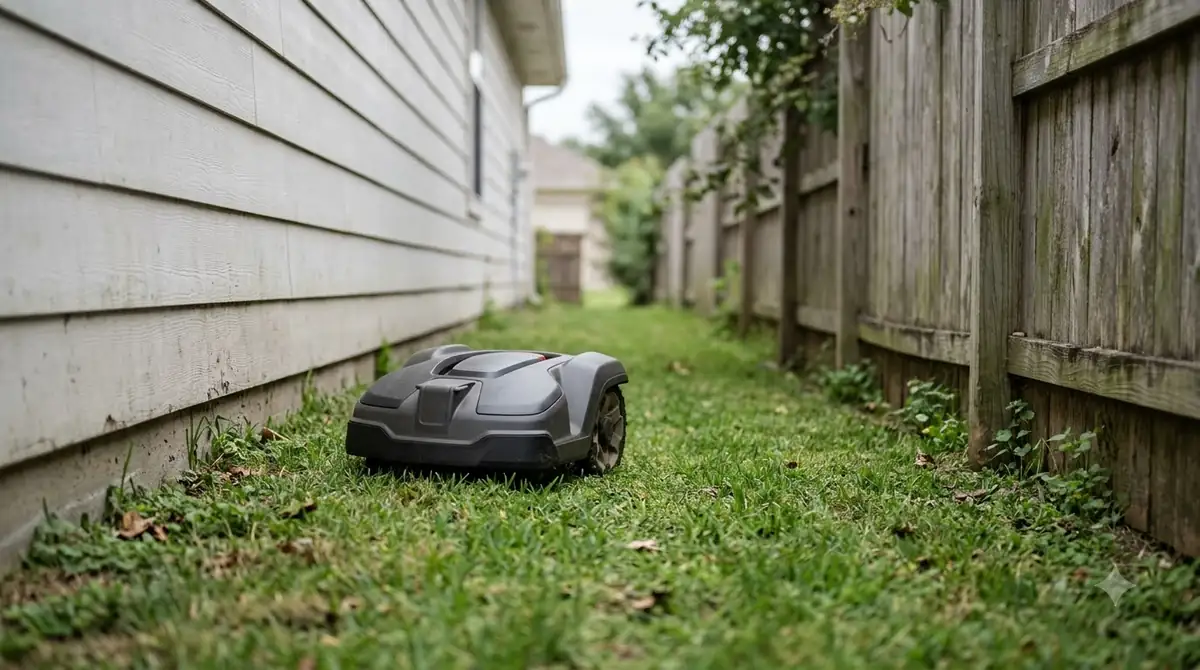
Husqvarna’s corridor width guide adds a setting that can help a mower through a tight spot. On installations with a physical boundary wire, the corridor width can be set from 1 to 9, and the factory settings are 6 for the boundary wire and 9 for the guide wire. The page also notes that a setting of 0 runs the mower right over the middle of the guide wire.
Independent figures are harder to find, but one Gardener’s World review reported results for specific models. The compact Ecovacs GOAT O600 was described as able to reach tight spaces and narrow pathways only 70 cm wide. The EGO AURA-R2 needed a 1 m gap for access, and the reviewer said it got stuck more than once in a few tight corners and a narrow path. NAPLA’s general guidance is a passageway of at least 1 m for most robot mowers, which is wider than the guide-wire minimum above, so the number you use depends on the model you choose.
Measure the narrowest point of each gap, not the average width. A path that is 1 m wide at one end and 70 cm at the other is a 70 cm path for planning purposes.
How the mower finds its way matters near beds
A wired mower follows its boundary wire and sensors, while a wire-free mower relies on satellite positioning, which our explainer on what virtual boundary mapping is covers in plain terms. Husqvarna’s EPOS guide for its wire-free system says stay-out zones stop the mower from entering sections where it is not allowed to mow. It also says zone accuracy may be reduced where the satellite signal is weak, and it strongly recommends a boundary wire island around virtual stay-out zones in those areas.
Trees add a second signal problem. Consumer Reports notes that a lot of tall trees could challenge a mower’s ability to connect with a satellite signal. Many cottage gardens have mature trees near the beds, so check the sky view over the lawn before you assume a wire-free model will hold its position, or look at robot mowers that work under trees without RTK.
Beds are a separate issue from signal. In the same Gardener’s World review, one model got stuck in a couple of flower beds on its first trip out. Reviews of this kind describe one unit on one lawn, so treat them as a warning to test the bed areas, not as a verdict on the model. Our guide to how a robot mower handles raised garden beds covers the bed edges in more detail.
Borders, edges and the fence line
Cottage borders are the hardest part of the lawn for a mower to cut cleanly. Consumer Reports says many models do not cut as close to fence lines or garden walls as a regular mower might. The table below lists the checks that matter most near borders and where the source for each one comes from.
| Check | Why it matters for a cottage border | Where the point comes from |
|---|---|---|
| Cutting deck position | A centrally mounted deck may not reach the border edge | Gardener’s World review of one model |
| Cut distance to fences and walls | Many models leave a strip uncut along a wall | Consumer Reports |
| Border definition | Some models need well-defined edges to stay on track | Gardener’s World review of one model |
| Bushy borders | One review found a model timid near bushy borders and reluctant to cut up to the edge | Gardener’s World review of one model |
The practical result is that a robot mower will usually leave a strip at the edge of a bed or a fence. Our reading is that you should plan a hand trim along those strips rather than expect the mower to finish them alone, and the best robot mower for a cottage garden lawn still leaves some edge work, so see our notes on the lawn edger to use with a robot mower.
Size, slopes and trees
Slope and tree layout are the other two limits on the best robot mower for a cottage garden lawn. Consumer Reports says a good robot mower should be able to understand where it is in the yard, turn corners and navigate hills. NAPLA recommends splitting a steep slope into separate areas for the upper and lower sections of the yard, and it suggests finding alternative routes for the mower.
Trees need room too. NAPLA’s figure of about 70 cm of clearance behind a tree is a sensible planning number for a cottage lawn with trunks close to the grass. NAPLA also suggests a raised border around trees to keep them out of the mower’s path.
What to check before you buy the best robot mower for a cottage garden lawn
Five checks cover most cottage gardens, and each one has a source above. Work through them in order, because the first check can rule out models before you read any other spec.
- Measure the narrowest passage. Use the smallest gap, measured wall to wall or bed edge to bed edge, and compare it with the guide-wire and boundary-wire figures.
- Map the beds and borders. Note every bed that the mower must avoid and every border it must reach, then decide whether a wire island or a zone can protect it.
- Check the navigation type. Wired systems depend on the boundary wire, while wire-free systems depend on satellite signal, so look at the trees around the lawn first.
- Look at the cutting deck. Check how close the deck gets to the border and to the fence, because a centrally mounted deck may leave more uncut grass.
- Read the manual for clearances. The sources read for this guide do not give a mower-to-bed distance, so the clearance number has to come from your model’s installation guide.
Frequently asked questions
Is there one best robot mower for every cottage garden?
No. The best robot mower for a cottage garden lawn depends on the narrowest passage, the number of beds and the navigation type. A compact mower may suit a tight plot, while a model that needs a 1 m gap may not fit the same lawn. Start with your own measurements, then compare the specs.
How wide does a gap need to be for a robot mower?
For a cottage garden lawn, Husqvarna’s support page gives 2 m (6 ft 6 in) between boundary wires for a passage, and 60 cm (24 in) when a guide wire is used. NAPLA says most robot mowers need at least 1 m. Check the figure for your exact model before you assume a gap is wide enough.
Can a robot mower avoid flower beds?
Yes, with a rule that matches the system. For a wire-free mower, Husqvarna’s EPOS guide says a stay-out zone is what stops the mower entering a bed. A boundary wire island alone will not prevent entry, but Husqvarna strongly recommends adding one around stay-out zones where the satellite signal is weak.
Do trees affect a robot mower’s navigation?
They can. Consumer Reports notes that tall trees may challenge a mower’s satellite connection, and NAPLA recommends about 70 cm of clearance behind a tree so the mower can pass. Check the sky view and the tree clearance on your own lawn before you choose a wire-free model.
Sources
- Husqvarna passage support page (Husqvarna): passage widths of 2 m and 60 cm with a guide wire.
- Husqvarna corridor width support page (Husqvarna): corridor setting range and factory defaults.
- Husqvarna EPOS guide (Husqvarna): stay-out zones, weak satellite signal and boundary wire around zones.
- Consumer Reports robotic lawn mower guide (Consumer Reports): yard layout, fence-line cutting and satellite signal under trees.
- NAPLA robot mower design tips (National Association of Landscape Professionals): passageway width, tree clearance, ramps and sloped areas.
- Gardener’s World robotic mower reviews (Gardener’s World): reported results for narrow paths, flower beds and borders on specific models.
 Up next8 min readBy YardHow Does a Robot Mower Handle Raised Garden Beds?Updated Nov 11, 2026
 9 min readBy YardHow Does a Robot Mower Handle Garden Furniture?Updated Nov 11, 2026
 8 min readBy YardBest Robot Mower for a Duplex Yard: What to Check Before You BuyUpdated Nov 11, 2026
 9 min readBy YardBest Robot Mower for a Condo Common Lawn: What to CheckUpdated Nov 11, 2026
 8 min readBy YardRobot Mower for a Hot Humid Climate: What to CheckUpdated Nov 11, 2026
 8 min readBy YardRobot Mower for Compacted Soil Lawn: 4 Checks FirstUpdated Nov 11, 2026