
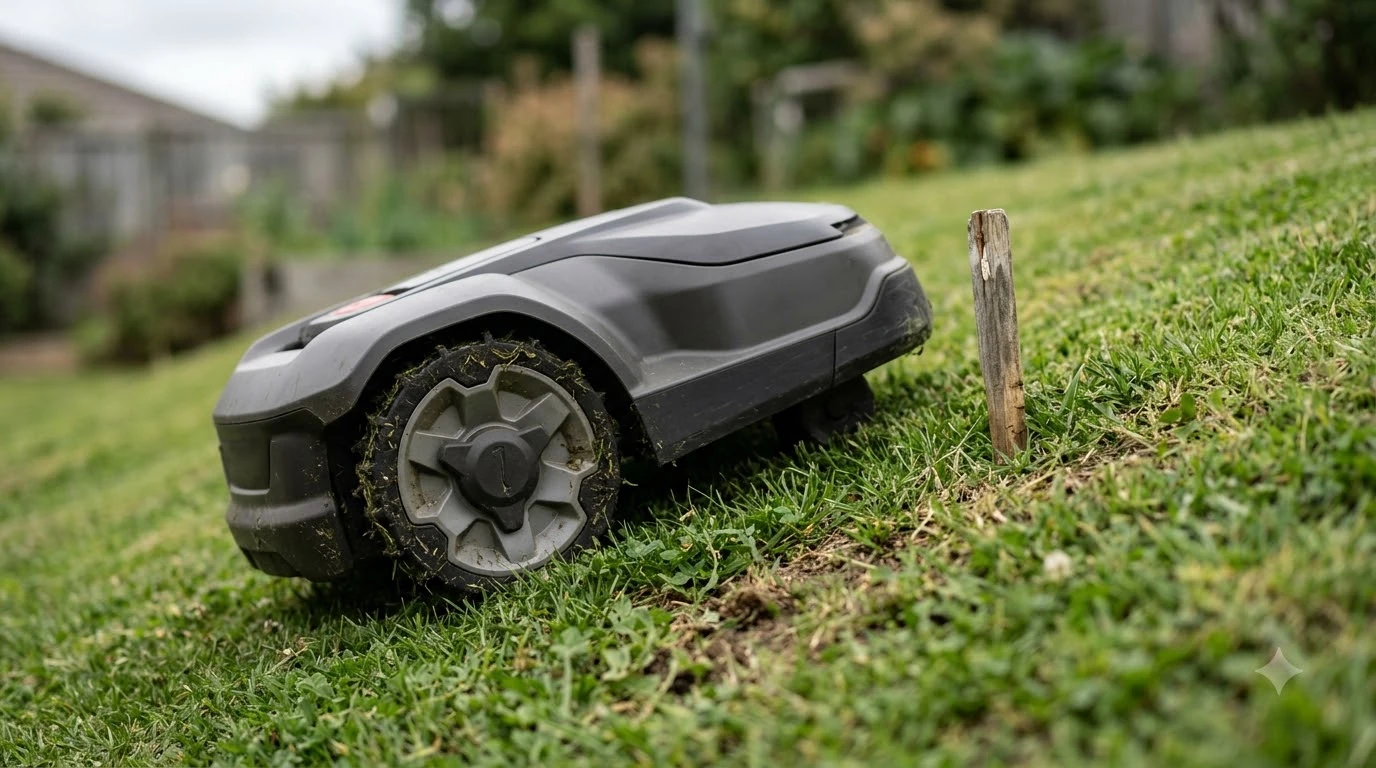

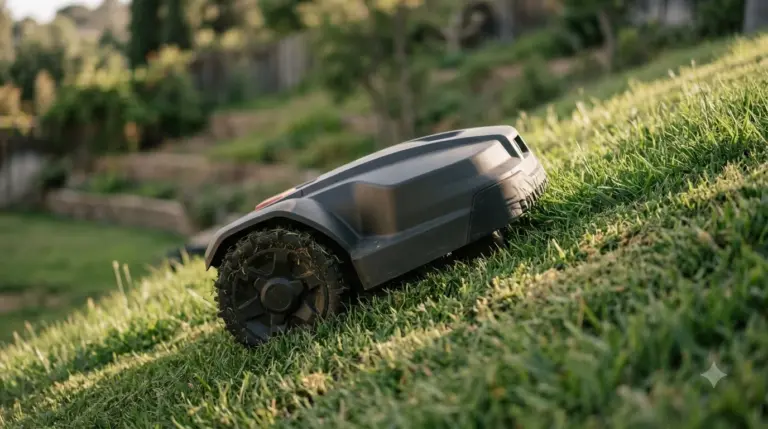
A robot mower for side slopes and ditches works when the slope sits inside the model’s rated limit and the boundary wire stays back from the edge. Manufacturer guidance we read gives ratings from about 25% to 70% depending on the model, and it tells you to keep the wire on flat ground before the slope starts. A ditch or bank edge should be treated as a drop-off, not as mowable grass.
The short answer
- Check the grade first. Measure the steepest part of the side slope in percent, then compare it with the model’s maximum rating.
- Leave a setback. Husqvarna’s guidance is to move the boundary inward on flat ground before the slope begins, with at least 50 cm (1.6 ft) of level transition ground.
- Fence off the ditch. The sources we read name steep embankments and drops as places to use no-go zones. None of them says a robot mower should cut into a ditch bottom.
What a side slope and a ditch ask of a robot mower
A side slope is a bank that runs along a fence line, a driveway, or a property edge. A ditch is a lower channel, often with a steep bank on one or both sides. For a robot mower, the two problems are the same: the wheels need traction on the incline, and the mower needs a clear, safe boundary so it does not roll over an edge or slide down a bank. Traction on steep ground is a model-specific limit, so the first step is always the numbers.
Our reading is that a slope which is inside the rating on a dry day can still be too steep after rain, so plan for the wet case when you size a robot mower for side slopes and ditches.
Robot mower for side slopes and ditches: how to read a slope
Slope is measured as rise over run. The Iowa State University Extension gardening guide defines it as the number of feet a slope goes up over a horizontal distance, and it gives both forms: “1:12 = 8.33%.” A rise of 1 foot over 12 feet is about 8.3% grade. This matters because a spec sheet can use percent while your measuring tool reads degrees (see measuring yard slope with a level for the tools).
The conversion is not linear in the way people expect. Grade in percent is the tangent of the angle multiplied by 100. Our calculation gives 20% = about 11.3 degrees, 30% = about 16.7 degrees, and 45 degrees = 100%. The eufy blog gives the 45-degree figure too, and it describes 10% to 25% as the range of basic mowers. Always check that a spec uses the same unit as your measurement, and read how slope ratings are explained if the numbers do not line up.
| Grade (%) | Angle (approx.) | What the sources say |
|---|---|---|
| 10% to 25% | 5.7 to 14 degrees | Range eufy gives for basic robot mowers |
| 20% | 11.3 degrees | Iowa State: “steep” at 20% (1:5) or more |
| 25% to 50% | 14 to 26.6 degrees | Husqvarna UK: standard models, depending on model |
| 30% | 16.7 degrees | Iowa State: too steep to mow for turf in general |
| 70% | 35 degrees | Husqvarna UK: 435X AWD upper limit |
Our reading: the 30% line in the table comes from general turf mowing advice, not from a robot mower rating. It shows why very steep banks are usually left for hand trimming or ground cover.
What manufacturer guidance says about slope limits
Husqvarna’s UK installation guide gives the most specific figures we read. Standard Automower models are rated from 25% to 50% “depending on the model,” and the 435X AWD is rated up to 70%, which it lists as 35 degrees. The guide also says to ensure that slopes in the work area and near the boundary do not exceed the limits for your model. Those are two different numbers in the same spec sheet, so read the boundary figure as well as the work-area figure.
The eufy blog adds a useful framing: the maximum rating is “an absolute limit rather than a target for daily mowing.” Our reading is that a mower rated at 45% will do better on a 25% bank than one that is working at its edge every day, especially on wet grass.
Use the manufacturer’s own table for your model, not a blog summary; the learn guide on how to choose a robot mower for slopes walks through the comparison. Brand blogs in this topic do not always agree with each other or with the math, so a rating in a blog post should be checked against the model manual before you rely on it.
Setting the boundary wire back from a bank
The wire is what keeps the mower off the bank, so its position matters more than the rating alone. Husqvarna’s UK guide says to “position the boundary further in on flat ground before the slope begins.” It also specifies at least 50 cm (1.6 ft) of level ground between the flat area and the steep section, so the mower has room to slow and turn before it reaches the grade.
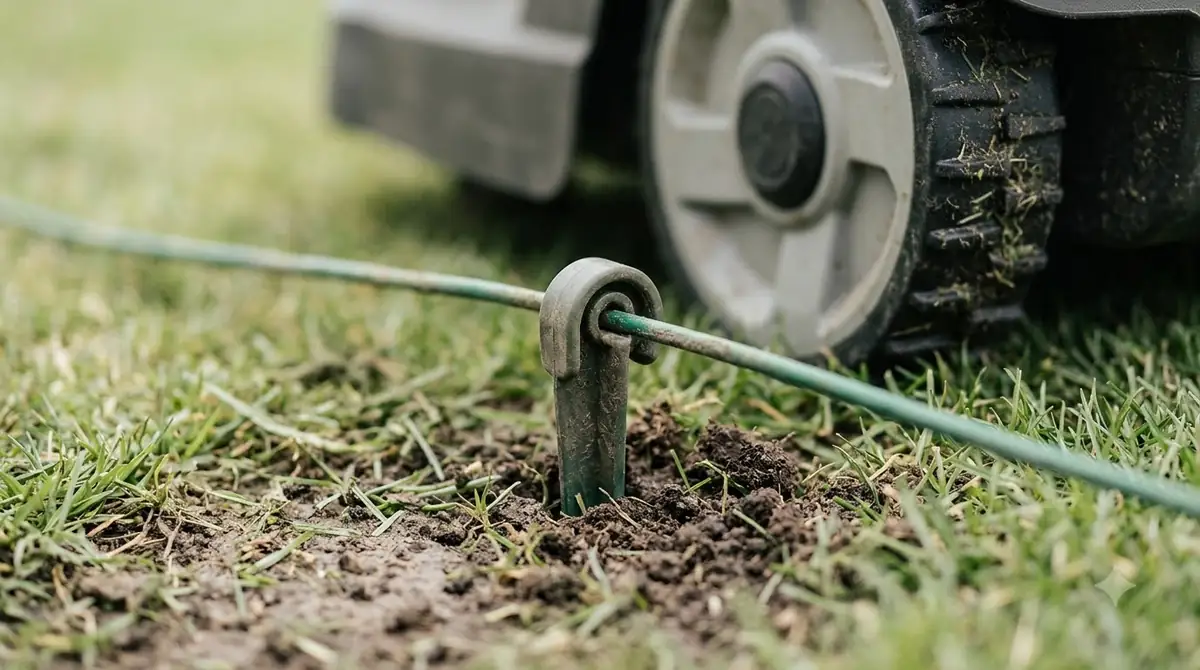
On AWD models working on 50% to 70% slopes, the same guide asks for 1.5 m (5 ft) between the bottom of the slope and the boundary wire. The guide wire, which tells the mower where to travel, should run “diagonally across the slope” for better traction and less grass wear, rather than straight up the bank.
For the outer edge of a yard next to a road, Husqvarna recommends a protective barrier of at least 15 cm (6 in) along the edge, such as a wall or fence. That barrier is a separate rule from the slope setback and applies in addition to it.
The Robomow edge-cutting blog we read gives a feel for how far a mower can go past the wire: in some models the overrun can be “as much as 30 cm.” Our reading is that you should leave more space than the cutting edge needs when a bank sits just outside the wire.
Treating a ditch as a drop-off
The manufacturer guidance we read does not give a rule for a ditch, and a separate page asks can a robot mower mow a drainage ditch. Husqvarna’s UK slope guide does not mention drop-offs, water, or ditches. The brand and retailer blogs are more direct: the eufy AU article says “Deep holes, thick tree roots, and sharp retaining wall drops trap mowers easily,” and the Sunseeker blog lists drop-offs among natural obstacles that a robot mower can get stuck on.
Our reading for a robot mower for side slopes and ditches is simple. Treat the lip of a ditch as the edge of the mowing area, and keep the boundary wire or a no-go zone back from it. Do not plan for the mower to cut the bank or the ditch bottom. The eufy article also says soil dips “greater than 3 cm” should be filled in or marked with a virtual boundary, and that is a useful rule for the uneven ground at the top of a ditch.
When to use no-go zones or hand trimming instead
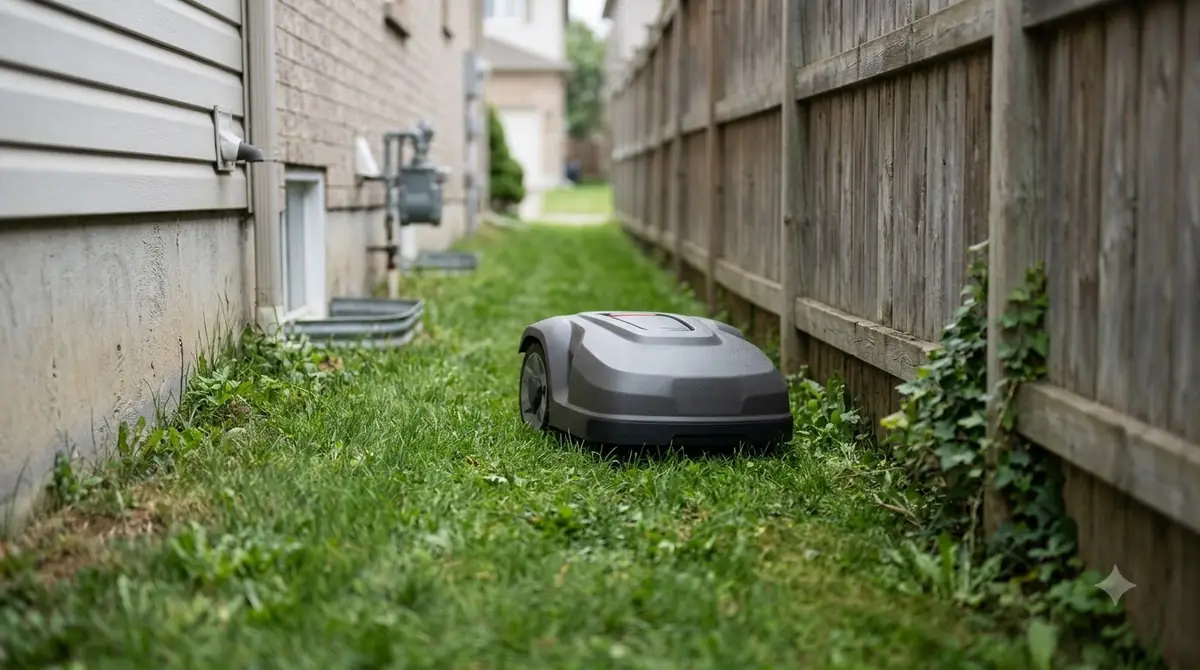
Where a bank is steeper than the model’s rating, the sources we read point to two options. The first is a no-go zone, which keeps the mower out of the area on apps that support it. The eufy article recommends drawing no-go zones “around thick tree roots, garden beds, and steep embankments.” The second is hand trimming or a different ground cover on the bank, since the Iowa State guide notes that slopes at about 30% and above need plantings other than turfgrass.
Our reading is that a no-go zone is the safer default on a hillside lawn too (see robot mower for hillside lawn). It costs nothing to draw, and it protects the mower and the bank. The main cost is the strip you still have to trim by hand, so measure that before you decide the slope is worth keeping as lawn.
Robot mower for side slopes and ditches: what to check before you buy
- Measure the steepest section. Use a level and a tape to get rise over run, then convert to percent. The Iowa State example, 1:12 = 8.33%, shows the method.
- Compare the rating with the boundary limit. Look for both the work-area number and the boundary number in the manufacturer’s table.
- Plan the setback. Check the wire layout on flat ground first, with at least 50 cm of level transition ground and 1.5 m for AWD on steeper banks.
- Decide what to do with the ditch. Use a wire island, a no-go zone, or hand trimming. Do not count on the mower to cut a ditch bottom.
- Check the wet-weather case. A dry-day rating is not the same as a wet-day result, so keep a margin below the rating.
Frequently asked questions
Can a robot mower mow a side slope?
Often yes, if the slope is inside the model’s rating. Husqvarna’s UK guide gives standard models 25% to 50% depending on the model, and the 435X AWD up to 70%. Check the work-area and boundary figures separately.
What slope percentage is too steep for a robot mower?
It depends on the model. Basic mowers are often rated around 10% to 25% according to the eufy blog, and premium or AWD models go higher. Iowa State Extension treats 20% as steep and says slopes around 30% are too steep for turf mowing in general.
How far should the boundary wire be from a slope?
Husqvarna’s UK guide says to move the boundary inward on flat ground before the slope begins, with at least 50 cm (1.6 ft) of level transition ground. On AWD models working on 50% to 70% slopes, it asks for 1.5 m (5 ft) from the bottom of the slope to the wire.
Can a robot mower cut a ditch bank?
The manufacturer guidance we read does not cover ditches. Treat the ditch edge as a drop-off, keep the boundary or a no-go zone back from it, and plan to trim the bank by hand.
Sources
- Gardening on Slopes and Hillsides (Iowa State University Extension): rise over run, the 1:12 = 8.33% example, and the 20% and 30% thresholds.
- Optimising an Automower installation for steep slopes (Husqvarna UK): model slope ratings, boundary setback, AWD clearance, guide wire direction.
- Robot lawn mower slope limits (eufy AU, brand blog): percent-to-degree examples, the “absolute limit” wording, drop-offs and soil dips.
- How cleanly does a robotic mower cut the lawn edge (Robomow blog, brand): cutting distance and wire overrun.
- Can robotic lawn mowers handle slopes (Sunseeker blog, brand): drop-offs as obstacles and no-mow zones for steep embankments.
 Up next9 min readBy YardCan a Robot Mower Work in a Lawn on Both Sides of the House?Updated Nov 11, 2026
 8 min readBy YardRobot Mower for Narrow Side Yard Passages: What Widths Work?Updated Nov 11, 2026
 7 min readBy YardRobot Lawn Mower for 45 Percent Slope: What to Check Before You BuyUpdated Nov 11, 2026
 7 min readBy YardHow to Measure Yard Slope in Percent and DegreesUpdated Nov 11, 2026
 8 min readBy YardHow Does a Robot Mower Handle Raised Garden Beds?Updated Nov 11, 2026
 9 min readBy YardRobot Mower for Terraced Yard: What to Check FirstUpdated Nov 11, 2026