
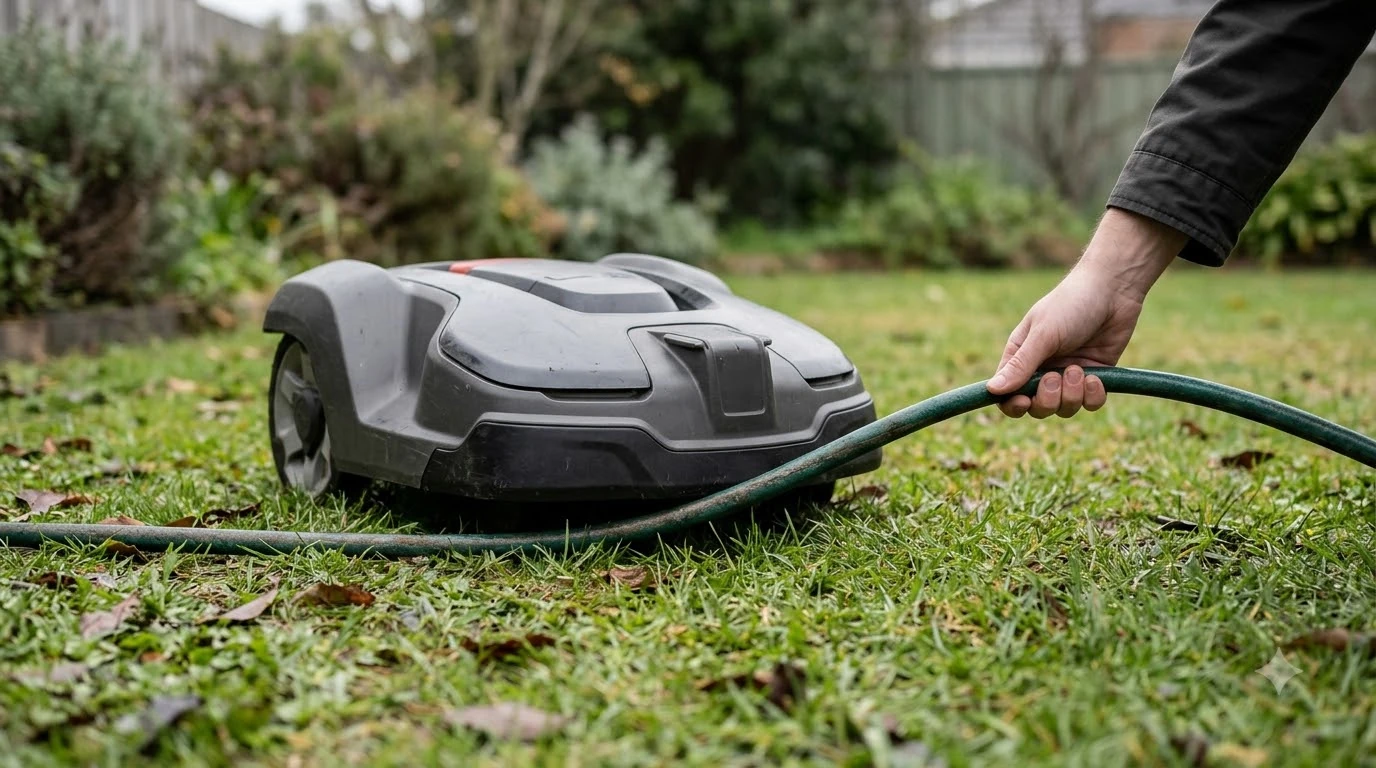

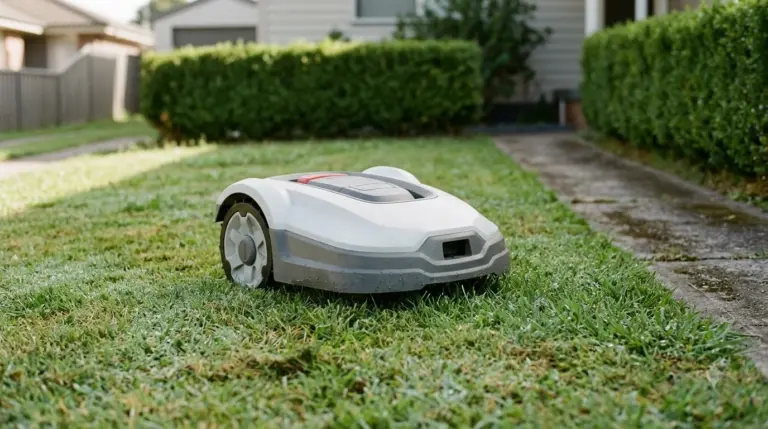
A robot mower garden hose guard keeps a hose out of a robot mower’s path, so the mower does not drag, stall on, or cut the hose. We did not find a dedicated hose guard product on any page we read, so the options below are practical setups built from the mower’s own features and general maintenance advice, not tested products.
The short answer
- Route the hose away from the mower’s zone: the most reliable step is to keep the hose off the lawn the mower covers.
- Use the mower’s keep-out features: mark the hose area as a no-go zone in the app, if your model supports it.
- Use the boundary wire: a wire loop around a fixed hose spot can keep the mower out, but it must be installed carefully.
- Check the hose after each run: look for kinks, cuts, or pulled fittings before you rinse or water.
Why a hose is a problem for a robot mower
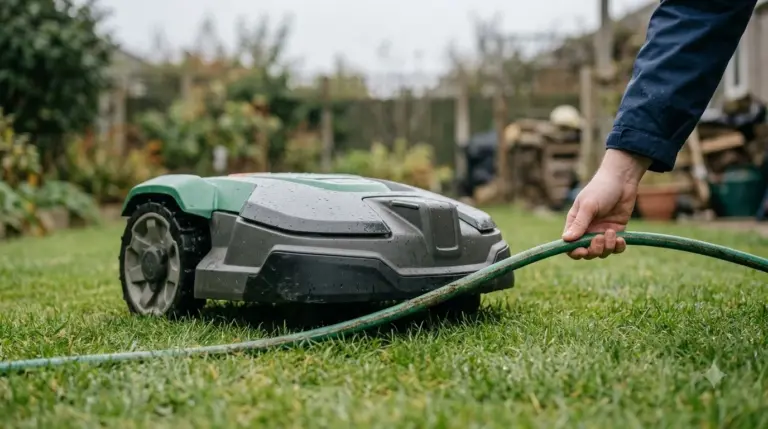
A hose lying across the lawn is a hazard for two reasons. It can wrap or stall the drive wheels, and the blades can nick or cut it if the mower runs over it. Husqvarna’s installation guidance also warns that debris and sharp objects can eventually break the boundary wire, which is the same kind of damage a hose can suffer. Keeping the hose clear of the mower’s path protects both. The simplest fix is storage, and a hose reel that keeps hoses tidy removes the hazard.
A robot mower garden hose guard starts with routing
The simplest approach is to avoid the problem. Run the hose along a bed edge, a fence line, or a hard path that sits outside the mower’s zone, and keep the reel or nozzle off the grass the mower covers. Our reading is that this works better than any guard, because a guard still needs the hose to be in a fixed spot every time.
When you move the hose, unroll it fully and check the length before you turn on the water. A hose that is bunched or half-coiled on the lawn is the most likely to catch the mower.
Do not rely on the mower’s sensors to spot a hose
It is tempting to assume the mower will simply stop for a hose. The Gardenia Organic article we read describes ultrasonic sensors that detect an obstacle, then stop, reverse, and change direction, treating objects within about 15 cm as hazards. It also notes that poor sensor mounting can make the mower misread objects. The article does not say whether low, thin objects such as a hose lying flat on the grass are reliably detected, so we cannot confirm that a hose will always be seen in time. Sensors will not reliably detect a hose, so virtual fence markers for hose areas can mark the zone instead.
Our reading is that a hose should be kept out of the zone by layout, not by trust in the sensors. Treat sensor stops as a backup, and use routing and keep-out zones as the main protection.
Use no-go zones in the app
Many robot mowers let you mark areas the mower should not enter. Check your model’s app for keep-out or exclusion zones, and mark the strip where the hose normally lies. This is a software fix, so it does not depend on the hose being in the same spot each time, but it does depend on the map being accurate. Re-check the zone after you change beds, paths, or the hose route.
Note that the mower needs a sound boundary and map to respect the zone. Anker’s maintenance guidance also notes that boundary wire can be damaged by “gardening tools, pets, wildlife, or ground movement,” so a hose that is dragged across the wire can cause a break. Keep the hose clear of the wire line itself.
Physical barriers and boundary wire
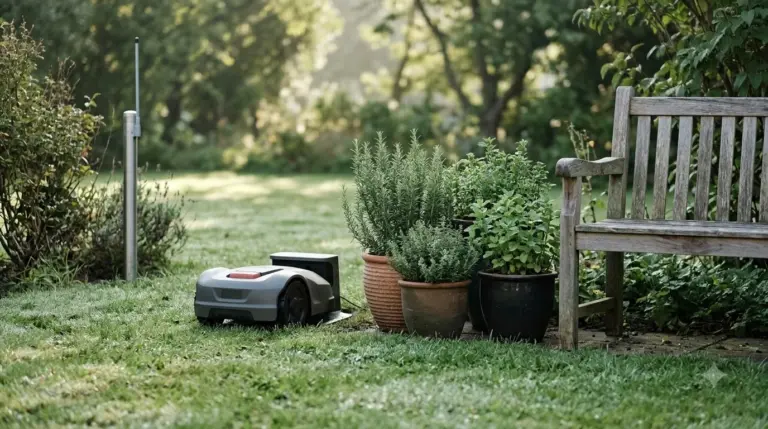
A physical barrier, such as a short edging strip or a planter, can keep a hose in one place. Place it outside the zone the mower can reach, not on the mowing path, or it will simply become another obstacle the mower meets. If you use the boundary wire to hold the mower back from a hose area, follow the same installation care you would use for any wire: stake it down, avoid sharp bends, and mow before you lay it, since long grass can lift and damage the wire, according to Husqvarna. Barriers come in many forms, and pet and garden fencing options are compared in a separate guide. Using wire to exclude a zone needs adequate cable, so boundary wire for fenced-off areas is worth reading about.
Protect the mower when you water
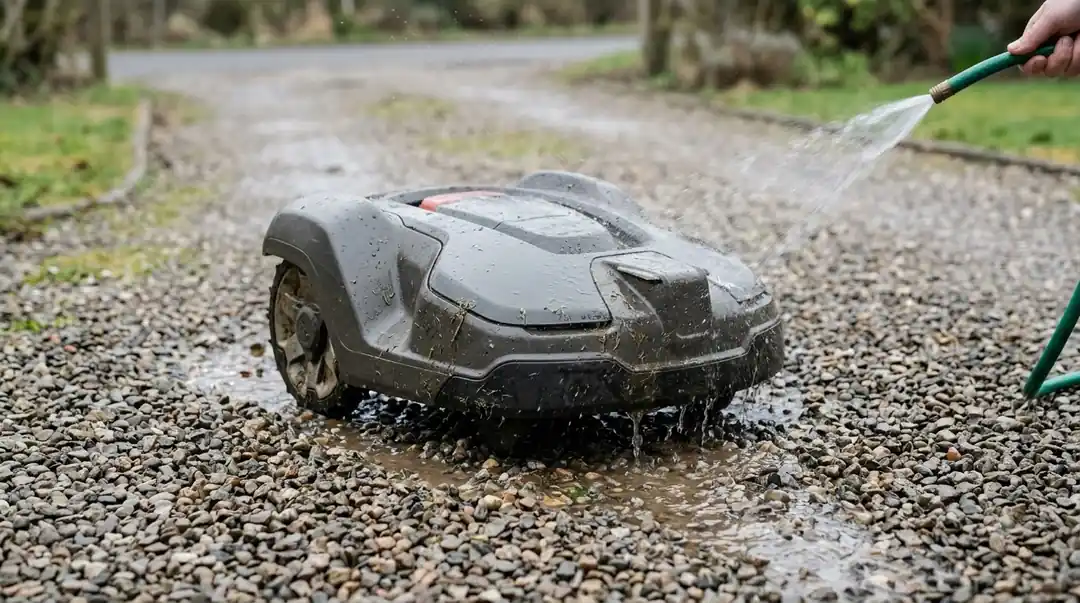
Watering and rinsing have their own rules. Anker’s guidance says a gentle rinse is acceptable only “if the manufacturer specifically allows it,” and it warns against pressure washers, which can damage seals, electronics, and moving parts. Keep water off the cameras, sensors, charging contacts, and ports. If you water the lawn near the mower’s dock, shut the mower off or park it first. Watering schedules can be coordinated with mowing using sprinkler controllers that sync with the mower.
A quick check routine
- Before watering. Confirm the mower is docked or paused and the hose is in its planned route.
- After each run. Look for kinks, cuts, or a pulled fitting on the hose.
- After a bad storm. Check the boundary wire for damage near where the hose lies.
- Each season. Re-check the keep-out zone and the wire path, since beds and hose routes change.
Related reads: A quick check routine can also cover guarding trees and similar obstacles in the same pass.
Frequently asked questions
Is there a garden hose guard for robot mowers?
We did not find a dedicated hose guard product on the pages we read. The practical options are routing the hose away from the mowing zone, using a no-go zone in the app, or a physical barrier placed outside the mower’s reach.
Can a robot mower run over a hose?
It can, and a hose left on the lawn is at risk of catching the wheels or being cut by the blades. Keep the hose off the mowing zone whenever possible, and check it after each run.
Can I rinse my robot mower with the hose?
Only if the manufacturer allows it. Anker’s guidance says a gentle rinse is acceptable in many cases, but mowers should be kept away from high-pressure water and sensors. Check the user manual before you use water.
Will a hose damage the boundary wire?
It can, if the hose drags across the wire or is pulled over the staked line. Anker lists boundary wire damage from gardening tools and ground movement, so keep the hose clear of the wire path and inspect it after heavy use.
Sources
- Tips to prevent wire break in an Automower installation (Husqvarna): mow before stapling, clear sharp objects, avoid sharp bends, inspect the wire.
- Can robot mowers cut around trees? (Gardenia Organic): ultrasonic sensor behavior, 15 cm hazard range, sensor mounting.
- Robotic lawn mower maintenance (Anker, formerly Eufy): rinsing rules, pressure washer warning, boundary wire damage from gardening tools.
 Up next8 min readGearBest Garden Hose Reel to Keep Away From Robot MowerUpdated Nov 13, 2026
 9 min readGearBest Garden Hose Sprayer to Clean Robot Mower: What Brands AllowUpdated Nov 13, 2026
 6 min readGearRobot Mower Tree Root Guard: Protecting Exposed Roots and Tree BasesUpdated Nov 20, 2026
 7 min readGearBest Replacement Cutting Disc Guard for Rocky Lawns: Materials, Fit, and CareUpdated Nov 19, 2026
 8 min readGearBest Path Pavers for Robot Mower Gravel CrossingUpdated Nov 11, 2026
 8 min readGearBest Flush Stepping Stones for a Robot Mower PathUpdated Nov 11, 2026