
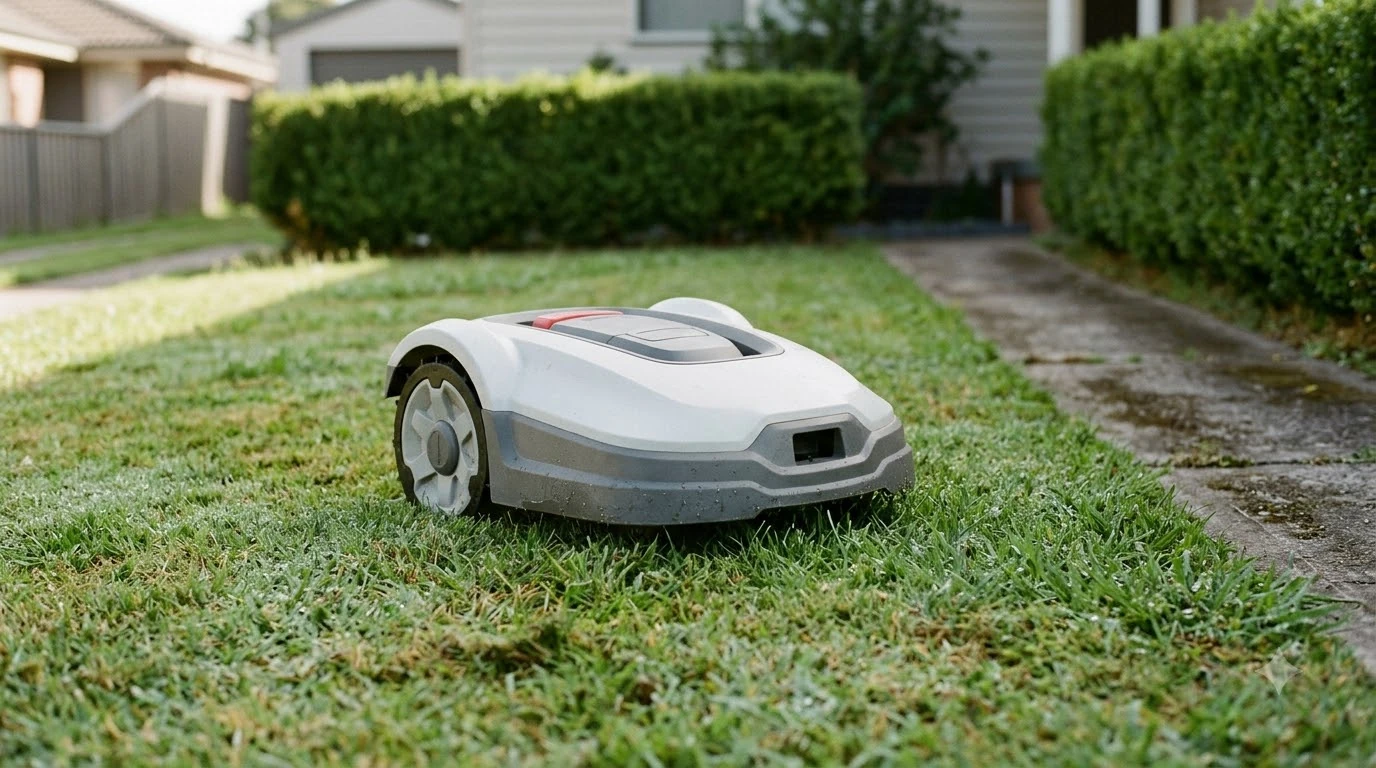

The best flush stepping stones for robot mower path are solid slabs that sit level with the lawn, with a crossing at least about 1 meter wide. Robomow’s guide says stones should be level with the ground surface and that a passage between zones should be at least one meter wide. Loose gravel is the weak point: the same guide warns of a high risk that a loose stone gets caught in the running mower and damages the blades. Wire-free models also need the crossing mapped in the app.
The short answer
- Surface: the best flush stepping stones for robot mower path are solid stone slabs, paving or concrete. Robomow says solid slabs are what the robot can safely cross.
- Height: stones level with the lawn. Robomow says the height difference between the lawn edge and the pavement should be identical; if not, backfill with soil so the mower can climb onto the stones.
- Width: at least 1 m for a passage between zones (Robomow). Anker gives 80 to 100 cm as a starting point for many gardens, and says to check the manufacturer’s minimum passage width.
- Wire-free mowers: map the crossing as a passage in the app. Worx Vision uses one RFID tag on each side of the path.
- Gaps: none of the pages we read gives a gap width, so check your model’s manual before you set spacing.
Why the passage needs a flat, level surface
A flat, stable surface is the main requirement for the best flush stepping stones for robot mower path, and manufacturers describe paving as the easiest case for a robot mower to cross.
Anker’s UK guide says flat paving slabs, concrete and asphalt are “usually the most straightforward surfaces” because of their stable base. It also says the transition from grass to hard surface should let the mower “roll onto and off the hard surface.” Robomow’s guide puts it more simply: “paved areas with a flat surface are unproblematic.”
A stepping-stone path is a weaker version of solid paving. Each stone is a small island with grass or soil between, so the stone size, the height match and the gaps all matter more than they do on a continuous slab. Our reading is that a path of separate stones needs more care than a single paved strip, and that the sources give less detail for it than for continuous paving.
Solid stepping stones versus loose gravel
For the best flush stepping stones for robot mower path, solid slabs are the safe choice and loose gravel is the risky one. Our guide to yards with gravel path crossings looks at that case in more detail.
Robomow says individual slabs are a common connection and advises laying “solid stone slabs, which the robot can safely cross.” On gravel, it says driving over the surface is possible “although not always advisable,” and warns of “a high risk of a loose stone getting caught in the running mower and damaging the blades.”
Anker’s guide gives a practical alternative for a loose path. It suggests you “create two flush rows of solid pavers or a narrow bonded-gravel strip for the wheels.” It also says firmly compacted fine gravel is a surface a mower may cross. The wording matters: firm, bonded or fixed surfaces are the ones the guides describe as crossable, and loose stones are the ones they warn about.
Our reading: if your path is loose gravel today, the cheapest fix that the sources support is to lay the two wheel tracks in solid pavers or a bonded strip, and leave the loose middle alone. Test it before you rely on it.
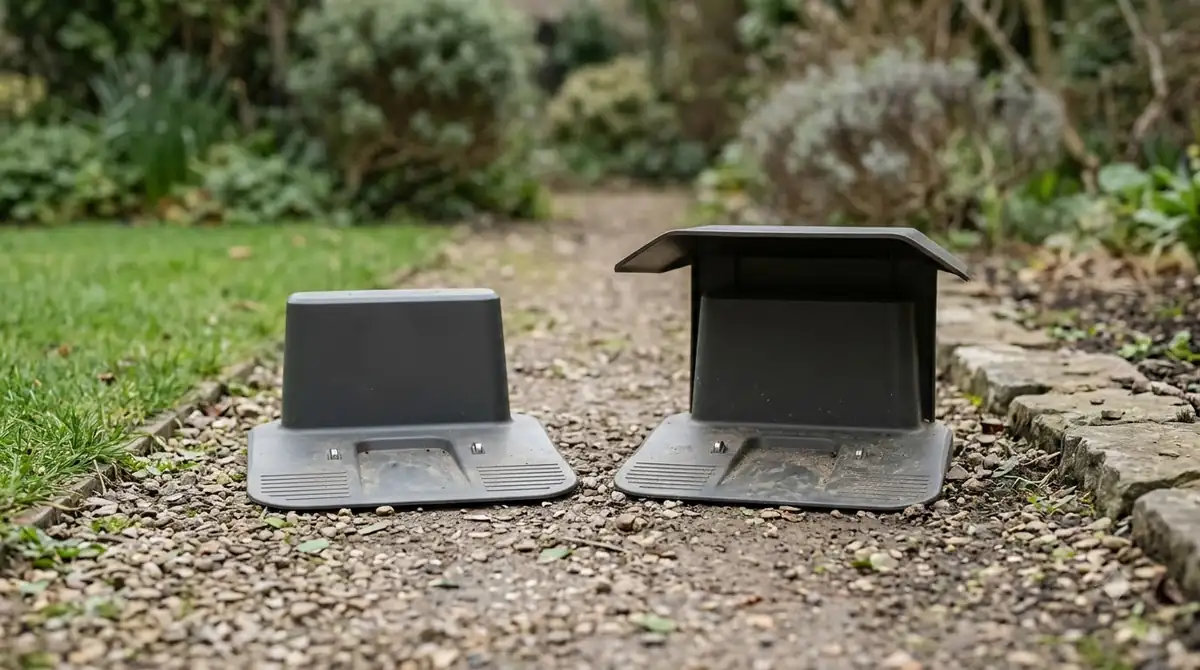
Best flush stepping stones for robot mower path: height and gaps
The stone tops should match the lawn, and the gaps between stones are the part the sources leave open.
Robomow says to “lay the stones so that they are level with the ground surface.” It adds that the difference in height between the lawn edge and the pavement should be identical. If the stones are not level, its suggestion is to backfill with soil so the robot can get over the slope onto the stones.
Worx’s support note for the Vision model says the mower will not cut the area it crosses. For the grass between the stones, Worx suggests using a tool such as a grass trimmer. So the gaps will stay uncut by the robot, and you should plan to trim them by hand. If the stones border a lawn edge, mowing strip pavers for edges solve a related problem.
We recommend checking the gap size in your model’s manual, because none of the pages we read gives a figure for it.
Wire-free mowers: mapping the crossing in the app
A wire-free mower treats the best flush stepping stones for robot mower path as a mapped passage, so the crossing needs setting up in the app, not only laying on the ground. See also how robot mowers deal with narrow paths.
Anker’s guide describes the crossing as a passage, channel or transit route between zones. It advises mapping it as a non-mowing connection and confirming that “the blades remain off while the mower travels over paving.” Its example gives a pathway length of 1 to 60 m, and says the path should be “flat and fully passable.”
Worx Vision’s support page is about a stepping-stone path specifically. To guide the mower across, place one RFID tag on each side of the path. Worx notes that the mower will not cut the area it crosses.
Anker says to run a supervised test in both directions. Watch the wheels, the body and the cutting deck, and stop if the mower “scrapes, slips or repeatedly recalculates.” It also says a mower must be able to find its charging station from every connected zone, not only reach the far lawn.
Wire-based mowers: where the wire goes
On wire systems, the boundary wire is laid in the joints or under the stones, not on top of them. If you are new to wire, start with installing a boundary wire and the question of whether to bury or peg the wire.
Robomow advises placing “the perimeter wire marking the passage in the joints or under the cobble stones.” It also suggests a “small loop on each side of the entrances” to narrow the passage, so the robot does not mow the crossing itself. Our reading is that this advice applies only to wire-based mowers. A wire-free mower does not use this method, and the app mapping above replaces it.
What the sources do not tell you
The sources do not give a stone gap width, a step height limit or a slope limit for stepping stones.
We found no manufacturer figure for the maximum height step a mower can climb onto a stone, and no gap size that the robot can cross safely. Husqvarna’s general page on how robotic mowers work does not mention paths or stepping stones, so we did not use it for this guide. For limits on the best flush stepping stones for robot mower path with your model, the manual or support page for your mower is the only reliable source.
- Pick solid stones. Use slabs, paving or concrete. Avoid loose stones.
- Level them. Set the tops level with the lawn, or backfill with soil if they sit higher.
- Check the width. Aim for at least 1 m, and check the manufacturer’s minimum.
- Map or wire it. Map the crossing in the app for wire-free models, or place the wire in the joints for wire systems.
- Test both ways. Run a supervised pass in each direction, and stop if the mower scrapes, slips or keeps recalculating.
Frequently asked questions
Can a robot mower drive over stepping stones?
Robomow’s guide says solid stone slabs can be crossed safely, provided they are level with the lawn. Loose gravel is possible but “not always advisable.” Check your model’s manual before you rely on a crossing.
Should stepping stones sit above or below the grass?
Robomow says to lay the stones level with the ground surface. If they are not level, it suggests backfilling with soil so the robot can climb onto the stones.
How wide should a robot mower path be?
Robomow says a passage between zones should be at least one meter wide. Anker gives 80 to 100 cm as a starting point for many gardens, and advises checking the manufacturer’s minimum passage width.
Do wire-free mowers need anything special for a path?
Anker’s guide says to map the crossing as a passage in the app and confirm the blades stay off over paving. Worx Vision uses one RFID tag on each side of a stepping-stone path to guide the mower across.
Sources
- Can a robotic lawnmower cross paths? (Robomow): stone levels, solid slabs, gravel risk, 1 m passage, wire placement in joints.
- Robot lawn mower cross path guide (Anker UK): gravel strips, 80 to 100 cm starting width, app mapping, supervised test.
- Mower will not cross a stepping stone path (Worx support): RFID tag on each side, no cutting over the crossed area, trimmer for grass between stones.
 Up next8 min readGearBest Path Pavers for Robot Mower Gravel CrossingUpdated Nov 11, 2026
 6 min readGearRobot Mower Garden Hose Guard: Keeping a Hose Out of the Mower PathUpdated Nov 13, 2026
 10 min readGearBest Garage for Mammotion YUKA: Fit, Roof and Drainage ChecksUpdated Nov 14, 2026
 7 min readGearHow Long Do Robot Mower Blades Last? Brand Intervals ExplainedUpdated Nov 19, 2026
 8 min readGearBest Pet Waste Scooper for Robot Mower Yards: What to CheckUpdated Nov 14, 2026
 7 min readGearMammotion Yuka Replacement Battery: What to Check Before You BuyUpdated Nov 11, 2026