
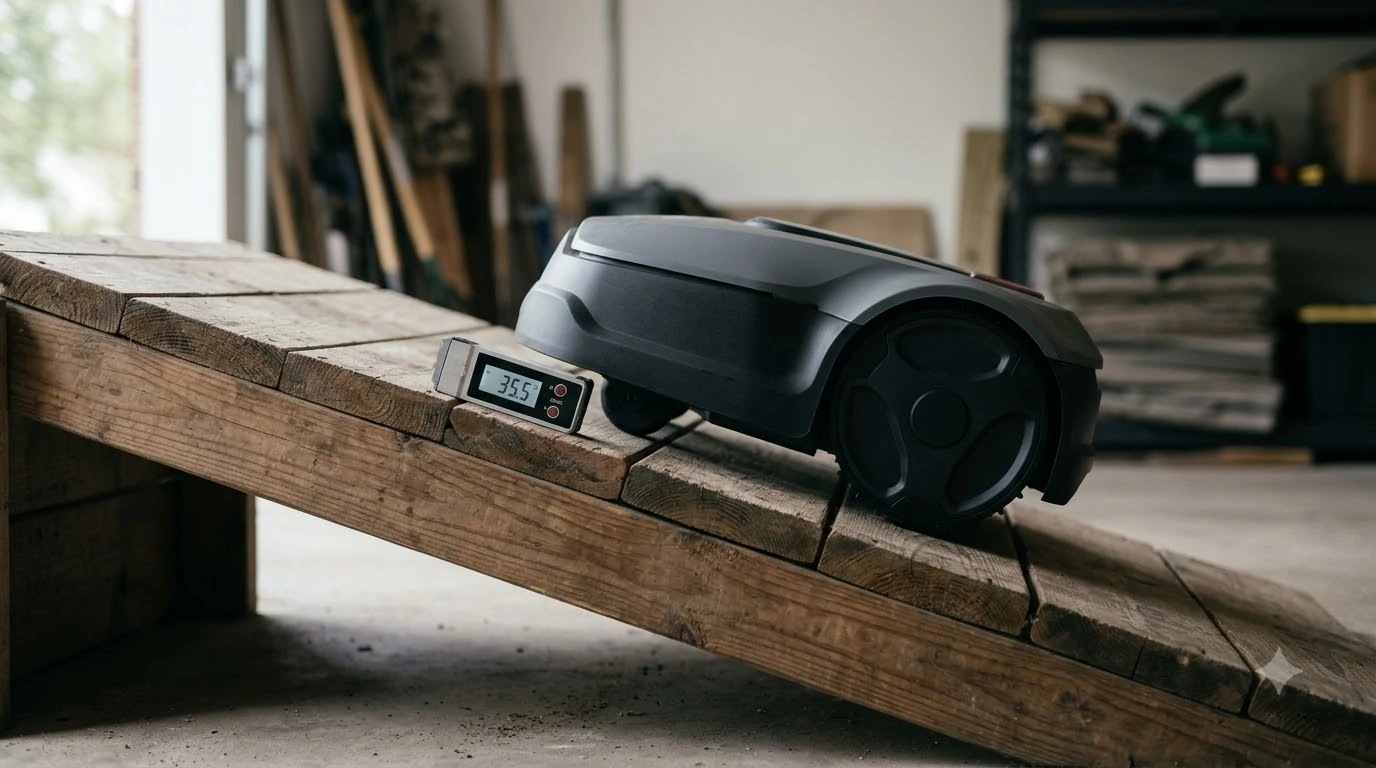

Are robot mowers dangerous? Not for most adults when the safety features work, but they do carry documented risks for hedgehogs and other small animals. Manufacturer sources say many models stop their blades when lifted or tipped, and a 2021 Swiss study rated 11 of 18 tested mowers as high risk for hedgehogs. The model you own and the schedule you run it on decide most of the risk.
The short answer
- For adults: the sources we read describe pivoting blades (Husqvarna) and lift sensors (manufacturer claims), and none reported independent injury counts for robot mowers.
- For hedgehogs: a 2021 Swiss Animal Protection study found 11 of 18 mowers posed a high risk, with young animals most exposed.
- For pets: sensors may miss small animals in long grass or in the dark.
- Lift stop: many models stop the blades when lifted or tipped, but not all do. Check your manual.
- Schedule: the Swiss study recommends daytime running with supervision, and Husqvarna offers a Wildlife Consideration setting that stops movement from dusk to dawn.
Do robot mowers stop their blades when lifted?
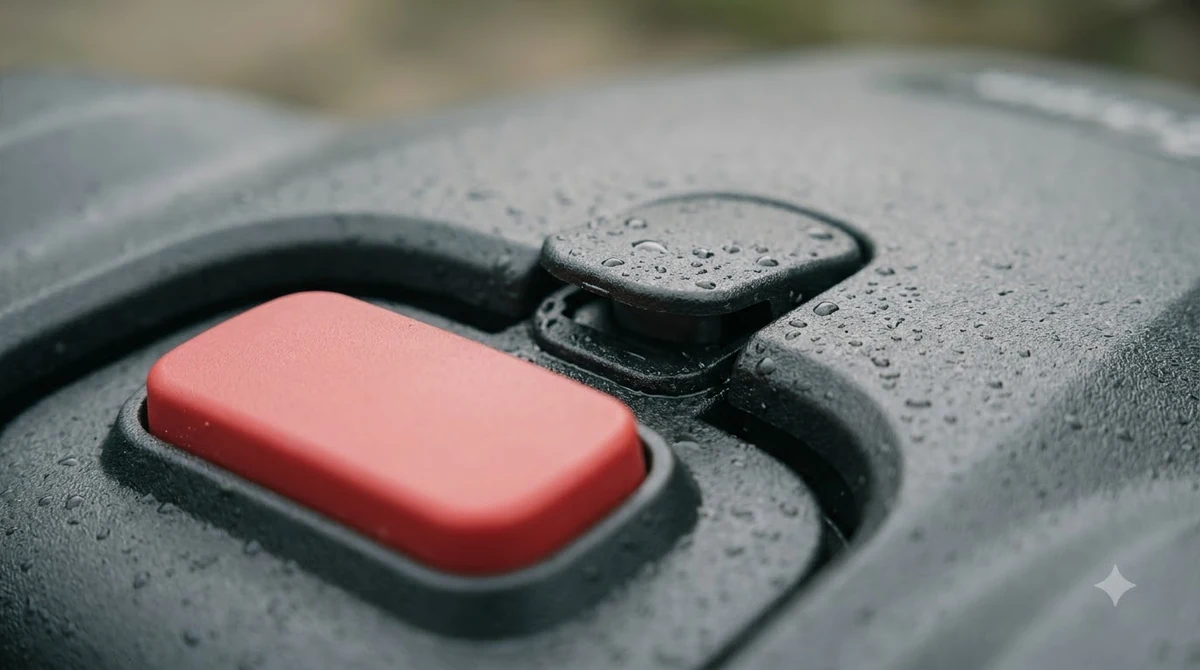
Many robot mowers stop their blades when someone lifts or tips them, and this is the feature most often cited as the main safeguard. Anker and eufy say many models “automatically stop the blades the moment the mower is lifted or tips over,” and add that this applies to many models, not all. Husqvarna describes its blades as pivoting, with most models also fitted with skid plates, front-wheel drive, or both.
The lift stop is a sensor function, so it depends on the specific model. Husqvarna’s commercial rep, quoted by the National Association of Landscape Professionals, describes sensors that “immediately turn off blades from spinning if the mower is lifted or turned over.” Husqvarna’s own consumer Q&A page does not explain how the blades behave when the mower is lifted or tipped, so the manual for your model is the place to confirm it.
Our reading is that a lift stop protects a person who reaches under a running mower, but it does not protect an animal that the mower bumps and pushes. That gap is the reason the wildlife data below matters more than the lift claim.
Are robot mowers dangerous to hedgehogs?
Hedgehogs are the clearest case of documented harm. A Swiss Animal Protection study tested 18 robot mowers and rated 11 of them as high risk for hedgehogs, roughly 61 percent of the models. The study reported that young hedgehogs are at particular risk, and that the blades can injure an animal’s feet when the mower nudges it.
The same study found that some mowers do not stop quickly enough to avoid a hedgehog that has curled into a ball, which is the defensive posture hedgehogs use. The article reporting the study recommends running mowers during the day and supervising them.
| Risk point | What the sources say | Source |
|---|---|---|
| Model rating | 11 of 18 mowers rated high risk | Swiss Animal Protection study, reported July 2021 |
| Who is hurt most | Young hedgehogs | Same study |
| Injury type | Blades can cut feet when the mower nudges the animal | Same study |
| Stopping | Some mowers do not stop in time for a curled hedgehog | Same study |
| Start-up delay | Husqvarna mower drives away for 5 seconds before blades start, giving sheltering animals time to leave | Husqvarna Q&A |
| Quiet hours | Husqvarna wildlife mode stops movement from dusk to dawn, set in the app | Husqvarna Q&A |
Two design points in the table matter. The 5-second delay gives an animal sheltering under the body a chance to leave before the blades start. The dusk-to-dawn quiet period keeps the mower still during the hours when wildlife is out. Neither feature is standard across every brand, so check whether your mower offers them.
Pets and small animals sensors can miss
Are robot mowers dangerous to dogs and cats? Obstacle detection is the second layer of protection, and the sources describe it as imperfect (see how robot mowers avoid obstacles for the sensor types). Basic models rely on bump sensors, while more advanced models use cameras, ultrasonic sensors, or AI object recognition, according to eufy’s description of its own range.
Anker and eufy also warn that “even modern obstacle detection systems may not spot every small animal in long grass or dark conditions.” That is a manufacturer statement, but it matches the hedgehog findings: the risk is highest for low, small, and still animals. Pets resting on the lawn are listed among the obstacles the mower can avoid, but the same page admits the limits above.
For a dog or cat, the practical step is to keep the lawn clear while the mower runs and to trim tall grass before a run. Household rules for children and animals are covered in our guide to robot mower safety for kids and pets. Our reading is that a camera-based model reduces this risk more than a bump-only model, but no source we read quantifies the difference.
Slopes, tilt, and the limits on each model
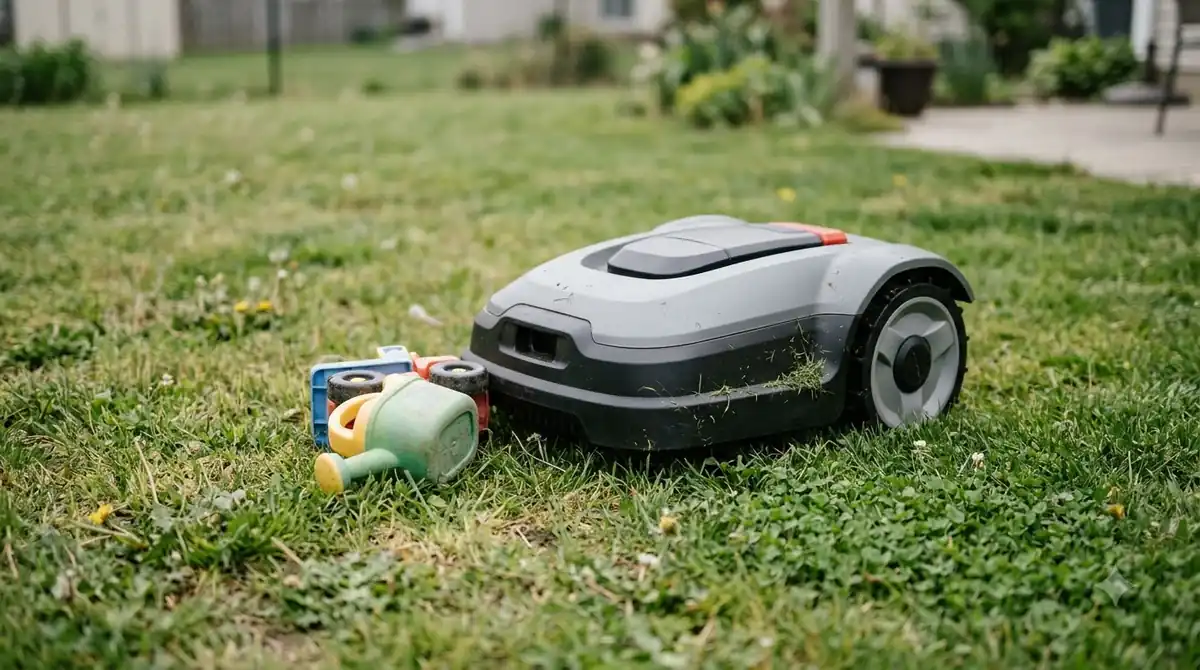
Are robot mowers dangerous on slopes? A robot mower can tip over on a slope, and tipping is the situation where the lift stop is most important. Slope ratings are model-specific, so it helps to know how robot mower slope ratings work before comparing numbers. Anker and eufy list a maximum slope of 18 degrees for two of their models, the E15 and E18, and do not give a figure for other models.
Do not assume the slope limit of one brand applies to another. Read the maximum slope in the spec sheet for your model, and measure the steepest part of the lawn with a digital angle tool before you run the mower there. If the lawn is steeper than the rating, the safer option is to mow that section by hand or fence it off.
What the safety standard covers
The main international reference is IEC 60335-2-107:2017, the second edition published on 15 December 2017 by the International Electrotechnical Commission. The standard sets safety requirements for battery-powered robotic rotary lawnmowers whose battery is rated at no more than 75 V DC, and it also covers mains-powered charging stations and signal sources for perimeter delimiters.
The standard states that it deals with all significant hazards presented by these machines, both in intended use and under reasonably foreseeable misuse. It excludes electromagnetic compatibility, though it does cover noise. Anker and eufy also cite BS EN 50636-2-107 as the UK and European standard for robotic lawn mowers.
- What it covers: the design and construction of robotic lawn mowers, including hazards to people and animals in normal use.
- What it does not cover: EMC, and machines outside its scope, which is limited to battery robotic rotary mowers rated up to 75 V DC.
- Our reading: a standard sets a minimum. It lowers the risk, but it does not remove the wildlife or slope risks described above.
Commercial mowers and injury data
The commercial side of the market is covered by a trade article from the National Association of Landscape Professionals, published 24 January 2024. The article contains no injury, incident, or accident statistics, and its safety claims come from vendors. It cites no independent testing.
Some commercial vendors describe detection zones. Zapt’s Nomad protocol, as the article reports it, stops the cutting deck when a person or animal is within 5 meters (about 15 feet), and shuts the whole unit down within 3 meters (about 10 feet). These are vendor claims, not independent test results. The Husqvarna representative quoted in the article recommends posting signs in public areas where a robot mower is working.
For a home lawn, the same logic applies: post a sign or use a PIN-protected start (a PIN also doubles as robot mower theft protection) when neighbors or visitors may cross the lawn while the mower runs.
What to check before you buy
Most of the risk in the sources depends on features you can check on a spec sheet or in the manual before purchase. Use this list as a starting point.
| Check | Why it matters | Where to look |
|---|---|---|
| Lift and tilt stop | Stops the blades when the mower is lifted or tipped, if the model has it | Manual, safety section |
| Blade design | Husqvarna describes pivoting blades, with skid plates on most models | Product page or manual |
| Sensor type | Bump-only sensors react after contact; camera or AI detection can react earlier | Spec sheet |
| Maximum slope | Sets the steepest part of the lawn the mower can handle | Spec sheet |
| PIN or app lock | Stops accidental starts by children or others | Manual or app |
| Wildlife or quiet mode | Stops movement from dusk to dawn to protect wildlife | App settings |
| Standard label | Shows the model was built to the named safety standard | Packaging or manual |
Once the mower is running, watch its first few cycles, check the sensor area for grass and debris, and keep the lawn clear of toys and garden tools. So are robot mowers dangerous? For most adults the evidence points to a low and manageable risk, while small wildlife and pets in long grass carry the clearest documented risk, so the model and the schedule you choose matter.
Frequently asked questions
Are robot mowers dangerous for adults?
The manufacturer sources we read describe lift sensors and pivoting blades, and they say many models stop the blades when lifted or tipped. None of the sources reported independent injury counts for robot mowers, so the evidence for adults is mostly design claims rather than measured injury rates.
Can a robot mower hurt a hedgehog?
Yes, according to a 2021 Swiss Animal Protection study. It tested 18 robot mowers and rated 11 as high risk, with young hedgehogs most exposed. Blades can cut feet when a mower nudges an animal, and some mowers do not stop in time for a curled hedgehog.
Do robot mowers stop for a child?
The lift stop and PIN lock can help, but none of the pages we read guarantee that a mower will detect a child in every situation. Keep children indoors or behind a barrier while the mower runs, and check the model’s manual for the lift behaviour.
Should I run a robot mower at night?
The Swiss study recommends running mowers in the daytime and supervising them. Husqvarna offers a Wildlife Consideration setting that stops movement from dusk to dawn. If your garden attracts hedgehogs, a daytime schedule is the simpler choice.
Sources
- IEC 60335-2-107:2017 publication page (IEC): scope, edition date, hazards covered, EMC exclusion.
- Questions and answers about robotic mower safety (Husqvarna): pivoting blades, 5-second start delay, wildlife dusk-to-dawn mode.
- Robot mowers harmful to hedgehogs, according to study (LE News, reporting a Swiss Animal Protection study): 11 of 18 mowers rated high risk, injury details.
- Are robot lawn mowers safe? (Anker/eufy, manufacturer): lift stop claim, 18-degree slope on two models, sensor limits, BS EN 50636-2-107 reference.
- Are Commercial Autonomous Mowers Safe? (NALP, The Edge, 24 January 2024): vendor claims, detection zones, absence of injury statistics.
 Up next10 min readLearnAre Robot Mowers Worth It for Seniors? 5 Simple ChecksUpdated Nov 11, 2026
 8 min readLearnAre Robot Mowers Worth It for Large Yards?Updated Nov 11, 2026
 9 min readLearnAre Robot Mowers Tax Deductible for Rental Property?Updated Nov 11, 2026
 8 min readLearnAre Robot Mowers Expensive to Repair? What to ExpectUpdated Nov 11, 2026
 7 min readLearnAre Robot Mowers Safe at Night for Wildlife?Updated Nov 11, 2026
 7 min readLearnWhat Is NTRIP for Robot Mowers?Updated Nov 11, 2026