

Do robot mowers stop for animals? Not reliably. In a 2021 study of 18 models, every mower had to touch a dead hedgehog before it detected the animal, and none avoided contact with cameras or ultrasonic sensors. A 2023 follow-up of 19 models found the same contact-first pattern, so the practical protection is a daylight run and a lawn check.
The short answer
- Detection: the tested mowers found hedgehogs by touching them, not by seeing them first.
- Smallest animals: no tested model detected juvenile hedgehogs under 200 g.
- Injury risk: in a 2023 follow-up of 19 models, some mowers injured the carcasses and others pushed them aside unharmed.
- Daylight only: researchers at the University of Oxford and the 2023 study both advise running robot mowers in daylight, because hedgehogs are mainly nocturnal.
- Before each run: check the lawn for wildlife, and confirm in your manual how the blades behave when the mower is lifted.
How do robot mowers detect animals?
A robot mower finds obstacles with the sensors built into its body. The 2021 study tested 18 robot lawn mower models against dead European hedgehogs, and it included models fitted with cameras and ultrasonic sensors. Those sensors did not change the core result: the mowers only registered an animal when they physically touched it. Our reading: a bumper or contact sensor is a last-moment trigger, and it was the one that did the detecting in these tests.
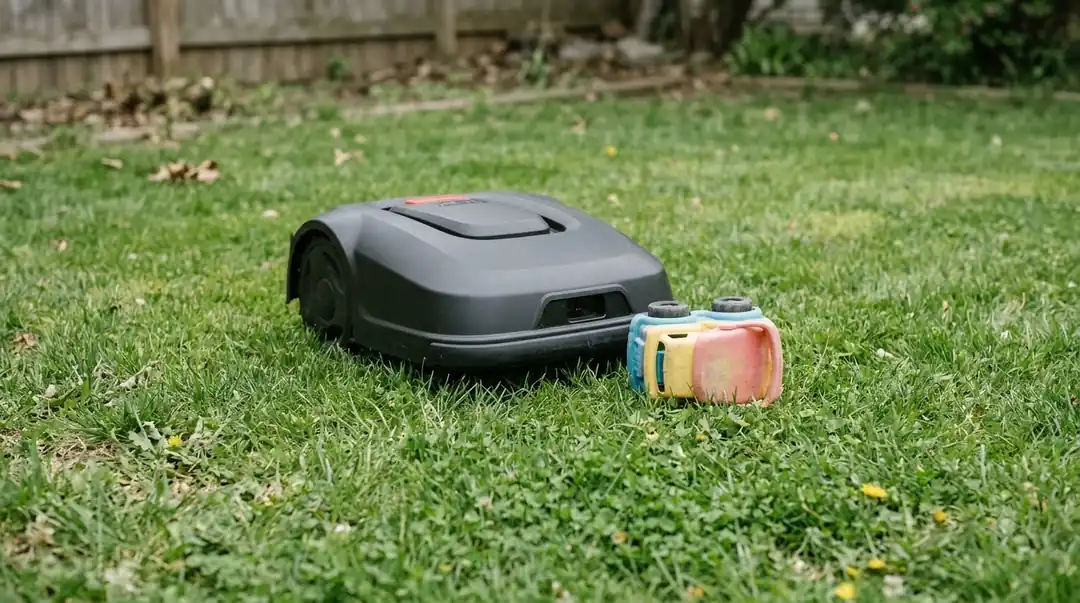
The 2021 method was simple to follow. Each mower was run 12 times against a dead hedgehog, giving 216 daylight tests that were filmed. The cadavers came in four weight classes and were placed in three positions, and each result was scored against six damage categories.
This matters because a bump-based or contact-based system reacts after the mower has already reached the animal. A camera or ultrasonic system is designed to see the animal earlier, but the study found that none of the tested models detected a hedgehog early enough to avoid contact. For readers who want the sensor basics first, there is a separate guide to how robot mowers avoid obstacles and a closer look at how vision robot mowers work.
Our reading: a sensor type on the spec sheet tells you what the machine can try to do, not what it will do with a small animal in tall grass. That is why the honest answer to “do robot mowers stop for animals?” in this test was: only after contact.
Do robot mowers stop for animals before touching them?
In the 2021 study, detection and avoidance were the weak points, and the authors’ wording is direct: all models had to touch the hedgehogs to detect them. The table below summarises what the study found for each part of the test.
| Test point | What the study found |
|---|---|
| Detection method | All models had to touch the hedgehog to detect it |
| Cameras and ultrasonic sensors | No model detected a hedgehog early enough to avoid contact |
| Juvenile hedgehogs under 200 g | None of the mowers detected them |
| Test material | Dead animals, from rehabilitation centres in Denmark; no live animals were used in this study |
The gap for small animals is the most concerning result. In the study’s own description, a mower can drive over a small juvenile without detecting it, because the body sits below the blades and shows no visible injury. The authors add that in a live animal this could still cause injury or bruising, perhaps from the wheels rather than the blades. The study tested cadavers, so it cannot show how a living animal would move or react in the path of a mower.
Which animals are most at risk?
Small wild animals that live in or near grass are the best-studied case, and European hedgehogs are the main example. The 2023 follow-up tested 19 models against dead juvenile hedgehogs weighing 250 to 600 grams, and it scored the damage on a 0 to 4 scale, where 4 meant the carcass was injured by the blades.
- Size matters: larger carcasses were less likely to be injured, and height was the most influential size measure.
- Some models did better: four models had no or extremely few injuries in that test, including the Gardena Sileno Life, Husqvarna Automower 450X, LandXcape LX812i and STIHL iMOW 7.
- Injuries reach rehabilitation centres: the Oxford team says hedgehog rehabilitation centres report a significant increase in injuries caused by robotic mowers.
The 2023 authors also reported which factors did not change the result. Carcass firmness (frozen or thawed), the position of the carcass and the selected technical features of the mowers did not affect the probability of injury. Apart from one single incidence, every mower still had to touch the carcass to detect it.
A few models avoiding injury in one lab test is not a safety certificate. The same study notes that its results come from dead animals, and the proposed standard has not yet been adopted. Treat any mower as a possible risk to wildlife, whatever its spec sheet says.
Do robot mowers stop for animals other than hedgehogs? The studies cited here do not cover other species, so the hedgehog results are the best available guide, not a rule for every animal. For household rules around dogs, cats and children, see our separate guide on robot mower safety for kids and pets.
What owners can do before a robot mower runs
Daylight running and a lawn check before every start are the two steps that the study authors and the Oxford team both recommend. Neither depends on the sensor specification, so they work on any model. The steps below turn that advice into a routine you can repeat before each run.
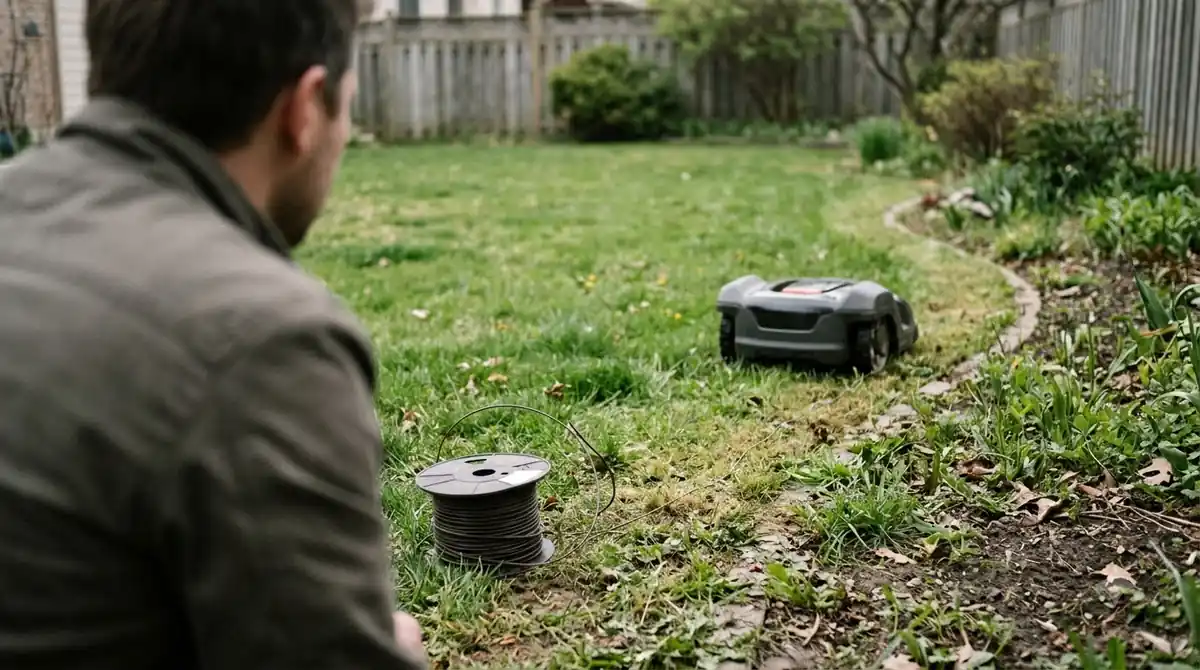
- Walk the lawn first. Look for hedgehogs and other vulnerable wildlife in tall grass, under shrubs and along the edges, then clear the area before you start the mower.
- Schedule daytime runs. The Oxford team advises running these machines only during daylight hours, since hedgehogs are mainly nocturnal. Our guide to the best time of day to run a robot mower covers the lawn side of that choice.
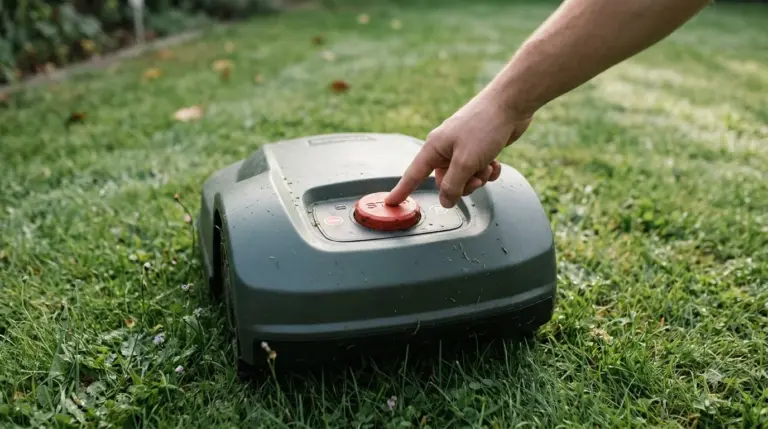
- Find the STOP control. Look in your manual for where it is and what it does, so you can halt the mower at once if you see an animal.
- Check the manual for lift behaviour. Confirm whether your model stops its blades when it is lifted or tilted. The studies on this page did not test that behaviour, so this guide does not confirm it. Our explainer on why robot mowers can be dangerous looks at blade-stop claims in more detail.
- Watch the first pass after changes. A new boundary, a remapped yard or a software update can change where the mower goes, so observe it once before you leave it to run alone.
The Oxford live-animal trials add a useful detail for owners. The team tested 50 live hedgehogs, each twice, with a disarmed, bladeless mower that stopped 50 cm away. The animals fled, stood rigid with a partly curled body, or sniffed the mower, and younger hedgehogs were bolder than adults. On a second encounter the animals tended to act more shy. Our reading: a live animal can move or freeze in ways that a dead test animal cannot, so a lawn check is still needed even when the mower has run safely before.
Heads up
Our reading: daylight running lowers the risk to nocturnal wildlife, but it does not stop a mower from reaching an animal that is resting in long grass. So do robot mowers stop for animals that stay still? Not reliably, and the lawn check is the step that matters most.
What researchers want next
The researchers want better sensors, camera-based detection and blades that fold away when they hit something harder than grass. Dr Sophie Lund Rasmussen of the Oxford team says that in the worst case a mower ran straight over a dead hedgehog with the blades still running, which is the kind of result a standard test should prevent.
The team has proposed a test with soft hedgehog crash-test dummies. Under the 2023 proposal, a model that shows only categories 0 to 2 could be labelled hedgehog-safe, and any category 4 result would fail. The study says the protocol still needs validation and has not yet been adopted into the CENELEC standard. Until a labelled test exists, the answer to “do robot mowers stop for animals?” depends on the model and the lawn.
Frequently asked questions
Do robot mowers stop for hedgehogs?
Not reliably. In the 2021 study of 18 models, every mower had to touch a hedgehog before it detected the animal, and the mowers did not detect juveniles under 200 grams. Check the lawn before each run.
Are robot mowers safe for dogs?
The studies cited here tested dead and live hedgehogs, not dogs. They do not show whether any model reacts to a dog in time. The practical rule is supervision, a lawn check and keeping pets out of the area while the mower runs.
Should I run my robot mower at night?
The Oxford team and the 2023 study both advise daylight running only, because hedgehogs are mainly nocturnal. Night running adds risk for small animals that are active after dark, and the studies cited here tested mowers in daylight only.
Do robot mowers stop their blades when lifted?
The studies cited here did not test this behaviour, so this guide cannot confirm it for any model. Read the safety section of your manual and test the stop behaviour under supervision before you rely on it.
Sources
- Wildlife Conservation at a Garden Level: The Effect of Robotic Lawn Mowers on European Hedgehogs (peer-reviewed study, Animals journal): 18 models, detection by contact, juveniles under 200 g not detected.
- Testing the Impact of Robotic Lawn Mowers on European Hedgehogs and Designing a Safety Test (peer-reviewed study): 19 models, injury categories, daylight advice, proposed labelling test.
- Hedgehog safety test developed for robotic lawnmowers (University of Oxford, Department of Biology): live hedgehog trials, rehabilitation centre reports, owner advice.
 Up next8 min readLearnDo Robot Mowers Have Blade Stop Sensors? What Lift and Tilt Sensors DoUpdated Nov 11, 2026
 7 min readLearnCan a Robot Mower Cut Your Foot? What the Sources SayUpdated Nov 11, 2026
 9 min readLearnRobot Mower Pros and Cons: What Owners Should Weigh Before BuyingUpdated Nov 11, 2026
 8 min readLearnDo Robot Mowers Mulch Grass? Yes, Most DoUpdated Nov 11, 2026
 7 min readLearnWhat Is NTRIP for Robot Mowers?Updated Nov 11, 2026
 9 min readLearnAre Robot Mowers Dangerous?Updated Nov 11, 2026