


A robot mower for a yard with exposed septic cleanout pipes works well as long as you either exclude those risers with no-go zones or boundary islands, or choose a model whose sensors and chassis clearance safely handle low PVC caps. Left unprotected, a protruding pipe stub can either trip bumper-only units or get nicked by spinning razor blades if it sits right at deck height. With a few straightforward yard adjustments and the right navigation setup, automated mowing stays hands-off without risking costly plumbing damage.
The short answer
- Height dictates the risk: Cleanout pipes sticking out by only an inch or two sit right in the danger zone where a mower deck can scrape the cap or high-center the chassis, whereas taller risers trigger bumper or optical sensors cleanly.
- Virtual no-go zones are the cleanest fix: Wire-free RTK and LiDAR mowers let you draw small circular exclusion zones around each cleanout cap in an app in seconds, leaving only a tiny ring to trim occasionally.
- Boundary-wire islands still work reliably: If you use a wired mower, running an out-and-back boundary wire loop around each pipe stops the mower before contact, provided the two parallel feed wires touch so their signals cancel out.
- Bumper-only bots need help on short stubs: Older or entry-level machines without camera or LiDAR detection rely on physical shell collision, which may not register a narrow, low-profile PVC cap before the blades pass over it.
- Never bury or seal over access caps: Local sanitation codes require septic cleanouts and tank inspection ports to stay accessible, so landscaping around them beats cutting pipes below grade without a proper valve box.
Why exposed septic cleanout pipes challenge robot mowers
Most residential septic systems rely on 3-inch or 4-inch PVC cleanout pipes and wider tank access risers that sit right in the middle of the lawn, creating narrow vertical obstacles that behave very differently from trees or fences.
Unlike a wide tree trunk or a solid fence post, a standard 4-inch PVC cleanout stub presents a slim target with a flat cap that often sits flush with or just a few inches above the soil. According to county on-site sewage construction standards such as the Klickitat County Gravity System Construction Manual, building sewer lines commonly use 3-inch or 4-inch PVC with cleanouts placed two feet from the foundation and at intervals along the line to the tank. Because those caps sit directly in turfgrass rather than mulched beds, a robot mower passes over their exact coordinates several times a week.
The mechanical risk depends almost entirely on how high the cap stands relative to the mower’s cutting disc and bumper shell. Most residential robot mowers cut grass at heights between 20 mm and 70 mm (roughly 0.8 to 2.75 inches). When a cleanout cap protrudes by 1 to 2.5 inches, the mower’s outer bumper shell can pass right over the top of the cap while the lower chassis or spinning blade disc catches the edge. Even a light PVC scrape can crack a weathered cap, allowing rainwater, clippings, and soil to enter the sewer line.

Taller risers—those extending 6 inches or more above grade—pose far less danger to the blades because they strike the front bumper or trigger optical and LiDAR sensors before the cutting deck reaches the pipe. Still, repeated daily bumps against a rigid PVC stub can loosen threaded plugs over a full mowing season if you let a bump-and-turn mower bounce off the pipe indefinitely.
How different robot mower navigation systems handle PVC risers
How well a robot mower copes with exposed cleanouts comes down to whether it relies on physical collision bumpers, boundary wire loops, or active AI vision and 3D LiDAR sensors.
Physical bumper mowers detect obstacles only when the outer shell shifts against internal hall-effect sensors. That works fine on broad, tall objects, but a narrow 4-inch pipe cut low to the ground can slip underneath the bumper lip or wedge between a front caster wheel and the deck. Wired models solve this through perimeter wire islands, where you loop the boundary wire around the pipe so the mower turns away before touching it.
Modern wire-free models combine satellite RTK positioning with forward-facing RGB cameras or solid-state 3D LiDAR. For example, product specifications for the Segway Navimow H2 series list a solid-state 3D LiDAR and 140-degree RGB camera system capable of 1 cm obstacle detection accuracy alongside app-drawn off-limit zones. Similarly, multi-sensor platforms like the Mammotion LUBA 3 AWD pair 360-degree LiDAR with dual-camera AI vision, allowing the mower to recognize small yard protrusions and steer around them without physical contact.
| Mower Navigation Type | Detects Low 2-Inch PVC Cap? | Setup Method Around Cleanouts | Maintenance Trade-Off |
|---|---|---|---|
| Bumper-only (random bounce) | Unreliable if cap sits below bumper skirt | Requires physical collar, paver ring, or wire island | Repeated bumps can loosen threaded cleanout plugs |
| Boundary-wire with island loop | Yes, stops at the wire before contact | Route parallel out-and-back wire around each pipe | Cannot easily move zone if you add landscaping later |
| RTK + AI Camera Vision | Usually detects high-contrast white/green caps | Draw a circular no-go zone in the companion app | Camera lens needs occasional wiping; shadow accuracy varies |
| 3D LiDAR + RTK + Vision | High reliability day or night at close range | Combine app no-go zones with active sensor avoidance | Leaves an uncut ring around the cap that needs string trimming |
Preparing your yard and cleanout pipes before the first mow
A 15-minute physical check of every septic pipe and tank lid in your yard prevents broken caps and saves you from troubleshooting stuck-mower alerts later.
Walk your lawn along the path from your house foundation to the septic tank and drainfield, noting every visible pipe, vent, or green plastic tank riser lid. Make sure each cleanout plug is threaded snugly and free of cracks before scheduling automated runs. If you are setting up a new mower, follow standard pre-installation advice from manufacturer guides such as the Husqvarna Automower installation checklist: mow the lawn short first and clear sticks or debris so wires or mapping runs sit flat against the turf.
- Measure each protrusion above soil level. Use a tape measure to check how far every cleanout cap or riser lid sticks above the dirt—not the top of the grass blades. Anything under 3 inches deserves an exclusion zone or protective collar so the deck cannot snag it.
- Install a flush-grade valve box or donut collar where appropriate. For low cleanouts you want to mow straight over, a heavy-duty round irrigation valve box set flush with the soil protects the PVC plug while supporting the mower’s wheels. If you prefer leaving the pipe exposed for easy plumber access, slip a flat concrete tree ring or paver collar around the base so grass cannot grow against the stem.
- Map virtual no-go zones or lay wire islands. On wire-free RTK or LiDAR mowers, drive the robot around each pipe during initial mapping to create a tight off-limit circle with a few inches of buffer. On wired systems, run the boundary wire out to the pipe, loop around it, and run the return wire directly beside the outgoing wire so their magnetic signals cancel out.
- Test the perimeter at slow speed. Run a manual spot-mow or edge test near the cleanout pipes while watching closely to confirm the cutting disc clears any paver ring and the chassis never climbs onto a sloped riser lid.
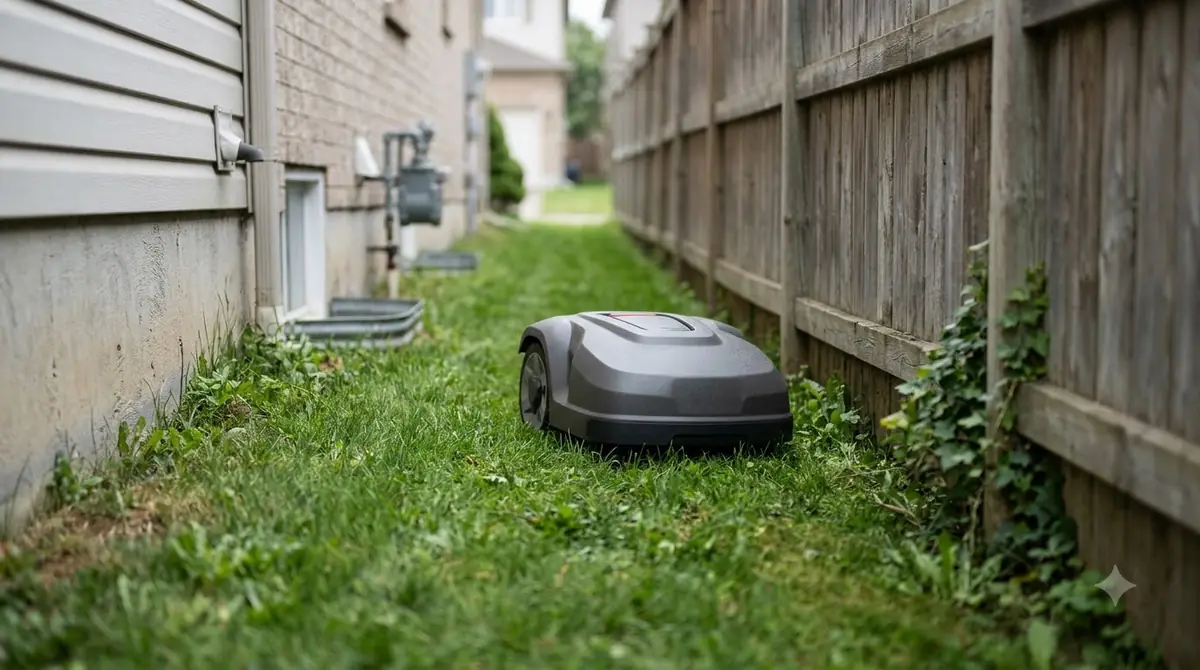
Heads up
Never cement over, permanently bury, or saw off a septic cleanout pipe below grade without installing an accessible, watertight box cover. Local health departments and plumbing codes require cleanouts and septic tank inspection ports to remain reachable for routine pumping and emergency line clearing.
What to look for when choosing a mower for septic-heavy lawns
If your yard has multiple cleanouts, a distribution box cover, and a raised tank lid, prioritize software mapping precision and adjustable deck height over raw cutting width.
First, look for easy app-based no-go zone editing. Septic yards often have three or four separate access points scattered across the lawn, and drawing virtual circles in an app takes far less effort than trenching four separate boundary wire islands. Make sure the app allows small circular or custom polygon exclusion zones rather than forcing huge rectangular blocks that leave large patches of uncut grass.
Second, check the maximum cutting height and vertical step-climbing spec. A mower capable of cutting at 60 mm to 70 mm (around 2.4 to 2.75 inches) keeps the spinning blades higher off the turf, giving extra margin over slightly uneven soil settling around a septic tank. At the same time, look at the mower’s vertical passing ability—for instance, Segway lists a 3 cm vertical passing limit on its Navimow H2 platform—because a low climbing threshold helps prevent the robot from mounting a beveled plastic tank lid and getting high-centered on top.
Third, consider compact cutting widths if cleanouts sit close to fences, air-conditioning pads, or flower beds. A 180 mm to 220 mm cutting disc maneuvers cleanly through tight gaps between a cleanout riser and a property border without forcing the mower to make wide multi-point turns right over your plumbing.
Frequently asked questions
Can a robot mower drive right over a septic tank lid?
If the septic tank lid is heavy-duty fiberglass, concrete, or thick reinforced plastic set completely flush with the surrounding soil, most robot mowers can drive across it without issue. However, if the lid sits raised by an inch or more or has a domed profile, exclude it with a no-go zone so the mower does not scrape its blades or get high-centered.
Will a robot mower’s blades crack an exposed PVC cleanout pipe?
Robot mowers use lightweight, pivoting razor blades rather than a heavy steel rotary bar, so they rarely shatter thick Schedule 40 PVC on a single tap. Repeated strikes against a thin or sun-brittled cap, however, can chip the plastic or knock a loose cap off, which is why exclusion zones or protective collars are recommended.
How much uncut grass is left around a cleanout pipe no-go zone?
Depending on the mower’s edge-cutting offset and how tightly you draw the boundary, you will typically have a 2-inch to 5-inch ring of untrimmed grass around the pipe. Placing a flat concrete paver donut or mulch ring around the cleanout eliminates that string-trimming chore completely.
Does a septic drainfield affect RTK satellite or boundary wire signals?
Underground PVC drainfield pipes and plastic septic tanks do not interfere with RTK GPS satellite reception or low-voltage boundary wire signals. Only large metal structures, dense tree canopies, or tall buildings above ground degrade RTK satellite accuracy.
Sources
- On-Site Sewage Construction Manual for Standard Gravity Systems (Klickitat County Health Department): verified standard 3-inch and 4-inch PVC sewer line sizing and cleanout placement intervals.
- Navimow H2 Series Robot Lawn Mower Specifications (Segway Navimow): verified 3D LiDAR plus RGB vision obstacle detection accuracy, cutting height range, and 3 cm vertical passing specification.
- Automower Wired Installation Made Simple (Husqvarna US): verified pre-installation lawn preparation and boundary wire island splicing procedures.
 Up next9 min readBy YardChoosing and Setting Up a Robot Mower for a Yard With an Outdoor Kitchen IslandUpdated Nov 19, 2026
 9 min readBy YardChoosing and Setting Up a Robot Mower for a Yard with Crushed Granite PathwaysUpdated Nov 19, 2026
 9 min readBy YardChoosing and Setting Up a Robot Mower for a Yard With an Above-Ground Pool LadderUpdated Nov 19, 2026
 9 min readBy YardChoosing and Setting Up a Robot Mower for a Yard With a Split-Rail Wooden FenceUpdated Nov 19, 2026
 8 min readBy YardChoosing and Setting Up a Robot Mower for a Yard With a Pool Deck Coping LipUpdated Nov 19, 2026
 9 min readBy YardChoosing and Setting Up a Robot Mower for a Yard With Flagstone Walkways Set in GrassUpdated Nov 19, 2026