
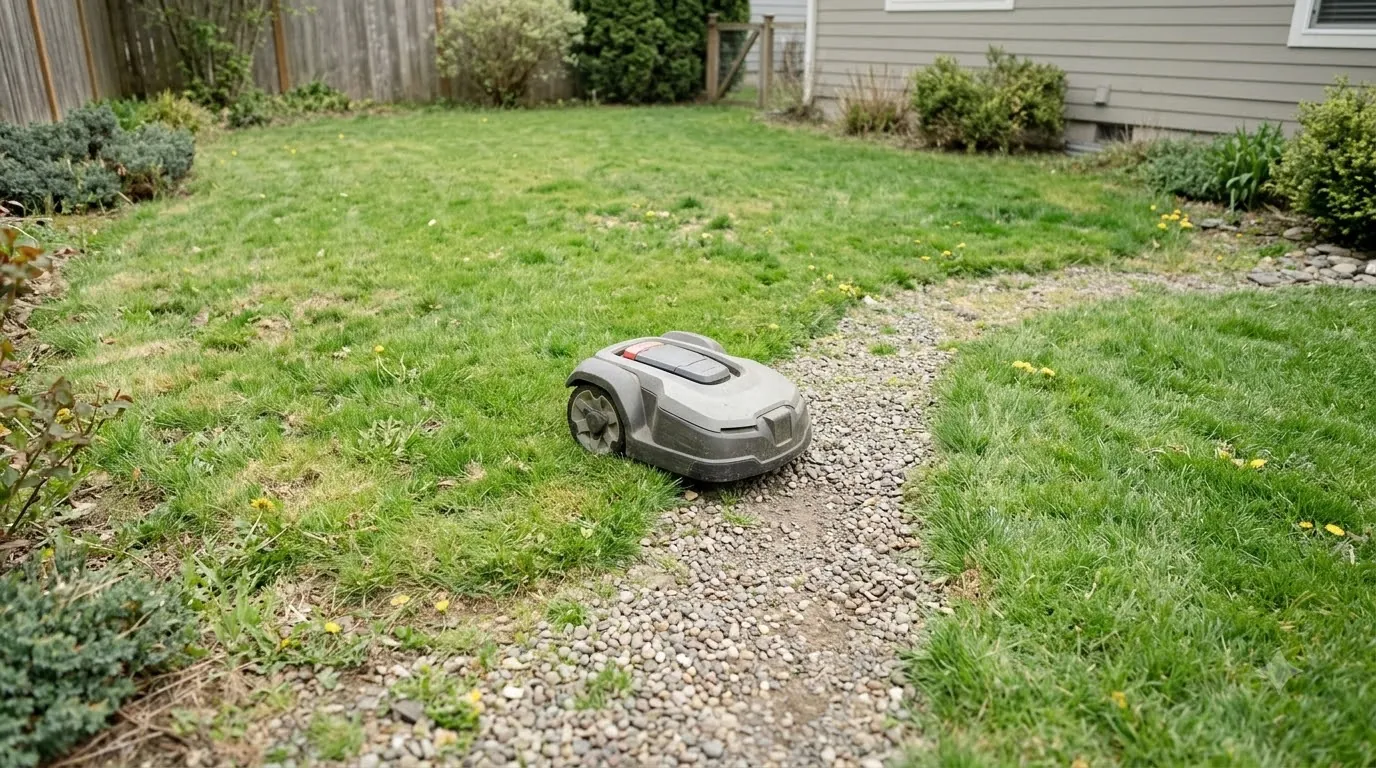

A robot mower for a lawn with black walnut trees and hulls can handle the grass underneath the canopy, provided you clear fallen walnuts before mowing and protect the machine from dense tree cover. Black walnuts drop heavy, golf-ball-sized fruits that neither pivoting razor blades nor star knives can safely chop, and a dense canopy can interfere with satellite-based navigation. With a few hardware checks and a simple autumn cleanup routine, an automated mower will still save you hours of weekly cutting.
The short answer
- Clear hulls before mowing: Iowa State University Extension notes black walnut fruits measure 1.5 to 2 inches across, which is large enough to jam under a low-clearance deck or lift drive wheels off the turf.
- Watch blade wear and deck height: Most robot mowers use small pivoting razor blades that fold inward on impact rather than shattering hard shells, though repeated strikes dull blades fast if your cutting height is set low.
- Check canopy navigation: Dense walnut foliage can weaken satellite signals on wire-free RTK models unless the mower pairs satellite positioning with onboard cameras or uses a physical boundary wire.
- Grass handles the tree chemistry: According to University of Wisconsin-Madison Extension, common lawn grasses like Kentucky bluegrass and fescues tolerate juglone, the compound found in walnut hulls and roots, though rotting piles will still smother turf.
Why black walnut hulls challenge robot mowers
Black walnut hulls create physical clearance and blade-wear problems rather than chemical damage to the mower itself.
According to Iowa State University Extension, a mature black walnut produces a round fruit roughly 1.5 to 2 inches in diameter, wrapped in a thick, fleshy green husk around a hard woody shell. Unlike a gas rotary mower that relies on a heavy steel bar spinning at high speed to pulverize or discharge debris, a robot mower uses lightweight, low-wattage motors designed strictly for clipping grass tips.
In our reading of manufacturer manuals, including Robomow’s guidance on fallen fruit and nuts, small debris is occasionally rolled over, while larger objects either trigger obstacle sensors or wedge beneath the chassis. When a round 2-inch walnut hull lodges between the cutting deck and the turf, it can lift the drive wheels until the mower loses traction and throws an error. Even if the mower clears the hull, the sticky outer husk leaves dark, tannin-rich residue on wheels, bumpers, and blade discs that traps grass clippings and dries into a hard crust.
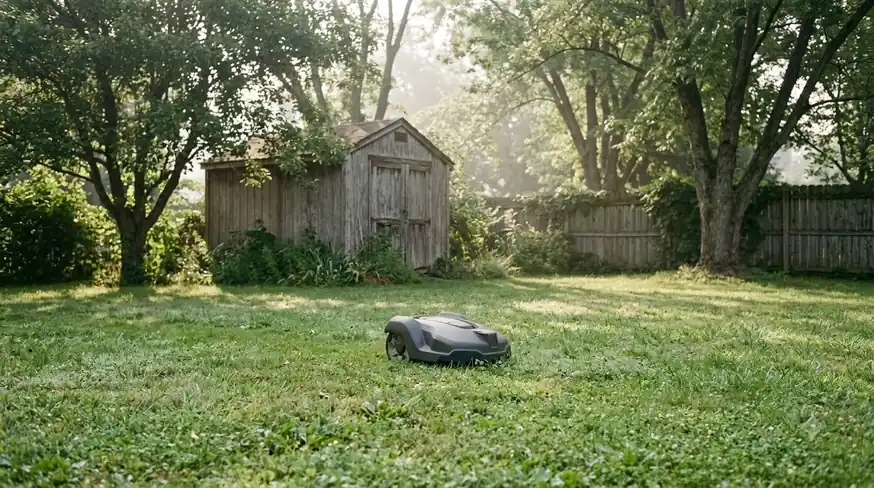
How different blade systems and deck heights respond
Pivoting razor discs and rigid star blades react differently when they strike a hard walnut shell, and cutting height determines how often those strikes happen.
Most residential robot mowers—such as Husqvarna Automower, Segway Navimow, and Mammotion LUBA models—mount small, double-edged razor blades onto a spinning disc. As Segway Navimow’s user manual explains, centrifugal force holds these blades outward while cutting grass, and each blade pivots inward on its screw when it hits a solid object. That folding action protects the motor shaft from sudden shock, though Robomow notes that razor-style blade discs lose cutting sharpness quickly when they repeatedly clip nuts, leading to frayed, brownish grass tips.
Fixed multi-prong star blades, found on select heavier-duty models, resist dulling better against nuts and soft windfalls, yet they still cannot safely mulch hard black walnut shells. Setting your deck height higher during late summer and fall—around 3 inches or above—gives the undercarriage extra room to pass over partially buried nuts without constant blade contact, while also supporting deeper turf roots.
| Mower Feature | How It Copes with Walnut Hulls | Practical Setup Tip |
|---|---|---|
| Pivoting razor discs | Blades fold inward on impact to spare the motor, but edges dull quickly against hard shells. | Inspect blades weekly during nut drop and swap dull sets before grass tips fray. |
| Fixed star blades | More durable against occasional nut strikes and soft husks, though hard shells still cause wear. | Avoid running over dense clusters of fallen fruit; clear piles first. |
| High deck setting (3 inches or more) | Increases ground clearance so smaller hulls pass underneath without wedging the deck. | Raise cutting height in late August before the main autumn nut drop begins. |
| AI vision and bumper sensors | Camera-equipped mowers may steer around visible green husks; bumper-only units tap and reverse. | Keep camera lenses clean of dust and sticky walnut residue for reliable detection. |
Heads up
Never reach under the deck to pry out a wedged walnut hull while the mower is powered on. Manufacturer manuals instruct owners to press the stop button, switch off the main power, and wait until the cutting disc has stopped spinning completely before tilting or lifting the unit.
Navigation under a heavy walnut canopy
Large black walnut trees cast wide, dense shade that can block satellite signals unless your mower uses camera backup or a perimeter wire.
North Carolina State Extension notes that mature black walnuts commonly reach 50 to 75 feet tall with a canopy spread of 50 to 70 feet. Many wire-free robot mowers rely on RTK-GNSS satellite positioning to stay inside virtual boundaries. Segway Navimow’s installation manuals warn that thick tree cover over the lawn or charging station weakens satellite reception, which can cause a pure-RTK mower to pause or drift off-line beneath heavy foliage.
If your black walnuts form an unbroken roof over the yard, look for one of two navigation approaches:
- RTK paired with vision or LiDAR: Newer wire-free systems combine satellite antennas with onboard RGB cameras or 3D sensors so the mower can track visual landmarks across shaded stretches where satellite lock drops temporarily.
- Physical boundary wire: Traditional perimeter-wire mowers follow a buried or pegged copper loop and bump sensors, making them completely immune to overhead leaf cover.

Keeping turf healthy around juglone and fallen hulls
While lawn grass survives the natural chemistry of black walnut roots, uncollected hulls will smother turf and stain mower housings if left to rot in place.
Black walnut trees release juglone, an allelopathic compound concentrated in their buds, roots, leaves, and nut hulls that wilts sensitive garden plants like tomatoes and azaleas. Fortunately, University of Wisconsin-Madison Extension confirms that common turfgrasses—including Kentucky bluegrass and fine or tall fescues—are tolerant of juglone and grow normally under walnut canopies.
The real threat to your lawn is physical suffocation and stain buildup. Piles of heavy hulls block sunlight, mat down cool-season grass right when it enters fall growth, and create uneven bumps that trip up a robot mower’s wheels. A quick pre-mow routine keeps both the grass and the bot running smoothly:
- Walk the dripline before scheduled runs. Black walnuts drop heaviest from late summer into mid-autumn, especially after windy nights. Focus your check within the 50-to-80-foot radius under the canopy.
- Gather hulls with a nut roller or rake. Wire basket nut gatherers roll easily across turf and pick up 2-inch hulls without bending over, clearing a shaded yard in a few minutes.
- Keep hulls out of garden mulch piles. University extension guides advise composting walnut hulls separately for several months so juglone breaks down before the material touches sensitive flower or vegetable beds.
- Wipe the undercarriage and wheel wells. Check the gaps between the wheels and fenders for wedged shells or sticky husk residue, wiping surfaces with a damp cloth after the mower is switched off.
Frequently asked questions
Can a robot mower chop up black walnut hulls?
No. Robot mowers use lightweight blades meant only for slicing grass tips, not pulverizing 1.5-to-2-inch woody nuts. Running over fallen hulls dulls blades rapidly and can wedge the mower’s deck off the ground.
Will black walnut sap or hull juice ruin a robot mower?
The dark juice from fresh green hulls will stain plastic housings and gum up wheel treads, though it does not corrode sealed electronics. Wiping the wheels and underside with a damp cloth keeps dried husk buildup from jamming moving parts.
Do wire-free robot mowers lose signal under large black walnut trees?
Pure satellite-guided mowers can lose RTK lock under a 50-to-70-foot walnut canopy, especially when leaves are wet. Models that blend satellite navigation with onboard cameras—or traditional boundary-wire mowers—handle deep tree cover much more reliably.
Does juglone from black walnuts kill the grass a robot mower cuts?
No. According to University of Wisconsin-Madison Extension, standard lawn grasses such as Kentucky bluegrass and fescues tolerate juglone, though thick piles of uncollected hulls and leaves will smother the turf if left on the ground.
Sources
- Black Walnut | Natural Resources (Iowa State University Extension): used for mature black walnut fruit diameter (1.5 to 2 inches) and physical characteristics.
- Black Walnut Toxicity to Plants (University of Wisconsin-Madison Extension): used for juglone concentration in nut hulls and tolerance of Kentucky bluegrass and fescue turfgrasses.
- How does the robotic lawnmower deal with fallen fruit and the like? (Robomow): used for blade disc versus star blade durability on nuts and wheel-wedging behavior.
- Navimow i-Series User Manual (Segway Navimow): used for pivoting razor blade mechanics and tree-canopy GNSS signal guidance.
 Up next8 min readBy YardChoosing and Running a Robot Mower for a Lawn with Heavy Morning Coastal FogUpdated Nov 19, 2026
 8 min readBy YardChoosing and Running a Robot Mower for a Lawn with Sweetgum Spiky Seed BallsUpdated Nov 19, 2026
 9 min readBy YardChoosing and running a robot mower for a lawn with crabgrass and dallisgrassUpdated Nov 19, 2026
 8 min readBy YardCan You Use a Robot Mower for a Lawn With Pecan Trees and Fallen Shells?Updated Nov 19, 2026
 8 min readBy YardCan a Robot Mower Handle a Lawn With Oak Tree Acorns in Autumn?Updated Nov 19, 2026
 7 min readBy YardWill a Robot Mower Get Stuck on a Lawn With Tree Roots?Updated Nov 13, 2026