
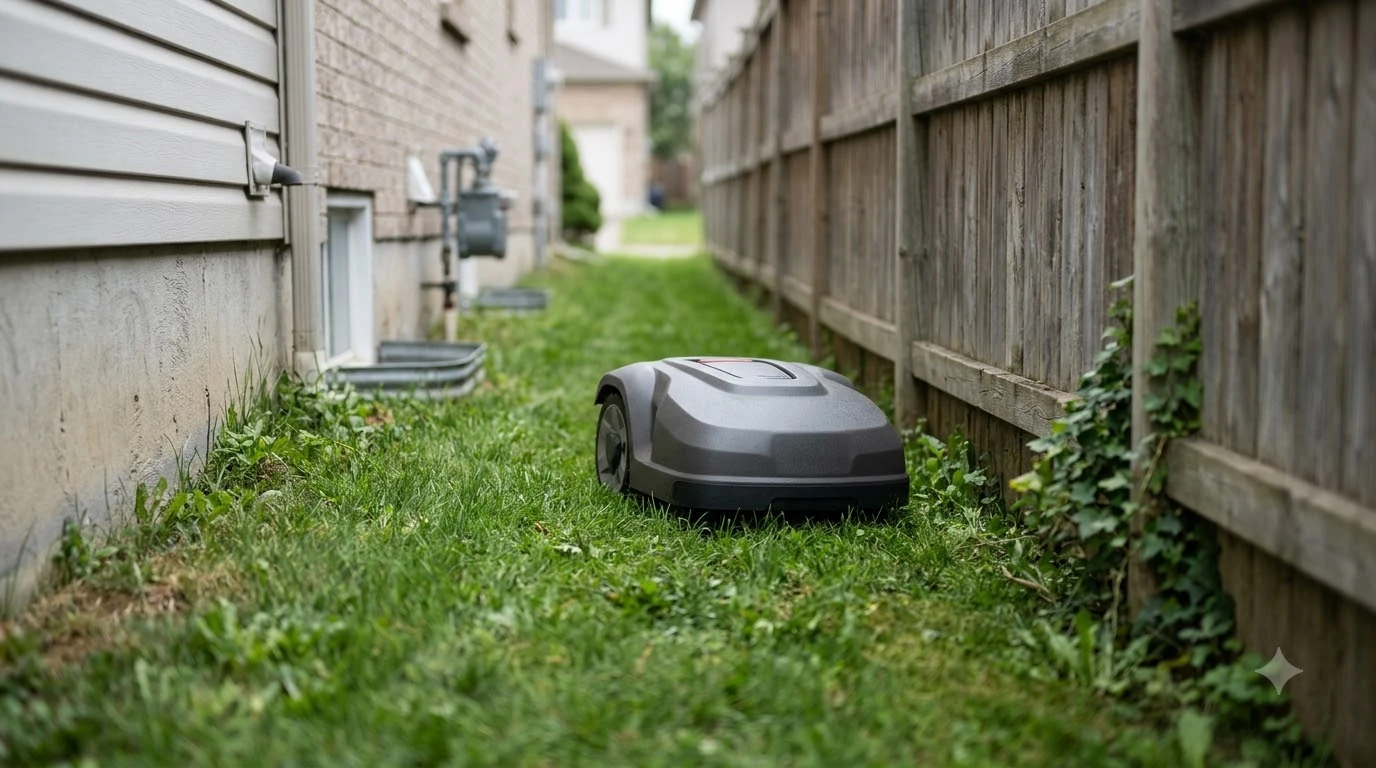

A robot mower for a yard with an above-ground pool ladder works safely and reliably if you isolate the ladder’s footprint with a boundary wire island, set a virtual no-go zone, or choose a model with low-clearance obstacle avoidance. Standard robotic mowers rely on bumper sensors or high-mounted cameras that can miss thin, angled ladder rails or wedge themselves beneath the bottom steps. Taking ten minutes to map out the ladder’s entry point prevents trapped mowers, damaged plastic treads, and unmowed patches around your pool deck.
The short answer
- Primary hazard: Angled A-frame ladders create low-clearance wedges where a mower chassis can get stuck underneath the steps.
- Wired boundary fix: Route a perimeter island around the ladder base, keeping the outgoing and incoming wires close together so the magnetic signals cancel out.
- Wire-free GPS fix: Draw a virtual keep-out zone around the ladder in your mower’s companion app, adding a small buffer for satellite drift.
- Sensor limitations: Ultrasonic and vision sensors often struggle to detect narrow tubular steel or resin rails against tall grass.
- Removable ladders: Flip-up or removable outside steps let your mower cut right up to the pool wall once the ladder is stowed away.
Why above-ground pool ladders trip up robot mowers
Unlike solid walls or round pool frames, an above-ground pool ladder presents an open, angled geometry that confuses standard robotic collision sensors.
Most entry-level and mid-range robot mowers use physical bump sensors mounted around the upper shell. When a mower approaches a vertical tree trunk or a solid resin pool wall, the shell depresses, triggering a reverse-and-turn maneuver. However, an A-frame pool ladder slopes outward from the top rail down to the grass. As the mower drives forward, its low front nose slides underneath the bottom rung before the upper shell ever touches the frame. Once the rear drive wheels lose traction or the top hood jams against the underside of a step, the mower stalls and sends an error alert to your phone.
Even newer wire-free models equipped with optical cameras, LiDAR, or ultrasonic sensors face challenges around pool steps. Narrow white resin rails or thin powder-coated steel tubes can blend into bright sunlight or shadows cast by the pool wall. Furthermore, splash-out from swimmers keeps the turf directly under the ladder damp and soft. Heavy drive wheels spinning on wet grass near the ladder feet quickly dig ruts, turning the entry area into a muddy patch that gets tracked straight into your pool water.
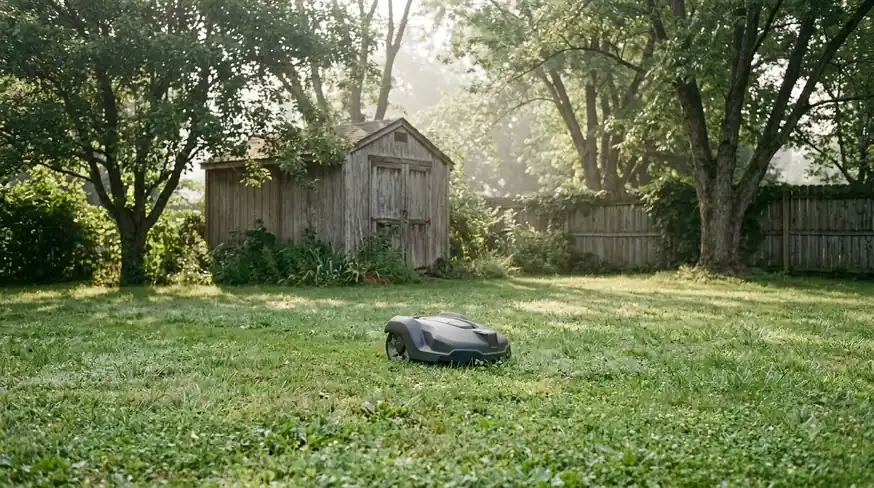
How different navigation systems handle pool steps
Your mower’s guidance technology determines whether you need physical wire barriers, software boundaries, or simple seasonal habits to protect the ladder area.
Traditional boundary-wire mowers use a low-voltage electrical loop to define the cutting perimeter. According to Husqvarna Automower boundary wire guidelines, rigid obstacles that cannot withstand a collision—or structures a mower might climb—must be fenced off with an island loop. While the rounded wall of a steel-sided above-ground pool is sturdy enough for gentle bumper contact, the ladder itself should always be excluded unless it is fully retracted.
Real-Time Kinematic (RTK) GPS and vision-based mowers eliminate physical wires, relying instead on satellite positioning and onboard cameras. In these systems, you walk the mower via remote control around the ladder footprint to record a virtual no-go zone. Because consumer RTK accuracy can shift by a few inches depending on tree cover or house walls reflecting satellite signals, setting your virtual border slightly wider than the ladder feet prevents accidental scrapes.
| Navigation Type | How It Detects the Ladder | Recommended Setup Strategy | Trimming Gap Left Behind |
|---|---|---|---|
| Boundary Wire + Bumper | Physical contact after crossing wire | Create a perimeter island around the ladder base | Moderate; requires manual string trimming around the island |
| RTK GPS + Virtual Zones | Stored map coordinates | Draw an app-based no-go zone with a 6-inch buffer | Moderate; depends on buffer size and signal stability |
| AI Vision / LiDAR + RTK | Visual and depth recognition | Combine a virtual no-go zone with active obstacle avoidance | Small; vision sensors allow closer edge passes |
| Ultrasonic / Radar Add-on | Acoustic or radio wave reflection | Enable slow-down mode near obstacles; still use an island | Small to moderate; thin rails may still evade detection |
Setting up a boundary wire island around your ladder
Creating a wire island isolates the pool ladder from the main lawn while letting the mower safely cross the connecting path without stopping.
If you run a wired robot mower, isolating the ladder is a straightforward Saturday morning task that requires only extra perimeter cable and a handful of ground stakes. Following Worx Landroid obstacle island instructions, the key is ensuring the two parallel wires leading from the outer yard edge to the ladder touch each other without crossing over. When the outgoing and returning wires run side by side, their electromagnetic fields cancel out, allowing the mower to drive smoothly over the bridge while treating the loop around the ladder as a hard stop.
- Measure the ladder footprint. Place stakes around the outer legs of the ladder, leaving at least 12 inches of clearance from the base pads so the mower’s cutting disc never clips the plastic feet.
- Run the feed wire inward. Starting from the closest point on your main perimeter wire, route a single strand straight toward your ladder stakes, securing it flat against the soil every few feet.
- Loop around the ladder base. Circle the ladder perimeter clockwise or counterclockwise depending on your manufacturer’s manual, keeping gentle curves rather than sharp 90-degree bends.
- Return the wire along the exact same path. Bring the cable back to the main perimeter line right beside the incoming strand, pinning both wires under the same ground stakes so they remain pressed together without overlapping.
- Test the signal cancelation. Start your mower near the bridge path and watch it cross the parallel lines; if it stops or turns around, check that the two wires are not twisted over one another.
Heads up
Never cross the outgoing and returning island wires over each other. Crossing them inverts the magnetic signal, causing the mower to recognize the bridge as an impassable wall or lose track of its zone completely.
Managing removable ladders and pool deck transitions
Swapping a fixed A-frame ladder for a flip-up or removable outer section lets your robot mower trim flush against the pool wall without leaving messy grass tufts.
Many above-ground pool owners dislike the ring of tall grass that builds up inside a permanent wire island or virtual no-go zone. One practical workaround is using an ANSI-compliant pool ladder with an outer section that swings upward and locks out of reach when the pool is not in use. When the outside steps are lifted off the turf, the remaining vertical wall of the pool acts as a clean, continuous barrier.
Before letting your mower bump directly against the pool wall, inspect the lower track and any exposed filter hoses. Skimmer hoses, pump cords, and ground-fault interrupter cables often drape down from the pool wall right beside the ladder. Secure all hoses off the ground with wall brackets, or include the pump equipment pad inside the same wire island or no-go zone as the ladder. If your pool has a partial wrap-around deck where the ladder sits on composite boards rather than grass, verify that the transition lip between the lawn and deck is flush; otherwise, a mower climbing halfway onto a low deck edge can high-center its blades.
Maintenance habits for pool-side turf and blades
Pool chemicals, wet grass clippings, and frequent foot traffic around the ladder require a few simple adjustments to your mowing schedule and blade care.
Turf surrounding an above-ground pool endures heavier wear than the rest of the backyard. Bare feet climbing in and out of the ladder compact the soil, while splashed chlorinated or saltwater spray settles onto the grass blades. Most robotic mower manuals advise against running machines during heavy rain or immediately after heavy watering because wet clippings clump underneath the cutting deck and corrode metal fasteners.
- Schedule morning or late-evening runs: Set your mower to cut the pool zone before midday swimming starts so the grass is dry and the machine stays out of swimmers’ way.
- Raise the cutting height slightly: Keeping cool-season or warm-season turf around 2.5 to 3 inches helps shade compacted soil near the ladder and reduces mud splash onto the mower chassis.
- Rinse the underside carefully: Wipe down the blade disc and wheel wells with a damp cloth rather than spraying a pressurized garden hose directly into the waterproof seals, especially if saltwater pool splash dries on the housing.
- Check blade screws monthly: Exposure to pool moisture accelerates surface oxidation on standard carbon-steel blades; switching to stainless-steel replacement blades extends service life near chlorinated water.
Frequently asked questions
Can a robot mower bump safely against an above-ground pool wall?
Yes, most steel-walled above-ground pools handle gentle bumper taps from lightweight robot mowers without denting. However, soft-sided inflatable or thin-frame pools should be isolated with a boundary wire or virtual no-go zone to prevent punctures or frame shifting.
Will chlorine or saltwater splash ruin a robot lawn mower?
Occasional splash-out will not immediately break an outdoor-rated mower, provided you schedule mowing outside active swim hours. Over time, dried pool chemicals can corrode blade screws and wheel axles, so wiping the chassis down every couple of weeks helps prevent rust.
How wide should I make a no-go zone around my pool ladder?
Leave at least 6 to 12 inches of clearance beyond the widest base pads of the ladder. This buffer accounts for GPS signal drift on wire-free mowers and ensures the mower’s turning radius never clips the ladder legs.
Do ultrasonic or camera-based robot mowers avoid pool ladders automatically?
They help reduce hard impacts, but thin white resin or tubular metal ladder rails can still trick optical and ultrasonic sensors depending on lighting angles. Pairing obstacle avoidance with a mapped no-go zone or wire island gives much more reliable protection.
Sources
- How to place the boundary wire for Automower (Husqvarna US Support): Used for island loop rules, parallel wire signal cancellation, and obstacle clearance guidance.
- Installing the boundary wire around obstacles (Worx Landroid Manual): Used for wire routing steps, non-overlapping parallel wire rules, and rigid obstacle handling.
 Up next8 min readBy YardChoosing and Setting Up a Robot Mower for a Yard With a Pool Deck Coping LipUpdated Nov 19, 2026
 9 min readBy YardChoosing and Setting Up a Robot Mower for a Yard With a Split-Rail Wooden FenceUpdated Nov 19, 2026
 9 min readBy YardChoosing and Setting Up a Robot Mower for a Yard with Crushed Granite PathwaysUpdated Nov 19, 2026
 9 min readBy YardChoosing and Setting Up a Robot Mower for a Yard With an Outdoor Kitchen IslandUpdated Nov 19, 2026
 10 min readBy YardChoosing and Setting Up a Robot Mower for a Yard with Exposed Septic Cleanout PipesUpdated Nov 19, 2026
 9 min readBy YardChoosing and Setting Up a Robot Mower for a Yard With Flagstone Walkways Set in GrassUpdated Nov 19, 2026